The threat of nuclear war and the increasing rate of climate change means we must walk a thin line when it comes to nuclear power.
When you are told what someone is against, ask them what they are for. If you against nuclear power, what kind of power are you for? Reasonable answers include coal, natural gas, biomass, wind, solar, hydro, or geothermal. However, not all of these answers are equally genuine given the constraints of our world. Renewable energy sources have not historically been economically or technologically viable. Our energy landscape is changing today. A future with more renewables and no nuclear power is possible, yet it may not be the best choice if we are serious about climate change. Nuclear power has often been eschewed out of fear, not practicality or rationality.
I have a new online project and venue that I have launched! Common Observer is a collaborative online venue of science, art, philosophy, and culture. The tagline is "Common Observer, uncommon observations." The idea is that we must reason as if we are the most common observer, but that doesn't preclude uncommon observations. An uncommon observation is something that challenges our human condition of common observation. A poem, a theorem, a dance, an equation, a painting, a story, a novel, or a theoretical truth may all be uncommon observations about the world we inhabit.
Yet fear not, I will still post on The Astronomist, in particular I will cross post any original scientific content I create. The reason for this shift of focus is at least two fold. First, it is hard to find time to generate original thoughtful content while finishing a PhD so Common Observer will have more aggregated content. Second, while so many people love astronomy, I feel a broader forum of wider interests will better grip reader's attention, as well as my own attention.
I hope that Common Observer can be a successful collaborative project. In order to realize that goal I am currently searching for culture, art, philosophy, or poetry contributors. So please check out the new project, share it with friends and colleagues, or contact me if you have inclinations to collaborate. Follow Common Observer on twitter, subscribe to the RSS, or just visit the site often. Thanks for the continued support.
I got asked about 2012 the other day. Something about Mayans predicting the end of the world and or hidden planetary alignments. Sometimes I don't know where to begin addressing something so wrong. Whether you ask a scientist or a Mayan elder though they agree there is no end of days in 2012. Here is a scientist, Neil deGrasse Tyson, on the subject:
And here is David Morrison, expert on Earth impact hazards, speaking about misconceptions related to the year 2012:
The way of the future is fusion. I dream of a world where humans have harnessed the power of the Sun. Clean, safe, energy. But there is no clear path to fusion. The most exciting possibility for a future with fusion may be the International Thermonuclear Experimental Reactor or ITER. ITER is not the only option of course. Previously, I have discussed the National Ignition Facility or NIF which has pioneered unique technologies is the field, but their success is not ensured. Many small research projects around the world are also struggling to realize the dream of fusion, but with budget shortfalls and increasing pressure to produce results we as a society may shortsightedly end the dreams of a fusion future.
Fusion is what powers the Sun and all stars in our Universe. Fusion is the joining of two or more separate atomic nuclei into a larger nuclei. Fusion can create energy because the mass of the input and output nuclei are not necessarily equal in mass. An overview of what fusion is and why it is so important can be seen on my previous post on Fusion for the Future. Many scientists in the field acknowledge that a rapid development of fusion is unlikely, much less a commercial development, but there is hope. A reasonable time frame may be half a century before we see a world powered by the same process which drives the Sun. It will be an almost entirely clean, limitless, reliable, and safe source of power.
Christopher Llewellyn Smith states some cold hard numbers that are worth mentioning again. The price of ITER is at least 13 billion Euros or $17 billion. This cost is justified and dwarfed by the magnitude of the energy usage on Earth which amounts to a $5 trillion dollar a year market (I checked some of these numbers and they seem approximately correct. Did you know that you can download the International Energy Agency's annual reports as an iPhone or iPad app?). Particularly shocking are the subsides to fossil fuels which are over $500 billion a year worldwide (I am not so sure about this number, but the United States alone subsides fossil fules to the tune of $10 billion a year) while the subsides to renewables are only $45 billion worldwide. Smith says that the renewable energy sources of wind, bio, geothermal, and marine will never be able to meet the world's energy needs a current consumption rates. We must use solar, fission, or fusion energy.
It is a curious thing to ask a scientist to speculate on the future, but these two scientists have indulged us with a time frame for achieving fusion. Maybe the middle of this century at best they say. What makes fusion so difficult?
The key to releasing the energy of the Sun is forcing the nuclei of atoms close enough together for them to overcome their electrical repulsion and allow the strong force which binds nuclei to merge the nuclei together. Such favorable conditions for atoms to smash into each other can only occur under extreme temperatures and pressures, like say at the center of a star, but it is almost impossible to hold a star on earth. Anything which is hot enough to undergo fusion is also hot enough to burn through any container, thus we must contain something without quite touching it. Enter the magnetic doughnut known as the tokamak. A tokamak is a toroidal or doughnut shaped container that uses magnetic fields to confine plasma. Plasma is a state of matter where all the atoms are ionized (the electrons that normally orbit the protons in the nucleus have escaped)—and at these temperatures the atoms contained in the tokamak are definitely ionized. Magnetic fields apply a force on the charged particles of plasma such that the plasma can be corralled and kept away from the walls of the container. In an actual tokamak huge magnets encircle the enclosure as shown in the figure here where the magnetic coils and the ITER plasma surface is shown. The colors and contour lines indicate the magnetic field strength which is not quite perfect, the lines are wavy, due to deviations from perfect symmetry in the structure because the tordioal magnetic field is made of a finite number of magnetic coils. The ITER tokamak will be huge. Check out the tiny little person (bottom left) in the image below.
The complexity of this machine is astounding. One key challenge that must be overcome is the confinement of the plasma in a controlled manner. The Confinement Topical Group will determine exactly how to accomplish the confinement and avoid the performance degrading effects of Edge Localized Modes or (ELM modes). The hotter the plasma is the more internal plasma pressure is that must be balanced by stronger magnetic pressure fields; we could view this system in analogy to a balloon where that the plasma is the air under pressure and balloon's walls are the magnetic fields. The exact ratio of the plasma's internal current, the physical size of the tokamak, and the torodial magnetic field is a carefully tuned parameter to balance the gas temperature and magnetic pressures which does not yet have a known optimal configuration (the goal is I/aB < 2.5 where I is the plasma current, a is the minor radius, and B is the toroidal field on axis). It has been observed that the ELM modes periodically become unstable and have breakouts. This creates a large energy flux in a short time, like that of a solar flare on the Sun, where hot plasma breaks free of the magnetic fields. When this occurs the plasma may touch the side walls of the tokamak and overheat the internal surfaces to many thousands of degrees. The side wall surfaces will be evaporated and eroded inside the plasma chamber. In this way the ELM modes result in the introduction of plasma impurities which contribute to raising the effective atomic number (the number of free protons per particle) of the plasma which results in greatly reduced fusion efficiency or even the halting of the fusion reaction entirely; the target is to keep the effective atomic number below two. The aggregate erosion is large and the lining of the tokamak walls may need be replaced often. In order to operate the machine continuously and cost effectively the ELM modes must be controlled. The control of ELM is paramount for a successful fusion tokamak. In the video below Alberto Loarte tells us a little more about the control of ELM modes and clever ways that the ELMs are dealt with.
The plasma instabilities inside a fusion reactor are a serious engineering challenge, but they are not a safety concern at all. Unlike a fission reactor, when a fusion reactor is compromised it does not go critical in a dangerous explosion (like a fission reactor would), instead it just fizzles out harmlessly. This technology is not perfect though because while some may claim that a fusion reactor would create no dangerous radioactive material in fact it would produce some radioactive material that would need to be handled. It is the walls of the reactor which will become slightly radioactive (through neutron activation). Conveniently though the half life of such radioactive waste materials is less than 100 years and could be entirely handled on site.
We should all be hoping for fusion. I spoke with Michel Claessens, the head of communications for ITER, and one of the questions I asked him was, what should the public know about fusion and ITER?
As much as possible. More seriously, I would be happy if people understood the differences between fission and fusion.
And he has a point I think. Most people simply don't understand what is at stake and what our options our. If you are reading this then you are already more informed than most. Tell people about the difference between fusion and fission and encourage your government (no matter what country you live in) to follow a wise energy policy. While I was writing this article the United States changed its funding proposition for ITER which was a welcome change because at one point the United States looked like it would falter on its commitment to fusion research and ITER completely. This is an investment in our future and the Earth. I asked Claessens a question about this topic too, how important is worldwide collaboration in achieving a successful ITER project?
Worldwide collaboration is useful and even necessary - to pool and ensure the best use of resources (human and financial). The ITER project is so complex that no single country has the scientific and technological skills to build the machine alone. In addition, the international collaboration was seen by ITER fathers (Gorbachev and Reagan) as a way out to cold war.
The idea of harnessing the power of the Sun on the Earth is so much more than just a scientific endeavor. It is a very human dream to hold the Sun (what culture does not have some kind of original creation story or explanation for the sun?) and it is possible that realizing this dream may bring us together for all of the right reasons.
Peter Kareiva has surprisingly radical ideas on conservation. He is the chief scientist at the Nature Conservancy and is serious about protecting the Earth and all the creatures that depend on it. His views are unconventional in some ways. He argues that enviromentalism is on the decline and that we need to choose our environmental battles.
It is a fact that I have written more fiction in my life than science writing and more science writing that I have scientific papers. When my advisor has asked me to write I am able to naturally come up with an abstract and an introduction like a magician pulling a rabbit out of a hat. I summarize the current state of the field neatly and present our results as the natural evolution of what comes next. Then when it comes to writing out the details of the research and the work I slow down. My advisor has a bit of criticism about the introduction (it is not specific enough they say), and plenty of criticism for the rest of the writing as if my entire style is not adequate. What is with the style of science writing in grants and research papers?
It as if scientists are bound to a certain kind of writing that is dry, concise (and it has to be when we have to pay per page published in most research journals), and standardized. I think many scientist would agree that our language doesn't have to be dry as long as it is standardized. Expository writing is different from other kinds of writing sure, but we have to ask ourselves how and why? Science writing for journalism is different than that of science writing for papers of grants even though they are both technically expository writing. I wonder if this is because they must be or because mediocre writing has become the style in science papers. Adam Ruben has written a wonderful opinion piece over at Science magazine mocking some of the quirks of scientific paper writing. The piece is worth a read and he includes a list of science paper tropes which are hilarious. Here is an excerpt:
1. Scientific papers must begin with an obligatory nod to their own relevance, usually by citing exaggerated figures about disease prevalence or other impending disasters. If your research does not actually address one of these issues, pretend it does, because hey, that didn’t stop you on the grant application. For example, you might write, “Twenty million children die of scabies every day. OMG we built a robot kangaroo!”
2. Using the first person in your writing humanizes your work. If possible, therefore, you should avoid using the first person in your writing. Science succeeds in spite of human beings, not because of us, so you want to make it look like your results magically discovered themselves.
3. Some journals, such as Science, officially eschew the passive voice. Others print only the passive voice. So find a healthy compromise by writing in semi-passive voice.
ACTIVE VOICE: We did this experiment.
PASSIVE VOICE: This experiment was done by us.
SEMI-PASSIVE VOICE: Done by us, this experiment was.
Yes, for the semi-passive voice, you’ll want to emulate Yoda. Yoda, you’ll want to emulate.
Are there more connections in a cubic millimeter of your brain than there are stars in the Milky Way? We are going to answer that question in a moment, but first take a look at this image of hippocampal neurons in a mouse's brain. It is an actual color image from a transgenic mouse in which fluorescent protein variations are expressed quasi-randomly in different neurons. This kind of image is known as a brainbow and is aesthetically awesome further it may be one way to empirically examine a cubic millimeter of the brain (neuron tomography).
In reality mapping even an entire cubic millimeter of the brain is an extremely daunting task, but we can still answer my original question. First, I know that there are different kinds of neurons that vary in size and that some neurons can have a soma (the big part that has the nucleus from which the dendrites extend) spanning a millimeter in size. Thus if you picked a random cubic millimeter of brain you could run right into the heart of a neuron and you would find very few connections. Given this fact, we can very easily answer this question with a resounding no, however, this seems like an unsatisfactory trite approach. So I looked up some numbers on how many neurons are in the brain, how many connections are in the brain, and how many stars are in the Milky Way. Lets answer the question using the 'average' number of connections per cubic millimeter.
How many neurons and connections there are in the brain? This is kind of a tricky question and I am not a nuerobiologist so I have gone to several resources for the answer. Professor of Computational Neuroscience at MIT Sebastung Seung says in a TED talk
your brain contains 100 billion neurons and 10,000 times as many connections
In a human, there are more than 125 trillion synapses just in the cerebral cortex alone
René Marois from the Center for Integrative and Cognitive Neurosciences at Vanderbilt Vision Research Center states in a recent paper [1]
The human brain is heralded for its staggering complexity and processing capacity: its hundred billion neurons and several hundred trillion synaptic connections can process and exchange prodigious amounts of information over a distributed neural network in the matter of milliseconds.
I have enough expert sources now to confidently say these experiments agree that the human brain has some 100 billion neurons (1011). The number of connections seems less precise, but it is at least several 100 trillion connections (1014) as judged by Marios and Smith and as much as 1015 as judged by Seung.
The number of connections in the brain is tricky to define. We may define a synaptic connection as each place the neuron touches another neuron and a synapse is present. It doesn't seem to make sense to simply count incidental contact. Further, there is the question of whether we should count redundant contacts between neurons. We can obtain an upper bound on the number of connections in the brain by considering the case in which every neuron is connected to every other neuron. Coincidentally the operation of connecting every node in a network with every other node is a process I am familiar with from cross correlating radio signals. Anyways, the equation we are looking for is N(N-1)/2 where N is the number of nodes in the network. Thus, for our N=1011 neurons the maximum number of non-redundant connections is about 1022. This maximum bound is huge! But how huge is it really? Hilariously, while searching for an answer to my original question I found a message board pondering the grand statement
There are more connections in the brain than atoms in the Universe.
A really clever person pointed out that
Theoretically, if we took all the atoms in the universe; wouldn't that include the atoms within the brain?
People have this feeling that the number of connections between items can be much larger than the number of actual items in the collection and while this intuition is true the idea that there are more connections in the brain than there are atoms in the universe is absurd. Lets put it in perspective that a few grams of any substance, like water, is measured units of moles. A mole is standard unit of measurement corresponding to the absolute 6.02 x 10²³. Thus even a drop of water contains more atoms than there are connections in the brain.
Now we need to know how many neurons and connections are in an average cubic millimeter of the brain. How big is the brain? John S. Allen of the Department of Neurology at University of Iowa stated in a recent paper that[2]
The mean total brain volumes found here (1,273.6 cc for men, and 1,131.1 cc for women) are very comparable to the results from other high-resolution MRI-volumetric studies.
We can take the volume of the brain as 1000cc as a low estimate (which will only over estimate the density of connections).
The final thing we need to know to answer the question at hand is the number of stars in the Milky Way. Like every other number we have been working with it is rather uncertain. Even if we define a star as only those spheres of gas which are large enough to fuse hydrogen at some point in their lifetime we don't know the answer because we can't see the multitudes of dim stars. There are probably at least 500 billion star like objects in the Milky Way. Lets take 100 billion as the number to be conservative.
Finally, lets bring all the numbers together. One cubic millimeter is 1/1000 of a cubic centimeter and 1/1000000 (10-6) of the entire volume of the brain. We can scale the total number of connections in the brain (using the high estimate of 1015 connections in the brain) then we find that there are 109 connections in a cubic millimeter of the brain. The 109 connections in a cubic millimeter of the brain is two orders of magnitude smaller than a low estimate of the number of stars in the Milky Way. No, on average there are not more connections in a cubic millimeter of your brain than there are stars in the Milky Way.
My first response to this question was bullshit! This question (or rather statement) is made by David Eagleman here at a TEDx talk and here on the Colbert Report. Colbert also called out Eagleman when he dropped this factoid, but it didn't stop the interview. I have also contacted some actual neuroscientists to see what they thought of this statement and they agree with me that it is not true. Maybe there is special part of the brain particularly more dense in connections than the brain on average, but that would be misleading like saying the density of the Milky Way is that of water because, you know, certain parts of the Milky Way are water. The better statement would be to say that there are are more connections in the brain than there are stars in the Milky Way. As Colbert would say, I am putting you on notice Eagleman.
While we are on the subject I want to mention my favorite talk about the brain which mixes just the right amount of wonder and fact. It is the TED talk I mentioned earlier by Sebastian Seung on what he calls the connectome - the network of connections in your brain between neurons which physically dictates how you think. In the video he discusses another volume tomography technique in the brain using a cube of mouse brain tissue just 6 microns on a side. It is another great visualization for what is actually in a cubic millimeter of your brain.
References
[1] Marois, R., & Ivanoff, J. (2005). Capacity limits of information processing in the brain Trends in Cognitive Sciences, 9 (6), 296-305 DOI: 10.1016/j.tics.2005.04.010
[2] Allen, J., Damasio, H., & Grabowski, T. (2002). Normal neuroanatomical variation in the human brain: An MRI-volumetric study American Journal of Physical Anthropology, 118 (4), 341-358 DOI: 10.1002/ajpa.10092
Repetition is ubiquitous and has many different meanings in education, art, literature, science, and life Ideas replicate and mutate; cultural memes spread through culture seamlessly. Manufactured goods are produced as nearly identical as possible. Deviations from the mold are discarded and parts are interchangeable. Digital data is almost limitlessly replicable. Any data or idea committed to the digital world is perfectly copied (sparing the occurrence of a flipped bit) until it is intentionally modified. This characteristic of digital ideas presents a unique challenge for creators of content, distributors, and bored people on the internet. And of course animals and plants on Earth have the ability to self replicate themselves with minor variations. What do we make of all of this?
I am keen on the intersection of art and science on this matter. I like making collages and have highlighted repeated images before with 35 images of space helmet reflections and 100 images of macchiatos. Through repetition and distortion images may be amplified or diminished. It depends on perspective. Generally in artistic endeavors, as in life, the slight variations of a repeated theme are aesthetically pleasing. On the other hand technical work such as engineering, data analysis, or manufacturing requires precise replication. I work in radio astronomy where each radio telescope in the array is nearly identical and the need for precision trumps all other considerations. I find that randomness is never particularly interesting, but neither is absolute order. Somewhere in between these extremes we have something really beautiful.
Perhaps it is cruel to snuff out the shinning gleam in the eyes of a person who upon hearing that I am an astronomer exclaims, "Oh, I love astrology!" and I reply, "No, I study ASTRONOMY." But they don't understand it. The subtle differences in syllables of the words belies the vast gulf in empirical tendencies between the separate endeavors and it is too much to explain. I simply walk away.
I hate astrology and I hate when people get astronomy and astrology mixed up. I could be more understanding, but I have to choose my battles. I meet a lot of interesting people in coffee shops, bars, airplanes, parties and wherever else life takes me and when someone gets excited about the fact that I study astronomy it means they have a deep curiosity about the skies above. That curiosity is occasionally deeply misguided with astrology and their questions are so fundamentally misconceived I struggle to answer them with candor and accuracy (for example they ask, 'Do the planets affect our daily lives?' and I hesitate to answer honestly that we must consider their gravitational pull, so the answer must be yes). On the other hand I meet people who are genuinely interested in massive collections of gravitationally bound glowing gas and I am very happy to answer their questions.
There is a real danger when logic, or pseudologic, is applied to astrology. Recently there was an uproar about the shifting of the zodiac that made it into some news headlines. Briefly I shared the frustrated sentiments of astrologers because the shifted zodiac has been well known for some time, why is the public just now hearing about it? The book in the image above is from the seventies and claims right there on the cover that, 'Most astrology is unscientific and inaccurate', and goes on to explain the shifted zodiac and how to have a movie ending romance. The ideas in this book are the apotheosis of dangerous thought. A little bit of knowledge is a very dangerous thing when combined with pseudologic in the guise of rigorous proof. It has also not escaped my observation that many of the people I have known who believe in astrology also believe in God as if to demonstrate the utter confusion and inconsistency of their minds. I don't mean to badger defenseless people here. This is simply an honest expression of how I feel. I have summed up my sentiments into a paragraph which I think would be nice to place on a card with which to hand out to people who confuse astrology with astronomy:
I cannot rightly conceive of a logic which would allow one to study such disparate phenomena of love, planets, stars and come to see any connection. Perhaps, desperate for meaning people find it wherever they look; conclusions are forged before the data have been taken. Those who would apply science to astrology may as well attempt to apply science on whom to love and sociologists do study what makes a lasting relationship and neurobiologists study what chemicals are active in the brain during feelings of love, but no scientist will claim that Romeo shouldn't love Juliet. I believe science and an understanding of natural phenomena adds to the beauty life, but pseudologic and lies even when propagated with good intentions ultimately lead to pain and suffering. The human mind has the ability to find patterns anywhere, indeed often where they do not exist.
Today I am crossing Australia, the Pacific, and then the West Coast by airplane and I feel guilty. You see everything that I do in my daily life to be environmentally friendly is nullified by my airplane travel. Even if I was completely carbon neutral in my daily life the excessive amount of airplane travel that I partake in each year would place me me in the same ranks as the worst polluters in America. According to a green manifesto (also see this description of 'low-energy astrophysics') by astrophysicist P.J. Marshall and others the average energy consumption per day of a person in the U.S. is 250 kWh/day/person. An astrophysicist uses an extra 133kWh/day/astronomer, yet the vast majority of that additional energy usage, 113 kWh/day/astronomer, is contributed by flying. The key message of the manifesto is that while astronomers are not actually a significant energy consumer in the U.S. (they use 0.001% of the national total energy production) we are high profile scientists who must set an example. Astronomers believe global warming is real, and thus must act.
I am going to Australia for two weeks on Sunday to work on data collecting and commissioning of the Murchison Widefield Array (MWA). The MWA is a next generation radio telescope being built in the radio free void of Western Australia. The radio sky is a largely unexplored area of astronomy. The radio sky holds many exciting scientific prospects and by observing it we can learn about cosmology, the first stars, our Sun, galaxies, the structure of the Milky Way, pulsars, dark matter, and dark energy. Studying the sky in radio wavelengths is tricky because of the complex electrical engineering problems its presents and the sheer computing challenge which arises from the fact that each antenna must be correlated with every other antenna thus thus computational cost of adding antennas goes as the number of antennas squared. Currently we have 32 'antennas' out (already more than the VLA); each antenna actually consists of 16 dual polarization dipoles (seen below in the image). The final MWA layout will have 512 antenna tiles with 8192 dipole elements sensing the sky in the frequency range of 80-300 MHz. We have already generated some fantastic images of Centaurus A and other fields, but I am not sure what images I am allowed to release. In the next two weeks I will write up what I am up to in my Australian travels and hopefully I will post some never before seen images.
Fusion is only 50 years away and it will solve all of the worlds energy problems. That is the good news. The bad news is that it has been 50 years away for the last 50 years. If that situation is maddening to you then you are not alone. Leonardo Mascheroni, a retired Los Alamos National Laboratory physicist, wanted funding to build a colossal laser for producing energy from fusion and was willing to trade the United States' nuclear weapons secrets to realize his dream. Mascheroni was recently indicted on charges of treason concerning selling nuclear arms secrets and is awaiting trial sometime this year. In the meantime the United States is pressing forward with a completely separate laser fusion project called the National Ignition Facility or the NIF which uses 192 lasers fired in unison to recreate the energy source of the stars harnessed on Earth.
In this post I am going to talk about the basics of fusion and the NIF. I also have questions and answers with a physicist on the project, Siegfried Glenzer, at the end of the post. I asked him some hard questions not just about the science, but also about the politics going on around the project. Physicists would like their experiments and budgets to work in a vacuum, but alas they never are. I deeply thank doctor Glenzer for answering my questions.
What is fusion?
Fusion is the joining of two or more separate atomic nuclei into a larger nuclei. Fusion can create energy because the mass of the input and output nuclei are not necessarily equal in mass. Specifically, if the mass of the output nuclei is less than the total mass of the input nuclei then the mass difference is made up by the production of energy as Einstein taught us E=mc2 (conversely if the output nuclei are more in total mass than the input nuclei then the reaction would consume energy). In particular, stars like our Sun fuse lighter elements into heavier elements up until the point the star is attempting fusion of iron which does not produce energy because iron has the largest binding energy per nucleon. Actually fusion processes in stars normally involve several intermediate nuclei or elements. The most important process for our Sun is the proton-proton chain which fuses four hydrogen nuclei, 11H, to form a single helium nuclei 42He with a mass difference of ΔM. Einstein's mass energy relation shows us how much energy this process releases.
4 ⋅ 11H -42He = ΔM
ΔM c2 ≈ 27 MeV
The key to joining two nuclei together is overcoming the repulsive electric Coulomb force between nuclei. The positive charge on nuclei repel each other until the two nuclei actually meet and then the attractive short range strong nuclear force takes over to bind the two nuclei into new larger nuclei. The fewer the number of protons in the nuclei the easier it is to fuse. The repulsive force between nuclei may be overcome in several ways. Inside stars heat and pressure, which comes from the stars gravitational contraction, occasionally forces two nuclei close enough together for them to fuse and all together the star burns consistently for a very long time. The more massive the star the hotter and denser it is at the center so larger nuclei can be fused. The production of heavier elements by stars fusing hydrogen is essentially the origin of all elements heavier than lithium; massive stars occasionally explode, and thus we are all made of stardust. The input elements for the first fusion reactors will be the hydrogen isotopes of deuterium (H with a neutron) and tritium (H with two neutrons) because this reaction has the highest nuclear cross section and high energy yield.
Why is fusion important?
Fusion is very important; this is the kind of physics that future presidents should understand. In this post I am focusing on the basics of fusion and the prospects for the National Ignition Facility and a in a future post I will talk about another project known as ITER. I should clarify that there are effectively many different kinds of fusion machines and an important distinction is net energy positive and net energy negative machines. The ratio of fusion power to input power (often denoted Q in the field) must be positive to have a viable energy solution. There exist at this moment very many fusion machines which take more input power than they make in output power (they have a fractional Q value). Some of the current machines seem fantastic like 'table top' pyroelectric fusion devices, but the reality is that they take energy to run and have no foreseeable future in the energy game. These devices play a role as portable neutron generators in labs for various research purposes or in security as nuclear material detectors. Net energy positive machines have not yet been invented. The NIF will not produce energy, but will be a testbed for fusion technologies. The fusion technology goal is the sustainable production of energy from abundant raw elements such as hydrogen, helium, or related isotopes (Helium 3, deuterium, tritium). Fusion using these light elements is cheap, safe, and green. Fusion is cheap (however the technology development is expensive!) because the raw elements like hydrogen are abundant, further as a consequence of this virtually infinite supply (one in every 6,500 atoms on Earth is a deuterium atom) it can be considered a renewable energy. Fusion is safe because when a fusion nuclear reactor malfunctions unlike a fission nuclear reactor the reaction will snuff itself out rather than proceed uncontrollably to the point of a thermonuclear explosion. Finally, fusion is green or environmentally friendly because it produces no climate altering products.
There are so many reasons fusion is important. Fusion is the future. It is the next step in humanity's technological evolution. This video from the BBC Horizons series with physicist Brian Cox gives a cursory look at the NIF, and puts the entire endeavor into perspective (and to boot in finishes with The Kinks This Time Tomorrow which has the most appropriate lyrics ever).
How do we use fusion to make energy?
Under the correct conditions of incredibly high density, pressure, and temperature a self sustaining fusion process can occur. These conditions are of course exactly what you find at the center of a star, but on Earth these conditions are engineered via the use of confinement and heating mechanisms. The NIF will use a symphony of lasers to simultaneously heat and compress a pellet of deuterium and tritium to simulate the conditions inside of a star. A deuterium and tritium target has been chosen for this first experiment because the fusion cross section between deuterons and tritons is three orders of magnitude larger than for any other atoms. Other fusion projects like ITER will use a toroidal (or doughnut shaped) chamber known as a tokamak to confine a deuterium and tritium plasma which is then heated through magnetic field confinement or radio frequency heating kind of like a big nuclear microwave. Once the fusion process is begun radiation and fast neutrons will be emitted which will be absorbed by the walls of the machine in order to gather heat to drive a steam-turbine generator to produce electricity pretty much just like every power plant.
How does NIF work?
It all starts with a single primordial laser source with very low power which is slightly preamplified and split into 48 parts. These pulses are then amplified by a factor of 10 billion in another set of preamplifiers then they are split into 192 parts and sent to the main amplifier. Then electrical energy stored in capacitors is dumped into 7680 xenon flashtubes which operate pretty much like the flash on your camera, except they are over 6 feet tall and take 30 kilojoules of input power each. The bright incoherent full spectrum light from the flashtubes passes through Neodymium doped glass and in a stupendously inefficient process amplifies the laser beams. The lasers bounce back and fourth a few times and finally go through the amplifier and the main optics system again before heading to the target chamber. At this point the primordial laser has been amplified by a factor of 1015 (in the video below he says quadrillion which apparently doesn't even have an agreed upon meaning, I think 1015 is right). The beams travel equidistant paths into the final optics assemblies which convert the original infrared light in to UV light that enters the target chamber. Inside the chamber the light focuses onto a little cylinder called a hohlraum and then, maybe, fusion starts. This process is very complex, this video explains it way better than I can.
Finally the lasers converge in the center of the laser chamber on the hohlraum. What is a holraum and what happens next? This was one of the questions I asked Dr. Glenzer and he responds,
A hohlraum is a radiation enclosure. The laser irradiates the inside of the hohlraum wall and is converted to soft x-rays. The soft x-rays homogeneously ablate the outer layer (the ablator) of a 2.2 mm spherical fusion capsule in the center of the hohlraum. Due to Newton's third law, the dense fuel on the inside the ablator layer is accelerated towards the center producing a hot plasma surrounded by dense deuterium and tritium (1000 times solid density). The center will get very hot launching a burn wave into the dense deuterium-tritium layer: A microscopic star is born.
This is in theory, exactly what happens. The 192 lasers induce densities and temperatures sufficient for nuclear fusion by not allowing the spherical fusion capsule to explode asymmetrically (technically this is called internal confinement fusion). The rate of fusion is proportional to density squared times the temperature to the fourth power, so the more rapidly the capsule can be made to implode the better. In reality the lasers impending on the capsule will create an imploding shock which will cause instabilities to grow under high acceleration of the shell during the convergence and allow energy to escape ruining the efficiency of fusion. Compression is maximized by keeping the fuel cool hydrodynamically with several laser pulses stepped in time such that the spherical deuterium and tritium fuel capsule is qausi-isentropically compressed. When the deutrieum and tritum nuclei get close enough for the strong force to kick in fusion results in 14 MeV neutrons and 3.5 MeV alpha particles being emitted. The 3 MeV alpha paricles have a short mean free path in the dense enviroment which causes local heating and facilitates sustained fusion.
However, no one has ever measured the dynamic compression and shock breakout pressures present in the shell and the nonlinear nature of the process means is must be determined experimentally. There is no equation anyone has to say how this is going to work because the system is so complex. An example of one specific issue the physicists at the NIF face is the so called Rayleigh-Taylor instability that originates from the interface between the solid shell and the deuterium and tritiutm fuel within it. It is this instability which causes the fusion reaction to proceed asymmetrically such that the necessary temperatures and pressures are not reached because instead the capsule explodes before the implosion is complete. Overcoming physics challenges like this will lead to efficient fusion.
Politics at the NIF
The politics of the NIF are as complicated as the fusion itself. The project is wildly expensive so that alone makes it controversial and beyond fusion the NIF has a second major task that doesn't fit in their public relations campaign so well. The NIF will provide needed data on the nuclear weapons status, capability and performance in this era of nuclear weapon testing abstinence. The United States has a stockpile stewardship and management program run by the DOE which tests nuclear weapons, but it can't go around nuking like it used to as a result of the comprehensive test ban treaty established in 1996 (edit: the United States has signed but not ratified this treaty, regardless live nuke testing is frowned upon in the modern age) . The NIF should be able to experimentally simulate on small scales the conditions of pressure, temperature, and energy density close to those that occur during a nuclear explosion. I have never read anything that describes how the NIF is meeting these goals in technical terms information is tight. As for our would be spy, Mascheroni, the evidence regarding his case was placed under a limited protective order by a judge last Tuesday. Documents containing sensitive nuclear weapons information will be crucial in his case, but, like so much else at the NIF, confidential.
Hope for the NIF
The NIF has everything: science, intrigue, spies, money, and hope. The hope is that it leads the path forward to sustainable fusion. The issue currently is that there is a physics and engineering problem at the NIF and based on what is known today it seems unlikely that NIF will produce any practical amount of fusion energy because it wasn't designed to. It is a scientific experiment which will give us answers about fusion. It will light a path forward, literally, with the power of the stars.
Questions and Answers on the NIF
I leave you with some questions and answers with Dr. Glenzer.
1) What are the design challenges of the NIF?
The NIF laser is finished and operational. At this point, we can deliver more than 1.2 MJ energy and 400 TW (yes, 400 TW) on target and we have calculations that indicate a good chance at ignition at these energies if everything else works as expected.
One of our goals is to increase the laser energy and power further to 1.8 MJ and 500 TW to increase ignition margin. This requires careful placement of beam smoothing optics and proper planning of optics maintenance. We are in the process of implementing this capability while we are doing experiments in the facility every day. A very challenging task.
2) What does focusing lasers at a hohlraum with a deuterium-tritium target at the center do? And what is a hohlraum?
A hohlraum is a radiation enclosure. The laser irradiates the inside of the hohlraum wall and is converted to soft x-rays. The soft x-rays homogeneously ablate the outer layer (the ablator) of a 2.2 mm spherical fusion capsule in the center of the hohlraum. Due to Newton's third law, the dense fuel on the inside the ablator layer is accelerated towards the center producing a hot plasma surrounded by dense deuterium and tritium (1000 times solid density). The center will get very hot launching a burn wave into the dense deuterium- tritium layer: A microscopic star is born.
3) This machine creates a star on Earth?
Yes, a microscopic star will exists for a billionth of a second burning deuterium and tritium into helium nuclei.
4) In an experiment in early November of 2010 a 1.3 megajoule laser shot run produced a world record neutron yield for laser-driven fusion in internal confinement target, thus fusion is being achieved at NIF, yet this is not considered ignition. What does ignition mean and what advancements are necessary to achieve it?
Ignition means producing a burning plasma where fusion processes occur on a much higher rate than observed so far. This is about the case when the energy produced by fusion processes is of the order of 1 MJ, i.e. of the same order as the laser energy used to heat the target.
This is of fundamental interest for laboratory astrophysics and dense plasma physics. To make this process useful for energy production using fusion we are further developing targets that produce about a factor of 100 more energy than initially used by the laser.
5) This machine is designed to do vastly more than just fusion. What other fundamental physics is explored?
The rough split is 40% fusion, 40% defense, and 20% basic science. There are calls for proposals on the NIF website, and Universities around the world have responded to the first call submitting more than 40 proposals. Eight experiments were selected to be scheduled on NIF in the next few years. The proposals include the study of supernovae plasmas or states of matter of ultra-high pressures and densities never produced the laboratory before.
6) The NIF has been accused of black ops, cost overruns, political pork-barreling, and misleading the public on the reality of fusion. Does this situation put additional pressure on the scientists on the project?
I do not believe that there is additional pressure when people are asking critical questions. Fact is that there are fewer world-leading science machines left in the US than before- see LHC in CERN or the upcoming XFEL at DESY. I believe that NIF will make a big difference in science and it will be worth the investment.
7) When will we have sustainable energy producing fusion on Earth?
Good question - I believe that I will live to see it happen (I was born in 1966).
References
Glenzer, S., MacGowan, B., Michel, P., Meezan, N., Suter, L., Dixit, S., Kline, J., Kyrala, G., Bradley, D., Callahan, D., Dewald, E., Divol, L., Dzenitis, E., Edwards, M., Hamza, A., Haynam, C., Hinkel, D., Kalantar, D., Kilkenny, J., Landen, O., Lindl, J., LePape, S., Moody, J., Nikroo, A., Parham, T., Schneider, M., Town, R., Wegner, P., Widmann, K., Whitman, P., Young, B., Van Wonterghem, B., Atherton, L., & Moses, E. (2010). Symmetric Inertial Confinement Fusion Implosions at Ultra-High Laser Energies Science, 327 (5970), 1228-1231 DOI: 10.1126/science.1185634
Check out this lovely art by Jeremy Geddes. He is a Melbourne artist who works with mostly oil paints. His paintings have glowing colors and he has this recurrent cosmonaut theme that vaguely makes them seem relevant. Below are three of my favorite images that I have seen: The White Cosmonaut, The Red Cosmonaut, and Heat Death. Of his cosmonaut series he himself is vague,
I wanted to construct my own reality through my paintings, a quiet melancholic space that operates by it’s own set of underlying rules and runs it’s own oblique narrative. With each successive painting, I try to build the world and uncover it’s form. The cosmonaut paintings are the first step in this.
And on his piece Heat Death he again lets your mind linger on meaning and reasoning,
Hopefully, I communicate everything I want to say through the painting itself. I’m not interested in giving it a didactic final meaning. I just want to spark questions in the viewer.
Artists have the luxury of letting their art speak so that they don't have to. Scientists don't have this luxury and generally must have a didactic (although, not intending to imply moral) explanation of nature; an explanation which may or may not be close to the truth. Science ultimately doesn't self explain its emphases on truth seeking. Truth is like art, sought for its own sake. Oh and please, if someone wants to buy me the Red/White Cosmonaut diptych print feel free.
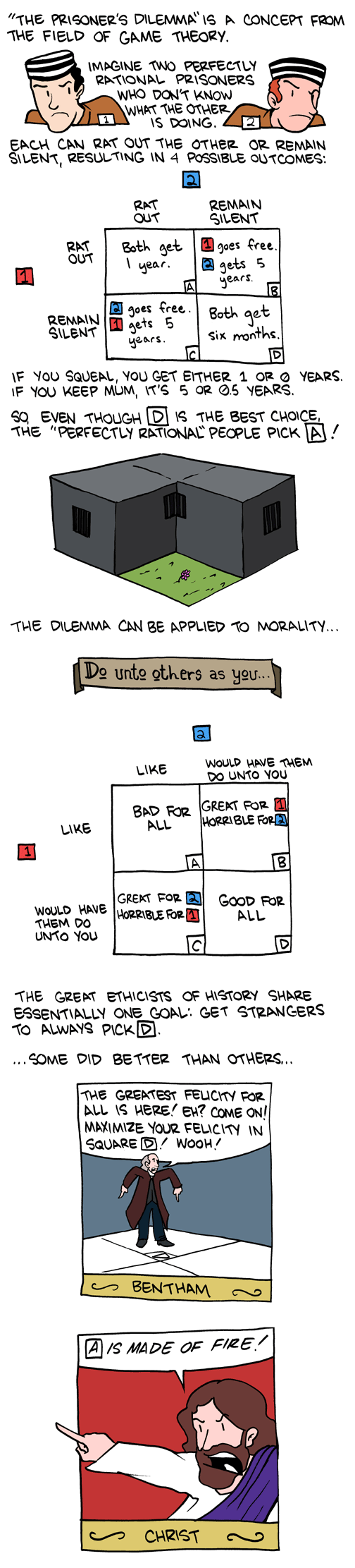
Making good decisions is complicated. Game theory applies logic and mathematics to determine the optimal course of action for individuals when acting in the presence of other participants. Now, individual actions must take into account logic, morals, and personal preference, but there are general rules or situations in which the optimal course of action is clear. This comic (or infographic?) by SMBC illustrates the application of game theory to a classic problem, the prisoners dilemma, and by extension morality.
The prisoners dilemma is a great way to find your moral compass. We can apply a similar decision matrix as used above to many different kinds of situations, like Pascal's wager, where one attempts to bet on the existence of God. The logic of pascal's wager concludes that one should believe, or at least act as if one believes in God (this result is unsatisfactory to many, but wait I have a response). I was recently considering applying a decision matrix to answer the question, 'Should you believe in science?' There are other ways to phrase the question, like 'Should you be a skeptic?' or 'Should you follow logic?' Decision theory gets tricky here. In order to answer the question I recalled an analogy a professor used in a philosophy class I took long ago. My professor wanted us to consider a philosophical umpire calling a game. The umpire could either state that she was very vigilant such that she, 'calls em as I see em' (admitting fallibility), or the umpire could say that, 'I call them as they are' (denial of fallibility). In the situation before replays I could almost see the umpire taking either stance with reason because they are the final arbiter on the field. In this modern age it is completely untenable for an umpire to state that she calls everything'as they are because replays are available. In life any experience that can be repeated is like a game with replays; an experiment is a game with replays. We all must be like the philosophical umpire and we can reason out how to behave using these ideas.
Below I have made a logic table. On the left vertical axis is the true outcome of an event with respect to how you perceived it and on the top horizontal axis is how you see yourself judging the event. The conclusion of the table is that application of the scientific method is really powerful. Admitting that you make errors in judgement means that you always allow potential for improvements in the future outcomes, but insistence on being right leads you to a false world view. I think that scientists, skeptics, and atheist have essentially the same goal and are all standing in the top right corner there jumping up and down trying to get people to choose to be skeptical.
'calls em as I see em' (skeptic)
'calls em as they are'
right
positive result, skeptic world view, positive future results
positive result, superficially correct world view, positive future results
negative result, skeptic world view, potential for improved future results
negative result, false world view, negative future results
wrong
It almost seem to be a tautology that logic says you should use logic to understand the world. This decision matrix casts doubt on the result of all other decision matrices like Pascal's wager such that we can escape being certain that belief in God is best, but simultaneously this result casts doubt on itself. Paradoxically what this really seems to say is that you should be skeptical about being skeptical.
I have been on blog sabbatical for some time, but I am going to be back in full force in about two weeks blogging from a lake in southern Germany. I have been invited to Lindau Germany to cover the 60th Meeting of Nobel Laureates in about two weeks. You can follow what I have to say along with several other bloggers on the Lindau Blog and you can also submit an original and stimulating question you would like to ask a Nobel Laureate.
One of the goals of the Lindau conference is to facilitate dialogue between Nobel laureates and young scientists. The conference will consist of lectures by the Nobel laureates followed by panel discussions between the young scientists and laureates. There will be an exchange of ideas on basic research as well as applications in fields such as medicine, physics, chemistry and economics. It is great to see this atmosphere of exchange between the various generations and the encouragement to young scientists for the future. Personally, I am very excited to hear the talks and have the opportunity to ask Nobel laureates questions. I could use some recommendations on good questions to ask a Nobel laureate. Some questions I have thought of
What was an assumption you or your field had that has turned out to be completely wrong?
As a young researcher, how can we deal with the reality of daily failures and obstacles?
What kind of fundamental research could lead to unexpected applications in daily life?
Whole lives begin and end
in a thousandth
of a thousandth
of a thousandth of a second.
creation
grief
love
fury
sorrow
and death,
all occur in infinitesimal portions.
Protons give sentimental tokens
to one another,
through dancing electrons,
spinning in joyful abandon
to the music of quark logic.
Schrödinger's symphony builds to a cacophony.
Rhythm breaks down to decay the choreography.
Neutrons, split apart—with the grief of separation grow cynical.
Unstable and paranoid they guard their neutrinos from others.
Resentment and regret grow exponentially;
to radiate outward,
seeping into the ground water.
Futurism is an endeavor fraught with speculation. This is an inescapable fact. Many people, myself included, like to think about the future and wild things like space travel or exotic space ships, but this thinking is too often aimed at tangible objects and fiction. What we need is a frame work for thinking about the future that involves the most important factor and that is people. Consider the future in terms of the human development index versus planetary health. Consider how the future might be and what we want the future to be like. This is a refreshing approach to futurism because rather than an obsession with a singular aspect of the future, like the singularity, we are encouraged to make a plan for what to do with the wild technologies we may or may not obtain. Here is Dr. Chris Luebkeman with four predictions for Earth's future.
Today, a philosophical diversion on the evolution of religion. Specifically I was thinking about the metaphorical evolution of religion and the Darwinian evolution of the human mind with a predisposition to the mystical. I was reminded about this topic and a Science article from some time ago when I saw a review for The Evolution of God a new book by Robert Right. My thesis on the topic is that as long as religion infers a survival advantage upon a group then evolution will select individuals whose minds are wired to be religious; or as society changes rapidly religion itself will evolve in a cultural respect. In this recent NYRB article Can Science Explain Religion? Allen Orr reviews Right's book with positive and critical remarks, an excerpt:
In The Evolution of God, he [Right] both surveys the history of religion and, more important, offers a new theory to explain why this history unfolded as it did.
According to Wright's theory, although religion may seem otherworldly—a realm of revelation and spirituality—its history has, like that of much else, been driven by mundane "facts on the ground." Religion, that is, changes through time primarily because it responds to changing circumstances in the real world: economics, politics, and war. Wright thus offers what he emphasizes is a materialist account of religion. As he further emphasizes, the ways in which religion responds to the world make sense. Like organisms, religions respond adaptively to the world.
More formally, Wright argues that religious responses to reality are generally explained by game theory and evolutionary psychology, the subjects of his previous books. Subtle aspects of the human mind, he claims, were shaped by Darwinian natural selection to allow us to recognize and take advantage of certain social situations. The most important of these—and the centerpiece of Wright's theory—are what game theorists call non-zero-sum interactions. Unlike zero-sum games, wherein one player's gain is another player's loss, in some games both players can win; hence "non-zero-sum." The classic example is economic trade. In a free market, trade occurs when both parties benefit from exchange (otherwise they wouldn't engage in it).
Again, this theory doesn't seem new at all. It is, to my perspective, obvious that religion co-evolved with early humans precisely because religious tendencies in a society inferred an evolutionary advantage upon the group. Wright's basic theory is that due to historical circumstance the optimal strategy suggested by game theory has moved religion towards tolerance and conciliation. Religion changed its fundamental tenants throughout history in order that it would continue to instill advantages on its society. So, then this leads to the question, does religion and the church as an institution encourage prosociality or is it a self-serving system?
The Good Samaritan [painting by Jacopo Bassano, d. 1592, copyright 2006, The National Gallery, London]
Modern society has developed into a complex system in which people must work together. A cynical perspective is that people work together only in exchange for money or services with the ultimate goal of only helping themselves. There is nothing altruistic about the interactions. Yet, altruism is rampant. Another person helping another person with no aim other than to help can be described as a prosocial act. Prosociallity is defined as the quality of being beneficial to all parties and consistent with community laws and norms. Psychologists and evolutionary psychologists are seeking the answers as to why people engage in prosocial behavior, even at a cost to themselves in certain cases. Norenzayan and Shariff explain the issue in The Origin and Evolution of Religious Prosociality (Science 2008, a link to the article on the Science website is here. The Science link to the article will not be available to those who do not have a Science subscription. You would expect that an article about prosociality would be available to all in line with its prosocial topic, but that's situational irony for you. The direct link to the PDF posted above was from the author's web page and it may not be stable). The article abstract:
We examine empirical evidence for religious prosociality, the hypothesis that religions facilitate costly behaviors that benefit other people. Although sociological surveys reveal an association between self-reports of religiosity and prosociality, experiments measuring religiosity and actual prosocial behavior suggest that this association emerges primarily in contexts where reputational concerns are heightened. Experimentally induced religious thoughts reduce rates of cheating and increase altruistic behavior among anonymous strangers. Experiments demonstrate an association between apparent profession of religious devotion and greater trust. Cross-cultural evidence suggests an association between the cultural presence of morally concerned deities and large group size in humans. We synthesize converging evidence from various fields for religious prosociality, address its specific boundary conditions, and point to unresolved questions and novel predictions.
The authors run various experiments to determine in what situations people exhibit prosocial behavior. For example they ask when the average person would stop to help someone fallen on the sidewalk. Would a religious individual be more inclined to help that same fallen person, just as in the bible parable the good Samaritan? In the authors own words:
In several behavioral studies, researchers failed to find any reliable association between religiosity and prosocial tendencies. In the classic “Good Samaritan” experiment (22), for example, researchers staged an anonymous situation modeled after the Biblical parable—a man was lying on a sidewalk appearing to be sick and in need of assistance (Fig. 1, image above). Participants varying in religiousness were led to pass by this victim (actually a research confederate) on their way to complete their participation in a study. Unobtrusively recorded offers of help showed no relation with religiosity in this anonymous context (22). Only a situational variable whether participants were told to rush or take their time—produced differences in helping rates. Other behavioral studies, however, have found reliable associations between religiosity and prosociality, but under limited conditions. In one study (23), researchers compared levels of cooperation and coordination between secular and religious kibbutzim in Israel. In this economic game, two members of the same kibbutz who remained anonymous to each other were given access to an envelope with a certain amount of money. Each participant simultaneously decided how much money to withdraw from the envelope and keep. Players only kept the money they requested if the sum of the requests did not exceed the total amount in the envelope. If it did, the players received nothing. The results showed that, controlling for relevant predictors, systematically less money was withdrawn in the religious kibbutzim than in the secular ones (23).
In the conclusion the authors of this study on prosicoalty find evidence that prosociality is a bounded phenomenon. It more likely to be exhibited in situations where it helps in maintaining a favorable social reputation within the ingroup. It seems that evolution has enforced this self-serving ingroup behavior in some cases and evolution has also enforced purely altruistic behavior in other cases. The human mind certainly doesn't evolve on human time scales so it is up to religious groups to evolve their beliefs. Hopefully religious groups can continue to move towards tolerance, but in the meanwhile atheists will wonder why we need religion to move forward at all.
References:
Norenzayan A, & Shariff AF (2008). The origin and evolution of religious prosociality. Science (New York, N.Y.), 322 (5898), 58-62 PMID: 18832637
How to remember everything? I am not particularly keen on historical facts, but in order to remember various physical constants I recall historical dates:
The Cosmic Microwave Background: The CMB surface of last scattering occured at approximatley 1066 which is the year that historians consdier the begining of the Middle Ages (the years just prior being the late Dark Ages). Historically 1066 was the year of the Battle of Hastings and the ensuing Norman conquest of England. In the case of cosmology 1066 coresponds to the begining of the cosmological dark ages.
The mass ratio of a proton to an electron: The actual ratio of a proton to electron mass is 1836.153. The Battle of the Alamo was 1836. This trick works best if you are from Texas.
Euler's number: e is 2.7 1828 1828 I wrote it with the spaces between the 1828's because many people remember the 2.7. And 1828 is one year after Beethoven died. This trick works best if you know your classical composers.
This memory trick using historical dates seems strange even to me; if anything the physical constants actually helped me remember the history dates, but either way I remembered. Memory tricks can be powerful tools. For example you can memorize nearly 4000 digits of π with a mnemonic technique, but the most powerful memory enhancing approach is certainly the method of loci.
Be sure and watch the second part that teaches you the link memory technique.
This is a list of the 10 greatest modern astronomical observatories ever imagined. Some are being built presently, some are scouring for funding, and some are dreams. They are in no precise order, but I have tried to place them according to their extremeness with respect to scientific impact, cost, technology, and size.
1. Laser Interferometer Space Antenna
LISA is in a class of its own. In some sense it does not belong on this list because it literally transcends every other observatory on this list by monitoring the universe through gravitational waves and not electromagnetic waves. If LISA is successful it will be the first direct observation (unless a project like advanced LIGO beats it to the punch) of gravitational waves which are predicted by Einstein's theory of General Relativity. LISA will detect the variation in distance of three spacecraft flying in an equilateral triangle formation. The LISA instruments are classic interferometers sensitive to gravitational waves which distort the space-time between the spacecraft by as little as just tens of pm. Soon the LISA Pathfinder mission will be launched to prove the concept and technology necessary for the complete observatory. LISA is a profound step forward for humankind, like an infant opening its eyes for the first time.
2. Terrestrial Planet Finder
The TPF is visionary space mission which will likely consist of two observatories in space a coronagraph and an interferometer array. The TPF will search for extrasolar terrestrial planets around relatively close stars like the Alpha Centauri system and systems where the probability to find an extra solar planet is high. The coronagraph would be a very large optical telescope, at least three times that of Hubble, that would also have special optics to occult the light of bright stars in order to see the dim planets next to their brilliant host stars. The interferometer, illustrated above, would consist of several small infrared telescopes orbiting in formation; the interferometric technique would allow the telescopes to obtain a resolution of a much larger telescope.
3. James Webb Space Telescope
The JWST is considered the successor to the Hubble Space Telescope. It will study galaxy, star and planet formation in the Universe with supreme depth and precision. Just imagine the James Webb Ultra Deep Field. The telescope engineering is impressive. The telescope's primary mirror will consist of a 6.5 m (about 6 times the area of Hubble) gold coated beryllium refelector composed of 18 hexagonal segments which will unfold in space. The mirror is made of such special materials because of the need for specific thermal and reflective properties. For example beryllium is the metal with the greatest heat dissipation characteristics per unit weight and further its relatively low coefficient of thermal expansion imparts stability to the mirror. JWST is designed to observe very distant objects such that much of their light will be in the infrared when it reaches the telescope and therefore JWST will be an infrared telescope, hence the gold coated reflecting surface. JWST is packed with advanced technology like hemispherical resonator gyros which should last longer than the traditional mechanical gyroscopes which were on Hubble and needed servicing during missions. This is necessary because JWST will be far from earth at Lagrange point two, some 1.5 million km from Earth and not close enough for simple repair missions. If all this sounds ambitious and outlandish that is because it is, but the science that the JWST will produce will certainly justify the effort.
The OWL is the most unlikely telescope on this list; the project has been eclipsed by the European Extremely Large Telescope, the EELT, on all practical accounts. The OWL would be a unrealistically large 100 m telescope allowing it to observe objects as faint as an apparent magnitude of 38. In order to control costs the OWL would be based on mass production of major cost items like the structural components and segmented mirrors, but a review panel determined the cost would be at least 1.2 billion Euros. This cost is considered unacceptably high.
5. The Square Kilometer Array
The SKA will be a radio telescope with a million kilometers of collecting area. It will be the largest telescope ever created and perhaps the most expensive at 1.5 billion Euro. The SKA will probe the gaseous component of the early Universe with sensitivity 50 times greater than the Very Large Array. This sensitivity and a wide field of view will also allowing the SKA to probe general relativity by monitoring the timing of a network of pulsars. Like the VLA the SKA will be an interferometric array consisting individual antenna stations working together to synthesize an aperture with a diameter up to several thousand kilometers. Many things about the final design for the SKA are uncertain, in fact factions within astronomy have threatened to doom the entire project. The disagreements stem from different opinions on what the primary scientific objectives should be for the project. Currently it is planned that approximately 50% of the collecting area would be contained in a dense central array of 5 km in diameter to provide high brightness sensitivity at arc-second scale resolution for studies of faint spectral lines from structures in the early universe. Another 25% of the collecting area would be located within a diameter of 150 km; the image above shows a possible layout for the array with arms in a spiral pattern with a diamter of 150 km. The remainng 25% of the collecting area would be at baselines of 3000 km or greater. The distribution of antennas directly impacts what kind of science can be accomplished. The video below shows a possible layout for the SKA in dramatic fashion.
The EELT is the realistic result of the OWL telescope proposal. The primary mirror will be 42 meters consisting of 984 1.4 meter segments of only 50 mm thickness. The mirrors are thin in order to have excellent thermal properties. The EELT will have an adaptive optics system which will perform active adjustment of a 2.5 meter mirror to compensate for atmospheric affects which distort images. There will be 5000 actuators supporting this mirror which precisely adjust the mirror's shape thousands of times per second in order to correct images. The reality is that the limiting effect on all large ground based telescopes is atmospheric seeing, therefore all the ground based optical telescopes on this list use some kind of adaptive optics.
7. Large Synoptic Survey Telescope
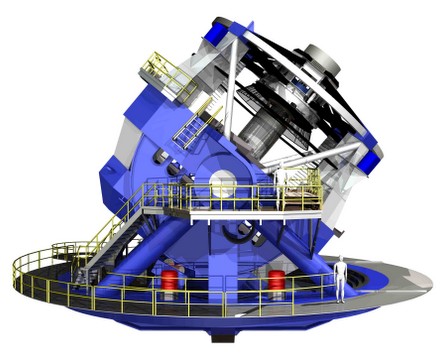
The LSST is an 8-meter telescope with a 3 degree field of view (consider that the moon is only half a degree in the sky). This design configuration allows the LSST to implement an observing program that detects near-Earth objects which are small and faint in exposures of 10 or 20 seconds, and it allows images to be stacked for deep and wide imaging for star and galaxy surveys. The science mission drivers of LSST include the nature of dark energy, the solar system, optical transients, and galactic structure. It is the LSST technology and the rate at which it will produce data that makes it so remarkable. The LSST camera is 3200 Megapixels (it is a giant array of 189 CCD chips) and will create 400,000 sixteen Megapixel images per night (resulting in about 30 TB) for a total of 60 PB of raw data over 10 years. The total data volume after processing will be over 100 PB requiring 250 TFlops of computing power for processing. LSST will be wide, fast, and deep. It should be ready for first light by 2014.
8. Thirty Meter Telescope
The TMT is another extremely large ground based telescope. Its design calls for a collecting area that is thirty meters or about 100 feet in diameter. In order to better explore the early universe it will be sensitive to light in the optical near infrared. Relative to the Hubble the TMT will have 144 times more collecting area and a factor of 10 better spatial resolution in the near-infrared. The TMT will have a primary mirror composed of 492 segments with a rotating tertiary mirror (as seen in the above image, a Ritchey-Chretien telescope) in order to direct light onto multiple instruments and it will of course use adaptive optics to correct for turbulence in earth's atmosphere. The TMT will implement a scaled of version of the segmented mirror technology of the Keck telescopes at a size which will produce significant science at a reasonable cost.
9. Giant Magellan Telescope
The GMT differentiates itself from the other giant ground based telescopes on this list in that its primary mirror will not be segmented in the standard manner, but will instead consist of seven monolithic 8.4 m mirrors. Because six of the mirrors are off-axis (they don't focus light to a point directly above them, but rather to a point off to their side; see image above) they present a unique engineering challenge that will synthesize a telescope with a resolving power of a single 24.5 m mirror. Currently the first mirror has been cast at the Steward Observatory Mirror Lab as a proof of concept that an acceptably accurate shape can be achieved.
10. Atacma Large Submillimeter Array
ALMA is probably the most practical observatory on this list and it is almost already completed (located in the Atacama desert), whereas many of the other observatories on this list are only the twinkle in astronomer's eyes. It is currently under construction in the thin (altitude of 5,000 m or 16,000 feet), dry air, of northern Chile. ALMA is not actually a single telescope, but an array of 50 (this number may change and has already been reduced once) antennae working in unison. It merits a place on this list because it will revolutionize astronomy by providing a senstive eye on mm wavelength light where early universe star/planet formation can be viewed best. Each of its 12 m antennas will observe in bands ranging fom 30 Ghz to 1 Thz and the array will have specialized telescope transporters which will enable baselines ranging from 150 m to 16 km. ALMA is only practical in respect to the grandiose telescopes on this list; it the the most ambitious ground-based telescope ever built and costs in excess of one billion US dollars.
The future of great astronomical observatories
This list is merely my musings on astronomical observatories. There are more productive observatories that have already built, or will be built, but these are the most exciting in my humble opinion. This list does not include even more speculative projects such as plans for a lunar radio telescope or an extremely sensitive and larger LISA. There are other planned observatories not mentioned, like IXO, that just didn't make the list.
It is of note that there is an over arching principle of segmentation present in all of these observatories; these telescopes use multiple almost identical components working in unison in order to gather signal. LISA, the SKA, TPF, and ALMA use interferometry or correlation to observe. The EELT, TMT, JWST, use segmented primary mirrors. GMT uses several identical mirrors to simulate one primary mirror. LSST uses a massive array of CCD detectors. Modern technology and the economic/complexity benefits of reproducible industrial construction make this possible, but it takes modern computing to gather the data from the individual receiving elements and produce coherent observations and science.





 The Cosmic Microwave Background: The CMB surface of last scattering occured at approximatley 1066 which is the year that historians consdier the begining of the Middle Ages (the years just prior being the late Dark Ages). Historically 1066 was the year of the
  The mass ratio of a proton to an electron: The actual ratio of a proton to electron mass is 1836.153. The