


Field of Science
-
-
Change of address11 months ago in Variety of Life
-
Change of address11 months ago in Catalogue of Organisms
-
-
Earth Day: Pogo and our responsibility1 year ago in Doc Madhattan

Showing posts with label observation. Show all posts
Showing posts with label observation. Show all posts
ALMA in Search of Our Cosmic Origins
ALMA (the Atacama Large Millimeter/submillimeter Array) is the most complex and ambitious astronomical observatory ever completed. And it is officially completed. Last week the telescope array was inaugurated at an official ceremony; all the major systems of the telescope are now operational. ALMA is an important instrument for astronomers because it allows us to see in the submillimeter wavelength band where stars formation in distant galaxies are evident. In addition to seeing distant galaxies dusty obscured regions of space can be explored with this instrument. In order to get such a fantastic view of the universe astronomers have had to build the telescope array at an elevation of 5000 meters (16,400 feet) in the dry Atacama desert because the atmosphere would otherwise (particularly water vapor) block the light at the these wavelengths. There have been many engineering and management hurdles in the completion of ALMA so the success of the project deserves recognition. ALMA is an expensive partnership between Chile, Europe, North America, and East Asia that represents what is hopefully the beginning of many more massive multinational collaborative astronomical observatories. The European Southern Observatory who does a lot of the primary management of the observatory also does a lot of great work generating public outreach. They have produced this video which presents the history of ALMA from the origins of the project decades ago to the recent first science results.
Alma means soul in Spanish. A beautiful name for the observatory that looks so serene as it gazes up at the Milky Way discovering our cosmic origins.

The Hubble Extreme Deep Field
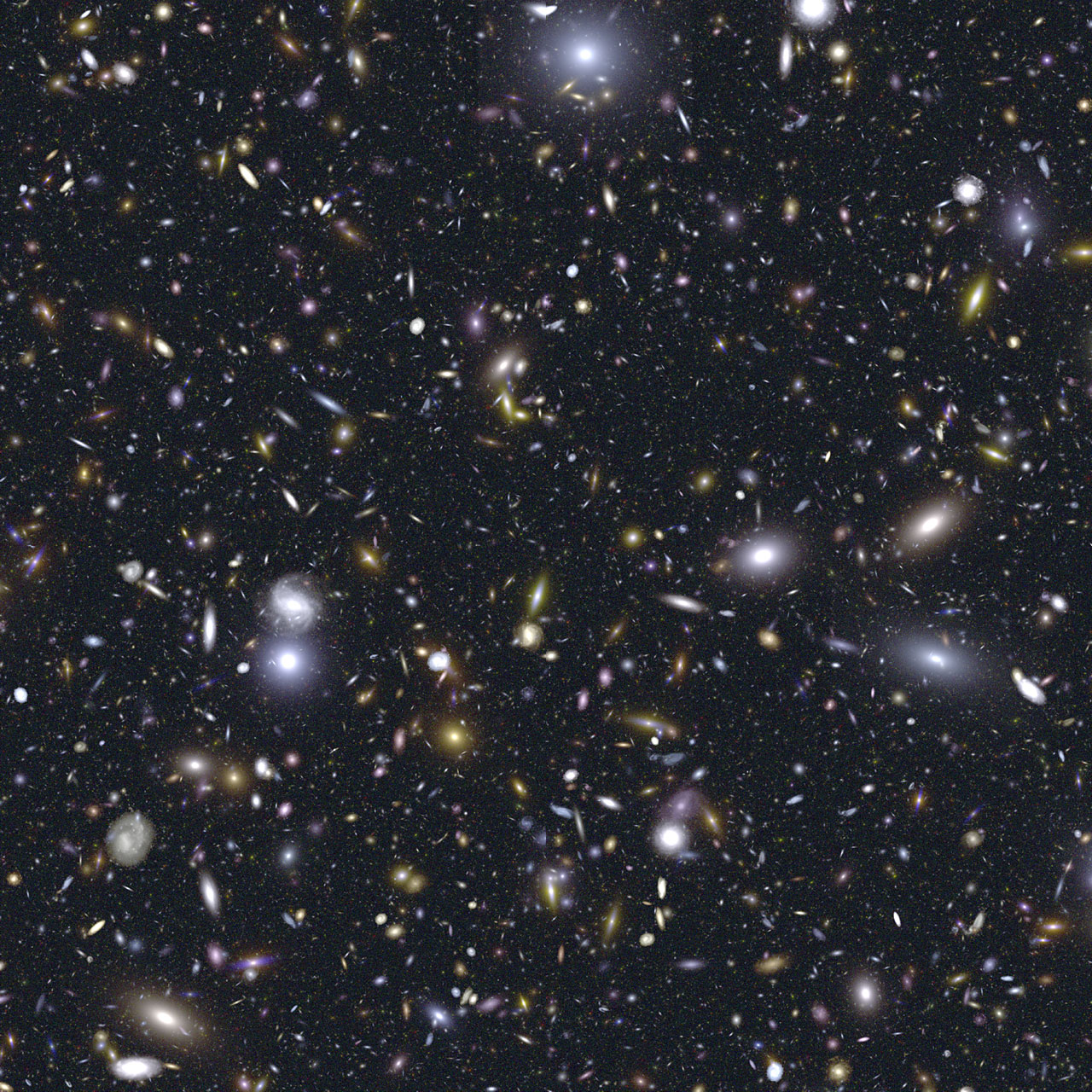
Almost a decade ago when astronomers pointed the Hubble Space Telescope at an apparently featureless patch of the sky they were rewarded with a spectacular image. The was the Hubble Ultra Deep Field. The image allowed us to see that galaxies were forming as early as just a billion years after the Big Bang. The farther from Earth we look the farther back in time we see; starlight from those distant galaxies is just arriving at earth now. Now we have glimpsed even further with the Hubble Extreme Deep Field. This new image was created by aggregating 10 years of Hubble images taken centered at the same location of the original Ultra Deep Field. In addition to staking old images additional new images were included which had been taken with infrared cameras installed during the 2008 Hubble Space servicing missions. Infrared images offer important additional data for distant galaxies because the light from such distant objects has been stretched to longer wavelengths as it has journeyed across the universe. Here is the Hubble Extreme Deep Field:


If you are intrigued by Hubble's deep images of the sky there is a Google Event webinar to discuss the latest findings. The public is invited. show up online and ask questions of the astronomers involved. It is at 1 p.m. Sept. 27 and can be joined either at HubbleSite’s Google Plus page or the HubbleSite YouTube Channel.

This is the deepest image of the sky ever seen. It allows us to explore the faintest galaxies ever as far back as a time just half a billion years after the Big Bang. Soon though we will have even deeper images. The James Web Space Telescope will be a 6.5 meter diameter(or 21 foot, so big that it will be a segmented mirror that will unfold in space) space telescope that will launch in 2018. It will see further. Here is a simulated image of what the James Web Space Telescope will see:
If you are intrigued by Hubble's deep images of the sky there is a Google Event webinar to discuss the latest findings. The public is invited. show up online and ask questions of the astronomers involved. It is at 1 p.m. Sept. 27 and can be joined either at HubbleSite’s Google Plus page or the HubbleSite YouTube Channel.
Perseid meteor shower 2012
Find a dark place on a late night this weekend to enjoy the Perseid meteor shower. You can even participate in citizen science by counting the number of meteors you see with NASA's Meteor Counter app.
Milky Way Hides Gamma Ray Lobes
The Milky Way has some nerve (or after you see the picture you may think, excuse my language, big cojones) for hiding a massive structure that about equals the size of the visible Milky Way. The Fermi gamma ray satellite observed the structure mired in a fog of gamma rays which are pervasive through our sky. Fermi has been making a survey of the complete sky for some time, but only through careful data analysis and removal of diffuse sources were the lobes readily apparent.
Spotting the lobes inside the Milky Way was difficult because from our view within we can't see the forest for the trees, but astrophysics expect that some galaxies have gamma ray lobes and Fermi has spotted such lobe structures like this in other galaxies such as Centarus A. So this result isn't that unexpected, except that it is. These gamma ray lobes are comparable to the entire size of our galaxy and they are just now being seen for the first time.


The structures are orthogonal to the plane of the Milky Way and have distinct edges; they are surprisingly geometrically perfect. They span about 7.5 kiloparsecs (or 25,000 light years). The lobes are composed of gamma rays which are super high energy photons; the photons obtain such high energies by interacting with particles, like free electrons, which are themselves moving close to the speed of light which then interact with the lower energy photons in their vicinity to boost the photons up to gamma ray energies.
The distinct edges of the lobes are indicative of a large and rapid formation event. The structures may have been formed by a massive burst of star formation followed by stellar explosions which seeded the lobes with gas, dust, and hot electrons over millions of years. There is a supper massive black hole at the center of many galaxies, including the Milky Way, which may create high energy lobes, but those lobes would only form when the black hole is actively undergoing accretion of matter. So this may be evidence that the 4 million solar mass black hole at the center of our galaxy underwent an active period where it accreted a large amount of matter and simultaneously released massive jets of energetic particles just a few million years ago.
It is an exciting discovery, but I don't have anything other than a press release to go on as of yet though a paper is accepted for publication in ApJ so more to come.
Spotting the lobes inside the Milky Way was difficult because from our view within we can't see the forest for the trees, but astrophysics expect that some galaxies have gamma ray lobes and Fermi has spotted such lobe structures like this in other galaxies such as Centarus A. So this result isn't that unexpected, except that it is. These gamma ray lobes are comparable to the entire size of our galaxy and they are just now being seen for the first time.

The structures are orthogonal to the plane of the Milky Way and have distinct edges; they are surprisingly geometrically perfect. They span about 7.5 kiloparsecs (or 25,000 light years). The lobes are composed of gamma rays which are super high energy photons; the photons obtain such high energies by interacting with particles, like free electrons, which are themselves moving close to the speed of light which then interact with the lower energy photons in their vicinity to boost the photons up to gamma ray energies.
The distinct edges of the lobes are indicative of a large and rapid formation event. The structures may have been formed by a massive burst of star formation followed by stellar explosions which seeded the lobes with gas, dust, and hot electrons over millions of years. There is a supper massive black hole at the center of many galaxies, including the Milky Way, which may create high energy lobes, but those lobes would only form when the black hole is actively undergoing accretion of matter. So this may be evidence that the 4 million solar mass black hole at the center of our galaxy underwent an active period where it accreted a large amount of matter and simultaneously released massive jets of energetic particles just a few million years ago.
It is an exciting discovery, but I don't have anything other than a press release to go on as of yet though a paper is accepted for publication in ApJ so more to come.
Hubble Bubble
The Copernican principle holds that humans are not privileged observers of the Universe. Copernicus stated that the Earth is not at the center of the solar system or at any particularly special position in the heavens. Modern cosmology has extended this idea to reason that the earth does not occupy any unique position in the Universe. Modern philosophy of science pushes the principle even further to conclude that every observer (even if they be they little green men) should reason as if they were the most standard observer. However, despite all these humble and rational thoughts it is still tempting to explain certain aspects of modern cosmology that seem finely tuned as consequences of observer selection effects. Namely I am speaking of dark energy or the accelerated cosmological expansion which supposedly could be explained if we occupy a privileged position near the center of a large, nonlinear, and nearly spherical void in mass density. The idea that the region of the cosmos around us could be a void is colloquially known in astronomy as the Hubble bubble. Technically a Hubble bubble is defined as a region of space wherein there is an observed departure of the local value of the Hubble constant from its cosmologically averaged value.
 Lets speculate a little further on what it would be like to live in a Hubble bubble. In the standard cosmological model of the Universe the structures we see today like galaxies and clusters of galaxies (and similarly the structures we don't see like the massive dark matter halos the visible matter is embedded in) formed from tiny primordial quantum fluctuations in the early universe. The fluctuations were random variations in density such that locations which were over-dense formed galaxies and those which were under-dense formed voids. It is possible, in fact statistically quite acceptable that there are voids of various sizes in the Universe. These voids would become increasingly under-dense as the Universe evolved and equivalently over-dense regions of the Universe became increasingly over-dense. Inside the void matter would expand outward due to the gravitational pull of matter in surrounding dense regions and thus an observer at the center of the void would see an accelerated expansion of matter outward. Now it is also possible that our entire observable Universe is a Hubble bubble, but that really flies in the face in all of cosmology. It is unfounded, absurd, and really the whole idea of a Hubble bubble may explain dark energy, but is hardly a very good explanation.
The Hubble Bubble is wildly speculative and precision cosmology has almost completely defeated it as a credible explanation. First, as the framework of cosmology has been successful resting on the Copernican principle it seems odd to throw it out now. It is odd and largely misguided. First, the probability of producing a void of necessary magnitude; to mimic aspects of dark energy is extremely small in the standard structure formation models. Second, the probability of an observer being at the center (the only location where the expansion effect would be noticed) is extremely low. Finally, the void would need to be close to spherical to match the observed spatial smoothness (or isotropy) of the universe. These qualitative arguments and many more quantitative arguments from precision cosmology data are laid forth in a recent paper by A. Moss, J. Zibin, and D. Scoot titled Precision Cosmology Defeats Void Models for Acceleration. The abstract follows:

References:
Adam Moss, James P. Zibin, & Douglas Scott (2010). Precision Cosmology Defeats Void Models for Acceleration arXiv preprint arXiv: 1007.3725v1
Conley, A., Carlberg, R., Guy, J., Howell, D., Jha, S., Riess, A., & Sullivan, M. (2007). Is There Evidence for a Hubble Bubble? The Nature of Type Ia Supernova Colors and Dust in External Galaxies The Astrophysical Journal, 664 (1) DOI: 10.1086/520625
The Hubble Bubble is wildly speculative and precision cosmology has almost completely defeated it as a credible explanation. First, as the framework of cosmology has been successful resting on the Copernican principle it seems odd to throw it out now. It is odd and largely misguided. First, the probability of producing a void of necessary magnitude; to mimic aspects of dark energy is extremely small in the standard structure formation models. Second, the probability of an observer being at the center (the only location where the expansion effect would be noticed) is extremely low. Finally, the void would need to be close to spherical to match the observed spatial smoothness (or isotropy) of the universe. These qualitative arguments and many more quantitative arguments from precision cosmology data are laid forth in a recent paper by A. Moss, J. Zibin, and D. Scoot titled Precision Cosmology Defeats Void Models for Acceleration. The abstract follows:
The suggestion that we occupy a privileged position near the center of a large, nonlinear, and nearly spherical void has recently attracted much attention as an alternative to dark energy. Putting aside the philosophical problems with this scenario, we perform the most complete and up-to-date comparison with cosmological data. We use supernovae and the full cosmic microwave background spectrum as the basis of our analysis. We also include constraints from radial baryonic acoustic oscillations, the local Hubble rate, age, big bang nucleosynthesis, the Compton y-distortion, and for the first time include the local amplitude of matter fluctuations, σ8. These all paint a consistent picture in which voids are in severe tension with the data. In particular, void models predict a very low local Hubble rate, suffer from an "old age problem", and predict much less local structure than is observed.The paper makes several quantitative arguments against the plausibility any kind of void model for cosmic acceleration by drawing together an impressive amount of cosmological data and technical expertise, however, they don't ever mention the term Hubble Bubble. A 2007 paper by Conley et al. takes the Hubble Bubble paradigm head on: Is There Evidence for a Hubble Bubble? The Nature of Type Ia Supernova Colors and Dust in External Galaxies. In Conley et al. they explore how dust effects the colors of type Ia supernovae because they reason if the dust can be modeled as a purely local Milky Way effect then the supernovae data would actually favor the Hubble Bubble. Of course, despite difficulties the analysis, they find that in their parametrization there is evidence for more than the simply effect of local Milky Way dust implying doom for the Hubble Bubble. So the Hubble Bubble has been burst.
References:
Adam Moss, James P. Zibin, & Douglas Scott (2010). Precision Cosmology Defeats Void Models for Acceleration arXiv preprint arXiv: 1007.3725v1
Conley, A., Carlberg, R., Guy, J., Howell, D., Jha, S., Riess, A., & Sullivan, M. (2007). Is There Evidence for a Hubble Bubble? The Nature of Type Ia Supernova Colors and Dust in External Galaxies The Astrophysical Journal, 664 (1) DOI: 10.1086/520625
Microwave Sky Seen by Planck
The first image of the microwave sky was released today by the Planck collaboration. The image is the result of a year of observations from the Planck satellite. How far we have come since the first image of the cosmic microwave background by COBE! The most prominent aspect of the image is the bright band across sky caused by diffuse gas and dust emission from our own Milky Way. Also visible are local clouds of gas, nearby galaxies such as Andromeda, and more distant galaxies which host supermassive black holes in their center. The more subtle variations which will be visible when the foregrounds are removed are tiny temperature fluctuations which carry information about the cosmic microwave background and primordial density fluctuations seeded by the Big Bang. However, scientists are waiting to dive into detailed analysis of the multi-frequency data ranging from 30 GHz to 857 GHz until all of the foregrounds and telescope systematics can be understood. Ultimately the Planck data will give us the most precise constraints humans have ever had on the parameters of our cosmos.
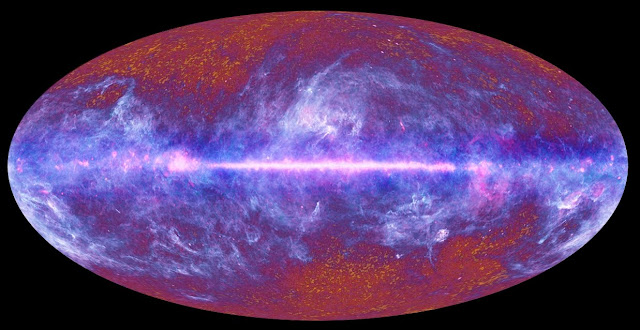 Planck is a major step forward in cosmic microwave background (CMB) observations because it measures polarization of microwave photons. The polarization of photons may carry information about the universe from inflation or when the CMB was generated 400,000 years after the Big Bang. Generally when an electromagnetic wave or photon is incident upon a free electron the scattered photon is polarized perpendicularly to the incident direction. Different regions of the CMB may have a net linear polarization generated when radiation from perpendicular directions in the sky has different intensities. Different directions in the sky have different intensities dependent upon perturbations; there are three kinds of perturbations 1) scalar perturbations due to density fluctuations, 2) vector perturbations due to vorticity (like cosmic strings or defects, although these are not likely to be detected), 3) and tensor perturbations due to gravity waves. The Planck mission will be the first CMB space satellite to measure the as of yet unseen gravity wave or "B-mode" poarlization which will reveal the physics of primordial gravity waves when the Universe was in existence for just 10-36 seconds.

An Upper Limit On Not Knowing What the F*** They're Doing
First, I should say that the Supernova Cosmology Group and others using Type Ia supernova as standard candles are very precise in their work and I don't seriously doubt their results as they have been very consistent with other observations. There is though the one dark shadow looming over all their results and that is systematic error. Cosmologists use Type Ia supernova as a lighthouse in the dark because we can assume that all lighthouses have the same intrinsic luminosity and therefore any difference in observed luminosity is due solely to the distance from us. Thus by observing distant supernovae and recording their various properties such as luminosity and recession velocity from us we can plot their velocity versus distance and we can learn about the expansion of our universe and the cosmological constant. However, we assumed that we knew their intrinsic luminosity, but of course there are always unknown unknowns:
The new Chandra results indicate that some Type Ia supernovae probably originate from the collision of white dwarf binaries. The collision occurs because the stars radiate away gravitational waves and move inevitably closer. The result is an explosion of two stars that are near the Chandrasekhar mass so the observed luminosity may not be so standard:
There is at least one caveat to the results and the explanation given above. The Chandra observations were focused on elliptical galaxies and on the the center of one spiral galaxy because these areas had minimal amounts of gas and dust which block X-rays from reaching detectors. To summarize the results, the dominant mechanism for Type Ia supernovae in the elliptical early type galaxies Chandra observed is white dwarf mergers and not mass accretion. The take away point is that cosmologists need to take into account the galaxy type when using supernovae as standard candles because elliptical and spiral galaxies have different supernova progenitors; the supernova cosmology surveys have only used a small fraction of supernova from elliptical galaxies though, so it wont really change current results! So all that worry to discover nothing so troubling, but perhaps we gain assurance that soon even more distant standard candles can be trusted (like the GRB as a standard candle) despite that we can never really place anything more than an upper limit on unknown unknowns.
References:
Marat Gilfanov, & Akos Bogdan (2010). An upper limit on the contribution of accreting white dwarfs to the type
Ia supernova rate Nature, 18 February 2010, Vol.463, p.924 arXiv: 1002.3359v1
As we know,Today I read two things online that I really enjoyed and I realized that they are actually very connected. On The Blog of Steve Shwartz I read that No One Knows What the F*** They're Doing (or "The 3 Types of Knowledge") and couldn't agree more (for example, I certainly don't know what I am doing). And in Nature I read about An upper limit on the contribution of accreting white dwarfs to the type Ia supernova rate (and the arXiv preprint here) which raised questions about possible systematics in the use of supernovae in cosmology. The abstract from the nature article:
There are known knowns.
There are things we know we know.
We also know
There are known unknowns.
That is to say
We know there are some things
We do not know.
But there are also unknown unknowns,
The ones we don’t know
We don’t know.
—Donald Rumsfeld, Feb. 12, 2002, Department of Defense news briefing
There is wide agreement that type Ia supernovae (used as standard candles for cosmology) are associated with the thermonuclear explosions of white dwarf stars. The nuclear runaway that leads to the explosion could start in a white dwarf gradually accumulating matter from a companion star until it reaches the Chandrasekhar limit, or could be triggered by the merger of two white dwarfs in a compact binary system. The X-ray signatures of these two possible paths are very different. Whereas no strong electromagnetic emission is expected in the merger scenario until shortly before the supernova, the white dwarf accreting material from the normal star becomes a source of copious X-rays for about 107 years before the explosion. This offers a means of determining which path dominates. Here we report that the observed X-ray flux from six nearby elliptical galaxies and galaxy bulges is a factor of ~30–50 less than predicted in the accretion scenario, based upon an estimate of the supernova rate from their K-band luminosities. We conclude that no more than about five per cent of type Ia supernovae in early-type galaxies can be produced by white dwarfs in accreting binary systems, unless their progenitors are much younger than the bulk of the stellar population in these galaxies, or explosions of sub-Chandrasekhar white dwarfs make a significant contribution to the supernova rate.So, what the researchers found using Chandra data is observational evidence that type Ia supernovae are not simply explosions of Chandrasekhar mass white dwarfs, which would have been the simple case. The 'classic' picture is that when the amount of material accreted onto a white dwarf exceeds the Chandrasekhar mass the dwarf explodes:
The new Chandra results indicate that some Type Ia supernovae probably originate from the collision of white dwarf binaries. The collision occurs because the stars radiate away gravitational waves and move inevitably closer. The result is an explosion of two stars that are near the Chandrasekhar mass so the observed luminosity may not be so standard:
There is at least one caveat to the results and the explanation given above. The Chandra observations were focused on elliptical galaxies and on the the center of one spiral galaxy because these areas had minimal amounts of gas and dust which block X-rays from reaching detectors. To summarize the results, the dominant mechanism for Type Ia supernovae in the elliptical early type galaxies Chandra observed is white dwarf mergers and not mass accretion. The take away point is that cosmologists need to take into account the galaxy type when using supernovae as standard candles because elliptical and spiral galaxies have different supernova progenitors; the supernova cosmology surveys have only used a small fraction of supernova from elliptical galaxies though, so it wont really change current results! So all that worry to discover nothing so troubling, but perhaps we gain assurance that soon even more distant standard candles can be trusted (like the GRB as a standard candle) despite that we can never really place anything more than an upper limit on unknown unknowns.
References:
Marat Gilfanov, & Akos Bogdan (2010). An upper limit on the contribution of accreting white dwarfs to the type
Ia supernova rate Nature, 18 February 2010, Vol.463, p.924 arXiv: 1002.3359v1
The Cosmos isn't strange, people are strange
The cosmos isn't strange, people are strange. The universe on the largest of scales is actually simple compared to the complexities of the human mind or even the weather. In a statistical sense all current observations indicate that universe is homogeneous and isotropic everywhere. The best evidence for this statement is the cosmic microwave background (CMB) radiation which is light from the big bang that has traveled unimpeded through the universe since recombination. A simple and consistent model for the universe is that just after the big bang an inflationary field with quantum fluctuations rapidly expanded. These fluctuations seeded the CMB with a Gaussian random field of temperature perturbations. The seventh year Wilkinson Microwave Anisotropy Probe (WMAP) data is consistent with an inflationary ΛCDM model that specifies just six parameters (see Larson et al. 2010): the baryon density Ωb, the cold dark matter density Ωc, a cosmological constant ΩΛ, a spectral index of scalar fluctuations ns, the optical depth to reionization τ , and the scalar fluctuation amplitude Δ2R. These results are not new. They are further refinements on previous WMAP data which have all been consistent with the ΛCDM model showing that the universe is flat, with a nearly (but not exactly) scale invariant fluctuation spectrum seeded by quantum flucuations during inflation, with Gaussian random phases, and with statistical isotropy over the entire sky. When WMAP data are combined with additional cosmological data, the ΛCDM model remains robust, and stronger constraints are placed on allowed parameters.
However, if you keep looking closer you can find surprises in the data. The human mind is a readily adept tool at recognizing patterns so a visual inspection of the WMAP image is always a good idea. You can find many statistically unlikely events in the WMAP sky map, but because the human mind is naturally a poor estimator of probabilities strange observations more often only mark the strange patterns of human thought and not fundamental inconsistencies of the cosmos. Exactly what is hidden in the cosmic microwave background is like asking what you see in the clouds, but some claim to see the secret masters of the universe at work. In fact you can see Stephen Hawking's initials in the WMAP image!
 This seems like an outrageous claim so the first thing I did when I heard this was to look at my desktop, which of course is an image of the WMAP sky, and indeed this is no ruse. All I have done in the above image is to outline what was already present; to corroborate this I encourage you to observe the original images of the microwave sky from the WMAP collaboration.
There are many other strange occurrences in the WMAP sky which are not so easily observed by the casual observer or with the human eye. However when you go bowling with the CMB even statistics can lead you astray. You have to ask yourself is physics cognitively biased? Some striking visual anomalies that cosmologists have pointed out include the extremely large cold spot at the center, the four blue ridges in the lower hemisphere, the 'SH' initials, etc. Despite these observations the standard cosmological interpretation (see Komatsu et al. 2010) is, not surprisingly, standard. There are no anomalies to account for, but many researchers are searching for them. The situation is similar to particle physics where if the LHC finds the Higg's boson at the expected energy range then the standard model is validated, but if something unexpected is found new physics, answers to open questions, or a new direction for discovery other than the standard model may be opened (indeed, some find the prospect of merely finding the Higg's boson a disappointment). For example if there is statistically significant support for a hemispherical or dipole power asymmetry across the sky this could point to evidence for a unique inflaton field and, out on a limb here, evidence for physics beyond our universe. The real question is whether or not there are anomolies in the data which are significant. In Bennet et al 2010 the prospect for CMB anomalies is seriously addressed. An excerpt from the abstract
References:
C. L. Bennett, R. S. Hill, G. Hinshaw, D. Larson, K. M. Smith, J. Dunkley, B. Gold, M. Halpern, N. Jarosik, A. Kogut, E. Komatsu, M. Limon, S. S. Meyer, M. R. Nolta, N. Odegard, L. Page, D. N. Spergel, G. S. Tucker, J. L. Weiland, E. Wollack, & E. L. Wright (2010). Seven-Year Wilkinson Microwave Anisotropy Probe (WMAP) Observations: Are
There Cosmic Microwave Background Anomalies? ApJ arXiv: 1001.4758v1
However, if you keep looking closer you can find surprises in the data. The human mind is a readily adept tool at recognizing patterns so a visual inspection of the WMAP image is always a good idea. You can find many statistically unlikely events in the WMAP sky map, but because the human mind is naturally a poor estimator of probabilities strange observations more often only mark the strange patterns of human thought and not fundamental inconsistencies of the cosmos. Exactly what is hidden in the cosmic microwave background is like asking what you see in the clouds, but some claim to see the secret masters of the universe at work. In fact you can see Stephen Hawking's initials in the WMAP image!
There are many other strange occurrences in the WMAP sky which are not so easily observed by the casual observer or with the human eye. However when you go bowling with the CMB even statistics can lead you astray. You have to ask yourself is physics cognitively biased? Some striking visual anomalies that cosmologists have pointed out include the extremely large cold spot at the center, the four blue ridges in the lower hemisphere, the 'SH' initials, etc. Despite these observations the standard cosmological interpretation (see Komatsu et al. 2010) is, not surprisingly, standard. There are no anomalies to account for, but many researchers are searching for them. The situation is similar to particle physics where if the LHC finds the Higg's boson at the expected energy range then the standard model is validated, but if something unexpected is found new physics, answers to open questions, or a new direction for discovery other than the standard model may be opened (indeed, some find the prospect of merely finding the Higg's boson a disappointment). For example if there is statistically significant support for a hemispherical or dipole power asymmetry across the sky this could point to evidence for a unique inflaton field and, out on a limb here, evidence for physics beyond our universe. The real question is whether or not there are anomolies in the data which are significant. In Bennet et al 2010 the prospect for CMB anomalies is seriously addressed. An excerpt from the abstract
In this paper we examine potential anomalies and present analyses and assessments of their significance. In most cases we find that claimed anomalies depend on posterior selection of some aspect or subset of the data. Compared with sky simulations based on the best fit model, one can select for low probability features of the WMAP data. Low probability features are expected, but it is not usually straightforward to determine whether any particular low probability feature is the result of the a posteriori selection or non-standard cosmology. Hypothesis testing could, of course, always reveal an alternate model that is statistically favored, but there is currently no model that is more compelling. We find that two cold spots on the map are normal CMB fluctuations. We also find that that the amplitude of the quadrupole is well within the expected 95% confidence range and therefore is not anomalously low. We find no significant anomaly with a lack of large angular scale CMB power for the best-fit CDM model. We examine in detail the properties of the power spectrum data with respect to the CDM model and find no significant anomalies. The quadrupole and octupole components of the CMB sky are remarkably aligned, but we find that this is not due to any single map feature; it results from the statistical combination of the full sky anisotropy pattern. It may be due, in part, to chance alignments between the primary and secondary anisotropy, but this only shifts the coincidence from within the last scattering surface to between it and the local matter density distribution. This alignment has been known for years and yet no theory has replaced CDM as more compelling. We examine claims of a hemispherical or dipole power asymmetry across the sky and find that the evidence for these claim is not statistically significant. We confirm the claim of a strong quadrupolar power asymmetry effect, but there is considerable evidence that the effect is not cosmological. The likely explanation is an insufficient handling of beam asymmetries. We conclude that there is no compelling evidence for deviations from the CDM model, which is generally an acceptable statistical fit to WMAP and other cosmological data.In case no one ever told you, the answer to any question asked in a paper's title is no. So if you make an arbitrary decision on how to run statistical analysis on your data (like something as a trivial as a tuned bin size in a histogram) this imposes a posterior selection on the data which will likely effect your conclusion. In order to draw conclusions about such a complicated observation (I began by saying this was all simple and I maintain that, but the instrument and detectors taking the observations are not simple) you must run Monte Carlo simulations to determine expected deviations from your model. So in conclusion cosmic variance limited data will necessarily show probabilistically unlikely events, and the cosmos isn't strange people are strange. Though this certainly isn't the end of probing the CMB with the PLANCK mission currently flying and CMB polarization just being explored. We still want to know how closely natures matches our theory, exactly or not exactly? And I will give you a hint here, you can always measure again so if you have to ask...
References:
C. L. Bennett, R. S. Hill, G. Hinshaw, D. Larson, K. M. Smith, J. Dunkley, B. Gold, M. Halpern, N. Jarosik, A. Kogut, E. Komatsu, M. Limon, S. S. Meyer, M. R. Nolta, N. Odegard, L. Page, D. N. Spergel, G. S. Tucker, J. L. Weiland, E. Wollack, & E. L. Wright (2010). Seven-Year Wilkinson Microwave Anisotropy Probe (WMAP) Observations: Are
There Cosmic Microwave Background Anomalies? ApJ arXiv: 1001.4758v1
Top Ten Observatories
This is a list of the 10 greatest modern astronomical observatories ever imagined. Some are being built presently, some are scouring for funding, and some are dreams. They are in no precise order, but I have tried to place them according to their extremeness with respect to scientific impact, cost, technology, and size.

LISA is in a class of its own. In some sense it does not belong on this list because it literally transcends every other observatory on this list by monitoring the universe through gravitational waves and not electromagnetic waves. If LISA is successful it will be the first direct observation (unless a project like advanced LIGO beats it to the punch) of gravitational waves which are predicted by Einstein's theory of General Relativity. LISA will detect the variation in distance of three spacecraft flying in an equilateral triangle formation. The LISA instruments are classic interferometers sensitive to gravitational waves which distort the space-time between the spacecraft by as little as just tens of pm. Soon the LISA Pathfinder mission will be launched to prove the concept and technology necessary for the complete observatory. LISA is a profound step forward for humankind, like an infant opening its eyes for the first time.

The TPF is visionary space mission which will likely consist of two observatories in space a coronagraph and an interferometer array. The TPF will search for extrasolar terrestrial planets around relatively close stars like the Alpha Centauri system and systems where the probability to find an extra solar planet is high. The coronagraph would be a very large optical telescope, at least three times that of Hubble, that would also have special optics to occult the light of bright stars in order to see the dim planets next to their brilliant host stars. The interferometer, illustrated above, would consist of several small infrared telescopes orbiting in formation; the interferometric technique would allow the telescopes to obtain a resolution of a much larger telescope.

The JWST is considered the successor to the Hubble Space Telescope. It will study galaxy, star and planet formation in the Universe with supreme depth and precision. Just imagine the James Webb Ultra Deep Field. The telescope engineering is impressive. The telescope's primary mirror will consist of a 6.5 m (about 6 times the area of Hubble) gold coated beryllium refelector composed of 18 hexagonal segments which will unfold in space. The mirror is made of such special materials because of the need for specific thermal and reflective properties. For example beryllium is the metal with the greatest heat dissipation characteristics per unit weight and further its relatively low coefficient of thermal expansion imparts stability to the mirror. JWST is designed to observe very distant objects such that much of their light will be in the infrared when it reaches the telescope and therefore JWST will be an infrared telescope, hence the gold coated reflecting surface. JWST is packed with advanced technology like hemispherical resonator gyros which should last longer than the traditional mechanical gyroscopes which were on Hubble and needed servicing during missions. This is necessary because JWST will be far from earth at Lagrange point two, some 1.5 million km from Earth and not close enough for simple repair missions. If all this sounds ambitious and outlandish that is because it is, but the science that the JWST will produce will certainly justify the effort.

The OWL is the most unlikely telescope on this list; the project has been eclipsed by the European Extremely Large Telescope, the EELT, on all practical accounts. The OWL would be a unrealistically large 100 m telescope allowing it to observe objects as faint as an apparent magnitude of 38. In order to control costs the OWL would be based on mass production of major cost items like the structural components and segmented mirrors, but a review panel determined the cost would be at least 1.2 billion Euros. This cost is considered unacceptably high.


The EELT is the realistic result of the OWL telescope proposal. The primary mirror will be 42 meters consisting of 984 1.4 meter segments of only 50 mm thickness. The mirrors are thin in order to have excellent thermal properties. The EELT will have an adaptive optics system which will perform active adjustment of a 2.5 meter mirror to compensate for atmospheric affects which distort images. There will be 5000 actuators supporting this mirror which precisely adjust the mirror's shape thousands of times per second in order to correct images. The reality is that the limiting effect on all large ground based telescopes is atmospheric seeing, therefore all the ground based optical telescopes on this list use some kind of adaptive optics.
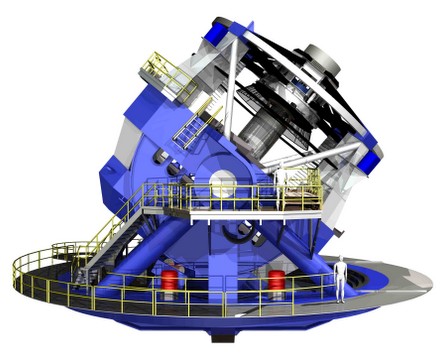
The LSST is an 8-meter telescope with a 3 degree field of view (consider that the moon is only half a degree in the sky). This design configuration allows the LSST to implement an observing program that detects near-Earth objects which are small and faint in exposures of 10 or 20 seconds, and it allows images to be stacked for deep and wide imaging for star and galaxy surveys. The science mission drivers of LSST include the nature of dark energy, the solar system, optical transients, and galactic structure. It is the LSST technology and the rate at which it will produce data that makes it so remarkable. The LSST camera is 3200 Megapixels (it is a giant array of 189 CCD chips) and will create 400,000 sixteen Megapixel images per night (resulting in about 30 TB) for a total of 60 PB of raw data over 10 years. The total data volume after processing will be over 100 PB requiring 250 TFlops of computing power for processing. LSST will be wide, fast, and deep. It should be ready for first light by 2014.

The TMT is another extremely large ground based telescope. Its design calls for a collecting area that is thirty meters or about 100 feet in diameter. In order to better explore the early universe it will be sensitive to light in the optical near infrared. Relative to the Hubble the TMT will have 144 times more collecting area and a factor of 10 better spatial resolution in the near-infrared. The TMT will have a primary mirror composed of 492 segments with a rotating tertiary mirror (as seen in the above image, a Ritchey-Chretien telescope) in order to direct light onto multiple instruments and it will of course use adaptive optics to correct for turbulence in earth's atmosphere. The TMT will implement a scaled of version of the segmented mirror technology of the Keck telescopes at a size which will produce significant science at a reasonable cost.

The GMT differentiates itself from the other giant ground based telescopes on this list in that its primary mirror will not be segmented in the standard manner, but will instead consist of seven monolithic 8.4 m mirrors. Because six of the mirrors are off-axis (they don't focus light to a point directly above them, but rather to a point off to their side; see image above) they present a unique engineering challenge that will synthesize a telescope with a resolving power of a single 24.5 m mirror. Currently the first mirror has been cast at the Steward Observatory Mirror Lab as a proof of concept that an acceptably accurate shape can be achieved.

It is of note that there is an over arching principle of segmentation present in all of these observatories; these telescopes use multiple almost identical components working in unison in order to gather signal. LISA, the SKA, TPF, and ALMA use interferometry or correlation to observe. The EELT, TMT, JWST, use segmented primary mirrors. GMT uses several identical mirrors to simulate one primary mirror. LSST uses a massive array of CCD detectors. Modern technology and the economic/complexity benefits of reproducible industrial construction make this possible, but it takes modern computing to gather the data from the individual receiving elements and produce coherent observations and science.
1. Laser Interferometer Space Antenna
2. Terrestrial Planet Finder
3. James Webb Space Telescope
4. Overwhelmingly Large Telescope
5. The Square Kilometer Array
The SKA will be a radio telescope with a million kilometers of collecting area. It will be the largest telescope ever created and perhaps the most expensive at 1.5 billion Euro. The SKA will probe the gaseous component of the early Universe with sensitivity 50 times greater than the Very Large Array. This sensitivity and a wide field of view will also allowing the SKA to probe general relativity by monitoring the timing of a network of pulsars. Like the VLA the SKA will be an interferometric array consisting individual antenna stations working together to synthesize an aperture with a diameter up to several thousand kilometers. Many things about the final design for the SKA are uncertain, in fact factions within astronomy have threatened to doom the entire project. The disagreements stem from different opinions on what the primary scientific objectives should be for the project. Currently it is planned that approximately 50% of the collecting area would be contained in a dense central array of 5 km in diameter to provide high brightness sensitivity at arc-second scale resolution for studies of faint spectral lines from structures in the early universe. Another 25% of the collecting area would be located within a diameter of 150 km; the image above shows a possible layout for the array with arms in a spiral pattern with a diamter of 150 km. The remainng 25% of the collecting area would be at baselines of 3000 km or greater. The distribution of antennas directly impacts what kind of science can be accomplished. The video below shows a possible layout for the SKA in dramatic fashion.
6. European Extremely Large Telescope
7. Large Synoptic Survey Telescope
8. Thirty Meter Telescope
9. Giant Magellan Telescope
10. Atacma Large Submillimeter Array
ALMA is probably the most practical observatory on this list and it is almost already completed (located in the Atacama desert), whereas many of the other observatories on this list are only the twinkle in astronomer's eyes. It is currently under construction in the thin (altitude of 5,000 m or 16,000 feet), dry air, of northern Chile. ALMA is not actually a single telescope, but an array of 50 (this number may change and has already been reduced once) antennae working in unison. It merits a place on this list because it will revolutionize astronomy by providing a senstive eye on mm wavelength light where early universe star/planet formation can be viewed best. Each of its 12 m antennas will observe in bands ranging fom 30 Ghz to 1 Thz and the array will have specialized telescope transporters which will enable baselines ranging from 150 m to 16 km. ALMA is only practical in respect to the grandiose telescopes on this list; it the the most ambitious ground-based telescope ever built and costs in excess of one billion US dollars.
The future of great astronomical observatories
This list is merely my musings on astronomical observatories. There are more productive observatories that have already built, or will be built, but these are the most exciting in my humble opinion. This list does not include even more speculative projects such as plans for a lunar radio telescope or an extremely sensitive and larger LISA. There are other planned observatories not mentioned, like IXO, that just didn't make the list.It is of note that there is an over arching principle of segmentation present in all of these observatories; these telescopes use multiple almost identical components working in unison in order to gather signal. LISA, the SKA, TPF, and ALMA use interferometry or correlation to observe. The EELT, TMT, JWST, use segmented primary mirrors. GMT uses several identical mirrors to simulate one primary mirror. LSST uses a massive array of CCD detectors. Modern technology and the economic/complexity benefits of reproducible industrial construction make this possible, but it takes modern computing to gather the data from the individual receiving elements and produce coherent observations and science.
Galaxy Zoo 2
 Galaxy Zoo is the worlds largest astronomy collaboration with over a hundred thousand collaborators. I mentioned Galaxy Zoo some time ago, but since then they have doubled the number of papers published from their collaboration and launched Galaxy Zoo 2. I want to discuss the impetus, implementation, and some of the results of the project here. It begins with the desire of astronomers to classify galaxies. And why would you want to classify galaxies? Well in order to learn about the cosmos, that is to learn about the properties of merging galaxies in the local universe, to learn about galaxy star formation, or to learn about the intrinsic spin of galaxies in our universe you may need to classify galaxies. The Galaxy Zoo collaboration has implemented the citizen science or crowd sourcing model in order to classify the million or so images of galaxies taken by robotic telescopes (like the Sloan Digital Sky Survey, SDSS, which produces images just like those seen here). Many years ago astronomers only had to inspect astronomical images by eye from photographic plates. The digital revolution has brought computers to bear on the problem as astronomers have implemented machine learning techniques such as neural networks in order to identify spiral from elliptical galaxies, but approaches like nueral networks are still limited by their training set size and are prone to errors. So as robotic survey telescopes have allowed us to gather a fantastic amounts of data technology has not been so successful at making sense of that data.
There have been several successful models for citizen science at home such Seti at Home and Folding at Home, but the most powerful computational device most people have at home is their own mind. The wisdom of crowds had already come to bear on one astronomical project, Stardust at Home, so galaxy classification was a natural application for citizen science. The Galaxy Zoo team had a simple approach to galaxy classification they implemented in Galaxy Zoo 1. They offer the user a single image, like those seen above, of a galaxy and 6 buttons:

I want to contribute to science
The Cosmos isn't strange people are strange
All those good willed people, what could possibly go wrong? The Galaxy Zoo published a paper on the Chiral correlation function of galaxy spins, that is they investigate if spiral galaxies have a tendency to spin clockwise or counterclockwise, and they discovered more about people than galaxies. If galaxies had a spin tendency it would quite simply undermine physics because chirality is a fundamental property of particles and cosmology. Indeed they found a tendency for galaxies to spin counterclockwise, but when they began to display the mirrored images of the galaxies (expecting to receive more clockwise responses this time) they found the users behavior to be inconsistent. This indicates that either people are strange or the user interface of Galaxy Zoo is strange. They sum up the results in their abstract:After establishing and correcting for a certain level of bias in our handedness results we find the winding sense of the galaxies to be consistent with statistical isotropy. In particular we find no significant dipole signal, and thus no evidence for overall preferred handedness of the Universe.This may seem like an obvious result because it is intuitively correct, but it is important to verify observationally what seems intuitively correct and further previous studies had found evidence for non statistical isotropy.
Hanny's Voorwerp
 The unique discovery of Hanny's Voorwerp was made possible only by the citizen scientists of the project. Hanny's Voorwerp is a green amoeba like blob next to a spiral galaxy that was discovered by a galaxy zoo volunteer, Hanny van Arkel, and hence the name of the object. It appears green in some optical images because of bright emission lines that dominate in the SDDS g band. Spectral analyis has shown that it is a highly ionized region leading to the hypothesis that it is the result of a powerful transient outburst because whatever energized the blob is now gone. Researchers hypothesize that Hanny's Voorwerp is a quasar light echo:
Hanny’s Voorwerp, is bright in the SDSS g band due to unusually strong [OIII] 4959, 5007 emission lines. We present the results of the first targeted observations of the object in the optical, UV and X-ray, which show that the object contains highly ionized gas. Although the line ratios are similar to extended emission-line regions near luminous AGN, the source of this ionization is not apparent. The emission-line properties, and lack of x-ray emission from IC 2497, suggest either a highly obscured AGN with a novel geometry arranged to allow photoionization of the object but not the galaxy’s own circumnuclear gas, or, as we argue, the first detection of a quasar light echo. In this case, either the luminosity of the central source has decreased dramatically or else the obscuration in the system has increased within 105 years. This object may thus represent the first direct probe of quasar history on these timescales.
Galaxy Zoo 2: Mergers
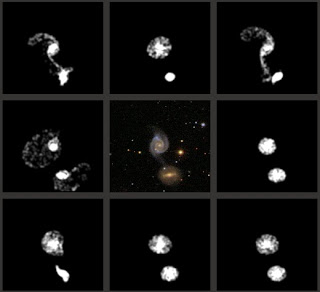 The result of users classifying galaxies as mergers were 3000 prime candidates with which they wanted to compare to simulations. The goal of Galaxy Zoo 2 is to understand cosmic mergers. They use the crowd source model again because this allows exploring the entire parameter space quickly whereas a machine may often find a local solution, but would be limited in knowledge of unique solutions. Galaxy Zoo 2 presents you, the user, with a 3x3 grid of galaxies. At the center is a real image of a galaxy and surrounding it are 8 simulated galaxies. You must select which simulations match the real image best. If you don't like any of your options you can click a button at the top and you get a slot machine effect of 8 new galaxies. It is very satisfying to demand random sets of galaxies and wait for a winner that matches what you are looking for. I found myself looking at upwards of 500 galaxies for each galaxy merger I classified which sounds absurd until you try it and see how easy it is. After selecting a few galaxies you can fine tune your selected simulations within parameter space and then select your final best simulation. The entire application runs the simluations locally on the user's machine in Java so the Zoo leverages everything a user has to offer from their computer's CPU to their brain.
Science Zoo
There are more Zoos in development. Moon Zoo is coming soon which will be like Galaxy Zoo for classifying features on the lunar surface using high resolution images from the Lunar Reconnaissance Orbiter Camera. Other fields will also be using the Zoo model, but surely astronomy offers the most exciting and beautiful possibilities. Astronomy is facing a flood of data soon with next generation projects like the Large Synoptic Telescope coming online in a few years. LSST will produce some 30 terabytes of data a night. This may be such a large amount of data that volunteers wont be able to sift through it all. In this case volunteers could provide the training sets for machine learning systems that could accurately classify data. The Zoo model will continue because people want to contribute to science.References:
Anze Slosar, Kate Land, Steven Bamford, Chris Lintott, Dan Andreescu, Phil Murray, Robert Nichol, M. Jordan Raddick, Kevin Schawinski, Alex Szalay, Daniel Thomas, & Jan Vandenberg (2008). Galaxy Zoo: Chiral correlation function of galaxy spins MNRAS, 392 (1225) arXiv: 0809.0717v2
Chris Lintott, Kevin Schawinski, William Keel, Hanny van Arkel, Nicola Bennert, Edward Edmondson, Daniel Thomas, Daniel Smith, Peter Herbert, Matt Jarvis, Shanil Virani, Dan Andreescu, Steven Bamford, Kate Land, Phil Murray, Robert Nichol, Jordan Raddick, Anze Slosar, Alex Szalay, & Jan Vandenberg (2009). Galaxy Zoo : 'Hanny's Voorwerp', a quasar light echo? MNRAS arXiv: 0906.5304v1
Leonids
The Leonid meteor shower peaks tonight in the early hours of this Tuesday morning. The Leonids result from the earth's passage through debris left from comet Temple-Tuttle. I would go into all this further, but the forecast for Seattle is rainy and cloudy for the next week, but perhaps you will have more luck observing the Leonids. It should be a sight, around 500 meteors per hour, but it wont compare to the 1833 Leonid meteor shower:


One estimate was that over 240,000 meteors fell during that period, so many meteors in the sky at a time that many people were woken from their beds and stared at the sky in panic, believing the sky to be on fire. Many feared that it was the end of the world and dreaded what they would see at daybreak.Update: I should clarify that when I refer to debris left by Temple-Tuttle I am referring to debris left by Temple-Tuttle's previous close passages to the sun which may have occurred long ago. For example the most recent close passage of Temple-Tuttle to the sun was 1998, but most of the meteorites seen in this shower were left by debris trails originating from passages in 1466 and 1533. And finally here is a cool meteor detector that works by detecting reflected radio waves from the ionized trails created by particles of rock entering the upper atmosphere.
Subscribe to:
Posts (Atom)