Field of Science

Showing posts with label NASA. Show all posts

The Hubble Extreme Deep Field

Almost a decade ago when astronomers pointed the Hubble Space Telescope at an apparently featureless patch of the sky they were rewarded with a spectacular image. The was the Hubble Ultra Deep Field. The image allowed us to see that galaxies were forming as early as just a billion years after the Big Bang. The farther from Earth we look the farther back in time we see; starlight from those distant galaxies is just arriving at earth now. Now we have glimpsed even further with the Hubble Extreme Deep Field. This new image was created by aggregating 10 years of Hubble images taken centered at the same location of the original Ultra Deep Field. In addition to staking old images additional new images were included which had been taken with infrared cameras installed during the 2008 Hubble Space servicing missions. Infrared images offer important additional data for distant galaxies because the light from such distant objects has been stretched to longer wavelengths as it has journeyed across the universe. Here is the Hubble Extreme Deep Field:
The new Hubble Extreme Deep Field


This is the deepest image of the sky ever seen. It allows us to explore the faintest galaxies ever as far back as a time just half a billion years after the Big Bang. Soon though we will have even deeper images. The James Web Space Telescope will be a 6.5 meter diameter(or 21 foot, so big that it will be a segmented mirror that will unfold in space) space telescope that will launch in 2018. It will see further. Here is a simulated image of what the James Web Space Telescope will see:
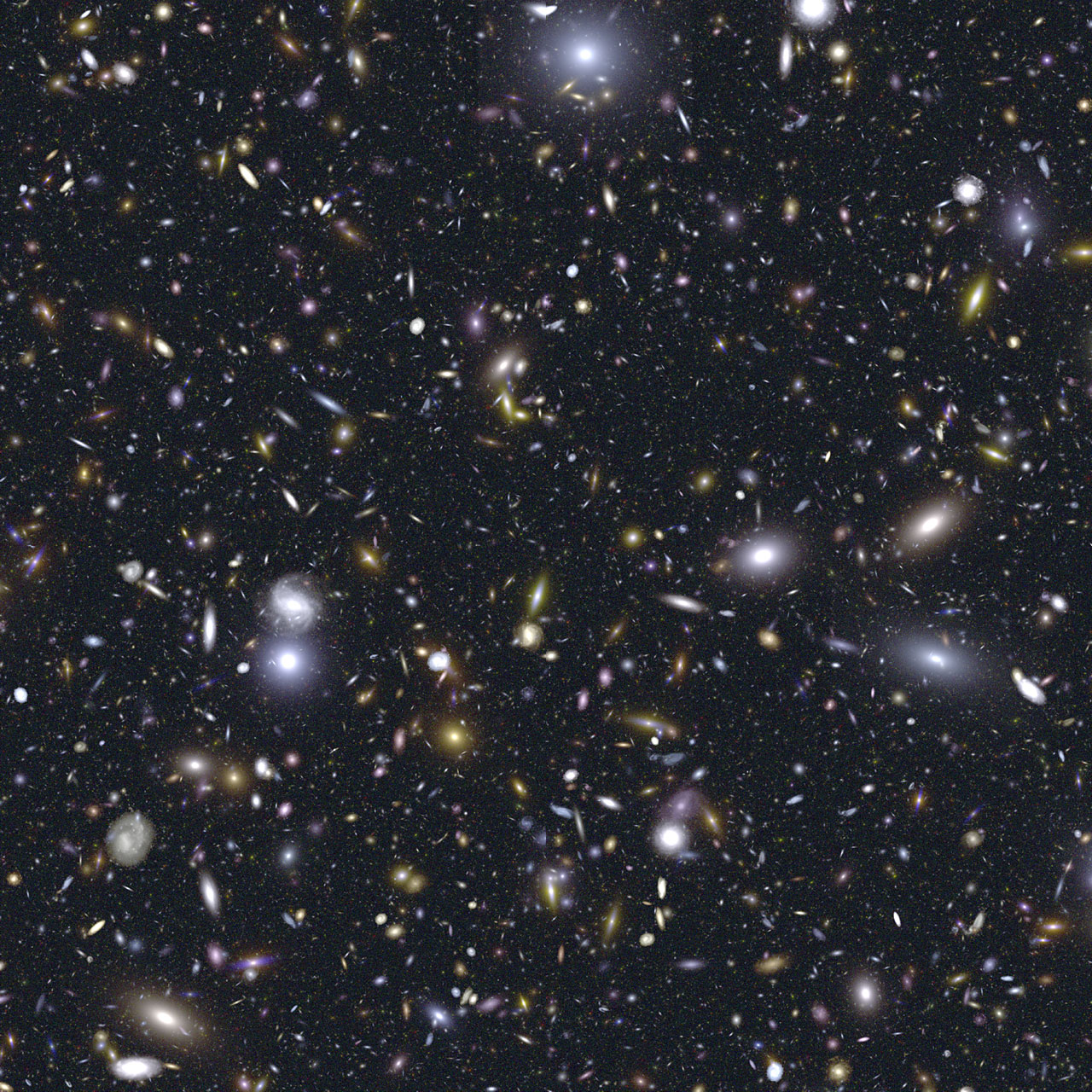
The James Web Space Telescope Simulated Deep Field Image
If you are intrigued by Hubble's deep images of the sky there is a Google Event webinar to discuss the latest findings. The public is invited. show up online and ask questions of the astronomers involved. It is at 1 p.m. Sept. 27 and can be joined either at HubbleSite’s Google Plus page or the HubbleSite YouTube Channel.
Mars Rover Curiosity


This animation depicts what will happen in August 2012 if all goes as planned for Curiosity, NASA's next Mars rover. This rover is much larger and and more competent than the previous rovers. It is about the size of a small car and has an entire suite of experiments on board. During entry it uses a series of thrusters to maneuver to the designated landing area. Once the ship has slowed down to Mach two (keep in mind that the atmospheric pressure on the surface of Mar's is of the order .05% that of Earth's) a parachute is deployed. As the vehicle slows the heat shield comes off and a radar detects how close the surface is approaching in order to slow for a smooth landing. The last daring step is a so called 'sky crane' which lowers the rover with a long cable from the rocket thrusted ship above. Eventually Curiosity will begin roving, but it won't be limited to roving only during the day by solar panels as the previous rovers were. The large tilted box on the back of the rover contains 4.8 kg of plutonium dioxide which emits heat serving as the power source of the rover. The power should keep flowing for much longer than the minimum specked science mission of two Earth years. The rover will seek out rough rocks such as ancient Martian riverbeds or canyons where evidence of early environments on Mars can be found. The ability to navigate to these areas is an important science requirement for the rover and is one of the reasons for the rover's large size and nuclear battery which should allow it to travel at least 20 kilometers during its lifetime. Geologists and astrobiologists also want to know if certain conditions such as those necessary for organic molecules are present. In the video a laser and a drill are shown performing experiments. The laser is ChemCam which will project onto hard to reach rocks and detect the reflected light in order to discern the chemical composition of rocks. The drill is about a centimeter in diameter and will extract the dust from the holes it creates to run experiments in mineralogy (the laser device inside the rover shown in the video) or detecting organic molecules. All of these experiments aim to answer the question, could Mars have had an environment capable of supporting life at one time?

If the sky crane works we may soon know the answer to this question. Curiosity has a launch window from November 25 to December 18, 2011 from Kennedy Space Center in Florida. And in other news NASA's James Webb Space Telescope is being threatened with the axe in budget bill in the U.S. House of Representatives today. NASA will never run out of adversaries pulling it down: Gravity and the budget.

Visions of space flight

We won't be getting out of the hood anytime soon.

It's the planetary neighborhood I am talking about here. The stars may beckon but it's an interplanetary, rather than interstellar culture that we will likely inhabit for hundreds if not thousands of years in the future. Baring the miracle of a "warp drive," the stars are simply too far away in space and time (via the theory of relativity) for a true interstellar culture to develop. The solar system with its 8 planets, 166 moons and countless asteroids and comets is likely to be our home -- our only home -- for a long, long time.

We should consider the implications of these limitations on coherent human cultures in space because today the president unveils his new plans for NASA.

The Obama administration made headlines recently when it reversed direction on NASA's Bush-era push to return to the Moon. The new plan turns to hungry young private space ventures to give us access to Near Earth Orbit. Stepping back on any present space mission the plan calls for development of the next generation of space technologies for the next generation of space exploration. But critics fault the Obama plan for its lack of any clear goals for these new technologies. Without a bold choice of destination -- Mars is the obvious choice) -- critics say the human space program will simply drift.
more by Adam Frank here. Also President Obama will announce plans for the future of Nasa at the Kennedy Space Center in Florida today.
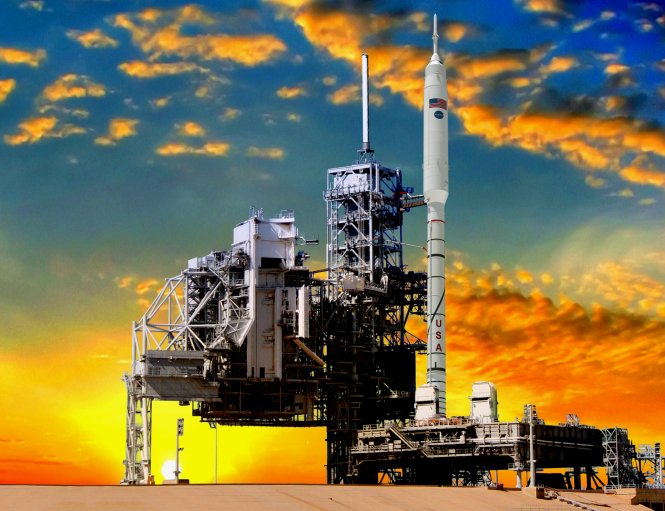
NASA Ares res I-X rocket

Hubble's New Look

A servicing mission was planned for the 19-year-old Hubble Space Telescope years ago, but after the instrument command and data handling module failed the repair mission was postponed so that an even more comprehensive repair mission could be undertaken. Three months ago the space shuttle Atlantis launched and successfully repaired the telescope. The instruments on the telescope which were repaired or replaced include the Wide Field Camera 3, the Advanced Camera for Surveys, the Cosmic Origins Spectrograph, and the Space Telescope imaging Spectrograph. So NASA is patting its back right now on a job well done and releasing an entire gallery of press images for the publicity, but there are real promises for science to come.

My favorite image is that of Planetary Nebula NGC 6302 (which could easily be called the Butterfly Nebula, but the name is taken), but the comparison of Stephan's Quintet taken by Hubble to the image I took using the Harlan J. Smith Telescope at the McDonald observatory is laughable.
butterfly nebula
quintet_hubble

Waiting is the hardest part

The New Horizons craft launching on the most powerful Atlas V rocket ever. Image by Ben Cooper

The New Horizons spacecraft took off in 2006 bound for Pluto. It took nine hours to make it past the moon. It wont arrive at Pluto until 2015. While we are waiting...

The Lunar Reconnaissance Orbiter recently arrived at the moon; it took five days. That is slow, but the good news is that soon I think we may have images of the Apollo moon landing sights. So have excuses ready moon conspiracy enthusiasts. In the mean time, keep waiting...