Field of Science

Showing posts with label astrophysics. Show all posts

The Hubble Extreme Deep Field

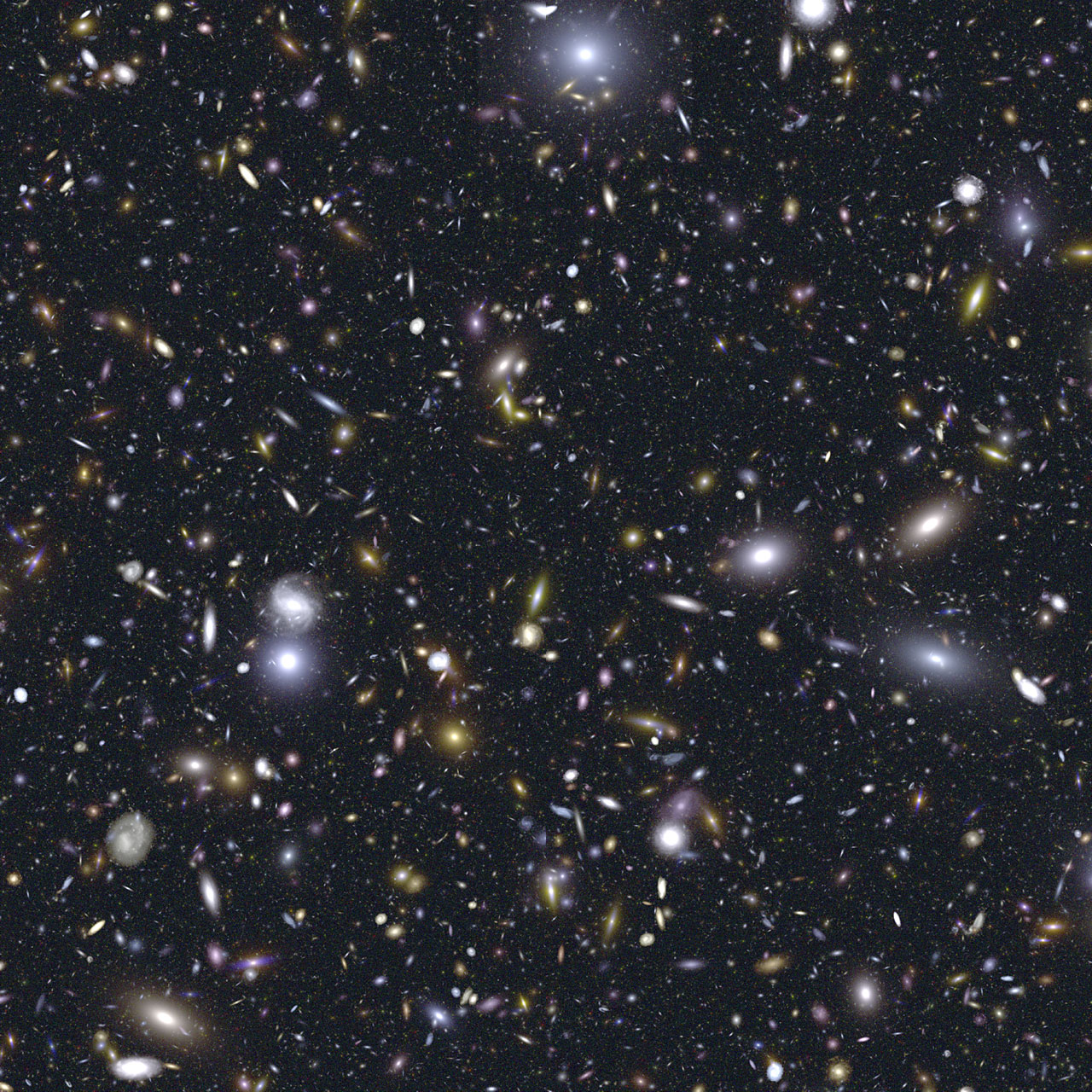
Almost a decade ago when astronomers pointed the Hubble Space Telescope at an apparently featureless patch of the sky they were rewarded with a spectacular image. The was the Hubble Ultra Deep Field. The image allowed us to see that galaxies were forming as early as just a billion years after the Big Bang. The farther from Earth we look the farther back in time we see; starlight from those distant galaxies is just arriving at earth now. Now we have glimpsed even further with the Hubble Extreme Deep Field. This new image was created by aggregating 10 years of Hubble images taken centered at the same location of the original Ultra Deep Field. In addition to staking old images additional new images were included which had been taken with infrared cameras installed during the 2008 Hubble Space servicing missions. Infrared images offer important additional data for distant galaxies because the light from such distant objects has been stretched to longer wavelengths as it has journeyed across the universe. Here is the Hubble Extreme Deep Field:
The new Hubble Extreme Deep Field


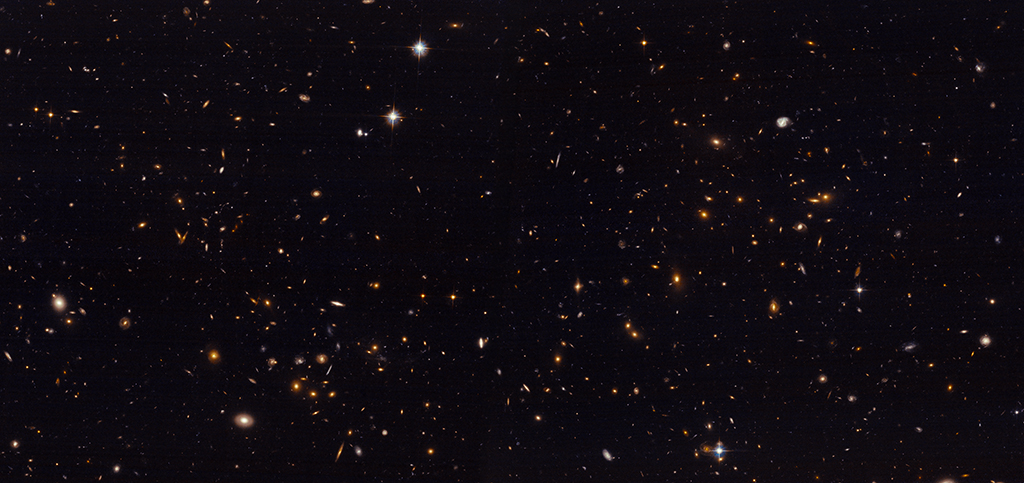
This is the deepest image of the sky ever seen. It allows us to explore the faintest galaxies ever as far back as a time just half a billion years after the Big Bang. Soon though we will have even deeper images. The James Web Space Telescope will be a 6.5 meter diameter(or 21 foot, so big that it will be a segmented mirror that will unfold in space) space telescope that will launch in 2018. It will see further. Here is a simulated image of what the James Web Space Telescope will see:
The James Web Space Telescope Simulated Deep Field Image
If you are intrigued by Hubble's deep images of the sky there is a Google Event webinar to discuss the latest findings. The public is invited. show up online and ask questions of the astronomers involved. It is at 1 p.m. Sept. 27 and can be joined either at HubbleSite’s Google Plus page or the HubbleSite YouTube Channel.

The Z Machine Makes Stars and Art

I met Don Winget years ago on a cloudy night in the control room of the Otto von Struve Telescope. His enthusiasm and excitement was overflowing. I could hardly see his face, lit eerily by red lights, but his words painted a picture of far away white dwarf stars. These stars are pulsating, cooling, and perhaps intertwined with mysterious undiscovered axion particles. He continues extraordinary pursuits. He is looking for white dwarfs on earth with the Z Machine. The Z Machine releases a powerful electrical discharge over a brief amount of time to create plasma, X-rays, shock waves, and an electromagnetic pulse. The Z Machine releases several times the combined energy output of all power plants on earth for a few brief nanoseconds with each shot. Usually it does nuclear weapons research, but this wonderful research aims to simulate aspects of white dwarf stars on earth and it is inspiring art.

Disassociate Galaxy Clusters

A dissociative galaxy cluster is a cluster of galaxies that just can't keep it together any longer. This may sound like an unnecessary anthropomorphication of galaxies, but it is actually a description of galaxy clusters which have collided and experienced stratification of their constituent parts. In the standard and successful model of cosmology the largest scale structures in the universe, like super clusters of thousands of galaxies, form via the merger of filamentary structures composed of smaller clusters of galaxies. Gravity keeps pulling clusters together along highways of galaxy clusters. Occasionally it is expected and observed that galaxy clusters meet each other head on in cosmic train wrecks moving at thousands of kilometers per second. These traumatic merging events scar the galaxy clusters for life. Their post traumatic stress afflictions include hot shocked X-ray gas and galaxies displaced from their gas halos. Lets consider the three main constituents of a galaxy cluster: stars, gas, and dark matter.
  • Clusters are made of aggregates of hundreds or thousands of galaxies and each galaxy is made of hundreds of billions of stars. The stars of the galaxy cluster are conspicuous in that they shine and are observable in pictures, but they account for only about 5% or less of the cluster's mass. The luminous stars of galaxies don't interact much during a collision with another cluster of galaxies and so they act like people in two crowds which are moving in opposite directions. Stars are part of the cosmic ghost train.
  • The gas in galaxy clusters accounts for about 10% of the regular (or baryonic) mass in clusters. Gas does interact during a collision. The gas clouds in colliding galaxy clusters slams together like two waves of water meeting and stalls out, but not without undergoing a process known as shock heating first which raises the gas temperature to millions of degrees.Gas is part of the cosmic train wreck.
  • The dark matter in galaxy clusters is the most dominant part of the cluster by mass making up about 90% the mass. Dark matter does not interact much. The dark matter halos travel right through each other like ghosts when two clusters collide. However, it is possible that the dark matter does interact slightly and dissociative collisions are a powerful tool in constraining this dark matter interaction. The dark matter halos of the colliding clusters should sail right past each other like two ghost trains, but if the trains slow down even in the slightest it may indicate something strange.
These so called dissociation mergers are difficult to observe and analyze. They require telescopes in space, follow up observations on the ground, observations in multiple wavelength regimes, and algorithms to predict the distribution of dark matter. So far there are six such dissociation mergers systems detected. You would think it would be obvious to spot some of the most massive structures in the universe smashing into each other, but spotting galaxy clusters is actually very difficult because of their great distance. Perhaps in an optical survey, like that in the image below taken by the Hubble Space telescope, over densities of galaxies are detected.

In practice many times it is easier to first identify galaxy clusters through their gas content because the gas content is more massive than the stellar component. Many new clusters are identified by observing the cluster gas's effect in the microwave regime or in the X-ray regime. In the image below taken by the the NASA Chandra X-ray observatory the hot intracluster gas is seen in pink. This image corresponds to exactly the same field of view on the sky as the optical image above.
It may dawn on you that by the very definition of dark matter there is no telescope which can observe it directly. The only in way in which dark matter interacts strongly is through gravity and thus that is how astronomers look for it. Through theoretical predictions and confirmed observations we know that gravity bends light and thus massive galaxy clusters will bend the light of even more distant galaxies. Thus through weak gravitational lensing the dark matter betrays its presence. A careful statistical analysis of galaxy shapes in the optical image above reveals that the galaxies which are confirmed not to be in the foreground cluster are slightly distorted in shape via the gravitational force of the dark matter which is in the foreground. A reconstruction of the total mass in the clusters is shown in the image below where the parts of the cluster which have the most mass are shown in blue. This image corresponds to exactly the same field of view on the sky as optical and X-ray images above.
Finally, a superposition of all the data allows us to glimpse at what a crisis this merging cluster is in. Note that the optical image remains in its original color, the gas is in pink, and the mass is in blue. The image below is known as the Musket Ball Cluster. The actual collision of galaxies occurred about 700 million years ago. We can rewind the collisions in our heads and envision that blue/optical cluster on the right of the image was once on the left and so the blue/optical cluster on the left of the image was once on the right; the clusters collided head on and the gas stopped dead at the center, but the galaxies and dark matter hardly stopped. There are several other images below of other dissociative cluster mergers with the same color scheme. Notice the different morphologies and distributions of mass, stars, and gas. The collisions are not always so straight forward.

Musket Ball Cluster. X-ray: NASA/CXC/UCDavis/W.Dawson et al; Optical: NASA/STScI/UCDavis/W.Dawson et al.
Train Wreck Cluster. X-ray: NASA/CXC/UVic./A.Mahdavi et al. Optical/Lensing: CFHT/UVic./A.Mahdavi et al.
Bullet Cluster. Credit: X-ray: NASA/CXC/CfA/M.Markevitch et al.;  Optical: NASA/STScI; Magellan/U.Arizona/D.Clowe et al.; Lensing Map:  NASA/STScI; ESO WFI; Magellan/U.Arizona/D.Clowe et al.
Bullet Cluster. Credit: X-ray: NASA/CXC/CfA/M.Markevitch et al.; Optical: NASA/STScI; Magellan/U.Arizona/D.Clowe et al.; Lensing Map: NASA/STScI; ESO WFI; Magellan/U.Arizona/D.Clowe et al.
The awesome thing about these cosmic mergers is how they can constrain the dark matter self-interaction cross-section. That is, exactly who much does dark matter interact with itself? The interpretation of these collisions is not always simple such as in the Train Wreck Cluster (seen above) where there seems to be an extra dark matter core not associated with any bright galaxy at the center of the image, but nonetheless these mergers can be thought of as astrophysical laboratories of dark matter. It would be very interesting to discover that dark matter self-interacts at all, however dissociate clusters will only be one piece of the extraordinary evidence necessary to make that claim.

ResearchBlogging.org

Dawson, W., Wittman, D., Jee, M., Gee, P., Hughes, J., Tyson, J., Schmidt, S., Thorman, P., Bradač, M., Miyazaki, S., Lemaux, B., Utsumi, Y., & Margoniner, V. (2012). DISCOVERY OF A DISSOCIATIVE GALAXY CLUSTER MERGER WITH LARGE PHYSICAL SEPARATION The Astrophysical Journal, 747 (2) DOI: 10.1088/2041-8205/747/2/L42

Jee, M., Mahdavi, A., Hoekstra, H., Babul, A., Dalcanton, J., Carroll, P., & Capak, P. (2012). A STUDY OF THE DARK CORE IN A520: THE MYSTERY DEEPENS The Astrophysical Journal, 747 (2) DOI: 10.1088/0004-637X/747/2/96

Markevitch, M., Gonzalez, A., Clowe, D., Vikhlinin, A., Forman, W., Jones, C., Murray, S., & Tucker, W. (2004). Direct Constraints on the Dark Matter Self‐Interaction Cross Section from the Merging Galaxy Cluster 1E 0657−56 The Astrophysical Journal, 606 (2), 819-824 DOI: 10.1086/383178

The Most Astounding Fact

We are part of this Universe, but perhaps more important is that the Universe is in us. You may have even heard it stated as a fact that we are made of stardust. What does this mean? Well in the early early Universe, a few minutes after the big bang, the Universe consisted of only hydrogen, helium, and a smidgen of lithium. There was no oxygen, carbon, or any other heavy elements. Complex life had to wait. It took hundreds of thousands of years for stars to form. Eventually in the cores of massive stars the atoms of which we exist were forged under massive pressure and heat through the process of fusion—the merging of lighter atoms to create heavier atoms. The key to unlocking those delicious elements was fantastic stellar explosions. We could say the stars died for us.

Humans are at least 60% water by mass (this is the most uncertain number here because after you drink a few beers this number quickly starts to change). Water is by mass is 11% hydrogen. Thus the mass of hydrogen in our body from water is at least 7% though of course there is lots of other hydrogen in our body from other molecules (lipids, amino acids, and so on). A better estimate is that we are 10% hydrogen by mass (if we do our accounting by number of atoms in the body we are 63% hydrogen atoms). Ultimately every atom in us is that is not hydrogen was forged in stars, and so 90% of the mass in our bodies is stardust.

Superluminal claims require super evidence

Neutrinos, those mercurial smidgens of the particle world, travel faster than the speed of light. That's the claim the OPERA collaboration makes in a paper subtly titled: Measurement of the neutrino velocity with the OPERA detector in the CNGS beam. This is a big claim that could have implications for particle physics and time travel. It has made the news, news, news, news, but what does it all mean? Lets talk about neutrinos.
faster than the speed of light
First, let me say that if neutrinos do travel faster than the speed of light then physicists have a lot of explaining to do. The repercussions of faster that light travel for any particle (also known as superluminal travel) would be revolutionary. So revolutionary that most physicists I spoke to this past week at a conference did not take the news too seriously: it was too extraordinary to comment on without further thought and details. The OPERA collaboration is actually very brave for putting this paper out there (i.e. on the ArXiV) and asking for outside analysis. They don't even pretend to begin to consider the ramifications. The last line of the paper sums up their position:
We deliberately do not attempt any theoretical or phenomenological interpretation of the results.
So let me ignore the wild theoretical implications and discussions of tachyons and just talk about the experiment and an astrophysical constraint on the velocity of neutrinos.

Why are physicists so confident that neutrinos travel at the speed of light? Well, start with the fact that every piece of credible data ever taken has never seen anything—be it particle or information—travel faster than the speed of light. Given previous observations it is hard to understand how neutrinos could be any different. Of course neutrinos are very difficult to measure because they interact very weakly with regular matter. Consider that 60 billion neutrinos generated from the core of the sun pass through your pinky each second and none of them interact with you (nor do they interact with the Earth, they are passing through you day and night).

The creation and detection of neutrinos is complicated. The process begins for the OPERA experiment over at CERN where the Super Proton Synchrotron (SPS) creates high energy (400 GeV/c) protons that collide with a graphite target producing pions and kaons which decay into muons and muon neutrinos. The neutrinos coming out of SPS are almost pure muon type neutrinos with an average energy of 17 GeV. The neutrinos travel through the solid Earth in a straight path unimpeded into a cavern below a mountain, Gran Sasso, in Italy. The OPERA neutrino experiment was designed to look for the direct appearance of muon to tau neutrinos (νμ → ντ), but their anomalous findings on the velocity of neutrinos is much more interesting.

The OPERA experiment found that the velocity of neutrinos was about 0.00248% faster than the speed of light. This measurement was made by precisely measuring the distance traveled by neutrinos and the time of travel. The OPERA collaboration did a lot of work to measure both parameters precisely. They found this velocity by measuring that the time of arrival of neutrinos at their detector by using atomic clocks. Their measurement was precise to a few nanoseconds. Wow, that is quick. Light only travels about a foot in a single nanosecond.

In order to measure the distance between CERN and Gran Sasso the OPERA team used very precise GPS systems. For example, they noticed a 2009 earthquake in that area produced a sudden displacement of 7 centimeters. So the exact distance the neutrinos traveled was 730534.61±.20 meters (or about 2.44 light milliseconds), however some have suggested that the GPS based positioning they used has errors introduced by atmospheric refraction. Intriguing possibility.

In order to measure the time, what OPERA calls the time of flight measurement, they used atomic cesium clocks. But the 'time' cannot be precisely measured at the single interaction level since the protons from the SPS source have a 10.5 microsecond extraction window. They had to look at time distributions where the most likely time for a burst of neutrinos to be created was inferred to higher precision. Additionally, the actual moment where the meson produces a neutrino in the decay tunnel is unknown, but it introduces negligible inaccuracy in the time of flight measurement. So, these distance and time measurements are really important, but really subtle. I recommend reading the paper if you are a glutton for punishment.
There is a very interesting constraint on the speed of neutrinos that comes from astronomy. It was the neutrinos and photons released from the death of a star. Supernova 1987A (SN 1987A) exploded 168,000 years ago when fusion in the core of an old star ceased and the weight of the outer layers of the stars caused the core to collapse. The protons in the atoms of the core of the star merged with the electrons present and converted themselves into neutrinos and electron neutrinos. A mega amount of electron neutrinos, about 1058, were generated and they began their epic journey to Earth. Some of these neutrinos arrived on Earth one morning in February of 1987 in a burst lasting less than 13 seconds. Of those many neutrinos two dozen interacted with detectors on Earth.
Astronomers observed light from SN 1987A just three hours after the neutrinos arrived. Just such a delay is expected as the fireball of the supernova had to have some time to expand and become transparent to photons, whereas neutrinos could escape much sooner. The explosion occurred at a known distant out in the Large Magellenic Cloud. This distant explosion created photons and neutrinos in a timed race to the Earth. With the these measurements in hand (the distance to the supernova and the time of arrival of the photons compared to neutrinos) we can determine the speed of neutrinos from SN1987A.

The accuracy and precision of measurements from SN 1987A are actually much greater than measurements taken at Gran Sasso despite the three hour time window difference between neutrino and photon travel. It comes down to the fact that the relative distance between Earth and SN 1987A is about 1016 times larger than the distance between CERN and Gran Sasso. This means that time measurements from SN 1987A can be extremely imprecise and still be much more precise than the OPERA measurements.

If the neutrinos from supernova 1987A had been traveling as fast as the neutrinos detected at Gran Sasso they would have arrived about four years sooner than the light from SN 1987A.

This supernova constraint on the velocity of neutrinos is very nice, but it doesn't answer every question because the comparison may not be apples to apples. The OPERA neutrinos are tau type, not electron type. And they are traveling through the Earth, not empty space. And they were much higher energy. The neutrinos from SN 1987A were only about 10 MeV, about one hundred times lower energy than the neutrinos in this study. Some may argue that higher energy neutrinos travel faster than lower energy neutrinos. However, a velocity-energy dependence should have stretched out the 13 second arrival time of neutrinos. Further, part of the OPERA collaborations analysis involved splitting the data into two bins with mean energies of 13.9 and 42.9 GeV; a comparison between the two bins indicated no energy dependence on velocity. Thus, while it may still be true that GeV neutrinos move faster than MeV neutrinos, the theoretical wiggle room is shrinking.

This experiment may be a signal of new physics or a case of systematic errors. Yet, even physicists who have developed theories that allow for superluminal velocities are doubtful so I would not bet on proof of hidden extra dimensions or time travel to come from this experiment. Much more extraordinary evidence is necessary to confirm such an extraordinary claim as breaking the speed limit of our Universe.

A Primer on Radio Astronomy from Australia

Murchison, AUSTRALIA - I am seemingly in the middle of nowhere, and yet I do not doubt that the Murchison Widefield Array (MWA) is at the center of the Universe. Australia is beautiful out here. The area is surprisingly green because of recent rains and the sunsets are a mix of pastel reds and blues. At night the sky is filled with shooting stars and the Milky Way cuts through the sky so bright that dust lanes and nebula, like the Cosack Nebula, seem to have been painted in black on top of the band of stars in our galactic plane. The radio sky as the MWA sees it would look very different. In order to grasp what the MWA does we will have to first explore what radio astronomy and interferometry is.
Radio astronomy is the alchemy of astronomy; shrouded by secrecy and perpeputated by false claims of being able to transmute raw data into gold. There was a time when radio astronomy was really hard, and that time is always, but technology is making new things possible. The Murchison Wide Field array that I am working on here in the outback is only one of the many next generation low frequency radio telescopes coming online or planned such as LOFAR, LWA, and others.

Modern astrophysicists can observe the Universe using light, particles, or (hopefully) gravity waves. Classically astronomers observed light through a telescope, but today we don't look through telescopes and we don't just vaguely see light; we precisley count photons from every part of the electromagnetic spectrum. Light is made of photons, but a photon can be thought of as a wave and a particle. Indeed, a photon is a wave and a particle at once. Longer wavelength photons have lower energy and lower frequency compared to short wavelength photons. In the radio regime of the electromagnetic spectrum the particle view of light is not very helpful, in fact many radio astronomers and engineers actually neglect to ever think about about photons and only consider wavelength or frequency. Radio astronomers view light as an electromagnetic waves impinging upon our patient antennas like waves on the beach.

Long wavelength photons come from some very interesting sources in the sky. Radio waves certainly come from the Sun, because the Sun emits some energy at just about every wavelength. Radio waves are also emitted by galaxies, pulsars, and neutral hydrogen (through the 21cm line). However, the wavelength of photons is not constant: it increases as the photons traverse the Universe due to cosmological redshift such that more distant objects are seen at progressively larger and larger wavelengths consider to more and more distant objects. In my research I am particularly interested in studying the distribution of matter in the Universe at the largest of scales and at the earliest epochs when there was an abundance of neutral hydrogen. Radio waves are perfect for studying these phenomena, but it is difficult to build a telescope that can see a widefield of view, can see a wide range of frequencies at once, and has good resolution.

As radio waves arrive at our antennas we can either immediately detect them or we can reflect them to a receiver. The Arecibo telescope in Puerto Rico is reflector type telescope, as are the antennas in the Very Large Array. The antenna on your car directly receives the electromagnetic wave because it induces an oscillation in the field inside the metal of the receiving antenna and then you can hook up a transistor, and a speaker - that is a radio like in your car.

The problem with detecting radio wavelengths is that they are not easy to catch and they act way too much like a wave. Waves have strange properties such as interference and diffraction. It can be shown from wave theory that a telescope of diameter D receiving light of wavelength λ has a fundamental angular resolution limit proportional to λ/D. For example the colossal 300 meter diameter Arecibo telescope can only resolve objects down to 3.5 arc minutes (or about half a degree) at a wavelength of .2 meters (or 1.4 Ghz) and that resolving power will only get worse as we move to longer wavelengths. So if you want to see small things in the sky you had better have a huge radio telescope. But wait, there is more. The field of view that a radio telescope can see is also proportional to λ/D. For example at a wavelength of .2 meters it would take Arecibo about 10 separate observations to make an image of the full moon which is about half a degree in the sky.

So if you want to look at the radio sky at high resolution you had better use a huge telescope, but if you want to look at the radio sky in huge swaths, like in survey, you had better use a small telescope. It would seem to be that we are at an impasse to find a decent resolution and decent field of view radio telescope. Enter radio interferometry.
The diagram above is a pictorial representation of the principles of radio interferometry. In box A we have a big radio dish like Arecibo and a radio wave incident upon it. The radio waves hit the dish and reflect to a receiver (not shown in the cartoon) at the focal point. In box B we have chopped our radio telescope into little bits and so while the dish would behave as a smaller dish it would operate via the same principles. Each part reflects the radio waves incident upon it to a single focal point. In box C we have moved the pieces of the dish into several independent dishes and wired them together. Each dish now has its own focus, field of view, and angular resolution limit (this setup is similar to the VLA). Finally, in box D we have gotten rid of even the dishes. Instead of turning the dish to point to a particular object we use the time delay due to the finite speed of light to 'point' the antennas. An object in the direction θ in the sky sends out radio waves that arrive at the antenna tilted. So to catch the same the wave on the antenna on the left and right spanning the arrow in the diagram we use the time delay τ. In this setup there is no pointing the dish there is only an electronic control of simple antenna elements; this is how the MWA works.

The most difficult part of pulling the telescope apart is reassembling the signals coherently. In the diagram this is the function of the box with the circle and x. In radio astronomy that box would be a complex supercomputer and is called a correlator. The computing power needed to operate a correlator scales as the number of antenna elements squared thus it really takes a powerful computer to operate an array with many antennas. The idea is that the signal from each pair of antennas is correlated together to determine the pattern of incident radio waves. This is the basic idea of radio interferometry; the beautiful thing is that you get the large field of view that each antenna would see and the excellent resolution that the large diameter of antennas provide. The description I have given here of radio interferometry is wildly simplified.
So here I am in a shed in Murchison. A generator is humming along and powering all our computers and equipment and importantly the air conditioner keeping me cool. Flies and strange insects pester us relentlessly the moment I step outside. There are a lot of great things about Australia, but it is also a very harsh environment out here. The array has not been cooperating perfectly: there are amplifiers, attenuators, analog to digital converters, correlators, and more that all have to act in symphony for the system to work. The last few days we have solved as many problems as we have created. The radio sky sends its nite rote down upon us and waits for us to complete the instrument.

Naming the Unknown #1

This post was chosen as an Editor's Selection for ResearchBlogging.orgNaming the Unknown is a new series where I highlight interesting papers in astrophysics. Research papers which I find compelling or of general interest will be spotlighted. The title 'Naming the Unknown' comes from accusation that cosmologists have simply begun to come up with names for those things which are not understood; yet, I do not think that anyone would claim that science is at times anything other than coming up with names for the unknown. Scientists define the unknown in terms of the other unknowns and as time passes the first unknown has a context, but ultimately all we have a is a self referential group of symbols that isn't necessarily any more logically sound than where we begun. The relation of fundamental particles (μ+ compared to a π+, obvious relation no?), the definition words in a dictionary, and all information suffers from the flaw of self referential formalisms. I digress. On to the first paper.
* * *

Fermi Bubbles: Giant, Multibillion-Year-Old Reservoirs of Galactic Center Cosmic Rays. Roland M. Crocker , and Felix Aharonian. DOI: 10.1103/PhysRevLett.106.101102


The Fermi telescope recently discovered evidence for giant gamma ray lobes associated with our Milky Way (you should see my first posted about the Fermi Bubbles here if you are not familiar with this remarkable discovery). The original paper on the Fermi bubbles was an observation description of the evidence for the bubbles; it was found that there are lobes extending above and below the plane of the Milky Way symmetrically with an extent of ~10 kpc and a unique energy spectrum. Several possible formation scenarios for bubbles were put forward, but no single theory was advanced a definitive. In a paper published this month in Physical Review Letters Roland Crocker and Felix Aharonian conclude that the bubbles are naturally explained due to a population of relic cosmic ray protons and heavy ions injected into the bubbles by high density star formation in the galactic center.
There are two general lines of thought as to the source of the bubbles. In one scenario the black hole at the center of our milky way is somehow responsible for the gamma ray lobes. The black hole paradigm can further be broken down into two sub-categories: tidal disruption of a star and active galactic nuclei.
  • The tidal disruption of a star occurs when the super massive black hole at the center of our Milky Way, Sagatarius A*, disrupts, or basically eats a wandering star. The tidal disruption of stars by black holes is viable and certainly does occur (see work by Guillochon et al. 2009) with the release of energy, hot plasma, wind, and shocks which could heat up the halo and produces thermal x-rays (see ongoing work by Cheng et al. 2011, unpublished). However, this explanation for the Fermi bubbles is slightly ad hoc and it would have to occur on a periodic basis to account for the bubbles.
  • Saggatarius A* is dormant now, but if a star cluster or gas cloud fell/accreted into it in the past it may have undergone an active galactic nuclei like phase which could  emit sufficient radiation and cosmic rays to explain the bubbles. This active galactic nuclei scenario would also have to occur periodically  (10 million years or so) to explain the presence of the bubble.
Lets forget super massive black holes and look at a simple alternative. Crocker and Aharonian invoke ongoing star formation in the galactic center to explain the hard-spectrum, uniform intensity, vast extension, and the energetics seen in the bubbles. Extremely long time scale star formation (on the order a billion years) will have with it an associated cosmic ray population which will be injected into the bubbles by a wind. Cosmic rays are hadrons (mainly protons and some heaver ions) accelerated by non thermal process such as supernovae shocks which move at extremely high velocities and thus carry lots of energy. The cosmic rays will lose energy primarily though collisions with other protons (pp collisions) in the low density plasma of the bubbles and subsequently produce gamma rays electrons, positrons, and neutrinos (intermediate meson particles are also created). This would explain the gamma ray emission at >100 Mev seen form the galactic plane. Under many conditions this kind of gamma ray emission would be expected to trace the underlying ambient density of matter with which the cosmic rays are colliding with, however, in the case of the Fermi bubbles the time scale for proton collisions and time scale for the particles to escape from the system are comparable. The bubbles would be a saturated system wherein the gamma ray luminosity is only proportional to the power injected independent of the gas density; this is a vital point in explaining the morphology of the lobes: they have a hard spectrum out to their edge and then end abruptly.

Based on IRAS satellite data the galactic center star formation rate is ~0.08 solar masses per year in turn implying a rate of ~0.04 supernovae per century. These supernovae inject power at a rate of 1039 ergs per second into cosmic rays. These cosmic rays are removed the from the immediate vicinity of the galactic center and transported into the bubble regions by a super wind generated by the ongoing star formation and supernovae themselves. A wind such as this is observed commonly in many other star forming galaxies such as NGC 3079. The wind speed is ~1200 kilometers per second and has sufficient velocity to escape locally, but it has been shown that the wind should stall at a height less than ~15 kiloparsecs above the plane and this would explain the exact height of the bubbles.

That continuous star formation (and subsequent supernovae) could be responsible for the Fermi bubbles is an Occam's razor kind of solution. It reproduces a number of observations seen in the bubbles and predicts some further properties. For example the electrons and positrons which are created along with the gamma ray emission will synchrotron radiate because of ambient magnetic fields with a luminosity of ~1026 ergs per second which is exactly what is seen in the 20-60 Ghz band by the WMAP satellite (the so called WMAP haze). This kind of after the fact observation is not so impressive, but the authors make various predictions which will be testable in future observations.

***
A large aside on the mess of publishing, press releases, and open access. When NASA made the press release on the Fermi bubbles and I first blogged about them I stated that I didn't have anything to go on besides the press release because no paper was available. How wrong was I! The first paper was published in The Astrophyical Journal, titled Giant Gamma-ray Bubbles from Fermi-LAT: AGN Activity or Bipolar Galactic Wind?, in November of 2010 (at the same time as the press release), but it was posted on the arxiv on the 29th of may 2010. This paper I mentioned here today was published the 16th of August 2010 on the arxiv and then published just a few days ago in March in physical review letters. It is astounding how long the peer review process took for each of these papers, but it is deplorable that NASA doesn't make readily available links to the actual paper. I could have told you about the Fermi bubbles and given a natural explanation for them about a year ago if I had been on top of this.

ResearchBlogging.orgReferences


Crocker, R., & Aharonian, F. (2011). Fermi Bubbles: Giant, Multibillion-Year-Old Reservoirs of Galactic Center Cosmic Rays Physical Review Letters, 106 (10) DOI: 10.1103/PhysRevLett.106.101102

Listening to the Universe

The enigmatic people at VBS TV just posted a piece on LOFAR, a next generation radio telescope (my own research is on a very similar radio telescope, the MWA, which I will discuss another day). Mother Board, the technology focused side of VBS even has a radio astronomy portal. Radio astronomy has never seemed so cool:
For the longest time, astronomy centered around what could be observed with our most wonderful and yet meager visual tool, the eye. But in the last fifty years, the ability to gaze up into space using radio waves, infrared and ultraviolet radiation and X- and gamma rays have provided new and completely unexpected information about the nature and history of the Universe, yielding a cosmic zoo of strange and exotic objects. But we have yet to properly explore the low radio frequencies, the lowest energy extreme of the spectrum accessible from the Earth. (Astronomers don’t actually listen to the signals, but convert them into data and images.)

With more “resolution” than any other telescope, the 1500 km-wide LOFAR array will open this frontier to a broad range of astrophysical studies, including transient sources, ultra high energy cosmic rays, cosmic magnetism, and the Epoch of Reionization. [more from Mother Board, Listening to the Universe]

I want to give one more shout out to the strange and amazing VBS TV. It is a news source which I have heard described as '60 Minutes meets Jackass' which is a powerful combination whether your watching Shane Smith in the Vice Guide to North Korea or anything from the expansive Vice Guide to Everything so please check it out.

Supermassive Black Holes

A black hole is a massive object with such powerful gravity that not even light may escape from it. Black holes only have three unique properties which are mass, charge, and spin. At one time black holes were a speculative phenomena, but astronomers now understand that black holes are a relatively common and important occurrence in our Universe, unfortunately the public and science fiction still seems to be in dark. There are a lot of misconceptions about black holes:
  • If the Sun was replaced by an equal mass black hole then the Earth would fall into it. In reality we would continue to orbit about the center of mass of the new black hole object and about eight minutes later after the Sun was removed it would be dark on Earth (that is how long it takes light from the sun to get to us). 
  • Supermassive black holes distort the space time around them in a very extreme way. Actually, the larger the black hole the smaller the distortion and tidal forces around it such that a very massive black hole hardly distorts the space time outside its event horizon, of course, every black holes does very strange things with space time inside the event horizon.
  • Tiny black holes created by particle accelerators like the LHC may destroy Earth. The truth is that these tiny black holes would evaporate extremely rapidly via Hawking Radiation and they have such a small gravitational interaction they would not pull in any other matter.
  • Black holes lead to extra dimensions. Why don't you jump into one and tell astrophysicists what you find?
Black holes are strange objects. Massive black holes shape the evolution of galaxies, charged black holes are thought not to exist, and spinning black holes pull space itself around at close to the speed of light.  According to Einstein mass tells space time how to curve and space time tells mass how to curve. So all mass distorts space in a small manner, but black holes create what are known as singularities where the mathematics which describes the curvature of space time breaks down.

You can solve the equations of general relativity and see how black holes arise, but they also arise in the context of standard Newtonian physics. Consider a rocket launching from earth into space. In order for the rocket to free itself from the gravitational pull of Earth it must be moving at the escape velocity (the actual situation is much more complicated than this, but suffice to say it's... complicated). We can find the escape velocity for any object of mass, m, away from a more massive object of mass M by setting the object's kinetic energy, 1/2 m v 2, equal to the potential energy of the object in the massive object's gravitational field, GMm/r, where G is Newton's gravitational constant. A terrible thing happens when you consider what happens if the object had a velocity equivalent to the speed of light, c. Suddenly you find there in a mass and radius combination which creates and object so dense from which not even light can escape. The radius to which an object must be compressed to form a black hole is known as the Shwarzchild radius or the event horizon.
Karl Schwarzchild was a German mathematician who was working as an artillery lieutenant during World War I when he was the first person to solve the Einstein field equations. He found a solution corresponding to a physical object with strange properties: apparently matter and energy could enter, but not exit ( again it is actually more complicated as Hawking has taught us, but I digress ). His solution known as the Schwarzschild metric is a rather succinct description of the spacetime around a non-spinning black hole:
The details of this equation aren't important here. I have shown it for two reasons. First, it really is a thing of beauty that some of you will hopefully appreciate. Second, is the realization that as the radius of the object r approaches the Schwarzchild radius rs the denominator becomes zero and dividing by zero is next to impossible. This is the singularity. The singularity is unavoidable as no mathematical trick or coordinate transformation can rid the Schwarzchild metric of all singularities.

The astronomy of supermassive black holes

Observations of other galaxies, particularly nearby galaxies, reveal compelling evidence that nearly all galaxies have a super massive black hole at their center. The Milky Way has a supermassive black hole at its center known as Sgr A*. How these black holes form is not well understood, but it must have been long ago when the universe was very young such that the black holes had time to grow. They may form from the collapse of some of the first stars created in the Universe known as Pop III stars or they may form from the monolithic collapse of a cold could of gas in the early Universe. Many galaxies emit very high energy radiation from their centers (ultraviolet, X-ray or gamma ray) that is easily explained by a super massive black hole at their center. These galaxies are said to have Active Galactic Nuclei (AGN), but our Milky Way does not emit such high energy radiation. This an interesting and lucky fact that astronomers have explained by noting that if gas is actively falling onto a black hole it forms and accretion disk which heats up to very high temperatures. Thus matter falling into a black hole emits massive amounts of powerful radiation just before it falls into the black hole. Active galactic nuclei are especially correlated with galaxies which have just undergone mergers with other galaxies which are gas rich; the theory, which is backed up by simulations and observations, says that when gas rich galaxies merge gas funnels into the central super massive black holes and induces a period of high luminosity. The black hole at the center of our Milky Way also undergoes periods of gas accretion or luminosity spikes in the X-ray to radio bands. One such event in May of 2003 was a powerful flare seen located just a few milli-arcseconds from the position of Sgr A* which corresponds to less than ten Schwarzschild radii from the black hole position.

Observing supermassive black holes

How do we know that we have really observed black holes not something else? This is a hard question and astronomers may often talk about compact massive objects instead of black holes if they are not certain about a particular object in the sky. In the case of the supermassive black hole at the center or our Milky Way more direct observations are possible. Astronomers have been watching Sgr A* for decades, but only with modern instruments has powerful evidence come to light. Observations of flare events close to the Schwarzschild radius of a suspected black hole like the event described above are one way. Also watching the gravitational influence of the dark object is another:
The movie above was made with high resolution near-infrared observations over many years (in the bottom left corner is the year of the observations) on the 10 meter Keck telescope in Mauna Kea by a group at UCLA led by Andrea Gehez. These stars are right at the center of the Milky Way in the immediate vicinity of Sgr A* and they are moving in a Keplerian orbit around a central mass which is unseen in optical light. The stars are moving at speeds up to 1400 km/s (or 3 million mph) and so using Kepler's laws of motion the central object is estimated to be four million solar masses. The object is also very minute. Given this great mass and small size astrophysicists only have one explanation for the object. In the near future radio astronomers plan to use interferometry to directly image the event horizon of Sgr A*.

An unexpected relationship between black holes and galaxies

We have good reason to believe that nearly all galaxies contain a central supermassive black hole. Furthermore, the mass of the central black hole strongly correlates with the mass, velocity dispersion, and momentum parameter of the corresponding host galaxy. The most interesting relation is that of the central black hole mass with the velocity dispersion of stars in the host galaxy bulge. This is known as the m-σ relation which has a very simple basic scaling:
Thus the mass of the central black hole and the velocity of nearby stars is highly correlated. This is an empirical relation and so the value of 5 here is approximate (for example in the plot below the value is 5.8 and in some previous work was as low as 4). This relation was discovered and reported in the literature in 2000 by two independent groups (Gebhardt et al. and Ferrarese et al.), but astronomers are still seeking a theoretical model able to elucidate the origin for the correlation.
What is so amazing is how strong the correlation is over a range of galaxy and black hole sizes as seen in the log-log plot above from a very recent paper on the archive by Feoli and Mancini which complied data from Hu 2009. Even a hundred million solar mass black hole will not have a significant gravitational effect on the stars in the bulge of a galaxy (the black hole is big, but there are billions of stars and they are far away from the black hole's gravitational force which of course drops as distance-2) so the  m-σ relation is somewhat of a mystery. Likely the current relation is dependent upon the galaxy and black hole co-evolution (as evidenced by the fact that the empirical scaling is only measured for cosmologically very close galaxies). Theorists and rock bands continue to search for a coherent explanation.

Look up and find your local black hole

Lets try and bring black holes back down to Earth by stargazing. The nearest (super massive) black hole is at the center of our Milky Way Galaxy in the constellation Sagittarius. Sagittarius according to Greek mythology is a centaur archer who was shot with a poisoned arrow and in honor he was given a place in the sky in the constellation Sagittarius. The arrow of Sagittarius points towards the bright star Antares in Scorpius, but it also points to the galactic center and the super massive black hole that lies there. A modern interpretation of the constellation is as a teapot which is as I have outlined it here, but I think the image of a centaur shooting an arrow in the heart of our galaxy is much more dramatic.
Sagittarius is best viewed during summer nights (this paragraph has been kind of western history and northern hemisphere centric, sorry) and can be found between the constellations Ophiuchus and Capricornus near the galactic plane. The actual object that is identified as the super massive black hole at the center of our galaxy is the luminous compact radio object Sagittarius A* (or Sgr A*) which is not visible in the optical spectrum. Another way to identify Sgr A* is that Scorpius almost wraps his tail around it. Look for Saggitarius's arrow and Scorpius's tail and you will have found a super massive black hole; happy sky hunting.

ResearchBlogging.org

Gebhardt, K., Bender, R., Bower, G., Dressler, A., Faber, S., Filippenko, A., Green, R., Grillmair, C., Ho, L., Kormendy, J., Lauer, T., Magorrian, J., Pinkney, J., Richstone, D., & Tremaine, S. (2000). A Relationship between Nuclear Black Hole Mass and Galaxy Velocity Dispersion The Astrophysical Journal, 539 (1) DOI: 10.1086/312840

Genzel, R., Schödel, R., Ott, T., Eckart, A., Alexander, T., Lacombe, F., Rouan, D., & Aschenbach, B. (2003). Near-infrared flares from accreting gas around the supermassive black hole at the Galactic Centre Nature, 425 (6961), 934-937 DOI: 10.1038/nature02065

Ghez, A., Salim, S., Weinberg, N., Lu, J., Do, T., Dunn, J., Matthews, K., Morris, M., Yelda, S., Becklin, E., Kremenek, T., Milosavljevic, M., & Naiman, J. (2008). Measuring Distance and Properties of the Milky Way’s Central Supermassive Black Hole with Stellar Orbits The Astrophysical Journal, 689 (2), 1044-1062 DOI: 10.1086/592738

A possible young black hole

Thirty years ago a supernova exploded 50 million light years away (right, so it actually exploded 50 million plus thirty years ago if you take into account the space and time like separation from this event) in the grand spiral design galaxy M100. A year ago a paper titled  Evidence for a Black Hole Remnant in the Type IIL Supernova 1979C appeared on the astrophysics preprint archive claiming that the continued X-ray emission from the object was consistent with a 5-10 solar mass black hole. Five days ago NASA announced it was going to make an an announcement. Today NASA made a press release claiming that NASA's Chandra satellite had found the youngest black hole ever. It is a beautiful discovery.

Or is it? Lets peer inside to see the inner beauty of this discovery. The original version of the paper was submitted to Astrophysical Journal Letters , but was not accepted and only after a revision was it submitted again this time to Monthly Notices of the Royal Astronomical Society Letters. Today along with the press release a third revision of the paper went up. The excitement really just boils down to the fact that SN1979c has been a remarkably consistent and bright X-ray source for its 30 year lifetime.

The object seems to have been an approximately 20 solar mass star before it collapsed, but the core which really counts when a star collapse was around 3 solar masses. A core that is much larger than 3 solar masses would collapse into a black hole, a core a little less than 3 solar masses would form a neutron star, but there is no way to know the exact size of the  progenitor star's core. Previous theories suspected the object was a magnetar or pulsar wherein the super hot dense objected emitted vast amounts of energy as it cooled and hence this induced the X-ray brightness. The new theory posits that the object is an accreting black hole remnant.

But seriously, an announcement of an accoutrement? It is a little sad how this paper hiding in plane sight was overlooked by bloggers and science writers alike. Even blogs, like Bad Astronomy, that normally expose flimsy stories like this have taken it easy. I think all press releases should come with a warning, science in progress.

Milky Way Hides Gamma Ray Lobes

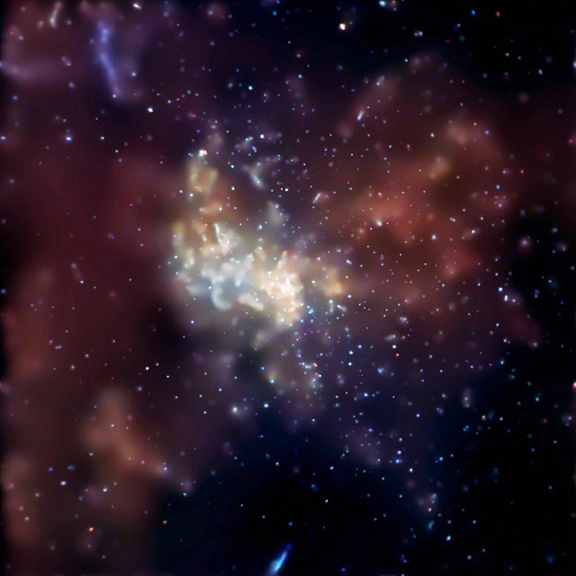
The Milky Way has some nerve (or after you see the picture you may think, excuse my language, big cojones) for hiding a massive structure that about equals the size of the visible Milky Way. The Fermi gamma ray satellite observed the structure mired in a fog of gamma rays which are pervasive through our sky. Fermi has been making a survey of the complete sky for some time, but only through careful data analysis and removal of diffuse sources were the lobes readily apparent.

Spotting the lobes inside the Milky Way was difficult because from our view within we can't see the forest for the trees, but astrophysics expect that some galaxies have gamma ray lobes and Fermi has spotted such lobe structures like this in other galaxies such as Centarus A. So this result isn't that unexpected, except that it is. These gamma ray lobes are comparable to the entire size of our galaxy and they are just now being seen for the first time.

The structures are orthogonal to the plane of the Milky Way and have distinct edges; they are surprisingly geometrically perfect. They span about 7.5 kiloparsecs (or 25,000 light years). The lobes are composed of gamma rays which are super high energy photons; the photons obtain such high energies by interacting with particles, like free electrons, which are themselves moving close to the speed of light which then interact with the lower energy photons in their vicinity to boost the photons up to gamma ray energies.

The distinct edges of the lobes are indicative of a large and rapid formation event. The structures may have been formed by a massive burst of star formation followed by stellar explosions which seeded the lobes with gas, dust, and hot electrons over millions of years. There is a supper massive black hole at the center of many galaxies, including the Milky Way, which may create high energy lobes, but those lobes would only form when the black hole is actively undergoing accretion of matter. So this may be evidence that the 4 million solar mass black hole at the center of our galaxy underwent an active period where it accreted a large amount of matter and simultaneously released massive jets of energetic particles just a few million years ago.
It is an exciting discovery, but I don't have anything other than a press release to go on as of yet though a paper is accepted for publication in ApJ so more to come.

Very precise pulsar measurements

A neutron star is made of neutrons, right? Astrophysicists ponder this question and forge theory after theory, but the only thing they conclude with certainty is that a neutron star by any other name would still be made of the densest form of matter know to exist in our Universe. Under certain conditions a star which has exhausted all of its fuel and is sufficiently massive will not be able to support its own weight with pressure support (as in a regular star) or with electron degeneracy support (as in a white dwarf) such that electrons and protons merge to form neutrons because it is a more energetically favorable arrangement of the matter. A neutron star is a sort of massive atomic nucleus, but without charge. The actual composition and detailed properties of neutron star are still theoretically uncertain.
New measurements of the pulsating neutron star and helium-oxygen-carbon white dwarf binary system J1614-2230 reported in a Nature letter are the highest precision determinations of a neutron star's mass to date. The data comes from the massive Green Bank Telescope using the new Green Bank Ultimate Pulsar Processing instrument which accurately records the time of arrival of each radio pulse sent out by the rapidly rotating neutron star (which is a pulsar). The quality of this instrument, having over a tera op of computing power, and the size of the telescope, 100 meters, made this measurement possible. For a quick rundown of this result you can watch these quick movies on the scientific implications and the technology behind the discovery which were created by the NRAO.

The analysis uses a general relativistic effect involving the time delay of light known as the Shapiro delay effect. When a light ray passes a massive object it follows a curved path. General relativity says that curvature of light rays can only take place when the velocity of the propagation of the light rays also varies with position. The Shapiro delay increases the light travel time through the curved space-time near a massive body. The equation to determine the time delay effect is delightfully simple.
The delay depends on the mass, M, of the time delaying body between the source and the observer, the gravitational constant G, the speed of light, c, and the geometry of the system. The geometry is that light has to be passing near the gravitating body before it gets to the observer for the effect to occur at all so the vector that points from the observer to the source, R, and the vector that points from the observer to the gravitating mass are vital. Pulsar J1614-2230 is a nearly edge on, 89 degrees, system meaning that when the white dwarf passes in front of the pulsar during the binary orbit the Shapiro effect will be very strong. I ran a quick calculation of the time delay and found it to be exactly on the order of a few microseconds. The first figure in the paper shows the geometry and the measured effect.
With this data in hand the standard Keplerian orbital parameters are calculated for this clean binary system and the masses of the objects are calculated. The mass of the neutron star was found to be 1.97 +/- 0.04 solar masses which is the most precise measurement of neutron star mass to date. Unfortunately this measurement technique does not provide any information about the radius of the neutron star, but because the mass was so high it already set a limit on the equation of state of the neutron star matter. This means that we can begin to answer what a neutron star is really made of. Different kinds of matter have a different behavior as you add more mass to them which is intuitive if you thought how discrepant with respect to size a planet made out of cotton candy versus rock would be. This result indicates that exotic models of hadronic matter including hyperons, kaon condensates are ruled out. Condensed quark matter is not ruled out, but highly constrained with this data. This is a big deal for particle physicists because this kind of system is an experiment that could never be carried out in a lab, but is necessary to probe fundamental physics.

This cool result on neutron stars glosses over another application of precise pulsar measurements that the authors of this Nature paper regarded as noise. The plot above is very neat and clean, but before the data looks like that a timing analysis must take into account the time delays associated with many more mundane effects. Effects that change the time of arrival of the pulsar include the variations in the Euclidean distance between the Earth and the pulsar resulting from Earth’s orbital motion, the proper motion of the pulsar, and its binary motion, dispersive delays in the interstellar medium, and time dilation of clocks in the observatory and pulsar frames and along the propagation path. The Earth's orbital motion about the solar system barycenter (known as the Roemer delay) is up to 500 seconds and so must be removed from the data. The powerful thing is that the Earth's orbital motion tells us about the mass and orbits of all the bodies in our solar system. A paper published in the Astrophysical Journal states that with ten years of careful observation of 20 pulsars the masses and orbits of solar system bodies could be determined better than with any other method and even undiscovered trans-Neptunian objects could be found.

Precise pulsar measurements are powerful. The first extrasolar planet ever discovered was actually made with pulsar measurements. Pulsars can tell us about the nature of neutron stars, the properties of own solar system, oh and even gravitational waves. If only astronomers had the money to build a pulsar timing array...

ResearchBlogging.org References

Demorest PB, Pennucci T, Ransom SM, Roberts MS, & Hessels JW (2010). A two-solar-mass neutron star measured using Shapiro delay. Nature, 467 (7319), 1081-3 PMID: 20981094

D. J. Champion, G. B. Hobbs, R. N. Manchester, R. T. Edwards, D. C. Backer, M. Bailes, N. D. R. Bhat, S. Burke-Spolaor, W. Coles, P. B. Demorest, R. D. Ferdman, W. M. Folkner, A. W. Hotan, M. Kramer, A. N. Lommen, D. J. Nice, M. B. Purver, J. M. Sarkissian, I. H. Stairs, W. van Straten, J. P. W. Verbiest, & D. R. B. Yardley (2010). Measuring the mass of solar system planets using pulsar timing ApJ arXiv: 1008.3607v1

Magnetic Fields in Cosmology

The existence of magnetic fields on cosmologically large scales is an unsolved problem in astrophysics. Theory favors a universe that did not begin with any magnetic fields present and classical magnetohydrodynamics restricts the spontaneous emergence of a magnetic state under the influence of ideal forces. In a paper entitled Twisting Space-Time: Relativistic Origin of Seed Magnetic Field and Vorticity appearing Physical Review letters Swadesh Mahajan and Zensho Yoshida propose a universal magnetic field generating effect using ideal special relativistic fluid dynamics. Mahajan and Yoshida's insight was that in describing magnetic fields, which are mathematically equivalent to a vorticity, a careful application of ideal dynamics in the framework of distortions caused by special relativity may result in the spontaneous emergence of a magnetic state in contrast to the previous theoretical result.

Magnetic fields are found to be important in every scale hierarchy of the universe. Most notably detailed images of galaxies paradoxically display regions of chaotic turbulence and beautiful grand coherent designs at once. Thus it is clear that turbulent motion on scales below hundreds of parsecs does not necessarily destroy coherent optical or magnetic features over scales of kiloparsecs. Indeed, magnetic fields are indirectly observed at optical and radio wavelengths by detecting the polarization of the electromagnetic field through the Faraday effect and also by the Zeeman splitting effect. The Faraday effect is the rotation of the linear polarization vector of light which occurs when polarized radiation passes through a magnetized and ionized medium. Radio observations are the most powerful technique and by measuring both the dispersion and polarization rotation the mean of the magnetic field along the line of sight can be measured. Such observations indicate a wide range of magnetic field are present in astrophysics. The image at right below shows the magnetic fields present in M51 which are likely similar in structure and strength to that of the Milky Way.
Faraday rotation, magnetic fields, m51
The total radio continuum emission from the "whirlpool" galaxy M51 (distance estimates range between 13 and 30 million light years) is strongest at the inner edges of the optical spiral arms, probably due to the compression of magnetic fields by density waves. The vectors give the orientations of the regular magnetic fields as derived from the polarized emission. The field lines follow nicely the optical spiral arms. Unexpectedly, strong polarized emission is observed also between the optical arms which indicates the action of a dynamo. This image was observed with the VLA in its most compact configuration at 6cm radio wavelength (broadband continuum). As the VLA cannot detect the diffuse, large-scale radio emission, data from the Effelsberg 100-m telescope in Germany at the same wavelength was added. Investigator(s):  Rainer Beck (MPIfR Bonn, Germany), Cathy Horellou (Onsala Space Observatory). Image courtesy of NRAO/AUI

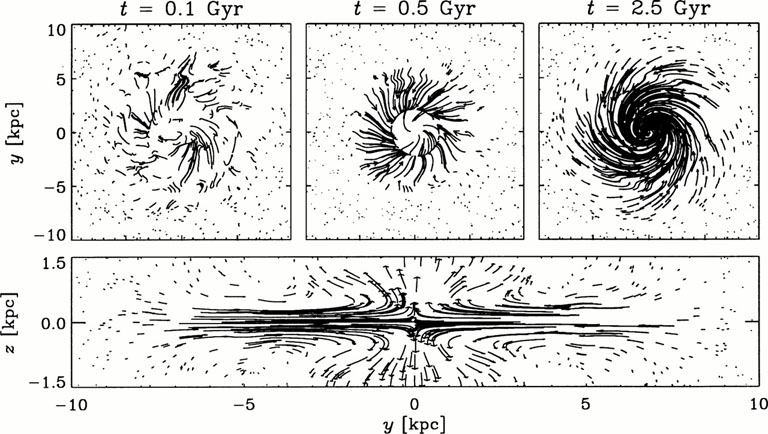
Microguass fields are present in galaxies at scales of a few kiloparsecs and on the much larger scales of megaparsecs ordered fields of perhaps a few orders of magnitude less are present in galaxy clusters. Magnetic fields in astronomy are controlled by induction of partially ionized gas. A common model for creating these magnetic fields is the dynamo effect wherein an electrically conductive fluid accelerated by some kinetic force generates convective motions in the fluid; it is plausible that a turbulent hydromagnetic dynamo of some kind coupled to an inverse cascade of magnetic energy wold give rise to regular galactic magnetic fields. Following the basic dynamo theory magnetic field lines can be simulated for galaxies which are consistent with observations. The dynamo theory is actually a mechanism for maintaining or growing fields rather than creating them, but it is expected that minuscule primordial magnetic field seeds in the early universe of cosmological origin drive the magnetic fields observed today.

The magnetic dynamo and the primordial magnetic seed theories are both unsatisfactory. The model wherein the the large scale magnetic field in galaxies is the result of the twisting of a cosmological magnetic fields by galactic differential rotation is not satisfactory because a primordial field wound up by differential rotation ultimately decays in an effect known as flux expulsion. The primordial seed theory must explain the presence of large magnetic fields in higher redshift objects when the universe was much younger when the fields should not have had sufficient time to grow. Researchers disagree over what initial primordial field strength is necessary to create the magnetic fields seen today; estimates vary from as large as 10-9 gauss [1] to 10-30 gauss [2], but either way an alternative model would be welcome.

Mahajan and Yoshida's work was motivated by the search for a universal mechanism for magnetic field generation. They key to creating a magnetic field is the vorticity of an ionized material which is analyzed in this paper with topological constraints. In mathematical terms fundamental cosmology requires a topological constraint on the vorticity of the universe (consider that you wouldn't expect the universe to have a preferred rotation), however this constraint can be broken by the application of special relativity. The problem of magnetic fields lies in the fact that vorticity must vanish for every ideal force such as the entropy conserving thermodynamic forces (this can be proven though the governing Hamiltonian dynamics of an ideal fluid where ultimately Kelvin's circulation theorem shows that if the initial state has no circulation the later sate will also be vorticity-free). Introduction of the Lorentz factor γ=(1-(v/c)2)-1/2 from special relativity destroys the exactness of the ideal thermodynamic force and allows spontaneous vorticity.

The authors find a new term that provides a magnetic field growing mechanism as long as the kinetic energy is inhomogeneous. The authors mechanism can provide a finite seed for even mildly relativistic flows. They provide an example for very standard parameters (electron density n=1010 cm3, temperature T= 20 eV and velocity, v, compared to c of v/c=10-2) and find their relativistic drive mechanism remains dominate over other effects until magnetic fields of 1 gauss or so which is much larger than most magnetic fields ever observed, thus the relativistic drive is the only dominant effect. The relativistic drive mechanism will likely help us understand, among other things, the origin of magnetic fields in astrophysical and cosmic settings.
ResearchBlogging.org
References:

[1] Beck, R., Brandenburg, A., Moss, D., Shukurov, A., & Sokoloff, D. (1996). GALACTIC MAGNETISM: Recent Developments and Perspectives Annual Review of Astronomy and Astrophysics, 34 (1), 155-206 DOI: 10.1146/annurev.astro.34.1.155

[2] Davis, A., Lilley, M., & Törnkvist, O. (1999). Relaxing the bounds on primordial magnetic seed fields Physical Review D, 60 (2) DOI: 10.1103/PhysRevD.60.021301

[3] Mahajan, S., & Yoshida, Z. (2010). Twisting Space-Time: Relativistic Origin of Seed Magnetic Field and Vorticity Physical Review Letters, 105 (9) DOI: 10.1103/PhysRevLett.105.095005