Field of Science

Showing posts with label philosophy. Show all posts

A Comet Unnoticed

Comet ISON. NASA/HSTComets have long been portents of change. They challenge the rote repetition of our skies. An astute observer of the sky will perhaps have recently noticed a new object in the sky, a comet, present for the last few weeks (you would have had to look east just before sunrise near the star Spica). This was the comet ISON. But comet ISON, having strayed too close to the Sun, has been mostly annihilated. If there is a comet in the sky and no one sees it, was it ever really there?  

William Carlos William's poem, Landscape with the Fall of Icarus, captures the essence of comet ISON's elusive journey around the Sun. Brueghel, the Felmish Renaissance painter, carefully recorded the event like a faithful astronomer, but the worker is not keen on the sky and Icarus goes wholly unnoticed. It is just the same to the worker, for had they noticed Icarus or not it would likely make no difference to their toils in the field. And similarly ISON went largely unnoticed.
According to Brueghel
when Icarus fell
it was spring

a farmer was ploughing
his field
the whole pageantry

of the year was
awake tingling
with itself

sweating in the sun
that melted
the wings' wax

unsignificantly
off the coast
there was

a splash quite unnoticed
this was
Icarus drowning
ISON made a brief appearance to the unaided eye for a few days before it grazed the sun and then uncoiled itself. But to the learned astronomer ISON is still interesting. Comets are rare objects in the inner solar system so even a dead comet is a chance to learn something, in fact, further spectroscopic observations of this dead comet's remains will continue to tell us exactly what it was made of. There is a legacy here.

I am a contributor over at 3 Quarks Daily now so you can read the rest of the story of this lost comet over there...

Common Observer, uncommon observations

common observer, uncommon observationscommon observer, an online venue of science, art, philosophy, and culture
I have a new online project and venue that I have launched! Common Observer is a collaborative online venue of science, art, philosophy, and culture. The tagline is "Common Observer, uncommon observations." The idea is that we must reason as if we are the most common observer, but that doesn't preclude uncommon observations. An uncommon observation is something that challenges our human condition of common observation. A poem, a theorem, a dance, an equation, a painting, a story, a novel, or a theoretical truth may all be uncommon observations about the world we inhabit.

Yet fear not, I will still post on The Astronomist, in particular I will cross post any original scientific content I create. The reason for this shift of focus is at least two fold. First, it is hard to find time to generate original thoughtful content while finishing a PhD so Common Observer will have more aggregated content. Second, while so many people love astronomy, I feel a broader forum of wider interests will better grip reader's attention, as well as my own attention.

I hope that Common Observer can be a successful collaborative project. In order to realize that goal I am currently searching for culture, art, philosophy, or poetry contributors. So please check out the new project, share it with friends and colleagues, or contact me if you have inclinations to collaborate. Follow Common Observer on twitter, subscribe to the RSS, or just visit the site often. Thanks for the continued support. 

The Most Astounding Fact

We are part of this Universe, but perhaps more important is that the Universe is in us. You may have even heard it stated as a fact that we are made of stardust. What does this mean? Well in the early early Universe, a few minutes after the big bang, the Universe consisted of only hydrogen, helium, and a smidgen of lithium. There was no oxygen, carbon, or any other heavy elements. Complex life had to wait. It took hundreds of thousands of years for stars to form. Eventually in the cores of massive stars the atoms of which we exist were forged under massive pressure and heat through the process of fusion—the merging of lighter atoms to create heavier atoms. The key to unlocking those delicious elements was fantastic stellar explosions. We could say the stars died for us.

Humans are at least 60% water by mass (this is the most uncertain number here because after you drink a few beers this number quickly starts to change). Water is by mass is 11% hydrogen. Thus the mass of hydrogen in our body from water is at least 7% though of course there is lots of other hydrogen in our body from other molecules (lipids, amino acids, and so on). A better estimate is that we are 10% hydrogen by mass (if we do our accounting by number of atoms in the body we are 63% hydrogen atoms). Ultimately every atom in us is that is not hydrogen was forged in stars, and so 90% of the mass in our bodies is stardust.

Perspectives on the Vertical


Cabinet Magazine has an interesting cultural perspective on human's attempts to zoom in and out of nature in the vertical. Particularly they focus on one of my favorite science films ever, Power of Ten.

Powers of Ten was originally inspired by a 1957 book by the Dutch educator Kees Boeke titled Cosmic View. By 1963, the Eameses were experimenting with tracking shots that gave the effect of a camera pulling away with accelerating motion from an object, and in 1968 used these in a film called A Rough Sketch for a Proposed Film Dealing with the Powers of Ten and the Relative Size of Things in the Universe. Shot in black and white, it was followed by an extended color version—the one known as Powers of Ten—made in 1977. The basic set-up of the latter film is well-known. It opens with a picnic scene in a park in Chicago. From a ground level view, the camera then switches to a vertical, aerial position from which it looks down, the frame centered—as we later find out—on an atom in the man’s hand. At this point the narrator tells us that we are one meter away and looking at a square one meter by one meter. Now the camera pulls away vertically and begins to accelerate so that every ten seconds our distance from the initial scene is ten times greater. The camera continues its upward trajectory until just after 1024 meters (100 million light years) when it gradually slows and begins its descent, collapsing beyond its original position and now decelerating through the ever-smaller dimensions of cells, molecules, atoms, and beyond.

Read on.

Nothing

Ethan Siegel over at his blog Starts With a Bang has some more interesting ideas on the physics of nothing and everything here and here.

Gödel's Proof

There is an idea of reason in the Universe. It is an abstraction which mathematicians have never been content with. Given that scientists exclusively use logic (or mathematical reasoning) for theories and experiments it is of incredible importance to know the limits of logic. It turns out that the study of math itself, metamathematics, has amazing insights on what is knowable.

In 1931 an unassuming paper was published in a German mathematics journal, the title of the paper (translated to English) was 'On Formally Undecidable Propositions of Principia Mathematica and Related Systems I'. It is a confusing title and the kind of paper which I would not understand. The author was a 26 year old Austrian named Kurt Gödel and he had just created a revolutionary idea, but as with so many great ideas it was not simple and it took great minds to fully appreciate it.

The ideas he put forth have been extremely influential and the collective name for the theories that grew from it are known as Gödel's incompleteness theorem. This theorem is a revolutionary outcome in mathematical logical that has implications for not only the philosophy of mathematics, but philosophy in general. It is thus surprising how relatively unknown the theorem is to the general public and even many scientists. I recently read the book Gödel's Proof by Nagel and Newman in just a few sittings at a coffee shop. It is a short and concise explanation of the proof that incrementally brought me closer to understanding the intricacies of Gödel's works.

Gödel's incompleteness theorem is a massive mountain of ideas that I will not attempt to conquer, but I think it is important that everyone at least gets a view. Gödel basically found that no solid guarantee is possible that mathematics is entirely free of internal contradiction. However, Gödel was not out to trash mathematics, contrarily he used mathematics itself to temper the reach of mathematics and place constraints on what is possible to known through mathematics much like a physicist theorizing that a black hole's event horizon places a limit on spaces which the physicist could actually go and measure. Gödel created a new technique of analysis and introduced new probes for logical and mathematical investigation.

The specifics of Gödel's proof even as outlined on wikipedia are extremely complicated (the entire proof is long and there are on the order of 200 links in the article so by the time you were done reading all of the prerequisite mathematical definitions you would have read thousands of pages) for anyone without (or with) extensive mathematical training, so I must admit that I don't understand it completely and not have I attempted to read the actual paper. I want to present here the shortest definition of Gödel's theorem not the the most rigorous.

The key to Gödel's incompleteness theorem is a concept of mapping. In the information age the concept of mapping or coding is familiar to many as in the case of mapping Morse code dots to letter characters. In the explanation that follows take it as a given that it can be shown that all logic systems are equivalent to or mappable to the operators we will be using; this assumption is vital, and I can't quite explain it without detail so I refer the inquisitive mind to read Nagel and Newman's book.

Let us construct a simple logic system using the arbitrary operators P, N, ⊃, and x that have certain properties which we take as given by the table defined below. In the left column a combination of operators is given and in the right column a definition in English of the operators meaning is given.

P⊃x    'print x'
NP⊃x    'never print x'
PP ⊃x    'print xx'
NPP⊃x    'never print xx'

We can combine these statements and create more complicated statements. For example P⊃y where y=P⊃x would mean 'print P⊃x' (note that implicitly I am also using the equals operator). Crucially then NPP⊃x would mean 'never print xx', and this statement could also be written NP⊃xx.

Next ponder what the last statement used on itself means. The statement NPP⊃y where y=NPP⊃ would mean 'never print NPP⊃NPP⊃', but this strange statement could also be written NPP⊃NPP⊃.

So either our system prints NPP⊃NPP⊃ or it never prints NPP⊃NPP⊃. It must do one or the other. If our system prints NPP⊃NPP⊃ then it has printed a false statement because the statement contradicts itself by self reference once it is printed. On the other hand if the system never prints NPP⊃NPP⊃ then we know that there is at least one true statement our system never prints.

So either there are logic statements which may be printed which are false statements, or there are true statements which are never printed. Our system must print some false statements if it is to print all true statements. Or our system will print only true statements, but it will fail to print some true statements.

In the example above I have taken arguments very similar to that in Raymond Smullyan's book Gödels Incompleteness Theorems in order to create an extremely concise, but hopefully accurate description of what lies at the core of Gödel's insight. In Nagel and Newman's book they explain Gödel's proof in much more detail by working out the details of mapping. For example in the explanation above I mapped mathematical statements to the idea of printing, but print could be equivalently be existence. Further, Nagel and Newman argue as Gödel did that all formal axiometric systems can be mapped in some way such that even the most complicated mathematical systems using the common operators of +,-,=, x,0,(,),⊃ and so on can be shown to be incomplete.

Gödel's incompleteness theorem has many forms and implications. Briefly I will demonstrate an analogous, but weaker form of Gödel's incompleteness theorem by analogy to the halting problem. I believe this demonstration is of importance to those of us immersed in the information age and perhaps easier to grasp or at least more applicable than Gödel's work.

The halting problem is to decide whether given a computer program and some input, whether the program will ever stop or will it continue computing infinitely. The key to the halting problem is the concept of computation and algorithms. In the original proof by the enduring Alan Turing specific meanings to the concepts of algorithm and computation were defined. He used a computational machine now known as a Turing complete computer, or a Turing machine. The definition of what constitutes a computer is to the halting problem what the mapping of symbols is to Gödel's theorem. It is at the heart of the problem, and thus actually one of the harder points to define so I will again leave that task as an exercise to the reader.

So lets look at two psuedocode programs and lets imagine that we also have a very special program written by a genius scientist which is called Halting. The scientist claims that Halting can correctly tell your own code B(P,i) whether a program halts.

Program B(P,i)
  if Halting(P,i)==true then
    return true // the program halts
  else
    return false // the program does not halt


Now here is the important part. The genius scientist claims we can analyze any kind of computer program, this is indeed the crux of the halting program, we want to know if any and every program stops. Now imagine a program E that takes X, which is any program, as an argument.

Program E(X)
  if B(X,X)==true then
    while(true) //loops forever
  else
   return true


The first thing E does is take B and passes it X for both arguments. Program E will get back from B either true or false. If it receives back true it will enter an infinite loop and if it receives back false it will terminate.

So suppose I take B and feed it E for both arguments. What answer will B(E,E) give? Think about it.

We will be running our special Halting program on E(E) which will then run the program B(E,E). The answer to B(E,E) will either be either true or false. If the result is false the program E actually returns true and halts immediately; if the result is true then Halting thinks our program does halt, but the program E throws itself into a loop upon this condition and will never halt. Either way program E lies. E was written very craftily to break B on purpose, but nonetheless the damage is done. E cannot be made reliable even in principle. It matters not how clever you are and or how powerful your computer is. There is simply no reliable computer program that can determine whether another program halts on an arbitrary input. The incompleteness problem may have seemed a little bit distant and philosophical, but if you have read this far it should be evident that the halting problem has deep implications computing.

What does Gödel's theorem mean for the real word, experimental verification, and deductive sciences? Well take for example the Banach-Tarski paradox which states that a solid ball in three dimensional space can be split into a finite number of non-overlapping pieces, and then be put back together in a different way to yield two identical copies of the original ball. This process violates sensible physic notions of conservation of volume and area. It turns out that Banach and Tarski came to this conclusion based upon deductions from the Axiom of choice. Now, whether we know anything at all about the axiom of choice we do know that the deductive conclusions drawn from it are in violation of physics. Thus, a physicist could argue that the axiom of choice is not a valid axiom for our Universe. Within mathematics it is unknown, unprovable Gödel says, whether or not we should accept the axiom of choice, because it is after all an axiom. The argument for whether a given axiom is to be accepted must be discussed outside the confines of the logic structure one is arguing about. It turns out that the axiom of choice is important for many other really important mathematical proofs which are used in physics all the time. I don't know what to make of it really, perhaps a mathematician out their should weigh in on this question.

Another important theorem that goes along with Gödel's theorem is Tarski's undefinability theorem. Tarski's undefinabtliy theorem makes a more direct assertion about language and self referential systems. Basically any language sufficiently powerful to be expressively satisfying is limited. In summation we have two vital points to the concept of incompleteness.
  1.  If a system is consistent, it cannot be complete and is limited.
  2. The consistency of the assumptions or axioms cannot be proven entirely within the system.
The repercussions of the meta analysis of logic are profound and subtle. Gödel really has thrown us for a loop. It is unclear if we should draw the line and say this is just a mere curiosity of mathematics or a deep truth about the Universe. It has been proposed by Douglas Hofstadter (author of Gödel, Escher, Bach) that consciousness itself comes from a kind of 'strange loop' induced by a self referential system in our minds. Primarily, I think we can conclude that Gödel's incompleteness theorem implies that in most situations the tools science has to analyze the world are more than adequate because the situations are not self referential. However, I do see a limit to what we can know about the Universe. As physicists forge forward, generally quite successfully, in understanding the Universe it appears that there really is some consistent mathematical basis for our Universe. Many physicists are searching for this mathematical basis to the Universe, it is the so called theory of everything. But does Gödel's result imply that this mathematical basis cannot be self consistent?

Consider this scenario. One day our most powerful, successful, and comprehensive theory ever will predict something that experiment cannot verify or worse an experiment will patently disagree with. Some will argue that the theory must be thrown out because classically the scientific method states that a theory disagreeing with experiment, or making nonsense predictions, is untenable. Another theory will be introduced that makes consistent and testable predictions, however this theory is not able to predict the most intricate traces of nature. Actually, that first case kind of sounds like string theory. Perhaps we will have to start talking about theories being incomplete instead of wrong one day.

I Hate Astrology

Perhaps it is cruel to snuff out the shinning gleam in the eyes of a person who upon hearing that I am an astronomer exclaims, "Oh, I love astrology!" and  I reply, "No, I study ASTRONOMY." But they don't understand it. The subtle differences in syllables of the words belies the vast gulf in empirical tendencies between the separate endeavors and it is too much to explain. I simply walk away.

I hate astrology and I hate when people get astronomy and astrology mixed up. I could be more understanding, but I have to choose my battles. I meet a lot of interesting people in coffee shops, bars, airplanes, parties and wherever else life takes me and when someone gets excited about the fact that I study astronomy it means they have a deep curiosity about the skies above. That curiosity is occasionally deeply misguided with astrology and their questions are so fundamentally misconceived I struggle to answer them with candor and accuracy (for example they ask, 'Do the planets affect our daily lives?' and I hesitate to answer honestly that we must consider their gravitational pull, so the answer must be yes). On the other hand I meet people who are genuinely interested in massive collections of gravitationally bound glowing gas and I am very happy to answer their questions.

There is a real danger when logic, or pseudologic, is applied to astrology. Recently there was an uproar about the shifting of the zodiac that made it into some news headlines. Briefly I shared the frustrated sentiments of astrologers because the shifted zodiac has been well known for some time, why is the public just now hearing about it? The book in the image above is from the seventies and claims right there on the cover that, 'Most astrology is unscientific and inaccurate', and goes on to explain the shifted zodiac and how to have a movie ending romance. The ideas in this book are the apotheosis of dangerous thought. A little bit of knowledge is a very dangerous thing when combined with pseudologic in the guise of rigorous proof. It has also not escaped my observation that many of the people I have known who believe in astrology also believe in God as if to demonstrate the utter confusion and inconsistency of their minds. I don't mean to badger defenseless people here. This is simply an honest expression of how I feel. I have summed up my sentiments into a paragraph which I think would be nice to place on a card with which to hand out to people who confuse astrology with astronomy:

I cannot rightly conceive of a logic which would allow one to study such disparate phenomena of love, planets, stars and come to see any connection. Perhaps, desperate for meaning people find it wherever they look; conclusions are forged before the data have been taken. Those who would apply science to astrology may as well attempt to apply science on whom to love and sociologists do study what makes a lasting relationship and neurobiologists study what chemicals are active in the brain during feelings of love, but no scientist will claim that Romeo shouldn't love Juliet. I believe science and an understanding of natural phenomena adds to the beauty life, but pseudologic and lies even when propagated with good intentions ultimately lead to pain and suffering. The human mind has the ability to find patterns anywhere, indeed often where they do not exist.

Skeptical: Philosophical Umpire

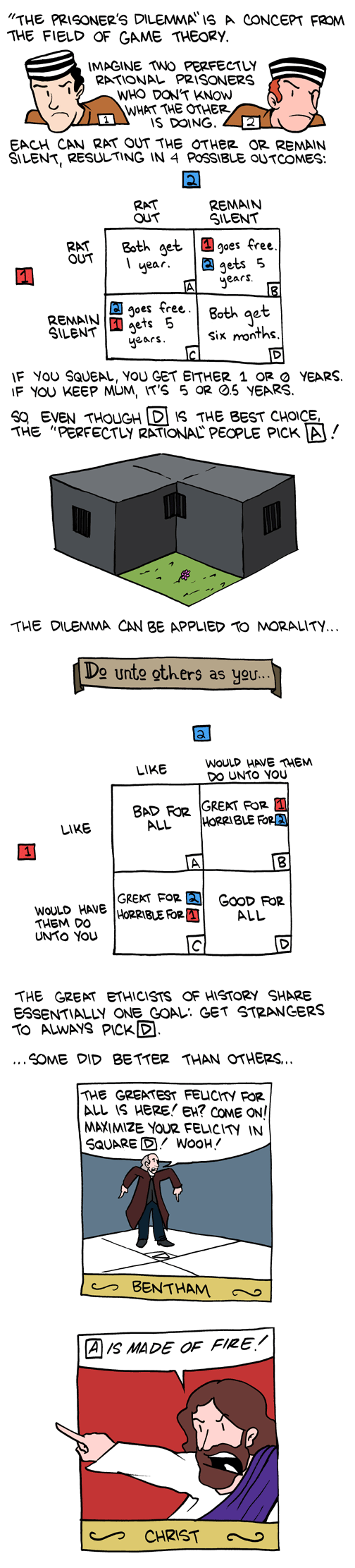
Making good decisions is complicated. Game theory applies logic and mathematics to determine the optimal course of action for individuals when acting in the presence of other participants. Now, individual actions must take into account logic, morals, and personal preference, but there are general rules or situations in which the optimal course of action is clear. This comic (or infographic?) by SMBC illustrates the application of game theory to a classic problem, the prisoners dilemma, and by extension morality.

prisoners dilemma
The prisoners dilemma is a great way to find your moral compass. We can apply a similar decision matrix as used above to many different kinds of situations, like Pascal's wager, where one attempts to bet on the existence of God. The logic of pascal's wager concludes that one should believe, or at least act as if one believes in God (this result is unsatisfactory to many, but wait I have a response). I was recently considering applying a decision matrix to answer the question, 'Should you believe in science?' There are other ways to phrase the question, like 'Should you be a skeptic?' or 'Should you follow logic?' Decision theory gets tricky here. In order to answer the question I recalled an analogy a professor used in a philosophy class I took long ago. My professor wanted us to consider a philosophical umpire calling a game. The umpire could either state that she was very vigilant such that she, 'calls em as I see em' (admitting fallibility), or the umpire could say that, 'I call them as they are' (denial of fallibility).  In the situation before replays I could almost see the umpire taking either stance with reason because they are the final arbiter on the field. In this modern age it is completely untenable for an umpire to state that she calls everything'as they are because replays are available. In life any experience that can be repeated is like a game with replays; an experiment is a game with replays. We all must be like the philosophical umpire and we can reason out how to behave using these ideas.

Below I have made a logic table. On the left vertical axis is the true outcome of an event with respect to how you perceived it and on the top horizontal axis is how you see yourself judging the event. The conclusion of the table is that application of the scientific method is really powerful. Admitting that you make errors in judgement means that you always allow potential for improvements in the future outcomes, but insistence on being right leads you to a false world view. I think that scientists, skeptics, and atheist have essentially the same goal and are all standing in the top right corner there jumping up and down trying to get people to choose to be skeptical.
'calls em as I see em' (skeptic)   'calls em as they are'   
right
positive result, skeptic world view, positive future resultspositive result, superficially correct world view, positive future results
negative result, skeptic world view, potential for improved future resultsnegative result, false world view, negative future results

wrong
It almost seem to be a tautology that logic says you should use logic to understand the world. This decision matrix casts doubt on the result of all other decision matrices like Pascal's wager such that we can escape being certain that belief in God is best, but simultaneously this result casts doubt on itself. Paradoxically what this really seems to say is that you should be skeptical about being skeptical.

The Future History of the Universe

Current observations of our universe indicate that the universe is expanding at an accelerating rate. The expansion of the universe will eventually place all galaxies which are not gravitationally bound to the Milky Way beyond our observable horizon (yet I caution that the notion of a horizon is a subtle point and a source of expanding confusion). Galaxies will cease to be brilliant. The passing of time will see stars exhaust all of their fuel. Stars will cease to shine. Black holes will evaporate due to Hawking radiation dispersing a bath of dull photons into the universe. Black holes will cease to exist. The universe will cool as it expands to a uniformly frigid temperature. Entropy will be maximized. The universe will be cold, dark, and lonely.
Roman forum, Andromeda galaxy, sepia photo
The future history of the universe described above is an implicit result of the standard cosmology accepted today. It is an extrapolation of accepted theory into the distant future. There is good reason to be skeptical of extraordinary predictions which is why the big bang and the past expansion history of the universe is the major focus of cosmology and not predicting the future of the universe. We need to know exactly what happened in the past to understand the reasons for the accelerating expansion (what is dark energy?). The current observations and the 'standard cosmology' I speak of are part of what is known in physics as the concordance model of cosmology. Every peer reviewed research paper that discusses the universe has this one sentence in it that goes something like this (taken from generic research paper on cosmology and extragalactic astrophysics):
Throughout this paper we assume a Friedmann-Lemaître-Robertson-Walker metric with a standard cosmology with ΩM=.3, Ω Λ=.7, H0=70 km s-1 Mpc-1.
Lets break down this generic statement and see what it implies. The Friedmann-Lemaître-Robertson-Walker metric implies we are assuming a universe which is consistent with a homogeneous isotropic expanding universe, the Ω values are dimensionless energy density parameters which quantify the energy contribution from matter (mostly dark matter, denoted M) and dark energy (denoted Λ), and finally the H0 value is the Hubble parameter in units of kilometers per second per megaparsec which describes how fast, v, an object at a given distance, d, is moving away from us such that H0=d/v. The statement effectively means that the universe is flat (it is conceivably possible that you could travel a very long way in one direction and end up where you started, like what happens if you travel around the earth, but observations indicate that this is not the case so we conclude the universe has no curvature) and the universe is expanding in such a way that the universe will not collapse back down on itself. Thus our best guess is that the universe will keep expanding forever. The consequence of this, and this is the crux here, is that as time moves forward entropy inexorably increases (this is the second law of thermodynamics) to the point that all ordered processes, complex systems, life and semblance of thought is impossible.

If you lived forever it would be hard to avoid the situation where eventually you and your fellow space travelers were huddled around a few dieing stars in a bland galaxy in an exhausted void. There are small stars which are burning today and will be burning in 100 billion years and more stars will form for a while. But eventually, stars really will shut down and cool. You could try to travel to another galaxy, but that would take a long time (if the distance to our neighbor galaxy Andromeda was held constant it would take about 2.5 million years to travel there at the speed of light), and even then there would be few stars and most problematically most other galaxies would have receded beyond our horizon. Where would you want to head in this barren universe? Recent studies of the entropy of the universe indicate that the majority of the entropy in the universe is actually contributed by super massive black holes. Interestingly gravity is rather unlike most systems in thermodynamics. Generally entropy is increased by say smashing something into many pieces, but for gravity when energy is uniformly distributed gravity is quite low compared to the state where matter has collapsed into stars or to the extreme state of a black hole. There is one more step in producing more entropy which occurs as black holes slowly emit radiation in the form of Hawking radiation. A black hole the mass of the sun would emit Hawking radiation for 2 × 1067 years which is much longer than the current age of the universe at 13.7 × 10⁹ years. A super massive black hole of 100 billion solar masses, about the mass of our entire Milky Way galaxy, would emit Hawking radiation for 2 × 10100   years. You could hang out near one of these black holes for a while as a source of energy because the black hole would still be producing entropy. Finally, all the black holes would also evaporate and the universe would consist of a diffuse gas of photons and leptons. Any activity in the universe would be very limited at this point and what did occur would take truly epic time scales.

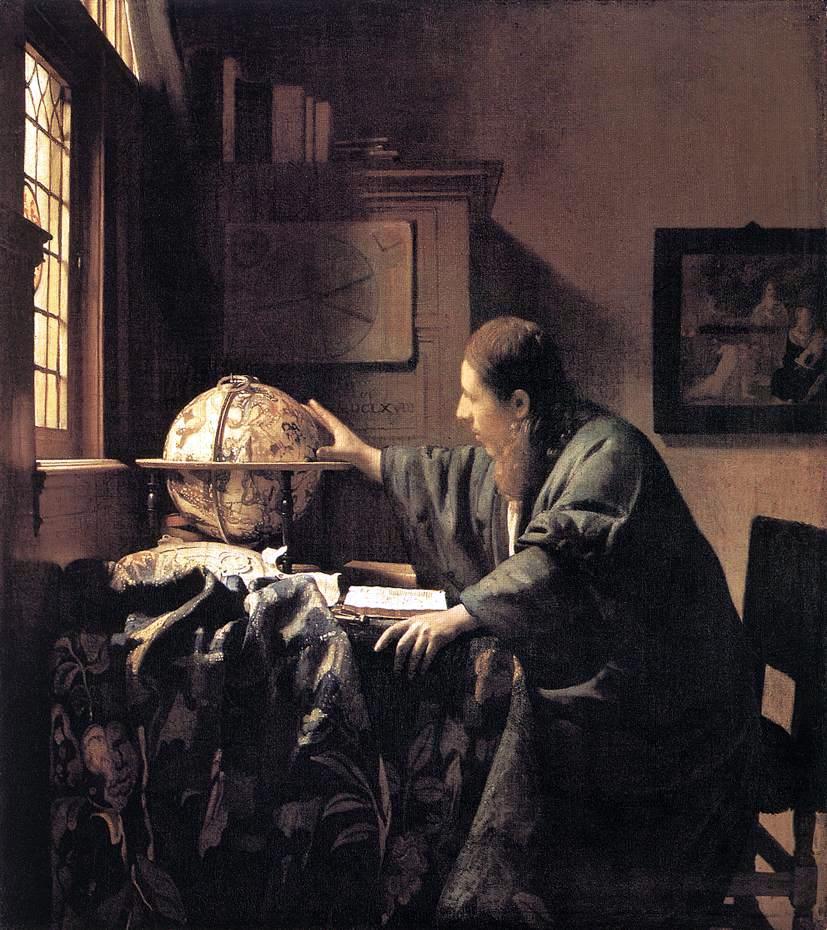
Vermeer, astronomer, cosmologyThe concordance cosmology, the theoretical models, and the measured parameters implicitly assume that the end of the universe is cold, dark, and lonely. The universe ending as cold void in which life can no longer be sustained is sometimes known as the Big Chill. At this point there is only speculation, perhaps it is philosophical. The universe may expand again in a secondary inflationary epoch or the vacuum may decay into an even lower energy state. Actually, there are other possible scenarios such as the Big Rip in which dark energy pulls apart the fabric of space through some exponentially increasing expansion. Revisionist history is the best kind of history, so when talking about the future history revisions are always welcome. There may already be information about universe which has been erased that would change our expectations. One example of the universe erasing information is if the radius of curvature of the universe is much greater than the horizon distance then observing this curvature would be like trying perceive the curvature of the earth just by looking at the horizon so as the universe, or earth, expanded observing curvature could more difficult. Paradoxically, conceding that there is information about the universe which has been erased which would indicate an ultimate fate other than the one outlined here also supports the argument that the ultimate fate of the universe is an extremely high entropy state.

Conceding that the universe may not be infinite or that the end is simply cold and lonely is very difficult for some. This theme was explored in Issac Asimov's story The Last Question in my previous post. In this story man ponders how the heat death of the universe can be avoided. Man asks the greatest computer created how the second law of thermodynamics can be reversed. [spoiler alert] After hundreds of billions of years the computer still cannot answer the humans. Ultimately all of humanities mental facilities from the trillions of humans spread throughout the universe merge their minds with this ultimate computer to from a singular unified mental process. The question is asked again and there is still no answer. Time goes on until space and time cease to exist, however the ultimate mind continues to ponder the question in hyperspace and eventually finds an answer. There is no one or no thing left to report the answer to so the mind decides to show the answer by demonstrating the reversal of entropy. The mind spends another eternity determining how to do this and writing a careful program to execute. Upon execution of the program the mind reverses entropy and thus creates the universe anew.

Hubble Bubble

The Copernican principle holds that humans are not privileged observers of the Universe. Copernicus stated that the Earth is not at the center of the solar system or at any particularly special position in the heavens. Modern cosmology has extended this idea to reason that the earth does not occupy any unique position in the Universe. Modern philosophy of science pushes the principle even further to conclude that every observer (even if they be they little green men) should reason as if they were the most standard observer. However, despite all these humble and rational thoughts it is still tempting to explain certain aspects of modern cosmology that seem finely tuned as consequences of observer selection effects. Namely I am speaking of dark energy or the accelerated cosmological expansion which supposedly could be explained if we occupy a privileged position near the center of a large, nonlinear, and nearly spherical void in mass density. The idea that the region of the cosmos around us could be a void is colloquially known in astronomy as the Hubble bubble. Technically a Hubble bubble is defined as a region of space wherein there is an observed departure of the local value of the Hubble constant from its cosmologically averaged value.
Lets speculate a little further on what it would be like to live in a Hubble bubble. In the standard cosmological model of the Universe the structures we see today like galaxies and clusters of galaxies (and similarly the structures we don't see like the massive dark matter halos the visible matter is embedded in) formed from tiny primordial quantum fluctuations in the early universe. The fluctuations were random variations in density such that locations which were over-dense formed galaxies and those which were under-dense formed voids. It is possible, in fact statistically quite acceptable that there are voids of various sizes in the Universe. These voids would become increasingly under-dense as the Universe evolved and equivalently over-dense regions of the Universe became increasingly over-dense. Inside the void matter would expand outward due to the gravitational pull of matter in surrounding dense regions and thus an observer at the center of the void would see an accelerated expansion of matter outward. Now it is also possible that our entire observable Universe is a Hubble bubble, but that really flies in the face in all of cosmology. It is unfounded, absurd, and really the whole idea of a Hubble bubble may explain dark energy, but is hardly a very good explanation.

The Hubble Bubble is wildly speculative and precision cosmology has almost completely defeated it as a credible explanation. First, as the framework of cosmology has been successful resting on the Copernican principle it seems odd to throw it out now. It is odd and largely misguided. First, the probability of producing a void of necessary magnitude; to mimic aspects of dark energy is extremely small in the standard structure formation models. Second, the probability of an observer being at the center (the only location where the expansion effect would be noticed) is extremely low. Finally, the void would need to be close to spherical to match the observed spatial smoothness (or isotropy) of the universe. These qualitative arguments and many more quantitative arguments from precision cosmology data are laid forth in a recent paper by A. Moss, J. Zibin, and D. Scoot titled Precision Cosmology Defeats Void Models for Acceleration. The abstract follows:

The suggestion that we occupy a privileged position near the center of a large, nonlinear, and nearly spherical void has recently attracted much attention as an alternative to dark energy. Putting aside the philosophical problems with this scenario, we perform the most complete and up-to-date comparison with cosmological data. We use supernovae and the full cosmic microwave background spectrum as the basis of our analysis. We also include constraints from radial baryonic acoustic oscillations, the local Hubble rate, age, big bang nucleosynthesis, the Compton y-distortion, and for the first time include the local amplitude of matter fluctuations, σ8. These all paint a consistent picture in which voids are in severe tension with the data. In particular, void models predict a very low local Hubble rate, suffer from an "old age problem", and predict much less local structure than is observed.
The paper makes several quantitative arguments against the plausibility any kind of void model for cosmic acceleration by drawing together an impressive amount of cosmological data and technical expertise, however, they don't ever mention the term Hubble Bubble. A 2007 paper by Conley et al. takes the Hubble Bubble paradigm head on: Is There Evidence for a Hubble Bubble? The Nature of Type Ia Supernova Colors and Dust in External Galaxies. In Conley et al. they explore how dust effects the colors of type Ia supernovae because they reason if the dust can be modeled as a purely local Milky Way effect then the supernovae data would actually favor the Hubble Bubble. Of course, despite difficulties the analysis, they find that in their parametrization there is evidence for more than the simply effect of local Milky Way dust implying doom for the Hubble Bubble. So the Hubble Bubble has been burst.

ResearchBlogging.org
References:

Adam Moss, James P. Zibin, & Douglas Scott (2010). Precision Cosmology Defeats Void Models for Acceleration arXiv preprint arXiv: 1007.3725v1

Conley, A., Carlberg, R., Guy, J., Howell, D., Jha, S., Riess, A., & Sullivan, M. (2007). Is There Evidence for a Hubble Bubble? The Nature of Type Ia Supernova Colors and Dust in External Galaxies The Astrophysical Journal, 664 (1) DOI: 10.1086/520625

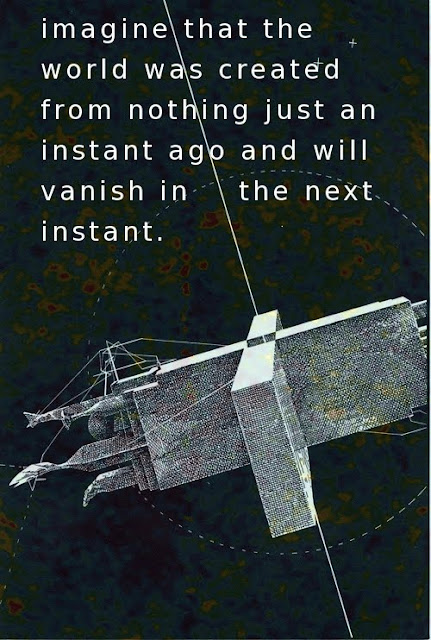
imagine

Imagine the world was just created a momemnt ago and will be gone the next
This is a philosophy experiment. The idea is not as absurd as it sounds (similarly, physicists are perplexed by the Boltzmann brain paradox and you should be too).You will not need any materials to preform it other than your brain. Simply consider what it would mean if the universe was created just an instant ago, and will vanish again the next instant.

Perceiving Itself


Through our eyes, the universe is perceiving itself.


Quote from Alan Watts. Art by Viktor Timofeev.

Goethe and Hemingway: Quantified

Quantified
Photo by Martin C. Eisenloeffel 
Welcome to the digital Weimar. The theme: linking art and science. How does art influence science? How does science influence art? Beauty, elegance, simplicity? Lets ask Goethe, Goethe, the last great polymath!

The Perimeter Institute's Quarks to the Cosmos festival presents Quantifying Goethe. Now experience simultaneously the Penderecki string quartet's quantum computer inspired music and an excerpt from Milan Kundera's Immortality chapter 17:

Strolling down a road in the other world, Hemingway saw a young man approaching him from a distance; he was elegantly dressed and held himself remarkably erect. As this dandy came closer, Hemingway could discern a slight, raffish smile on his face. When they were separated by just a few steps, the young man slowed his walk, as if he wanted to give Hemingway a last opportunity to recognize him.
    "Johann!" Hemingway exclaimed in surprise.
    Goethe smiled with satisfaction; he was proud that he head succeeded in producing such an excellent dramatic effect. Let's not forget that he had long been active as a theatrical director and had a sense of showmanship. He then took his friend by the arm (interestingly, even though he was now younger than Hemingway, he still behaved with the indulgence of the elderly) and took him on a leisurely walk.
    "Johann," said Hemingway, "today you look like a god." His friend's good looks caused him sincere joy, and he laughed happily: "Where did you leave you slippers? And that green eye shade? "And after he stopped laughing, he said, "That's how you should come to eternal trial. To crush the judges not with arguments but with you beauty!"
    "You know, I didn't say one single word at the eternal trial. Out of contempt.  But I couldn't keep myself from going there and listening to the proceedings. Now I regret it."
    "What do you want? You were condemned to immortality for the sin of writing books.  You explained it to me yourself."
    Goethe shrugged and said with some pride, "Perhaps our books are immortal, in a certain sense. Perhaps." He paused and then added softly, with great emphasis, "But we aren't."
    "Quite the contrary,"  Hemingway protested bitterly.  "Our books will probably soon stop being read. All that will remain of your Faust will be that idiotic opera by Gounod.  And maybe also that line about the eternal feminine pulling us somewhere or other..."
    "Das Ewigweibliche zieht uns hinan," recited Goethe.
    "Right. But people will never stop prying into your life, down to the smallest details."
    "Haven't you realized yet, Ernest, that figures they talk about have nothing to do with  us?"
    "Don't tell me, Johann, that you bear no relation to the Goethe about whom everybody writes and talks. I admit that the image that remained behind you is not entirely identical to you. I admit that it distorts you quite a bit. Still, you are present in it."
    "No, I'm not," Goethe said very firmly. "And I'll tell you something else. I am not even present in my books. He who doesn't exist cannot be present."
    "That's too philosophical for me."
    "Forget for a moment that you're an American and exercise your brain: he who doesn't exist cannot be resent. Is that so complicated? The instant I died I vanished from everywhere, totally. I even vanished from my books. Those books exist in the world without me. Nobody will ever find me in them. Because you cannot find someone who not exist."
    "I'd like to agree with you," said Hemingway, "but explain this to me: if the image you've left behind has nothing to do with you, why did you lavish so much care on it while you were still alive? Why did you invite Eckermann to join you? Why did you start writing Poetry and Truth?"
    "Ernest, resign yourself to the idea that I was as foolish as you. That obsession with one's own image, that's man's fatal immaturity. It is so difficult to be indifferent to one's image. Such indifference is beyond human strength. One becomes capable of it only after death. And even then it doesn't happen at once, but only a long time after death. You still haven't reached that point. You're still not mature. And yet you've been death... how long, actually?"
    "Twenty-seven years," said Hemingway.
    "That's nothing. You'll have to wait at least another twenty or thirty years before you become fully aware that man is mortal and be able to draw all the consequences from that realization. It won't happen any sooner. Just shortly before I died I declared that I felt such creative power within me, it was impossible for it to disappear without a trace. And of course I believed that I would live in the image I left behind me. Yes, I was just like you. Even after death it was hard to me to accept the idea that I no longer existed. You know, it's really very peculiar. To be mortal is the most basic human experience, and yet man has never been able to accept it, grasp it, and behave accordingly. Man doesn't know how to mortal. And when he dies, he doesn't even know how to be dead."
    "And do you know how to be dead, Johann?: asked Hemingway, in order to lighten the gravity of the moment. "Do you really believe that the best way to be dead is to waste time chatting with me?"
    "Don't make a fool of yourself, Ernest," said Goethe. "You know perfectly well that at this moment we are but the frivolous fantasy of a novelist who lets us say things we would probably never say on our own. But to conclude. Have you noticed my appearance today?"
    "Didn't I tell you the moment I set eyes on you? You look like a god!"
    "This is how I looked when all Germany considered me a pitiless seducer," Goethe said with an almost grandiose air. Then, moved, he added, "I wanted you to take me with you into your future years in precisely this way."
    "Hemingway looked at Goethe with sudden, gentle indulgence: "And you, Johann, how long have you lived since your death?"
    "One hundred and fifty-six," Goethe answered with some embarrassment.
    "And you still haven't learned how to be dead?"
    "Goethe smiled. "I know, Ernest. I've been behaving differently from what I've been telling you just a moment ago. But I permitted myself this childish vanity, because today we are seeing each other for the last time," And then, slowly, as one who would speak no more, he said these words: "You see, I have come to the definite conclusion that the eternal trial is bullshit. I have decided to make use of my death at least and, if I can express it with such an imprecise term, to go to sleep. To enjoy the delights of total nonexistence, which my great enemy Novalis used to say has a bluish color."
The entire Perimeter institute performance of Quantifying Goethe is shown below. The video above is an excerpt from the 29th minute.

Semi-analytical or semi-numerical


Some people think that asking whether the glass is half full or half empty is a deep and telling question; these people may also think that banal is a country. Scientists also play this little game sometimes when describing their work. Some science is numerical (of or pertaining to numbers; of the nature of a number). Some science is analytical (pertaining to or proceeding by analysis). Many scientists claim that their work is semi-analytical or semi-numerical. The prefix semi may be defined as precisely half (as per its original etymology), but here it must be used meaning partially or quasi. These definitions are useless because in the context of the 'hard' sciences, every shred of research is based on numbers (so it must be numerical) and every number is scrutinized and extrapolated (so it must be analytical) to relevant cases with theory. In conclusion all work is numerical and analytical, but it can't be 100% either so all work is semi-analytical and semi-numerical. Thus the actual labeling of research under one category or the other is useless.

In colloquial scientific usage numerical seems to apply when the research has reached some arbitrary threshold where the number of lines of code is much greater than the number of equations used. So maybe numerical means

Except, this definition seems necessary but not sufficient because if your doing observations then you probably also meet this criteria doing the data reduction. So really, numerical means that the result you derive cannot be proven with a single succinct analytical equation (though the correlations found may be analytical the proof of such correlations cannot be proven analytically). For example the four color theorem has only been proven using a computer-assisted proof. Some mathematicians fundamentally object to putting their trust in computers over the logical deductions of humans, and yet the four color theorem stands proven only by computers.
And so colloquially most scientists would be content to say that the four-color theorem or simulations (thought the comparison of these kinds of research together is dubious) done in the physical sciences are numerical. Scientists seem to think their research leans one direction or another on the analytical/numerical spectrum (also, I have no idea if this is standard or just my interpretation, but as I have seen it research is normally described as being semi with respect to the lesser used approach; that is research that is primarily analytic and only uses a tiny bit of numerical work is described as semi-numerical), but the distinction seems delicate given accepted modern scientific approaches . Upon cursory examination it is all semi-numerical or semi-analytical and the difference well the difference makes no difference all, but that isn't true is it?

Marx is claiming it was offside

Hegel is arguing that the reality is merely an a priori adjunct of non-naturalistic ethics, Kant via the categorical imperative is holding that ontologically it exists only in the imagination, and Marx is claiming it was offside.

Neoliberal Galt

Ayn Rand's novel Atlas Shrugged has had some kind of revival lately. I discussed the book a while ago in a previous post. Here is a follow up on what is being said about the book in the media. People are asking is it crazy to go Galt? Roughly speaking to go Galt means to emulate a character from the book, John Galt, and his philosophy that in a corrupt and inept system those with virtue and ability should refuse to perpetuate that system. In reality I think it means rich people are refusing to pay their taxes. There is a dichotomy in Rand's followers between liberals and conservatives, so is it neoliberal or is it conservative to go Galt? And Colbert weighs in also.

The Colbert ReportMon - Thurs 11:30pm / 10:30c
The Word - Rand Illusion
comedycentral.com
Colbert Report Full EpisodesPolitical HumorNASA Name Contest

Atlas Shrugged

I recently finished the epic book, Atlas Shrugged by Ayn Rand. It stills holds some serious sway. Ayn Rand started an intense school of thought, objectivism, which basically says something like, "The gifted should do what’s in their self-interest. If you have a sharp mind, it is your moral responsibility to make yourself happy. The weak are not your problem." I won't delve into my thoughts on it, but clearly her perspectives are controversial. I will say two things about this, first, she does have excellent and convincing arguments and I would recommend the read. Second, everyone 's self-interest may well be tied together on this planet; Rand never seems to discuss the fundamental difference between talent and means to realize that talent (though she does decry violence as a means) so we could argue about philosophy, but that wont change the fact that many people on earth face a poverty gap and objectivists do agree on action.

That was just a primer for my deeper question. If humans can escape from earth, shouldn't we? Even if only some humans can escape when the deluge comes isn't it our moral imperative to do so? Ayn Rand obviously thinks so. I leave you with this: Tsiolkovsky, considered the father of human space flight (and the prime mover of the space elevator, but more on that later), said, "The earth is the cradle of the mind, but one does not live in a cradle forever."