Field of Science

Showing posts with label art. Show all posts

Common Observer, uncommon observations

common observer, uncommon observationscommon observer, an online venue of science, art, philosophy, and culture
I have a new online project and venue that I have launched! Common Observer is a collaborative online venue of science, art, philosophy, and culture. The tagline is "Common Observer, uncommon observations." The idea is that we must reason as if we are the most common observer, but that doesn't preclude uncommon observations. An uncommon observation is something that challenges our human condition of common observation. A poem, a theorem, a dance, an equation, a painting, a story, a novel, or a theoretical truth may all be uncommon observations about the world we inhabit.

Yet fear not, I will still post on The Astronomist, in particular I will cross post any original scientific content I create. The reason for this shift of focus is at least two fold. First, it is hard to find time to generate original thoughtful content while finishing a PhD so Common Observer will have more aggregated content. Second, while so many people love astronomy, I feel a broader forum of wider interests will better grip reader's attention, as well as my own attention.

I hope that Common Observer can be a successful collaborative project. In order to realize that goal I am currently searching for culture, art, philosophy, or poetry contributors. So please check out the new project, share it with friends and colleagues, or contact me if you have inclinations to collaborate. Follow Common Observer on twitter, subscribe to the RSS, or just visit the site often. Thanks for the continued support. 

The Z Machine Makes Stars and Art

I met Don Winget years ago on a cloudy night in the control room of the Otto von Struve Telescope. His enthusiasm and excitement was overflowing. I could hardly see his face, lit eerily by red lights, but his words painted a picture of far away white dwarf stars. These stars are pulsating, cooling, and perhaps intertwined with mysterious undiscovered axion particles. He continues extraordinary pursuits. He is looking for white dwarfs on earth with the Z Machine. The Z Machine releases a powerful electrical discharge over a brief amount of time to create plasma, X-rays, shock waves, and an electromagnetic pulse. The Z Machine releases several times the combined energy output of all power plants on earth for a few brief nanoseconds with each shot. Usually it does nuclear weapons research, but this wonderful research aims to simulate aspects of white dwarf stars on earth and it is inspiring art.

Future/Proof

“From this distant vantage point, the Earth might not seem of particular interest. But for us, it’s different. Consider again that dot. That’s here, that’s home, that’s us. On it everyone you love, everyone you know, everyone you ever heard of, every human being who ever was, lived out their lives. The aggregate of our joy and suffering, thousands of confident religions, ideologies, and economic doctrines, every hunter and forager, every hero and coward, every creator and destroyer of civilization, every king and peasant, every young couple in love, every mother and father, hopeful child, inventor and explorer, every teacher of morals, every corrupt politician, every “superstar,” every “supreme leader,” every saint and sinner in the history of our species lived there – on a mote of dust suspended in a sunbeam.”

Outer Space

Perhaps at first the images seem like the brush strokes of artist infatuated with geometry and abstract forms. Then precise patterns becomes unmistakable and you envision the path the spacecraft traced in space and its journey over space and time. The origin of the images only serves to heighten your realization of how amazing the universe is.

The Stars seen from the the International Space Station


'Dedicated to those who dream of exploring the solar system, and those who are sharing their experiences while doing it.'

ASTRONOMICAL - The Movie


A scale model of our solar system in twelve 500 page volumes printed-on-demand. On page 1 the Sun, on page 6,000 Pluto. The width of each page equals one million kilometres.

This film takes us through the first volume where we encounter the Sun, Mercury, Venus, Earth, Mars and the Asteroid Belt.

Yes, this is just a film of someone flipping through a book that is the solar system to scale. Highlights include the Earth at minute 4:00, Mars at 5:25, and the asteroid belt at 6:40 (actually this is interesting because while even the sun fits on just two pages the asteroid belt spans for several minutes). The entire 12 volume set is available for the discerning and precise sky aficionado. Strange. Cool. Want.

On Replications

Repetition is ubiquitous and has many different meanings in education, art, literature, science, and life Ideas replicate and mutate; cultural memes spread through culture seamlessly. Manufactured goods are produced as nearly identical as possible. Deviations from the mold are discarded and parts are interchangeable. Digital data is almost limitlessly replicable. Any data or idea committed to the digital world is perfectly copied (sparing the occurrence of a flipped bit) until it is intentionally modified. This characteristic of digital ideas presents a unique challenge for creators of content, distributors, and bored people on the internet. And of course animals and plants on Earth have the ability to self replicate themselves with minor variations. What do we make of all of this?

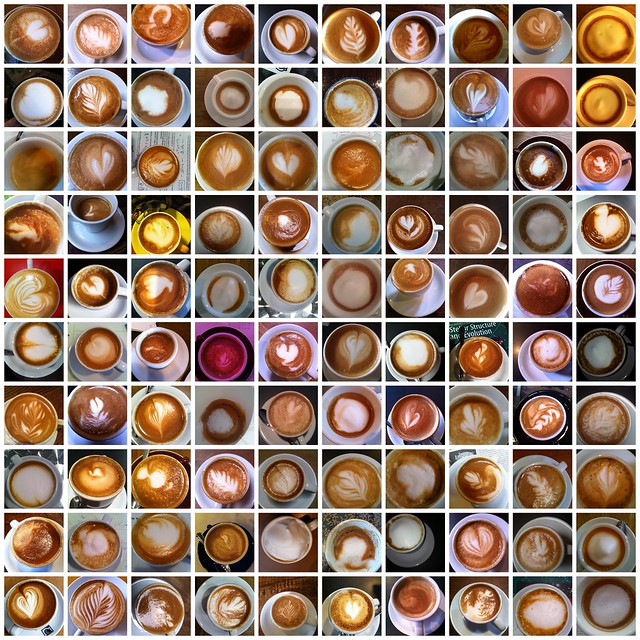
I am keen on the intersection of art and science on this matter. I like making collages and have highlighted repeated images before with 35 images of space helmet reflections and 100 images of macchiatos. Through repetition and distortion images may be amplified or diminished. It depends on perspective. Generally in artistic endeavors, as in life, the slight variations of a repeated theme are aesthetically pleasing. On the other hand technical work such as engineering, data analysis, or manufacturing requires precise replication. I work in radio astronomy where each radio telescope in the array is nearly identical and the need for precision trumps all other considerations. I find that randomness is never particularly interesting, but neither is absolute order. Somewhere in between these extremes we have something really beautiful.

Scratching the Surface

Perth, Australia - I found myself in a coffee shop in downtown Perth today just as I would likely of been in Seattle. It was as if I were in a parallel dimension and indeed I talked about parallel dimensions with some new friends I met. I asked them about places in Perth and they asked me about the Universe; I think I learned as much about Perth as they learned about the Universe.

I walked north towards a pub they recommended, but on the way I discovered something much more interesting. I stumbled upon the Scratching the Surface art show. It was a visual art gallery opening by several young artists just beginning to make they mark upon they world, or as they said just scratching the surface. I was walking along the street when I took a double take upon seeing book pages folded upon themselves in a mysterious manner. It was Pascal Proteau's work from recycled books. One of the most imposing works was a massive balance of books holding upon itself a crooked balance of folded book pages.
Nathan Brooker presented a series of works that were reminiscent of Andy Warhol in their repetition and bright colors. Some of his work was shocking. The image below is tame, but the Nathan did many more interesting things which cannot be shown (here is a seriously not safe for general consumption, very intense and shocking do not click here if you don't want to be offended image of Booker with art).
There was lots of shocking art including strange embroidery by Carla Adams. She used homely materials to create dangerous and daring works. I assure you that the image here is the most tame possible from the work she had on display. I asked her what had turned her mind to think of such juxtaposed concepts and she said that it was exactly that, the juxtaposition itself of feminine handy work and male homosexuality.
I was drawn in by the strange folding of books, but it was Ian Williams piece that really stole the show for me. He called it 'Under the Influence', but whatever the influence was it was inspired. An acrylic on oil board piece it was a work of labor as he told me it was painted with acrylic then sanded down then painted again. The entire piece had a subtle checkerboard texture pattern which resulted. And the eyes. The eyes followed the viewer from every angle. This piece was also amazingly large (1.8 by 1.2 meters) which added to its captivating features. It was a stunning piece. He is a talented artist.
Finally, here is a piece of art created just this evening by a friend who I know only as Silvia. She was an art student at the same school in Perth (CIT) as all the artists featured above. I went to a bar (with the aptly artistic name Ezra Pound) with her after the art show and she drew this for (or rather of) me.
It was a strange day in a strange place, but it was fantastic. Tomorrow, I head north into the desert and the Outback.

100 Images of Macchiatos

I drink a lot of macchiatos. If you don't know, a macchiato is an espresso coffee 'marked' with steamed milk.
You can see a larger version  here. I work in coffee shops almost daily here in Seattle, and over the last year or so I took these pictures of each drink I had. Each coffee shop and barista has a different way of making the drink and I didn't take each picture in any particular way to standardize them, but I really like the result: a collage of consumption of coffee: 100 images of macchiatos. A little while ago I posted Thirty Five Images of Space Helmet Reflections which was a similar image, alas, while I would like to of been wearing one of those space helmets the reality is that I spend my time merely dreaming of the stars in coffee shops.

White Cosmonaut, Red Cosmonaut

Check out this lovely art by Jeremy Geddes. He is a Melbourne artist who works with mostly oil paints. His paintings have glowing colors and he has this recurrent cosmonaut theme that vaguely makes them seem relevant. Below are three of my favorite images that I have seen: The White Cosmonaut, The Red Cosmonaut, and Heat Death. Of his cosmonaut series he himself is vague,
I wanted to construct my own reality through my paintings, a quiet melancholic space that operates by it’s own set of underlying rules and runs it’s own oblique narrative. With each successive painting, I try to build the world and uncover it’s form. The cosmonaut paintings are the first step in this.
And on his piece Heat Death he again lets your mind linger on meaning and reasoning,
Hopefully, I communicate everything I want to say through the painting itself. I’m not interested in giving it a didactic final meaning. I just want to spark questions in the viewer.
Artists have the luxury of letting their art speak so that they don't have to. Scientists don't have this luxury and generally must have a didactic (although, not intending to imply moral) explanation of nature; an explanation which may or may not be close to the truth. Science ultimately doesn't self explain its emphases on truth seeking. Truth is like art, sought for its own sake. Oh and please, if someone wants to buy me the Red/White Cosmonaut diptych print feel free.
The White Cosmonaut


The Red Cosmonaut

Heat Death

ATLAS Mural

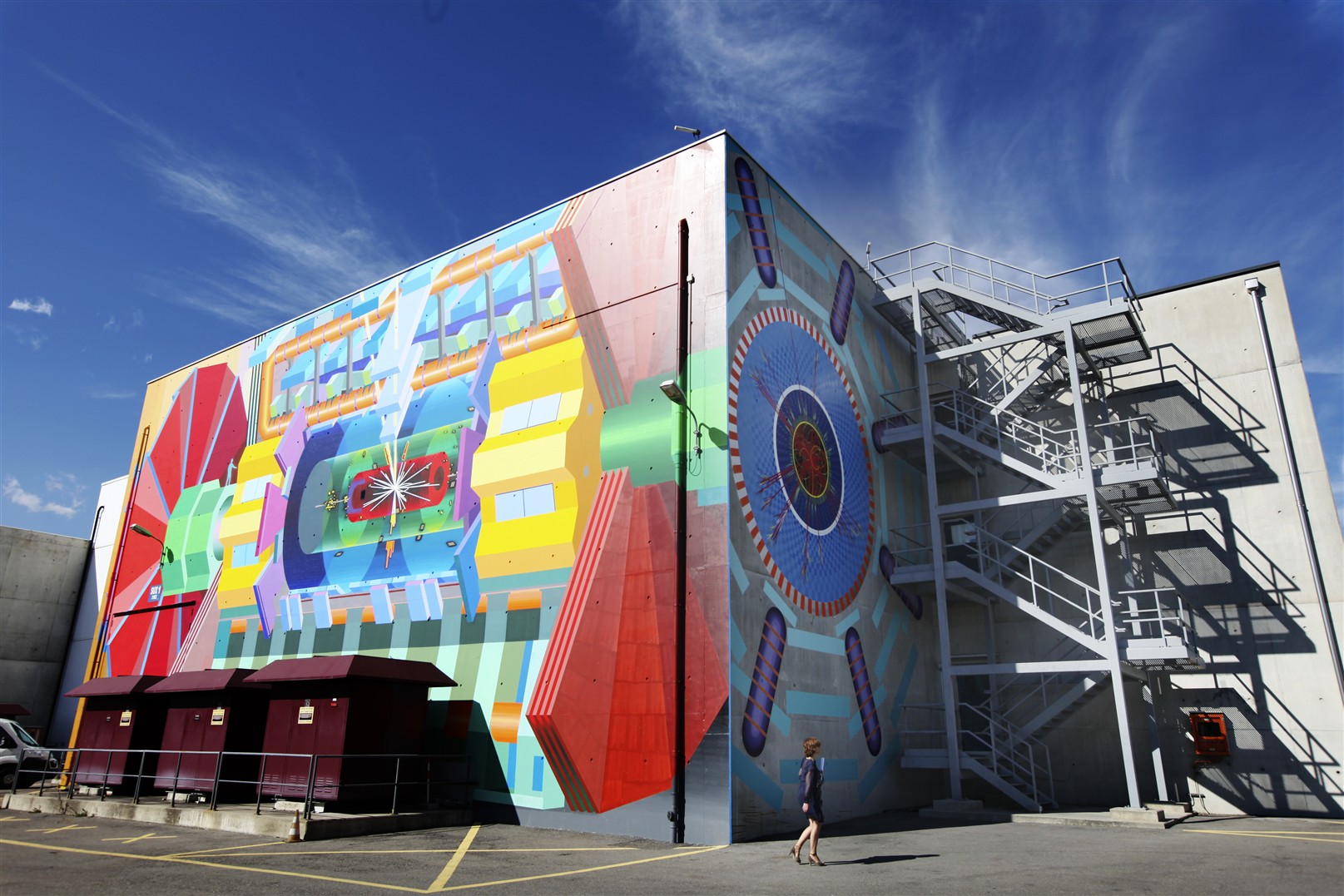
ATALAS commissioned an impressive mural of their detector that has just been completed. Artist Josef Kristofoletti created the massive mural of the Large Hadron Collider's ATLAS detector on the outside wall of loop point 01. The mural was commissioned by the ATALAS experiment after Kristofoletti first painted a similar, though much smaller, mural on the side of the Redux Contemporary Art Center in Charleston, South Carolina. Kristofoletti found inspiration for the art by merging his enjoyment of classic Italian Renaissance murals and his life long fascination with science. He says that the humongous size of ATALAS and the tiny particles it finds make the Large Hadron Collider fascinating, like an unprecedented modern cathedral of science. The event depicted in the mural shows an actual event recorded by ATALAS of a Z boson decay into two muons.


There are more concept pictures here or finished pictures from CERN here.

you are at the center of the universe

You Are at the center of the universe
The cosmological principle states the universe is homogeneous and isotropic when viewed on large enough scales. It is the ultimate extension of the Copernican Principle which asserts that the Earth is not in any special place in the universe. Mathematically this statement reduces to the Friedmann-Lemaître-Robertson-Walker metric solution to the Einstein field equations. In our expanding universe with scale factor a, as a function of time t, with the constant k representing the curvature of space (we have measured it and it is about zero), the angles θ and φ being the normal azimuthal and polar angles in spherical coordinates, and r being the radius, the metric solution to your universe is:
Friedmann-Lemaître-Robertson-Walker metric solution to the Einstein field equations
It is a beautiful thing that each observer is in a unique position to be at the center of their own observed universe because the expansion of the universe results in a coherent Hubble flow away from your point of reference in every direction. Thus one may entertain the notion that you are at the center of the universe. However, an external observer would also perceive that they are at the center of the universe. Thus, while observationally everyone is at the center of their own personal expanding universe, we logically conclude that this is merely an observational illusion of isotropic and homogeneous expansion. By carefully examining anisotropies in the cosmic microwave background or measuring the redshift of galaxies in different directions over time we can determine if the Copernican Principle is valid.

Einstein’s blackboard


Einstein’s blackboard as used in a lecture in Oxford on 16 May 1931:
At that time Einstein’s theories of relativity were being combined with astronomical data to explain the shifts towards the red in the spectra of distant galaxies, which indicated that the universe was expanding. In his lecture Einstein outlined a fairly simple model to explain this apparent expansion. In the first line on the blackboard, D, the measure of expansion in the universe, is defined in terms of the expansion factor P. The expression for the density of matter in the universe, given by ρ in the third line, is derived from the field equations. The last four lines contain numerical data, giving values for density, radius and age of the universe, where ‘L. J’ stands for ‘Licht Jahr’ (light year) and ‘J’ for ‘Jahr’ (year). According to the last line, the age of the universe is about 10, or perhaps 100 billion years (the bracket indicates an alternative figure, not a product of two figures).
From Bye-bye blackboard... from Einstein and others

Smithsonian Air and Space Posters


apollo
et
et
areopostale
amsterdam

The Smithsonian National Air and Space Museum has digitized their poster collection online. Above are some of my favorite picks and below a blurb about the posters.

Throughout their history, posters have been a significant means of mass communication, often with striking visual effect. Wendy Wick Reaves, the Smithsonian Portrait Gallery Curator of Prints and Drawings, comments that "sometimes a pictorial poster is a decorative masterpiece-something I can't walk by without a jolt of aesthetic pleasure. Another might strike me as extremely clever advertising … But collectively, these 'pictures of persuasion,' as we might call them, offer a wealth of art, history, design, and popular culture for us to understand. The poster is a familiar part of our world, and we intuitively understand its role as propaganda, promotion, announcement, or advertisement."

Reaves' observations are especially relevant for the impressive array of aviation posters in the National Air and Space Museum's 1300+ artifact collection. Quite possibly the largest publicly-held collection of its kind in the United States, the National Air and Space Museum's posters focus primarily on advertising for aviation-related products and activities. Among other areas, the collection includes 19th-century ballooning exhibition posters, early 20th-century airplane exhibition and meet posters, and twentieth-century airline advertisements.

The posters in the collection represent printing technologies that include original lithography, silkscreen, photolithography, and computer-generated imagery. The collection is significant both for its aesthetic value and because it is a unique representation of the cultural, commercial and military history of aviation. The collection represents an intense interest in flight, both public and private, during a significant period of its technological and social development.

To Octavio Paz


It looks like the NASA STEREO mission is continuing to not only study our closest star, but also inspire artists. Some lines from The Broken Jar by Octavio Paz,
A world of spin and flame is born in the head of the dreamer, blue suns, green whirlwinds, bird beaks of light pecking open the pomegranate stars
In this next film scientists at UC Berkeley talk about their research and the secret lives of invisible magnetic fields are revealed as chaotic ever-changing geometries,
Photons take hundreds of thousands of years to random walk there way from the core [of the sun] all the way out to where we see them in the photosphere yet in a millionth of second a [magnetic field line] reconnection completely changes topology of the corona

Missing Pages


This film mesmerizes me. Missing Pages is a short film by Jerome Oliver about a genius professor and the time machine he creates which leads him into internal battles, a war for humanities humanness, and a reckoning with reality. It is set in a sort of post-singularity minimalist landscape. The entire film is composed of manipulated digital photography with a technique called fotomation. If you enjoy film for films sake then one would argue solely on their use of an experimental approach that it should be watched, but I just really liked the film all around. The music adds a depth which keeps bringing me back.

Above is just the first third of the film. The above clip does not do justice to the film's quality. The clip was removed because it violated terms of service. Anyways, you can get all three parts of the film in high definition full screen for free from itunes here.