Field of Science

Showing posts with label graduate school. Show all posts

Sobre el Futuro and the Lindau Nobel Laureate Conference

It may appear that I haven't been busy lately because of the death of posts here at The Astronomist. You would be right to suspect that in reality I have actually been extremely busy. I passed my general exam here at the University of Washington and I am now a proto-doctor or a PhD candidate as it were. Regardless, now that this hurtle is out of the way I just have to do a thesis. In the spare time I have been up to so many other things. I did an interview with WHAT which is an organization that aims to raise a discussion about philosophy, science, and culture. They are based out of Spain, but the idea is international and focuses on people. I was interviewed as part of their series sobre el futuro or about the future where I talked about the future of the universe and the future for humans on Earth. I really, like the quote they caught from me, "No creo que ningún astrónomo piense que estamos solos en el Universo." You can watch the interview here.


Next up I am traveling to Lindau Germany once again to cover the Lindau Nobel Laureate Conference. I will be writing with the Nature blog team. I am very excited to be returning to Lindau this year. I first covered the Lindau Nobel Laureate conference in 2010 and at the time I really didn't know what to expect. I found that Lindau is an amazing place where ideas are exchanged at a rapid pace and discussions of science and the future are pervasive. I love it. I will be attending the conference from the journalist perspective of course so I will be interviewing people, including Nobel Laureates, while at the same time learning and communicating what I discover to a larger audience. If you haven't heard of the Lindau conference before (or even if you have) I recommend checking out the Lindau Mediatheque where they have videos of the lectures given by the Laureates. I am already blogging over on the Lindau blog; the conference starts on July 1st and lasts an entire week. Please go check it out and I will talk to you again from Germany.

Science writing versus writing like a scientist

It is a fact that I have written more fiction in my life than science writing and more science writing that I have scientific papers. When my advisor has asked me to write I am able to naturally come up with an abstract and an introduction like a magician pulling a rabbit out of a hat. I summarize the current state of the field neatly and present our results as the natural evolution of what comes next. Then when it comes to writing out the details of the research and the work I slow down. My advisor has a bit of criticism about the introduction (it is not specific enough they say), and plenty of criticism for the rest of the writing as if my entire style is not adequate. What is with the style of science writing in grants and research papers?

It as if scientists are bound to a certain kind of writing that is dry, concise (and it has to be when we have to pay per page published in most research journals), and standardized. I think many scientist would agree that our language doesn't have to be dry as long as it is standardized. Expository writing is different from other kinds of writing sure, but we have to ask ourselves how and why? Science writing for journalism is different than that of science writing for papers of grants even though they are both technically expository writing. I wonder if this is because they must be or because mediocre writing has become the style in science papers. Adam Ruben has written a wonderful opinion piece over at Science magazine mocking some of the quirks of scientific paper writing. The piece is worth a read and he includes a list of science paper tropes which are hilarious. Here is an excerpt:

Image of a book, by Flickr user romling1. Scientific papers must begin with an obligatory nod to their own relevance, usually by citing exaggerated figures about disease prevalence or other impending disasters. If your research does not actually address one of these issues, pretend it does, because hey, that didn’t stop you on the grant application. For example, you might write, “Twenty million children die of scabies every day. OMG we built a robot kangaroo!”

2. Using the first person in your writing humanizes your work. If possible, therefore, you should avoid using the first person in your writing. Science succeeds in spite of human beings, not because of us, so you want to make it look like your results magically discovered themselves.

3. Some journals, such as Science, officially eschew the passive voice. Others print only the passive voice. So find a healthy compromise by writing in semi-passive voice.

ACTIVE VOICE: We did this experiment.

PASSIVE VOICE: This experiment was done by us.

SEMI-PASSIVE VOICE: Done by us, this experiment was.

Yes, for the semi-passive voice, you’ll want to emulate Yoda. Yoda, you’ll want to emulate.


Read on you will want to, like a scientist you must write.

American Astronomical Society Meeting

The 217th American Astronomical Society Meeting was held here in Seattle this week. I attended every session I could, learned many new things, and met or reunited with many astronomy friends. I was too busy to blog during the event, but you can see what I and many others were saying during the conference by searching on twitter for #aas217 and below I have compiled a random selection of abstracts from interesting talks and posters I saw.
  • The History And Environment Of A Faded Quasar: HST Observations Of Hanny's Voorwerp And IC 2497. Keel, William C. Perhaps the signature discovery of the Galaxy Zoo citizen-science project has been Hanny's Voorwerp, high-ionization cloud extending 45 kpc from the spiral galaxy IC 2497. It must be ionized by a luminous AGN, either deeply obscured or having dimmed dramatically within 200,000 years. We explore this system using HST imaging and spectroscopy. The disk of IC 2497 is warped, with complex dust absorption near the nucleus; the near-IR peak coincides closely with the VLBI core marking the AGN. STIS spectra show the AGN as a low-luminosity LINER, with ionization parameter log U= -3.5, matching its weak X-ray emission. The nucleus is accompanied by an expanding loop of ionized gas 500 pc in diameter, opposite Hanny's Voorwerp. The loop's Doppler span 300 km/s implies kinematic age < 700,000 years. We find no high-ionization gas near the core, further evidence that the AGN is seen at a low radiative output (perhaps now dominated by kinetic energy). [O III] and Ha +[N II] ACS images show fine structure in Hanny's Voorwerp, including limb-brightened sections suggesting modest interaction with a galactic outflow. We identify small regions ionized by recent star formation, unlike the AGN ionization of the overall cloud. These H II regions contain blue continuum objects, consistent with young stellar populations; these occur where projected closest to IC 2497, perhaps meaning that the star formation was triggered by compression from an outflow. The ionization-sensitive [O III]/Ha ratio shows broad bands across the object, and no discernible pattern with emission-line structures or near the prominent "hole" in the ionized gas. These results fit with our picture of an ionization echo from an AGN whose ionizing luminosity has dropped by a factor >100 within the last 200,000 years. Such rapid fluctuations in luminosity could alter our understanding of AGN demographics. Supported by NASA/STScI. 

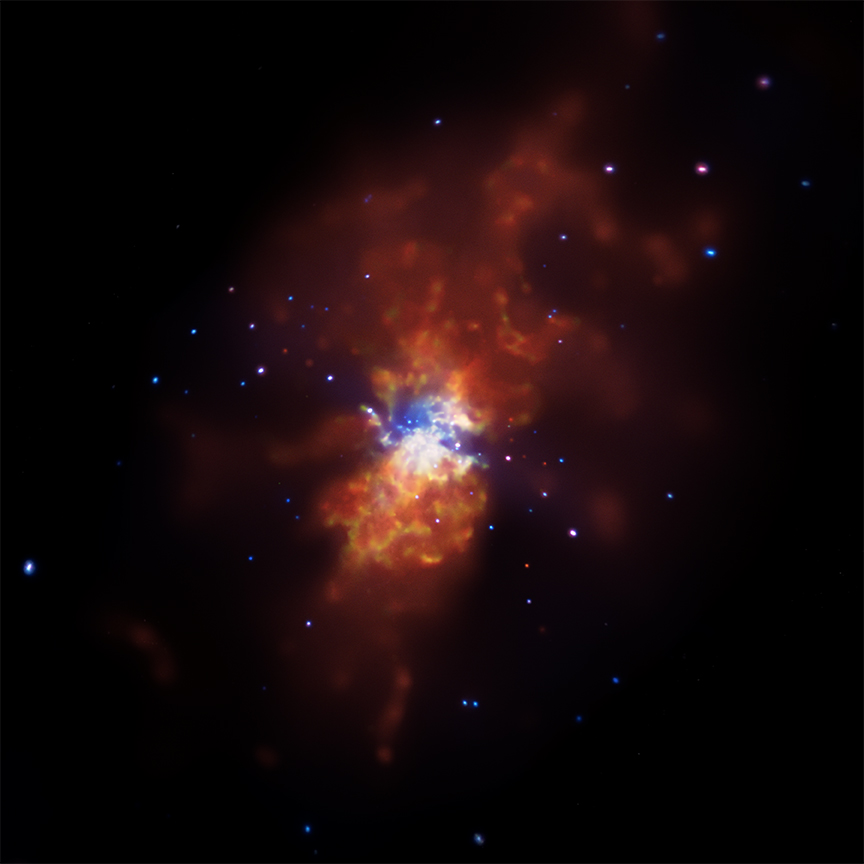
  • The Discrete X-ray Source Population of M82. Roy E. Kilgard.  M82 is the prototypical starburst galaxy in the nearby universe. As such, it is an excellent laboratory for studying high-mass X-ray binaries. We present an initial analysis of the discrete source population of M82, with an emphasis on the ultraluminous X-ray sources, using new and archival observations from the Chandra X-ray Observatory. M82 has been observed for more than 700 ks with ACIS and an additional 190 ks with the HRC, with observations spanning the entire Chandra lifetime to date. These data paint a portrait of the complex spectral and temporal variability of the high-mass X-ray binary population of a starburst galaxy. We will discuss the properties of these sources and the impact they have on the shape of the X-ray luminosity function. 

  • 3D Reconstruction of the Density Field: Using Redshift Information in Weak Lensing Analysis. Jake Vander Plas. We present a new method for constructing three-dimensional mass maps from gravitational lensing shear data. We solve the lensing inversion problem using truncation of singular values (within the context of generalized least squares estimation) without a priori assumptions about the statistical nature of the signal. This singular value framework allows a quantitative comparison between different filtering methods: we evaluate our method beside the previously explored Wiener filter approaches. Our method yields near-optimal angular resolution of the lensing reconstruction and allows cluster sized halos to be de-blended robustly. It allows for mass reconstructions which are 2-3 orders-of-magnitude faster than the Wiener filter approach, which will become increasingly important for future large surveys, e.g. LSST. Using this SVD framework, we discuss optimal redshift binning for 3D shear mapping, and explore how this informs the choice of binning in measurements of power spectrum evolution. 

  • Subtraction Of Point Sources From Interferometric Radio Images Through An Algebraic Forward Modeling Scheme. Gianni Bernardi.  Cutting edge cosmological investigations of the Epoch of Reionization (EoR) are driving a renovated effort in building low frequency radio interferometers. In order to detect the tiny EoR signal, high dynamic range (DR) imaging at frequencies below 200~MHz is required. High DR images are traditionally obtained by subtraction of bright sources from the ungridded visibilities, however, future generations of large-N radiotelescopes will generate such high volume data stream that the cost of storing the raw ungridded visibilities will be prohibitive. The DR will therefore be limited by well known pixelization effects. Further challenges for an image based deconvolution at low frequencies are a point spread function which varies significantly across the field of view, a time and frequency variable receptor response and ionospheric variability. In this presentation, we introduce a deconvolution algorithm which makes use of forward modeling to mitigate against the limitations of image-based deconvolution. Through forward modeling it is possible to generate a spatially variable point spread function and relate the sky brightness distribution to astrophysical parameters which are then retrieved through a non linear least squares minimization. We applied the method to the deconvolution of point sources on simulated observations of the Murchison Wide-field Array (MWA). MWA is the array with the largest number of correlated elements currently under construction (512 final elements) and will not have the option of storing the raw visibility data over long time integrations. We find that the accuracy to which point sources can be deconvolved/subtracted is only limited by their signal to noise ratio, not by their number or positions, therefore the DR increases with integration time. These results indicate this method to be promising for applications that require high DR imaging, like the detection of the EoR signal. This work was supported by the U.S. National Science Foundation. 

  • Early Astrophysics Results from Planck. Charles R. Lawrence. Since August 2009 Planck has been observing the sky at frequencies from 30 to 857 GHz, measuring not only the cosmic microwave background, but also everything else in the universe that radiates at these frequencies. I will describe the first scientific results from Planck covering a wide range of galactic and extragalactic astrophysics. 

  • Extracting The Astrophysics Of The First Sources From The 21 Cm Global Signal. Jonathan R. Pritchard. Low frequency radio observations of the redshifted 21 cm line of neutral hydrogen have the potential to open a new window into the period from redshift z=6-30 when the first galaxies formed and reionization occurred. Single dipole experiments targeted at the frequency evolution of the 21 cm global signal are likely to provide the first constraints on this epoch. In this talk, I discuss the science of this signal and quantify the prospects for these instruments using a Fisher matrix based approach. I will show that there is considerable room for these simple experiments to constrain the star formation rate and production of X-ray and UV photons by the first luminous sources, provided that issues of calibration, RFI, and the ionosphere can be controlled.

  • Radio Pulsars as Gravitational Wave Detectors: Recent Observational Results. Paul Demorest. The idea of using an array of millisecond radio pulsars as a nanohertz-frequency gravitational wave detector has continued to attract increasing attention over the past several years. Current experimental sensitivities are beginning to probe the upper limits of the predicted signal strength and a detection seems entirely within reach. The North American Nanohertz Observatory for Gravitational Waves (NANOGrav) project has been regularly timing a set of 20 millisecond pulsars over the past 5 years. These observations use the two largest radio telescopes on Earth, Arecibo Observatory and the NRAO Green Bank Telescope. In this talk, I will present newly developed analysis procedures and timing results from the NANOGrav 5-year data set. These are then used to place a new experimental limit on the strength of the stochastic nHz-frequency gravitational wave background.

  • Imaging the Spatial Fluctuations in Cosmic IR Background from Reionization with CIBER. Chris Frazer. The Cosmic Infrared Background Experiment (CIBER) is a rocket-born absolute photometry imaging and spectroscopy experiment optimized to detect unresolved infrared signatures of first-light galaxies that were present during reionization. The signatures from reionization are theorized to be dominant at the wavelengths upon which CIBER surveys. CIBER consists of two wide field imagers to measure the extragalactic background fluctuations in the H and I-Bands (1.6 and 0.9 microns respectively) of the cosmic infrared background (CIB) as well as two spectrometers designed to take measurements of the foreground zodiacal light and the absolute Extragalactic Background Light (EBL) spectrum They imagers are capable of examining high-redshift (z ~ 10-20) CIB fluctuations which will facilitate in the study of surface densities of sources associated with reionization. Studies of galaxies with similar redshift parameters (z > 6) are largely unaccounted for. The spectrometer configuration consists of one low resolution spectrometer and one narrow band spectrometer. They are respectively designed to take measurements of the absolute Extragalactic Background Light (EBL) spectrum, and foreground zodiacal light. In this poster we present the specifications for both CIBER imagers and detail how the fluctuations from galaxies during reionization will be measured.

  • The 21cm Forest. Katherine J. Mack. Future observations of the 21cm forest -- neutral hydrogen absorption against high-redshift radio sources -- will allow us to trace out the structure of the pre-reionization intergalactic medium (IGM), provided bright radio sources can be found at sufficiently high redshift. I will present a calculation of the expected 21cm forest as might be observed in coming years and show how statistical detection techniques could be used to overcome the low signal-to-noise. I will also discuss the trade-off between the availability of large populations of high-redshift background radio sources and the requirement that the IGM be sufficiently neutral for strong absorption. 

  • Gradual Mode Evolution in PSR B0943+10. Isaac Backus. 40 years after the discovery of pulsars, their emission mechanisms are still poorly understood. A problem which still lacks explanation is that of moding: it is observed that the average pulse profile of many pulsars switches between two or more discrete modes. We present an 8 hr observation of the well known drifting and moding pulsar B0943+10. While the pulsar has two discrete modes of emission, and switches between modes in less than a pulse, there is a gradual evolution of its properties within one of the modes: the linear polarization increases; the drift rate and the average pulse profile change with the same characteristic time. Under the subbeam carousel model, we infer from these dynamics that the ExB drift velocity may gradually vary during one mode which may imply a change in temperature at the polar cap.

  • Addressing Unconscious Bias: Steps toward an Inclusive Scientific Culture
    Author Block. Abigail Stewart. In this talk I will outline the nature of unconscious bias, as it operates to exclude or marginalize some participants in the scientific community. I will show how bias results from non-conscious expectations about certain groups of people, including scientists and astronomers. I will outline scientific research in psychology, sociology and economics that has identified the impact these expectations have on interpersonal judgments that are at the heart of assessment of individuals' qualifications. This research helps us understand not only how bias operates within a single instance of evaluation, but how evaluation bias can accumulate over a career if not checked, creating an appearance of confirmation of biased expectations. Some research has focused on how best to interrupt and mitigate unconscious bias, and many institutions--including the University of Michigan--have identified strategic interventions at key points of institutional decision-making (particularly hiring, annual review, and promotion) that can make a difference. The NSF ADVANCE Institutional Transformation program encouraged institutions to draw on the social science literature to create experimental approaches to addressing unconscious bias. I will outline four approaches to intervention that have arisen through the ADVANCE program: (1) systematic education that increases awareness among decisionmakers of how evaluation bias operates; (2) development of practices that mitigate the operation of bias even when it is out of conscious awareness; (3) creation of institutional policies that routinize and sanction these practices; and (4) holding leaders accountable for these implementation of these new practices and policies. Although I will focus on ways to address unconscious bias within scientific institutions (colleges and universities, laboratories and research centers, etc.), I will close by considering how scientific organizations can address unconscious bias and contribute to creating an inclusive scientific culture.

Busy

I am overwhelmingly busy right now. I wont have any time for The Astronomist until the middle of June or so because apparently taking painful qualifying exams builds character. In the meantime here are some diversions...
  • The Myth of Gravity
  • Erik Verlinde considers gravity as information. His theory implies that gravity is nothing more than the result of a system maximizing its entropy. See the full paper here.
  • The Holographic Universe
  • Craig Hogan’s suggests nature deals with quantum mechanics and spacetime through the holographic universe. See a paper that discusses holographic noise in gravity wave interferometers here.
  • The World Cup
  • Something completely different, but also completely awesome, and the physics of soccer is quite interesting too. Check out the video below that just begins to capture a fraction of the spirit of the World Cup held in South Africa this summer.

Ten Thousand Things

I have been rather busy lately with finals, my graduate qualifying exam, and ten thousand other things. I had no time to blog and further I still have to figure out what happened last night because I was all too alacritous to celebrate with the graduate students after the qualifying exam (they threw us a fiesta afterwards where every time you mention the qualifiyng exam you have to take a shot).

On top of all that the Murchison Widefield Array (MWA) collaboration meeting was this past week here in Seattle. The MWA is a radio telescope array that will explore a new scientific frontiers: the epoch of reionization, transient radio events, solar heliospheric and ionospheric research.


I have been getting involved with this project so now that the school semester is over it all starts again with research this summer. More on that as it develops.