


Field of Science
-
-
Change of address1 year ago in Variety of Life
-
Change of address1 year ago in Catalogue of Organisms
-
-
Earth Day: Pogo and our responsibility1 year ago in Doc Madhattan

Showing posts with label particle physics. Show all posts
Showing posts with label particle physics. Show all posts
Discovering the Higgs Boson
LINDAU, Germany — Tommrrow CERN will make an announcement, likely about the Higgs boson. The Higgs boson is a key part of the standard model of physics and this is a rather exciting discovery. You can read my article about the prospects for the discovery of the Higgs boson over at the Nature Lindau blog where I am writing.
Disassociate Galaxy Clusters
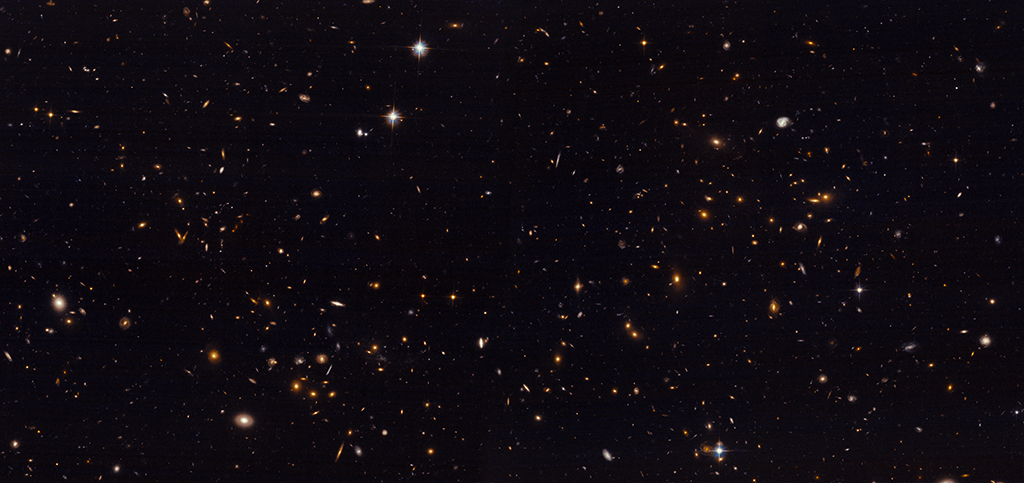
A dissociative galaxy cluster is a cluster of galaxies that just can't keep it together any longer. This may sound like an unnecessary anthropomorphication of galaxies, but it is actually a description of galaxy clusters which have collided and experienced stratification of their constituent parts. In the standard and successful model of cosmology the largest scale structures in the universe, like super clusters of thousands of galaxies, form via the merger of filamentary structures composed of smaller clusters of galaxies. Gravity keeps pulling clusters together along highways of galaxy clusters. Occasionally it is expected and observed that galaxy clusters meet each other head on in cosmic train wrecks moving at thousands of kilometers per second. These traumatic merging events scar the galaxy clusters for life. Their post traumatic stress afflictions include hot shocked X-ray gas and galaxies displaced from their gas halos. Lets consider the three main constituents of a galaxy cluster: stars, gas, and dark matter.
 In practice many times it is easier to first identify galaxy clusters through their gas content because the gas content is more massive than the stellar component. Many new clusters are identified by observing the cluster gas's effect in the microwave regime or in the X-ray regime. In the image below taken by the the NASA Chandra X-ray observatory the hot intracluster gas is seen in pink. This image corresponds to exactly the same field of view on the sky as the optical image above.
 It may dawn on you that by the very definition of dark matter there is no telescope which can observe it directly. The only in way in which dark matter interacts strongly is through gravity and thus that is how astronomers look for it. Through theoretical predictions and confirmed observations we know that gravity bends light and thus massive galaxy clusters will bend the light of even more distant galaxies. Thus through weak gravitational lensing the dark matter betrays its presence. A careful statistical analysis of galaxy shapes in the optical image above reveals that the galaxies which are confirmed not to be in the foreground cluster are slightly distorted in shape via the gravitational force of the dark matter which is in the foreground. A reconstruction of the total mass in the clusters is shown in the image below where the parts of the cluster which have the most mass are shown in blue. This image corresponds to exactly the same field of view on the sky as optical and X-ray images above.
 Finally, a superposition of all the data allows us to glimpse at what a crisis this merging cluster is in. Note that the optical image remains in its original color, the gas is in pink, and the mass is in blue. The image below is known as the Musket Ball Cluster. The actual collision of galaxies occurred about 700 million years ago. We can rewind the collisions in our heads and envision that blue/optical cluster on the right of the image was once on the left and so the blue/optical cluster on the left of the image was once on the right; the clusters collided head on and the gas stopped dead at the center, but the galaxies and dark matter hardly stopped. There are several other images below of other dissociative cluster mergers with the same color scheme. Notice the different morphologies and distributions of mass, stars, and gas. The collisions are not always so straight forward.
 Musket Ball Cluster. X-ray: NASA/CXC/UCDavis/W.Dawson et al; Optical: NASA/STScI/UCDavis/W.Dawson et al.
 Train Wreck Cluster. X-ray: NASA/CXC/UVic./A.Mahdavi et al. Optical/Lensing: CFHT/UVic./A.Mahdavi et al.
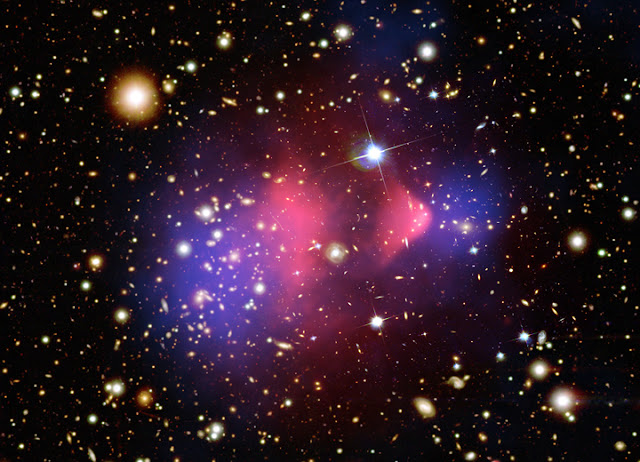 Bullet Cluster. Credit: X-ray: NASA/CXC/CfA/M.Markevitch et al.; Optical: NASA/STScI; Magellan/U.Arizona/D.Clowe et al.; Lensing Map: NASA/STScI; ESO WFI; Magellan/U.Arizona/D.Clowe et al.The awesome thing about these cosmic mergers is how they can constrain the dark matter self-interaction cross-section. That is, exactly who much does dark matter interact with itself? The interpretation of these collisions is not always simple such as in the Train Wreck Cluster (seen above) where there seems to be an extra dark matter core not associated with any bright galaxy at the center of the image, but nonetheless these mergers can be thought of as astrophysical laboratories of dark matter. It would be very interesting to discover that dark matter self-interacts at all, however dissociate clusters will only be one piece of the extraordinary evidence necessary to make that claim.

Dawson, W., Wittman, D., Jee, M., Gee, P., Hughes, J., Tyson, J., Schmidt, S., Thorman, P., Bradač, M., Miyazaki, S., Lemaux, B., Utsumi, Y., & Margoniner, V. (2012). DISCOVERY OF A DISSOCIATIVE GALAXY CLUSTER MERGER WITH LARGE PHYSICAL SEPARATION The Astrophysical Journal, 747 (2) DOI: 10.1088/2041-8205/747/2/L42
Jee, M., Mahdavi, A., Hoekstra, H., Babul, A., Dalcanton, J., Carroll, P., & Capak, P. (2012). A STUDY OF THE DARK CORE IN A520: THE MYSTERY DEEPENS The Astrophysical Journal, 747 (2) DOI: 10.1088/0004-637X/747/2/96
Markevitch, M., Gonzalez, A., Clowe, D., Vikhlinin, A., Forman, W., Jones, C., Murray, S., & Tucker, W. (2004). Direct Constraints on the Dark Matter Self‐Interaction Cross Section from the Merging Galaxy Cluster 1E 0657−56 The Astrophysical Journal, 606 (2), 819-824 DOI: 10.1086/383178
- Clusters are made of aggregates of hundreds or thousands of galaxies and each galaxy is made of hundreds of billions of stars. The stars of the galaxy cluster are conspicuous in that they shine and are observable in pictures, but they account for only about 5% or less of the cluster's mass. The luminous stars of galaxies don't interact much during a collision with another cluster of galaxies and so they act like people in two crowds which are moving in opposite directions. Stars are part of the cosmic ghost train.
- The gas in galaxy clusters accounts for about 10% of the regular (or baryonic) mass in clusters. Gas does interact during a collision. The gas clouds in colliding galaxy clusters slams together like two waves of water meeting and stalls out, but not without undergoing a process known as shock heating first which raises the gas temperature to millions of degrees.Gas is part of the cosmic train wreck.
- The dark matter in galaxy clusters is the most dominant part of the cluster by mass making up about 90% the mass. Dark matter does not interact much. The dark matter halos travel right through each other like ghosts when two clusters collide. However, it is possible that the dark matter does interact slightly and dissociative collisions are a powerful tool in constraining this dark matter interaction. The dark matter halos of the colliding clusters should sail right past each other like two ghost trains, but if the trains slow down even in the slightest it may indicate something strange.


Dawson, W., Wittman, D., Jee, M., Gee, P., Hughes, J., Tyson, J., Schmidt, S., Thorman, P., Bradač, M., Miyazaki, S., Lemaux, B., Utsumi, Y., & Margoniner, V. (2012). DISCOVERY OF A DISSOCIATIVE GALAXY CLUSTER MERGER WITH LARGE PHYSICAL SEPARATION The Astrophysical Journal, 747 (2) DOI: 10.1088/2041-8205/747/2/L42
Jee, M., Mahdavi, A., Hoekstra, H., Babul, A., Dalcanton, J., Carroll, P., & Capak, P. (2012). A STUDY OF THE DARK CORE IN A520: THE MYSTERY DEEPENS The Astrophysical Journal, 747 (2) DOI: 10.1088/0004-637X/747/2/96
Markevitch, M., Gonzalez, A., Clowe, D., Vikhlinin, A., Forman, W., Jones, C., Murray, S., & Tucker, W. (2004). Direct Constraints on the Dark Matter Self‐Interaction Cross Section from the Merging Galaxy Cluster 1E 0657−56 The Astrophysical Journal, 606 (2), 819-824 DOI: 10.1086/383178
The Boundary Between Knowledge and Belief
The director of CERN, Rolf-Dieter Heuer, talks to European Magazine.
More here.
It’s a quest for knowledge. The questions we are examining have been asked since the beginning of mankind. We are humans, we want to understand the world around us. How did things begin? How did the universe develop? That distinguishes us from other creatures. If you go outside at night and look up into the sky, you cannot help but dream. Your fantasy develops, you are naturally drawn to these questions about being and existence. And at the same time, our work has very practical consequences. When antimatter was introduced into the theoretical framework 83 years ago, nobody thought that this had any practical relevance. Yet today, the concept is used in hospitals around the world on a daily basis. Positron Emission Tomography (PET) is based on the positron, which is the anti-particle to the electron. Or take the internet. The idea of a worldwide network started in 1989 here at CERN, because we needed that kind of digital network for our scientific work. That’s the beauty of our research: We gain knowledge but we also gain the potential for technological innovation.

More here.
Antimatter trapped
A Nature letter recently reported on trapping antihydrogen. Researchers at CERN snagged 38 antihydrogen atoms in magnetic trap in what promises to the begining of fruitful research on deep symmetries in nature like charge, parity and time. I wrote up an article discussing the research for Ars Technia (where I am now an occasional contributor in case you hadn't heard) and I figure I should shamelessly self promote. From the article:
Researchers at CERN have created and trapped antihydrogen in an attempt to study the underpinnings of the standard model of physics. Antihydrogen is made of antiparticles, specifically an antiproton and a positron, instead of the proton and an electron that are present in natural hydrogen. It has the same mass but opposite charge of its normal matter counterparts.Continue reading CERN snags 38 antihydrogen atoms in magnetic trap.
Antimatter has a bad reputation for being dangerous because it annihilates on contact with regular matter, releasing prodigious amounts of energy. However, the clever reader will note that they have not been annihilated by the antimatter produced at CERN. The reality is that if you gathered all of the antimatter CERN has ever created, you wouldn't garner enough energy to power your laptop through reading this article.
The Universe seems to be made of mostly regular matter, so any antimatter encounters matter and is annihilated immediately after it has been created. Production and detection of cold antihydrogen atoms also happened at CERN in 2002, but those were short-lived. The new Nature letter describes how to overcome the difficulty of containing antihydrogen so that it isn't immediately destroyed.
ATLAS Mural
ATALAS commissioned an impressive mural of their detector that has just been completed. Artist Josef Kristofoletti created the massive mural of the Large Hadron Collider's ATLAS detector on the outside wall of loop point 01. The mural was commissioned by the ATALAS experiment after Kristofoletti first painted a similar, though much smaller, mural on the side of the Redux Contemporary Art Center in Charleston, South Carolina. Kristofoletti found inspiration for the art by merging his enjoyment of classic Italian Renaissance murals and his life long fascination with science. He says that the humongous size of ATALAS and the tiny particles it finds make the Large Hadron Collider fascinating, like an unprecedented modern cathedral of science. The event depicted in the mural shows an actual event recorded by ATALAS of a Z boson decay into two muons.


There are more concept pictures here or finished pictures from CERN here.
There are more concept pictures here or finished pictures from CERN here.
Colliding Particles
Colliding Particles is a series of films following a team of physicists involved in research at the new Large Hadron Collider (LHC). It is a creative documentary series (catch more episodes here) which is really well done and worth watching. Colliding Particles follows Gavin, Jon and Adam and their project, code name Eurostar, in their attempts to find the elusive Higgs Boson. One of the main aims of the the LHC is to discover once and for all whether the Higgs actually exists or not, and ‘Eurostar’ might just hold the key to finding out:
Upper Bound on Neutrino Masses from Galaxy Surveys
Cosmology not only probes the absolute mass scale of the neutrino but is a completely independent method to test against. In any case, it is imperative to include an accurate prescription for the neutrino in cosmology, as any failure to do so can bias the other cosmological parameters. A cosmological constraint on the sum of the neutrino masses is primarily a constraint on the relic big bang neutrino density Ων. One can relate this density to the sum of the mass eigenstates ∑mν as given by Ων= ∑mν/(93.14 h2 eV). The direct effects of the neutrinos depend on whether they are relativistic or nonrelativistic and the scale under consideration. Neutrinos have a large thermal velocity as a result of their low mass and subsequently erase their own perturbations on scales smaller than the free streaming length. This subsequently contributes to a suppression of the statistical clustering of galaxies over small scales and can be observed in a galaxy survey. The abundance of neutrinos in the Universe can also have a direct effect on the primary CMB anisotropies if nonrelativistic before the time of decoupling (i.e., when sufficiently massive). However, one of the most clear effects at this epoch is a displacement in the time of matter-radiation equality. All these cosmological effects can be used to impose bounds on the neutrino mass. Previous studies have capitalized on these signatures and have started to place sub eV constraints on the absolute mass scale . We utilize the new Sloan Digital Sky Survey MegaZ luminous red galaxy (LRG) DR7 galaxy clustering data to provide the first photometric galaxy clustering constraint on the neutrino and, combining with the CMB, examine the complementarity of these early- and late-time probes. With an almost comprehensive combination of probes this renders one of the tightest constraints on the neutrinos in cosmology and therefore physics.Cosmological observations provide independent constraints on the neutrino mass scale provided that a few assumptions (a flat universe with Gaussian and adiabatic primordial fluctuations and a constant spectral index for example) can be made. Compared to the prospects of current-to-next generation particle neutrino experiments (like KATRIN) it may be that astronomical surveys of the cosmic microwave background anisotropies or optical surveys of the large scale structure of the Universe will place the tightest constraints on neutrino masses for some time. Continue reading from the excerpt above written by Shaun Thomas, Filipe Abdalla, and Ofer Lahav on their invited viewpoint article in Physical Review Letters (freely available):Upper Bound of 0.28 eV on Neutrino Masses from the Largest Photometric Redshift Survey.
The Size of the Proton Measured with Lasers
A little over a week ago in Lindau, Germany Theordor Hanch hinted at new measurements of the size of the proton which may impact the fundamental theory of quantum electrodynamics. Hansch's lecture was an overview of the history of lasers progressing from our realization of the wave/particle duality nature of light to new research published in Nature on the size of the proton. The new research relies on the fact that the energy levels allowed within an atom depend upon the quantum mechanical interaction of the proton and the electron (or in the case of this recent experiment the exotic muon particle). Each atom has its own energy levels and corresponding spectral lines like a fingerprint. Understanding the spectra produced by atoms was historically very important, to stress this Hansch called the simple hydrogen spectrum the 'Rosseta stone of atoms.' Tiny discrepancies in the expected spectra of the atom in experiment compared to theory have led to major advances in fundamental knowledge. The breakthrough that allowed for exploration of these discrepancies in the behavior of atoms occurred exactly 50 years ago with the development of the laser.
The Hansch lecture on the heartbeat of light is available to watch on the Lindau conference website here. It is at least worth watching what he explains at minute 18 on the nonlinear self organization of light pulses in pulsed lasers in analogy to mechanical pendulums. He shows a video of ten mechanical pendulums in a row with staggered frequencies ranging from 30 to 39 cycles per minute. Each pendulum corresponds to one of the frequencies present in a laser cavity and at the first moment all the lasers are in phase such that constructive interference occurs corresponding to a laser pulse or a large transfer of energy. Quickly the pendulums get out of phase and although they look chaotic there are smaller emerging and disappearing patterns. If you wait long enough the pendulums briefly line up in phase again and this is when the laser when emit the next big flash of light. This demonstration is lovely because it underlies all of physics, if you are a physicist you probably can immediately visualize what I am describing, if you are not a physicist you may have to see the video to visualize what I am talking about, but everyone will appreciate the beauty of the simple demonstration which was effective enough to illicit a round of applause from the audience.
 Historically precision measurement of the hydrogen energy levels were difficult because Doppler broadening is large for the particularly light weight hydrogen atom. Hansch explained that with lasers you can pick out hydrogen that is standing still or at most moving sideways using saturation spectroscopy. The development of lasers allowed physicists for the first time to see single fine structure components in atoms particularity the Lamb shift discerning the 2S state where the electron comes close to the proton and the 2P state where it stays away. The saturation spectroscopy technique allows the Lamb splitting of energy levels to be seen plainly. The Lamb shift depends on the size of the proton, but to probe the proton size more finely tricks are needed.
The notion of size for a particle like the proton that resides in the realm quantum mechanics is tricky to define, but there are two classic ways of measuring its radius: scattering of electrons from a hydrogen atom or by looking at the exact energy levels of a hydrogen atom. The size of the proton has been based mainly on the precision spectroscopy of atomic hydrogen and calculations from bound-state quantum electrodynamics. It is known that a hydrogenic atom with a smaller Bohr radius would enhance the effects related to the finite size of the proton, that is to say a proton interacting with a bound oppositely charged massive particle would demonstrate effects in Lamb shift due to a contribution from the proton's size. A collaborative team of scientists lead by Randalf Pohl have spectroscopically measured the Lamb shift of muonic hydrogen and found the charge radius of the proton is 4% smaller than the previously accepted value.
Muonic hydrogen is like regular hydrogen but the electron has been swapped for a muon. The experiment called for muonic hydrogen in which a muon travels around the proton with a radius 200 times smaller than that of hydrogen constructed from and electron. A muon is an elementary particle similar to the electron, is has the the same negative charge and spin, but it is about 200 times more massive than an electron. The muon 'orbits' so close to the proton in fact that it actually spends some portion of its orbit within the radius of the proton. Muons decay quickly and creating muonic hydrogen is a task that could only be undertaken at the Paul Scherrer institute in Switzerland which is the sole location in the world where a muon beam of sufficient intensity could be generated.
The Lamb shift is the result of angular momentum conservation within the atom. The 2S state of hydrogen has zero angular momentum and the 2P state has an angular momentum of one (don't ask about units). As mentioned earlier the result is that in the 2S state the electron comes close to the proton and in the 2P state it stays away.
The experiment worked as follows. The researchers created muonic hydrogen at the Paul Scherrer Institute with equipment constructed especially for the experiment (it took ten years to build). Once the muonic hydrogen is created the researchers shine in a tunable infrared laser with a frequency corresponding to the splitting between the 2S and 2P states. The laser will excite some of the muons from the 2S into the 2P state (when the muonic hydrogen is created a tiny fraction of of it is naturally produced in the 2S state), but the muons will quickly decay to the ground state emitting a powerful x-ray in the process. The researchers measured the amount of x-rays emitted at each specific frequency they had their infrared laser tuned to and the exact frequency which generated the most x-ray flux is the Lamb shift measurement they made.
The new measurement is discrepant with previous results, but the team has done such a careful job of measurement, the first results indicating a discrepancy were discovered six years ago but the results were held, that theoreticians are questioning the accuracy of fundamental constants like the Rydberg constant and basic theories of quantum electrodynamics. There is some more discussion and interpretation of the experiment over at Uncertain Principles on how the proton is even smaller than we thought. I think that it is a very cool discovery. Hansch commented on discovery during his lecture with an anecdote about Arthuer Schawlow (who received the 1981 Nobel for his work with laser spectroscopy). Schawlow would ask students in the hallways at Stanford, 'What have you discovered?' and Hansch says the message to students is, 'I am not here to learn something old, I am here to discover something new.'
References:
Pohl R, Antognini A, Nez F, Amaro FD, Biraben F, Cardoso JM, Covita DS, Dax A, Dhawan S, Fernandes LM, Giesen A, Graf T, Hänsch TW, Indelicato P, Julien L, Kao CY, Knowles P, Le Bigot EO, Liu YW, Lopes JA, Ludhova L, Monteiro CM, Mulhauser F, Nebel T, Rabinowitz P, Dos Santos JM, Schaller LA, Schuhmann K, Schwob C, Taqqu D, Veloso JF, & Kottmann F (2010). The size of the proton. Nature, 466 (7303), 213-6 PMID: 20613837
The Hansch lecture on the heartbeat of light is available to watch on the Lindau conference website here. It is at least worth watching what he explains at minute 18 on the nonlinear self organization of light pulses in pulsed lasers in analogy to mechanical pendulums. He shows a video of ten mechanical pendulums in a row with staggered frequencies ranging from 30 to 39 cycles per minute. Each pendulum corresponds to one of the frequencies present in a laser cavity and at the first moment all the lasers are in phase such that constructive interference occurs corresponding to a laser pulse or a large transfer of energy. Quickly the pendulums get out of phase and although they look chaotic there are smaller emerging and disappearing patterns. If you wait long enough the pendulums briefly line up in phase again and this is when the laser when emit the next big flash of light. This demonstration is lovely because it underlies all of physics, if you are a physicist you probably can immediately visualize what I am describing, if you are not a physicist you may have to see the video to visualize what I am talking about, but everyone will appreciate the beauty of the simple demonstration which was effective enough to illicit a round of applause from the audience.
The notion of size for a particle like the proton that resides in the realm quantum mechanics is tricky to define, but there are two classic ways of measuring its radius: scattering of electrons from a hydrogen atom or by looking at the exact energy levels of a hydrogen atom. The size of the proton has been based mainly on the precision spectroscopy of atomic hydrogen and calculations from bound-state quantum electrodynamics. It is known that a hydrogenic atom with a smaller Bohr radius would enhance the effects related to the finite size of the proton, that is to say a proton interacting with a bound oppositely charged massive particle would demonstrate effects in Lamb shift due to a contribution from the proton's size. A collaborative team of scientists lead by Randalf Pohl have spectroscopically measured the Lamb shift of muonic hydrogen and found the charge radius of the proton is 4% smaller than the previously accepted value.
Muonic hydrogen is like regular hydrogen but the electron has been swapped for a muon. The experiment called for muonic hydrogen in which a muon travels around the proton with a radius 200 times smaller than that of hydrogen constructed from and electron. A muon is an elementary particle similar to the electron, is has the the same negative charge and spin, but it is about 200 times more massive than an electron. The muon 'orbits' so close to the proton in fact that it actually spends some portion of its orbit within the radius of the proton. Muons decay quickly and creating muonic hydrogen is a task that could only be undertaken at the Paul Scherrer institute in Switzerland which is the sole location in the world where a muon beam of sufficient intensity could be generated.
The Lamb shift is the result of angular momentum conservation within the atom. The 2S state of hydrogen has zero angular momentum and the 2P state has an angular momentum of one (don't ask about units). As mentioned earlier the result is that in the 2S state the electron comes close to the proton and in the 2P state it stays away.
The experiment worked as follows. The researchers created muonic hydrogen at the Paul Scherrer Institute with equipment constructed especially for the experiment (it took ten years to build). Once the muonic hydrogen is created the researchers shine in a tunable infrared laser with a frequency corresponding to the splitting between the 2S and 2P states. The laser will excite some of the muons from the 2S into the 2P state (when the muonic hydrogen is created a tiny fraction of of it is naturally produced in the 2S state), but the muons will quickly decay to the ground state emitting a powerful x-ray in the process. The researchers measured the amount of x-rays emitted at each specific frequency they had their infrared laser tuned to and the exact frequency which generated the most x-ray flux is the Lamb shift measurement they made.
The new measurement is discrepant with previous results, but the team has done such a careful job of measurement, the first results indicating a discrepancy were discovered six years ago but the results were held, that theoreticians are questioning the accuracy of fundamental constants like the Rydberg constant and basic theories of quantum electrodynamics. There is some more discussion and interpretation of the experiment over at Uncertain Principles on how the proton is even smaller than we thought. I think that it is a very cool discovery. Hansch commented on discovery during his lecture with an anecdote about Arthuer Schawlow (who received the 1981 Nobel for his work with laser spectroscopy). Schawlow would ask students in the hallways at Stanford, 'What have you discovered?' and Hansch says the message to students is, 'I am not here to learn something old, I am here to discover something new.'
References:
Pohl R, Antognini A, Nez F, Amaro FD, Biraben F, Cardoso JM, Covita DS, Dax A, Dhawan S, Fernandes LM, Giesen A, Graf T, Hänsch TW, Indelicato P, Julien L, Kao CY, Knowles P, Le Bigot EO, Liu YW, Lopes JA, Ludhova L, Monteiro CM, Mulhauser F, Nebel T, Rabinowitz P, Dos Santos JM, Schaller LA, Schuhmann K, Schwob C, Taqqu D, Veloso JF, & Kottmann F (2010). The size of the proton. Nature, 466 (7303), 213-6 PMID: 20613837
Subscribe to:
Posts (Atom)