Field of Science

Winter Solstice Lunar Eclipse Tonight

As a young child I remember going outside in my pajamas on a cool evening to see a lunar eclipse. Interesting I thought that the moon disappears regularly, yet this event was clearly special. I have since always wished I could have lived thousands of years ago and been able to predict lunar eclipses.

The moon appears to phase in and out of darkness to an Earth bound observer on a monthly cycle, but in reality the Sun's rays are always falling upon the moon. The arced and crescent moon shapes are due to our perspective on Earth of the spherical moon being illuminated from a single direction. The rotation of the moon and the revolution of the moon are synchronously locked in a period of 27 days, 7 hours, and 43 minutes such that only one lunar hemisphere is ever visible from Earth and the other side is apparently locked in darkness. In reality the dark side of the moon sees just as much Sun as the near side on a lunar day cycle almost matching the revolution period. Despite the moon's serene appearance it is a place of extremes because without an atmosphere the Sun heats the moon to 250 Fahrenheit (123 Celsius) during its day and the moon cools to -390 Fahrenheit (-233 Celsius) during its night.

There is of course one time in which the Sun's rays are not falling upon the moon. During a total lunar eclipse the Earth blocks the light from the Sun and the Earth's shadow casts the moon into a dark red copper shadow. A total lunar eclipse will be viewable tonight in the Northern Hemisphere at U.T. 7:41 (or E.S.T. 2:41 am or P.S.T. 11:41 pm). NASA has some further information about the lunar eclipse here. Unfortunately, clouds may block your view so check the weather, indeed here in Seattle the weather may completely block this rare winter solstice lunar eclipse. That is right, this lunar eclipse occurs on the winter solstice. This really is a rare event!

As solace I have looked up several times recently in Seattle to see a moon dog or a moon ring.  A moon dog and moon ring is a halo (the ring) and bright spots (the dog) to the left and right of the moon created by the moon's light refracting through ice crystals or high clouds in the atmosphere. Even if you can't see the Eclipse tonight look up this winter to perhaps see the Moon's winter halo.

Supermassive Black Holes

A black hole is a massive object with such powerful gravity that not even light may escape from it. Black holes only have three unique properties which are mass, charge, and spin. At one time black holes were a speculative phenomena, but astronomers now understand that black holes are a relatively common and important occurrence in our Universe, unfortunately the public and science fiction still seems to be in dark. There are a lot of misconceptions about black holes:
  • If the Sun was replaced by an equal mass black hole then the Earth would fall into it. In reality we would continue to orbit about the center of mass of the new black hole object and about eight minutes later after the Sun was removed it would be dark on Earth (that is how long it takes light from the sun to get to us). 
  • Supermassive black holes distort the space time around them in a very extreme way. Actually, the larger the black hole the smaller the distortion and tidal forces around it such that a very massive black hole hardly distorts the space time outside its event horizon, of course, every black holes does very strange things with space time inside the event horizon.
  • Tiny black holes created by particle accelerators like the LHC may destroy Earth. The truth is that these tiny black holes would evaporate extremely rapidly via Hawking Radiation and they have such a small gravitational interaction they would not pull in any other matter.
  • Black holes lead to extra dimensions. Why don't you jump into one and tell astrophysicists what you find?
Black holes are strange objects. Massive black holes shape the evolution of galaxies, charged black holes are thought not to exist, and spinning black holes pull space itself around at close to the speed of light.  According to Einstein mass tells space time how to curve and space time tells mass how to curve. So all mass distorts space in a small manner, but black holes create what are known as singularities where the mathematics which describes the curvature of space time breaks down.

You can solve the equations of general relativity and see how black holes arise, but they also arise in the context of standard Newtonian physics. Consider a rocket launching from earth into space. In order for the rocket to free itself from the gravitational pull of Earth it must be moving at the escape velocity (the actual situation is much more complicated than this, but suffice to say it's... complicated). We can find the escape velocity for any object of mass, m, away from a more massive object of mass M by setting the object's kinetic energy, 1/2 m v 2, equal to the potential energy of the object in the massive object's gravitational field, GMm/r, where G is Newton's gravitational constant. A terrible thing happens when you consider what happens if the object had a velocity equivalent to the speed of light, c. Suddenly you find there in a mass and radius combination which creates and object so dense from which not even light can escape. The radius to which an object must be compressed to form a black hole is known as the Shwarzchild radius or the event horizon.
Karl Schwarzchild was a German mathematician who was working as an artillery lieutenant during World War I when he was the first person to solve the Einstein field equations. He found a solution corresponding to a physical object with strange properties: apparently matter and energy could enter, but not exit ( again it is actually more complicated as Hawking has taught us, but I digress ). His solution known as the Schwarzschild metric is a rather succinct description of the spacetime around a non-spinning black hole:
The details of this equation aren't important here. I have shown it for two reasons. First, it really is a thing of beauty that some of you will hopefully appreciate. Second, is the realization that as the radius of the object r approaches the Schwarzchild radius rs the denominator becomes zero and dividing by zero is next to impossible. This is the singularity. The singularity is unavoidable as no mathematical trick or coordinate transformation can rid the Schwarzchild metric of all singularities.

The astronomy of supermassive black holes
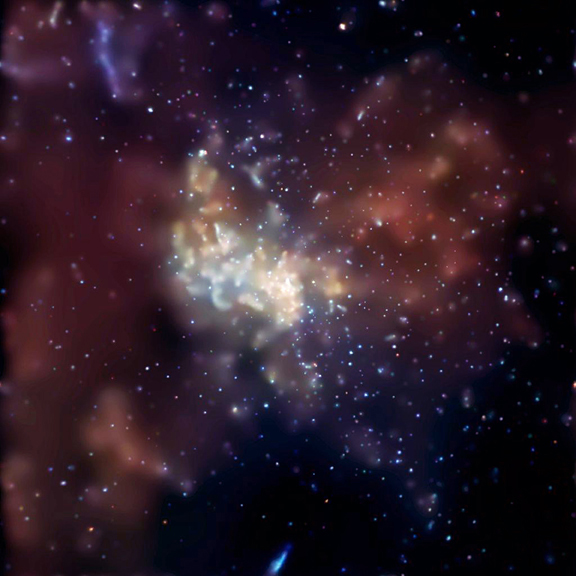
Observations of other galaxies, particularly nearby galaxies, reveal compelling evidence that nearly all galaxies have a super massive black hole at their center. The Milky Way has a supermassive black hole at its center known as Sgr A*. How these black holes form is not well understood, but it must have been long ago when the universe was very young such that the black holes had time to grow. They may form from the collapse of some of the first stars created in the Universe known as Pop III stars or they may form from the monolithic collapse of a cold could of gas in the early Universe. Many galaxies emit very high energy radiation from their centers (ultraviolet, X-ray or gamma ray) that is easily explained by a super massive black hole at their center. These galaxies are said to have Active Galactic Nuclei (AGN), but our Milky Way does not emit such high energy radiation. This an interesting and lucky fact that astronomers have explained by noting that if gas is actively falling onto a black hole it forms and accretion disk which heats up to very high temperatures. Thus matter falling into a black hole emits massive amounts of powerful radiation just before it falls into the black hole. Active galactic nuclei are especially correlated with galaxies which have just undergone mergers with other galaxies which are gas rich; the theory, which is backed up by simulations and observations, says that when gas rich galaxies merge gas funnels into the central super massive black holes and induces a period of high luminosity. The black hole at the center of our Milky Way also undergoes periods of gas accretion or luminosity spikes in the X-ray to radio bands. One such event in May of 2003 was a powerful flare seen located just a few milli-arcseconds from the position of Sgr A* which corresponds to less than ten Schwarzschild radii from the black hole position.

Observing supermassive black holes

How do we know that we have really observed black holes not something else? This is a hard question and astronomers may often talk about compact massive objects instead of black holes if they are not certain about a particular object in the sky. In the case of the supermassive black hole at the center or our Milky Way more direct observations are possible. Astronomers have been watching Sgr A* for decades, but only with modern instruments has powerful evidence come to light. Observations of flare events close to the Schwarzschild radius of a suspected black hole like the event described above are one way. Also watching the gravitational influence of the dark object is another:
The movie above was made with high resolution near-infrared observations over many years (in the bottom left corner is the year of the observations) on the 10 meter Keck telescope in Mauna Kea by a group at UCLA led by Andrea Gehez. These stars are right at the center of the Milky Way in the immediate vicinity of Sgr A* and they are moving in a Keplerian orbit around a central mass which is unseen in optical light. The stars are moving at speeds up to 1400 km/s (or 3 million mph) and so using Kepler's laws of motion the central object is estimated to be four million solar masses. The object is also very minute. Given this great mass and small size astrophysicists only have one explanation for the object. In the near future radio astronomers plan to use interferometry to directly image the event horizon of Sgr A*.

An unexpected relationship between black holes and galaxies

We have good reason to believe that nearly all galaxies contain a central supermassive black hole. Furthermore, the mass of the central black hole strongly correlates with the mass, velocity dispersion, and momentum parameter of the corresponding host galaxy. The most interesting relation is that of the central black hole mass with the velocity dispersion of stars in the host galaxy bulge. This is known as the m-σ relation which has a very simple basic scaling:
Thus the mass of the central black hole and the velocity of nearby stars is highly correlated. This is an empirical relation and so the value of 5 here is approximate (for example in the plot below the value is 5.8 and in some previous work was as low as 4). This relation was discovered and reported in the literature in 2000 by two independent groups (Gebhardt et al. and Ferrarese et al.), but astronomers are still seeking a theoretical model able to elucidate the origin for the correlation.
What is so amazing is how strong the correlation is over a range of galaxy and black hole sizes as seen in the log-log plot above from a very recent paper on the archive by Feoli and Mancini which complied data from Hu 2009. Even a hundred million solar mass black hole will not have a significant gravitational effect on the stars in the bulge of a galaxy (the black hole is big, but there are billions of stars and they are far away from the black hole's gravitational force which of course drops as distance-2) so the  m-σ relation is somewhat of a mystery. Likely the current relation is dependent upon the galaxy and black hole co-evolution (as evidenced by the fact that the empirical scaling is only measured for cosmologically very close galaxies). Theorists and rock bands continue to search for a coherent explanation.

Look up and find your local black hole

Lets try and bring black holes back down to Earth by stargazing. The nearest (super massive) black hole is at the center of our Milky Way Galaxy in the constellation Sagittarius. Sagittarius according to Greek mythology is a centaur archer who was shot with a poisoned arrow and in honor he was given a place in the sky in the constellation Sagittarius. The arrow of Sagittarius points towards the bright star Antares in Scorpius, but it also points to the galactic center and the super massive black hole that lies there. A modern interpretation of the constellation is as a teapot which is as I have outlined it here, but I think the image of a centaur shooting an arrow in the heart of our galaxy is much more dramatic.
Sagittarius is best viewed during summer nights (this paragraph has been kind of western history and northern hemisphere centric, sorry) and can be found between the constellations Ophiuchus and Capricornus near the galactic plane. The actual object that is identified as the super massive black hole at the center of our galaxy is the luminous compact radio object Sagittarius A* (or Sgr A*) which is not visible in the optical spectrum. Another way to identify Sgr A* is that Scorpius almost wraps his tail around it. Look for Saggitarius's arrow and Scorpius's tail and you will have found a super massive black hole; happy sky hunting.

ResearchBlogging.org

Gebhardt, K., Bender, R., Bower, G., Dressler, A., Faber, S., Filippenko, A., Green, R., Grillmair, C., Ho, L., Kormendy, J., Lauer, T., Magorrian, J., Pinkney, J., Richstone, D., & Tremaine, S. (2000). A Relationship between Nuclear Black Hole Mass and Galaxy Velocity Dispersion The Astrophysical Journal, 539 (1) DOI: 10.1086/312840

Genzel, R., Schödel, R., Ott, T., Eckart, A., Alexander, T., Lacombe, F., Rouan, D., & Aschenbach, B. (2003). Near-infrared flares from accreting gas around the supermassive black hole at the Galactic Centre Nature, 425 (6961), 934-937 DOI: 10.1038/nature02065

Ghez, A., Salim, S., Weinberg, N., Lu, J., Do, T., Dunn, J., Matthews, K., Morris, M., Yelda, S., Becklin, E., Kremenek, T., Milosavljevic, M., & Naiman, J. (2008). Measuring Distance and Properties of the Milky Way’s Central Supermassive Black Hole with Stellar Orbits The Astrophysical Journal, 689 (2), 1044-1062 DOI: 10.1086/592738

QR Codes

Science doesn't stop, but blogging occasionally does. Some good posts are on the way, but for today I have something fun: QR codes. You may recognize them as those little matrix barcodes that carry text, numbers, binary, or URLs that are starting to crop up in the real world in augmented reality or hardlink applications where objects in the physical world get linked to the digital world. If you didn't know already you can use your phone or camera to read these things no matter where you see them. They can carry quite a bit of information and because of fault tolerance and error handling in some cases portions of the QR code can be lost and the data still read. I made a few artistic renditions of a QR code that link to The Astronomist. I removed some of the bits from the center and replaced it with an A and I found I was still able to read them handily with the code scanner on my iPhone so I assume they aren't corrupt. Now I just need to make some stickers out of them or something so the digital and physical world will meet at The Astronomist.


Antimatter trapped

A Nature letter recently reported on trapping antihydrogen. Researchers at CERN snagged 38 antihydrogen atoms in magnetic trap in what promises to the begining of fruitful research on deep symmetries in nature like charge, parity and time. I wrote up an article discussing the research for Ars Technia (where I am now an occasional contributor in case you hadn't heard) and I figure I should shamelessly self promote. From the article:
Researchers at CERN have created and trapped antihydrogen in an attempt to study the underpinnings of the standard model of physics. Antihydrogen is made of antiparticles, specifically an antiproton and a positron, instead of the proton and an electron that are present in natural hydrogen. It has the same mass but opposite charge of its normal matter counterparts.

Antimatter has a bad reputation for being dangerous because it annihilates on contact with regular matter, releasing prodigious amounts of energy. However, the clever reader will note that they have not been annihilated by the antimatter produced at CERN. The reality is that if you gathered all of the antimatter CERN has ever created, you wouldn't garner enough energy to power your laptop through reading this article.

The Universe seems to be made of mostly regular matter, so any antimatter encounters matter and is annihilated immediately after it has been created. Production and detection of cold antihydrogen atoms also happened at CERN in 2002, but those were short-lived. The new Nature letter describes how to overcome the difficulty of containing antihydrogen so that it isn't immediately destroyed.
Continue reading CERN snags 38 antihydrogen atoms in magnetic trap.

A possible young black hole

Thirty years ago a supernova exploded 50 million light years away (right, so it actually exploded 50 million plus thirty years ago if you take into account the space and time like separation from this event) in the grand spiral design galaxy M100. A year ago a paper titled  Evidence for a Black Hole Remnant in the Type IIL Supernova 1979C appeared on the astrophysics preprint archive claiming that the continued X-ray emission from the object was consistent with a 5-10 solar mass black hole. Five days ago NASA announced it was going to make an an announcement. Today NASA made a press release claiming that NASA's Chandra satellite had found the youngest black hole ever. It is a beautiful discovery.

Or is it? Lets peer inside to see the inner beauty of this discovery. The original version of the paper was submitted to Astrophysical Journal Letters , but was not accepted and only after a revision was it submitted again this time to Monthly Notices of the Royal Astronomical Society Letters. Today along with the press release a third revision of the paper went up. The excitement really just boils down to the fact that SN1979c has been a remarkably consistent and bright X-ray source for its 30 year lifetime.

The object seems to have been an approximately 20 solar mass star before it collapsed, but the core which really counts when a star collapse was around 3 solar masses. A core that is much larger than 3 solar masses would collapse into a black hole, a core a little less than 3 solar masses would form a neutron star, but there is no way to know the exact size of the  progenitor star's core. Previous theories suspected the object was a magnetar or pulsar wherein the super hot dense objected emitted vast amounts of energy as it cooled and hence this induced the X-ray brightness. The new theory posits that the object is an accreting black hole remnant.

But seriously, an announcement of an accoutrement? It is a little sad how this paper hiding in plane sight was overlooked by bloggers and science writers alike. Even blogs, like Bad Astronomy, that normally expose flimsy stories like this have taken it easy. I think all press releases should come with a warning, science in progress.

Milky Way Hides Gamma Ray Lobes

The Milky Way has some nerve (or after you see the picture you may think, excuse my language, big cojones) for hiding a massive structure that about equals the size of the visible Milky Way. The Fermi gamma ray satellite observed the structure mired in a fog of gamma rays which are pervasive through our sky. Fermi has been making a survey of the complete sky for some time, but only through careful data analysis and removal of diffuse sources were the lobes readily apparent.

Spotting the lobes inside the Milky Way was difficult because from our view within we can't see the forest for the trees, but astrophysics expect that some galaxies have gamma ray lobes and Fermi has spotted such lobe structures like this in other galaxies such as Centarus A. So this result isn't that unexpected, except that it is. These gamma ray lobes are comparable to the entire size of our galaxy and they are just now being seen for the first time.

The structures are orthogonal to the plane of the Milky Way and have distinct edges; they are surprisingly geometrically perfect. They span about 7.5 kiloparsecs (or 25,000 light years). The lobes are composed of gamma rays which are super high energy photons; the photons obtain such high energies by interacting with particles, like free electrons, which are themselves moving close to the speed of light which then interact with the lower energy photons in their vicinity to boost the photons up to gamma ray energies.

The distinct edges of the lobes are indicative of a large and rapid formation event. The structures may have been formed by a massive burst of star formation followed by stellar explosions which seeded the lobes with gas, dust, and hot electrons over millions of years. There is a supper massive black hole at the center of many galaxies, including the Milky Way, which may create high energy lobes, but those lobes would only form when the black hole is actively undergoing accretion of matter. So this may be evidence that the 4 million solar mass black hole at the center of our galaxy underwent an active period where it accreted a large amount of matter and simultaneously released massive jets of energetic particles just a few million years ago.
It is an exciting discovery, but I don't have anything other than a press release to go on as of yet though a paper is accepted for publication in ApJ so more to come.

Very precise pulsar measurements

A neutron star is made of neutrons, right? Astrophysicists ponder this question and forge theory after theory, but the only thing they conclude with certainty is that a neutron star by any other name would still be made of the densest form of matter know to exist in our Universe. Under certain conditions a star which has exhausted all of its fuel and is sufficiently massive will not be able to support its own weight with pressure support (as in a regular star) or with electron degeneracy support (as in a white dwarf) such that electrons and protons merge to form neutrons because it is a more energetically favorable arrangement of the matter. A neutron star is a sort of massive atomic nucleus, but without charge. The actual composition and detailed properties of neutron star are still theoretically uncertain.
New measurements of the pulsating neutron star and helium-oxygen-carbon white dwarf binary system J1614-2230 reported in a Nature letter are the highest precision determinations of a neutron star's mass to date. The data comes from the massive Green Bank Telescope using the new Green Bank Ultimate Pulsar Processing instrument which accurately records the time of arrival of each radio pulse sent out by the rapidly rotating neutron star (which is a pulsar). The quality of this instrument, having over a tera op of computing power, and the size of the telescope, 100 meters, made this measurement possible. For a quick rundown of this result you can watch these quick movies on the scientific implications and the technology behind the discovery which were created by the NRAO.

The analysis uses a general relativistic effect involving the time delay of light known as the Shapiro delay effect. When a light ray passes a massive object it follows a curved path. General relativity says that curvature of light rays can only take place when the velocity of the propagation of the light rays also varies with position. The Shapiro delay increases the light travel time through the curved space-time near a massive body. The equation to determine the time delay effect is delightfully simple.
The delay depends on the mass, M, of the time delaying body between the source and the observer, the gravitational constant G, the speed of light, c, and the geometry of the system. The geometry is that light has to be passing near the gravitating body before it gets to the observer for the effect to occur at all so the vector that points from the observer to the source, R, and the vector that points from the observer to the gravitating mass are vital. Pulsar J1614-2230 is a nearly edge on, 89 degrees, system meaning that when the white dwarf passes in front of the pulsar during the binary orbit the Shapiro effect will be very strong. I ran a quick calculation of the time delay and found it to be exactly on the order of a few microseconds. The first figure in the paper shows the geometry and the measured effect.
With this data in hand the standard Keplerian orbital parameters are calculated for this clean binary system and the masses of the objects are calculated. The mass of the neutron star was found to be 1.97 +/- 0.04 solar masses which is the most precise measurement of neutron star mass to date. Unfortunately this measurement technique does not provide any information about the radius of the neutron star, but because the mass was so high it already set a limit on the equation of state of the neutron star matter. This means that we can begin to answer what a neutron star is really made of. Different kinds of matter have a different behavior as you add more mass to them which is intuitive if you thought how discrepant with respect to size a planet made out of cotton candy versus rock would be. This result indicates that exotic models of hadronic matter including hyperons, kaon condensates are ruled out. Condensed quark matter is not ruled out, but highly constrained with this data. This is a big deal for particle physicists because this kind of system is an experiment that could never be carried out in a lab, but is necessary to probe fundamental physics.

This cool result on neutron stars glosses over another application of precise pulsar measurements that the authors of this Nature paper regarded as noise. The plot above is very neat and clean, but before the data looks like that a timing analysis must take into account the time delays associated with many more mundane effects. Effects that change the time of arrival of the pulsar include the variations in the Euclidean distance between the Earth and the pulsar resulting from Earth’s orbital motion, the proper motion of the pulsar, and its binary motion, dispersive delays in the interstellar medium, and time dilation of clocks in the observatory and pulsar frames and along the propagation path. The Earth's orbital motion about the solar system barycenter (known as the Roemer delay) is up to 500 seconds and so must be removed from the data. The powerful thing is that the Earth's orbital motion tells us about the mass and orbits of all the bodies in our solar system. A paper published in the Astrophysical Journal states that with ten years of careful observation of 20 pulsars the masses and orbits of solar system bodies could be determined better than with any other method and even undiscovered trans-Neptunian objects could be found.

Precise pulsar measurements are powerful. The first extrasolar planet ever discovered was actually made with pulsar measurements. Pulsars can tell us about the nature of neutron stars, the properties of own solar system, oh and even gravitational waves. If only astronomers had the money to build a pulsar timing array...

ResearchBlogging.org References

Demorest PB, Pennucci T, Ransom SM, Roberts MS, & Hessels JW (2010). A two-solar-mass neutron star measured using Shapiro delay. Nature, 467 (7319), 1081-3 PMID: 20981094

D. J. Champion, G. B. Hobbs, R. N. Manchester, R. T. Edwards, D. C. Backer, M. Bailes, N. D. R. Bhat, S. Burke-Spolaor, W. Coles, P. B. Demorest, R. D. Ferdman, W. M. Folkner, A. W. Hotan, M. Kramer, A. N. Lommen, D. J. Nice, M. B. Purver, J. M. Sarkissian, I. H. Stairs, W. van Straten, J. P. W. Verbiest, & D. R. B. Yardley (2010). Measuring the mass of solar system planets using pulsar timing ApJ arXiv: 1008.3607v1

White Cosmonaut, Red Cosmonaut

Check out this lovely art by Jeremy Geddes. He is a Melbourne artist who works with mostly oil paints. His paintings have glowing colors and he has this recurrent cosmonaut theme that vaguely makes them seem relevant. Below are three of my favorite images that I have seen: The White Cosmonaut, The Red Cosmonaut, and Heat Death. Of his cosmonaut series he himself is vague,
I wanted to construct my own reality through my paintings, a quiet melancholic space that operates by it’s own set of underlying rules and runs it’s own oblique narrative. With each successive painting, I try to build the world and uncover it’s form. The cosmonaut paintings are the first step in this.
And on his piece Heat Death he again lets your mind linger on meaning and reasoning,
Hopefully, I communicate everything I want to say through the painting itself. I’m not interested in giving it a didactic final meaning. I just want to spark questions in the viewer.
Artists have the luxury of letting their art speak so that they don't have to. Scientists don't have this luxury and generally must have a didactic (although, not intending to imply moral) explanation of nature; an explanation which may or may not be close to the truth. Science ultimately doesn't self explain its emphases on truth seeking. Truth is like art, sought for its own sake. Oh and please, if someone wants to buy me the Red/White Cosmonaut diptych print feel free.
The White Cosmonaut


The Red Cosmonaut

Heat Death