


Field of Science
-
-
Change of address1 year ago in Variety of Life
-
Change of address1 year ago in Catalogue of Organisms
-
-
Earth Day: Pogo and our responsibility1 year ago in Doc Madhattan

Showing posts with label Lindau. Show all posts
Showing posts with label Lindau. Show all posts
Discovering the Higgs Boson
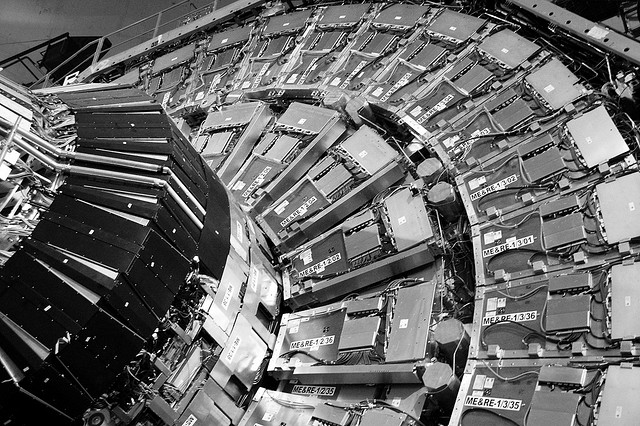
LINDAU, Germany — Tommrrow CERN will make an announcement, likely about the Higgs boson. The Higgs boson is a key part of the standard model of physics and this is a rather exciting discovery. You can read my article about the prospects for the discovery of the Higgs boson over at the Nature Lindau blog where I am writing.
Sobre el Futuro and the Lindau Nobel Laureate Conference
It may appear that I haven't been busy lately because of the death of posts here at The Astronomist. You would be right to suspect that in reality I have actually been extremely busy. I passed my general exam here at the University of Washington and I am now a proto-doctor or a PhD candidate as it were. Regardless, now that this hurtle is out of the way I just have to do a thesis. In the spare time I have been up to so many other things. I did an interview with WHAT which is an organization that aims to raise a discussion about philosophy, science, and culture. They are based out of Spain, but the idea is international and focuses on people. I was interviewed as part of their series sobre el futuro or about the future where I talked about the future of the universe and the future for humans on Earth. I really, like the quote they caught from me, "No creo que ningún astrónomo piense que estamos solos en el Universo." You can watch the interview here.

Next up I am traveling to Lindau Germany once again to cover the Lindau Nobel Laureate Conference. I will be writing with the Nature blog team. I am very excited to be returning to Lindau this year. I first covered the Lindau Nobel Laureate conference in 2010 and at the time I really didn't know what to expect. I found that Lindau is an amazing place where ideas are exchanged at a rapid pace and discussions of science and the future are pervasive. I love it. I will be attending the conference from the journalist perspective of course so I will be interviewing people, including Nobel Laureates, while at the same time learning and communicating what I discover to a larger audience. If you haven't heard of the Lindau conference before (or even if you have) I recommend checking out the Lindau Mediatheque where they have videos of the lectures given by the Laureates. I am already blogging over on the Lindau blog; the conference starts on July 1st and lasts an entire week. Please go check it out and I will talk to you again from Germany.
Next up I am traveling to Lindau Germany once again to cover the Lindau Nobel Laureate Conference. I will be writing with the Nature blog team. I am very excited to be returning to Lindau this year. I first covered the Lindau Nobel Laureate conference in 2010 and at the time I really didn't know what to expect. I found that Lindau is an amazing place where ideas are exchanged at a rapid pace and discussions of science and the future are pervasive. I love it. I will be attending the conference from the journalist perspective of course so I will be interviewing people, including Nobel Laureates, while at the same time learning and communicating what I discover to a larger audience. If you haven't heard of the Lindau conference before (or even if you have) I recommend checking out the Lindau Mediatheque where they have videos of the lectures given by the Laureates. I am already blogging over on the Lindau blog; the conference starts on July 1st and lasts an entire week. Please go check it out and I will talk to you again from Germany.
The History of the Universe
LINDAU, Germany — John Mather is humble when describing his measurements of the cosmic microwave background radiation despite the fact that Steven Hawking described this measurement as possibly the most important discovery humans have ever made. The cosmic microwave background radiation is the remnant glow of the Big Bang; it is the primary evidence. Mather is careful to place his work in context next to the original work of Penzias and Wilson who made the first measurement of the cosmic microwave background radiation.

The cosmic microwave background (CMB) was first measured by Penzias and Wilson in 1965, but it was predicted decades earlier independently by several astrophysicists. You can read about the journey Penzias and Wilson took to making their discovery in this previous post on pigeon waste, cosmic melodies and noise in scientific communication. Cosmologists were not content with the first tenuous measurement of the 2.7 kelvin background, but they would have to wait until the Cosmic Microwave Background Explorer (COBE) was launched in 1989 to measure the CMB to one part in 100,000 or 30 millionths of a degree difference in temperature. In 2006 John Mather and George Smoot received the Nobel Prize in physics for their discovery of the blackbody form and anisotropy of the CMB. Mather and Smoot's precision measurements indicated that the Big Bang produced radiation that was perfectly consistent with the theoretical predictions for a blackbody and that the anisotropy, or spatial variations, of the relic radiation were extremely miniscule. The observations fit the theory so well that when plotting the data the error bars must be enlarged to make them visible.
Mather told the attendees the entire history of the Universe during a morning lecture. First, there was the Big Bang. Then a brief period of stupendous growth occurred known as inflation. The early Universe was extremely hot and contained simple particles of matter as well as antimatter; the matter and antimatter annihilated upon contact until only one part per billion of of the early universe was antimatter (this is good for us, because we are made of normal matter, but a mystery to cosmologists). Within the first 3 minutes the formation of Helium nuclei had occurred. The Universe remained in a dense fog of mostly free protons, electrons, and Helium nuclei until about 400000 years after the Big Bang. At this point the Universe had cooled enough that electrons could become captured by the free protons and Helium nuclei to form neutral atoms. The photons which up until this point had been scattering off of the free particles suddenly found that they could effectively travel the entire distance of the universe before having another scattering. These photons cooled as they traversed the expanding Universe until they encountered the detectors on COBE.
If Mather is the stoic scientist, then Smoot is the adventuring explorer. In a break away afternoon session Smoot had the opportunity to tell young scientists a few more details about the CMB and the ramifications. The minor variations in the CMB are quantum fluctuations that were super sized during the period of inflation. Smoot says that our own galaxy was a quantum fluctuation at one time. Through analysis of the CMB with the technique of spherical harmonics Smoot is keen to to stress that the early Universe is extremely linear and that deviations from the known amount of dark matter, dark energy, or age of the universe creatures significant inconsistencies with the data and the theory.
Every galaxy we observe today is related to the small perturbations present in the early Universe. The cold spots in the CMB are slightly denser than the surrounding areas and so as the universe evolved gravity's long range attractive forces meant that over densities were inherently unstable. The over densities grew larger and larger until galaxies, clusters, and super clusters formed. Today, astronomers are measuring the result of this growth of structure through galaxy surveys such as as the Sloan Digital Sky Survey. The observed distribution of galaxies is perfectly consistent with the theories.
Telling the entire history of the Universe must be a humbling job. Astronomers, Mather says, actually have a simple job of describing the universe, galaxies, stars, and places where life may form. Astronomers don't actually have to say how life formed, but there are researchers and Nobel Laureates here at Lindau who are trying to answer that exact question. Mather finished his talk with more questions than answers. How did we get here? Are we alone? What happens next?
Subscribe to:
Posts (Atom)