


- The Myth of Gravity Erik Verlinde considers gravity as information. His theory implies that gravity is nothing more than the result of a system maximizing its entropy. See the full paper here.
- The Holographic Universe Craig Hogan’s suggests nature deals with quantum mechanics and spacetime through the holographic universe. See a paper that discusses holographic noise in gravity wave interferometers here.
- The World Cup Something completely different, but also completely awesome, and the physics of soccer is quite interesting too. Check out the video below that just begins to capture a fraction of the spirit of the World Cup held in South Africa this summer.
Field of Science
-
-
Change of address1 year ago in Variety of Life
-
Change of address1 year ago in Catalogue of Organisms
-
-
Earth Day: Pogo and our responsibility1 year ago in Doc Madhattan

Busy
I am overwhelmingly busy right now. I wont have any time for The Astronomist until the middle of June or so because apparently taking painful qualifying exams builds character. In the meantime here are some diversions...
Dark Matter Confronts Observations
Dark matter is like the Rome of astronomy, all observations lead to dark matter. The problem is that physicists and astronomers, don't know what it actually is. The observations which support dark matter come from many different independent observations, so it is not just some observational error. The observations which corroborate the dark matter paradigm make for a fantastic discussion, but for right now I would like to focus on explanations for what dark matter may be. Specifically, what kind of particles are dark matter?


If dark matter is thermal weakly interacting massive particles (WIMPs) then it may produce observable signals when it self annihilates. A popular model for the WIMP which would self annihilate is the neutralino (see figure at right). Self annihilation is exactly what it sounds like, like two identical but opposite forces meeting, the result is an explosion of energy and particles (the interaction conserves energy, momentum, and other quantum numbers). WIMP self annihilations into positrons and electrons could be detected by cosmic ray detectors. These self annihilations and the observable signal would be rare though. If they were common we would see a lot more signal. In the early universe these annihilations would have been much more common such that if there was a primordial abundance of dark matter it would have self annihilated to be consistent with the much lower density of dark matter we observe today (to wrap your head around this take my contrived analogy of a king who has many identical twin sons all born at once, in time they might murder each other until there was enough land for the remaining sons to all have just enough). Mathematically this is stated that the density of dark matter today, Ω, is proportional to the inverse of the particle cross section times relative velocity at freeze-out, σν, (think of this as probability the particles would interact). Today dark matter is said to have frozen out at its current density because on average a dark matter particle will travel the entire distance across the universe (this distance changes also invoking the Hubble scaling h) before interacting with another dark matter particle:
 This is known as the WIMP miracle. Particle physics independently predicts a particle with the right density to be the dark matter that astronomers observe.
Cosmic rays are charged particles (like positrons, e+,and electrons, e-) fired like bullets moving close to the speed of light at random throughout the universe and may be created by any of your favorite high energy astrophysical sources like magnetars, super massive black holes, supernovae, and so forth. Cosmic ray particles (any very fast moving charged particles) can interact with the galactic magnetic field, the interstellar medium, or the interstellar radiation field. These interactions generally cause the particles to lose energy and that energy is emitted in the form of observable photons. Thus dark matter will leave an astronomical signature not only in the form of cosmic rays from direct annihilation into positrons or electrons as discussed above, but also in the form of scattering of photons. The reason for all this talk about cosmic rays is that now we can see that the dark matter models explaining the PAMELA, ATIC, and Fermi results would also produce other observables, for example, an excess of gamma ray photons from the galactic center (they would be focused from the galactic center because that is where the dark matter would be densest and annihilating most rapidly) at energies 100 GeV and more. Another signal that may come from dark matter was seen in observations made by the WMAP satellite which detected residual microwave emission from the galactic center known as the 'WMAP haze'.
You can't just ask a particle where it came from. The electrons and positrons of WIMP annihilation are cosmic rays with an exotic origin, but because there may be an undetected 'local' pulsar producing the cosmic ray anomalies being detected we do not yet know where the positron excess originates. The interpretation of the photon background can be similarly difficult. It is well known that the cosmic x-ray background is the cumulative emission from active galactic nuclei (it can be modeled with a single power-law), but on top of this background local astrophysical phenomena and or dark matter annihilation may contribute to the signal. Astrophysicists are curious to know if dark matter annihilation is necessary or do cosmic rays account for all the gamma rays in diffuse galactic radiation? The most promising and ongoing source of data to constrain WIMPs comes from the Fermi collaboration. Despite initial excitement in the astrophysics community and the blogosphere about the possible origins of the anomalies (if you don't read the physics blogosphere see here or here) the Fermi collaboration now states their results on the measured cosmic-ray spectra are consistent with a standard model of diffuse galactic gamma-ray emission,
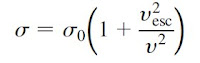 where νesc2=2GM/R. The Sommerfeld enhancement is the quantum extension of this classical phenomena. If you work through the entire derivation the result is that the enhacement leads to a cross section that scales at low energies as σν ∝ 1/ν. It turns out that the velocity of dark matter particles is a factor of ~10- 3 less now compared to what it was at freeze out. It is a miracle of dark matter that Sommerfeld enhancement provides an elegant mechanism for boosting annihilations now to exactly the amount needed.
However, a satisfactory solution to the dark matter problem must not only have dark matter annihilating at the correct rate, but it must also produce the right density and structure on all cosmological scales which is consistent with observations. In a paper appearing in Physical Review Letters, Jonathan L. Feng, Manoj Kaplinghat, and Hai-Bo Yu of the University of California, Irvine, point out some problems with these explanations, in thier own words from the abstract:
I must comment on the authors findings on spherical halos. I would agree that enhanced interactions can create significant changes in the shapes of dark matter halos, but I caution that analysis of a single galaxy is not sufficient to constrain dark matter. Observations of our own Milky Way indicate that our dark matter halo probably looks like a beach ball flattened perpendicular to the visible plane of the galaxy. This would corroborate the authors findings, however, I have had discussions with colleagues on dark matter forming spherical halos. Finally, it should be obvious that any dark matter model that calls for heavily interacting dark matter would produce wildly inconsistent results. One theory that is been proposed is that there is a hidden world of mirror-matter that acts just like regular matter, but it doesn't interact with regular matter through any force but gravity. Mirror galaxies, mirror stars, and mirror planets are completely inconsistent with observations! The experiments discussed above placed constraints on the type and mass of dark matter particles that would rule out such mirror-matter. I did not include or discuss the DAMA experiment's observations earlier because they had not been reproduced independently by any other group until very recently. The CoGeNT experiment now has a confirmation of the DAMA signal and this may change things by allowing the considered masses of dark matter candidates to be reduced considerably (this still doesn't allow for mirror-matter although some are implying it does). I refuse to equivocate my opinion that there is no hidden sector which is an exact copy of the standard model.
A survey of the lessons and knowns about dark matter indicates that we need more data. Dark matter models motivated from cosmic positron observations require an enhanced cross section to reproduce the data, but this enhanced cross section is inconsistent with the relic dark matter density and observations of dark mater halos. We need observers to determine if the cosmic positron excess is caused by a local astrophysical source such as a pulsar. We need theorists to develop a simple model for dark matter that is motivated from fundamental particle physics that make testable predictions for future observations.

References:
Abdo, A., et al. (2010). Spectrum of the Isotropic Diffuse Gamma-Ray Emission Derived from First-Year Fermi Large Area Telescope Data Physical Review Letters, 104 (10) DOI: 10.1103/PhysRevLett.104.101101
Nima Arkani-Hamed, Douglas P. Finkbeiner, Tracy R. Slatyer, & Neal Weiner (2008). A Theory of Dark Matter Phys.Rev.D79:015014,2009 arXiv: 0810.0713v3
Feng, J., Kaplinghat, M., & Yu, H. (2010). Halo-Shape and Relic-Density Exclusions of Sommerfeld-Enhanced Dark Matter Explanations of Cosmic Ray Excesses Physical Review Letters, 104 (15) DOI: 10.1103/PhysRevLett.104.151301

Dark Matter is not like any particle before
The most attractive candidate theory for dark matter would be simple, it would be motivated from fundamental particle physics, and it would make testable predictions for future observations. Whatever dark matter particles are we know that dark matter does not interact with photons, is electrically neutral, is highly non-relativistic, and it is dissipationless; so basically that means dark matter is boring. To drive at what dark matter really is I would first ask, can even begin to understand the observations without tying ourselves to any specific models for dark matter's nature? I do not know. I am merely going to outline the fundamentals of a plausible dark matter model and address how it confronts observations. There are dark matter particles theories invoked from supersymmtery, universal extra dimensions, and branes; the most common dark matter candidate which I will focus on here is the so called weakly interacting massive particle (WIMP). If dark matter is a WIMP, then we still have only narrowed down what kind of particle it is to a zoo of particles. If we want a pure motivation for an unknown dark matter particle we could go back to the early 1930's when Enrico Fermi developed a theory of beta decay that involved the neutrino and necessitated a new mass scale in nature; this mass scale introduces new fundamental particles that would interact weakly with regular matter and presto, WIMPs. It turns out that WIMPs, particularly supersymmetric neutralinos, are a compelling fit given the current data, but as more precises observations accumulate the theory faces scrutiny. There was a plague of rumors of an affirmative dark matter detection a year ago which were of course unfounded (it took much restraint not to throw in my lot with the speculations). Today dark matter looms as a unsolved problem because its existence is not in question, only its origin.A plausible theory for dark matter
Dark matter particles zoom right through matter without interacting, similarly to neutrinos, but unlike neutrinos dark matter particles are very massive. The gravitational potential of the largest structures in the universe, like galaxies and galaxy clusters, is dominated by dark matter. Dark matter is everywhere (yes, even here on Earth dark matter is present and it does have some gravitational effect, but it is infinitely more feeble compared to the Earth or the Sun), but dark matter doesn't clump, it doesn't form dark molecules, and it doesn't form dark galaxies. Regular matter that you or I are made of (known as baryonic matter) is gravitationally attracted to dark matter (non-baryonic matter), but dark matter dominates because there is so much of it. It is hard to notice dark matter because it only interacts with regular matter through gravity for the most part and gravity is the weakest of forces. Dark matter remains like giant clouds in which a galaxy or a cluster of galaxies resides within. Dark matter is different from regular matter because regular matter can be detected through electromagnetic waves which dark matter shouldn't produce, unless dark matter self annihilates.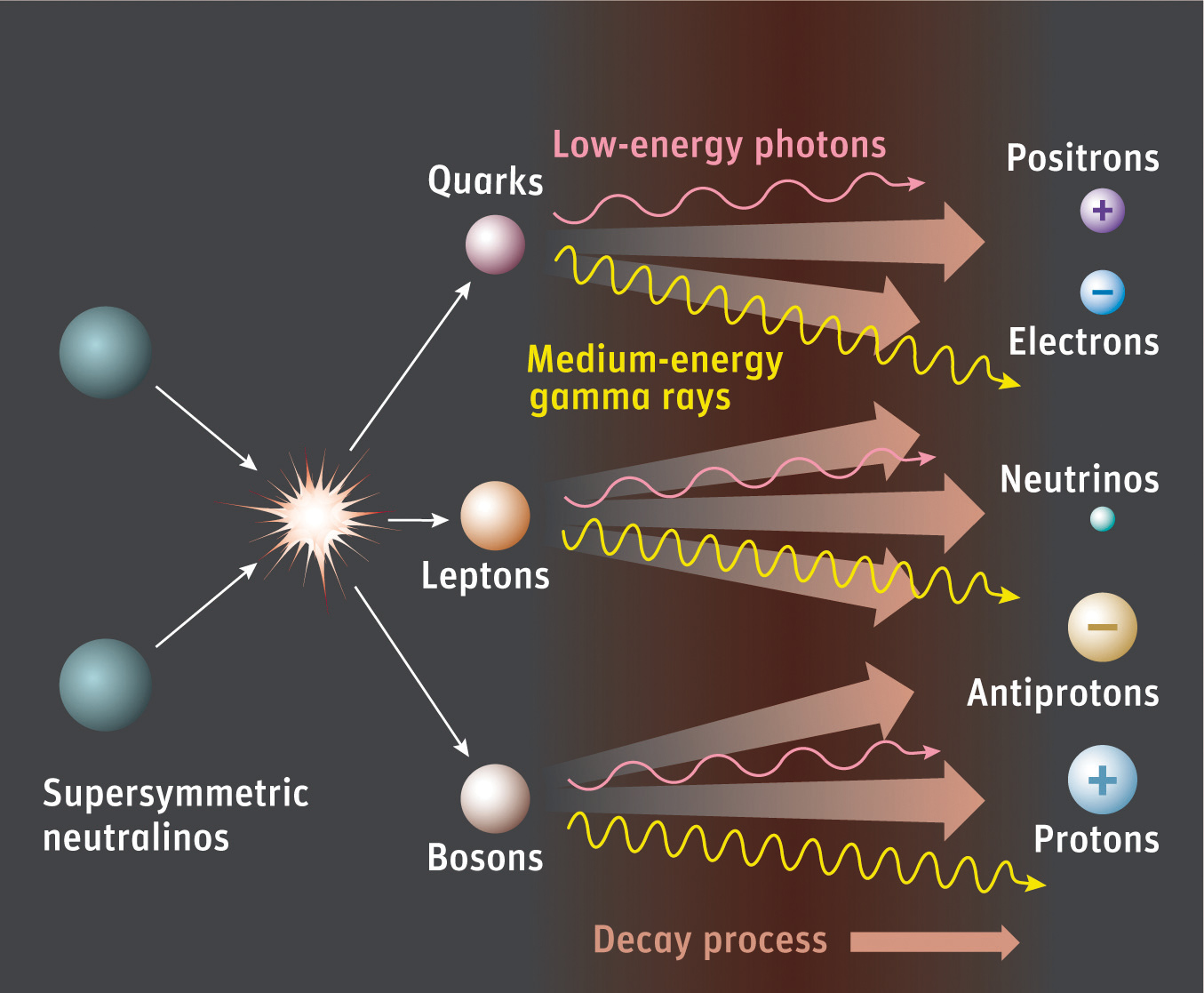
If dark matter is thermal weakly interacting massive particles (WIMPs) then it may produce observable signals when it self annihilates. A popular model for the WIMP which would self annihilate is the neutralino (see figure at right). Self annihilation is exactly what it sounds like, like two identical but opposite forces meeting, the result is an explosion of energy and particles (the interaction conserves energy, momentum, and other quantum numbers). WIMP self annihilations into positrons and electrons could be detected by cosmic ray detectors. These self annihilations and the observable signal would be rare though. If they were common we would see a lot more signal. In the early universe these annihilations would have been much more common such that if there was a primordial abundance of dark matter it would have self annihilated to be consistent with the much lower density of dark matter we observe today (to wrap your head around this take my contrived analogy of a king who has many identical twin sons all born at once, in time they might murder each other until there was enough land for the remaining sons to all have just enough). Mathematically this is stated that the density of dark matter today, Ω, is proportional to the inverse of the particle cross section times relative velocity at freeze-out, σν, (think of this as probability the particles would interact). Today dark matter is said to have frozen out at its current density because on average a dark matter particle will travel the entire distance across the universe (this distance changes also invoking the Hubble scaling h) before interacting with another dark matter particle:
Evidence for WIMPs
Recent observations from experiments and collaborations including ATIC, Fermi/GLAST, PAMELA, and others have observed an excess over the expected background of cosmic ray positrons (I am lumping these experiments together, but they actually detect subtly different kinds of particles and found different kinds of anomalies; for example PAMELA detected an upturn in the positron fraction e+/(e++e-) from 10-100 Gev while ATIC detected and excess in the total e++e- count at energies of 300-800 Gev). The reality is that anomalies are not unexpected given the uncertainty in astrophysical foregrounds which vary with energy.Cosmic rays are charged particles (like positrons, e+,and electrons, e-) fired like bullets moving close to the speed of light at random throughout the universe and may be created by any of your favorite high energy astrophysical sources like magnetars, super massive black holes, supernovae, and so forth. Cosmic ray particles (any very fast moving charged particles) can interact with the galactic magnetic field, the interstellar medium, or the interstellar radiation field. These interactions generally cause the particles to lose energy and that energy is emitted in the form of observable photons. Thus dark matter will leave an astronomical signature not only in the form of cosmic rays from direct annihilation into positrons or electrons as discussed above, but also in the form of scattering of photons. The reason for all this talk about cosmic rays is that now we can see that the dark matter models explaining the PAMELA, ATIC, and Fermi results would also produce other observables, for example, an excess of gamma ray photons from the galactic center (they would be focused from the galactic center because that is where the dark matter would be densest and annihilating most rapidly) at energies 100 GeV and more. Another signal that may come from dark matter was seen in observations made by the WMAP satellite which detected residual microwave emission from the galactic center known as the 'WMAP haze'.
You can't just ask a particle where it came from. The electrons and positrons of WIMP annihilation are cosmic rays with an exotic origin, but because there may be an undetected 'local' pulsar producing the cosmic ray anomalies being detected we do not yet know where the positron excess originates. The interpretation of the photon background can be similarly difficult. It is well known that the cosmic x-ray background is the cumulative emission from active galactic nuclei (it can be modeled with a single power-law), but on top of this background local astrophysical phenomena and or dark matter annihilation may contribute to the signal. Astrophysicists are curious to know if dark matter annihilation is necessary or do cosmic rays account for all the gamma rays in diffuse galactic radiation? The most promising and ongoing source of data to constrain WIMPs comes from the Fermi collaboration. Despite initial excitement in the astrophysics community and the blogosphere about the possible origins of the anomalies (if you don't read the physics blogosphere see here or here) the Fermi collaboration now states their results on the measured cosmic-ray spectra are consistent with a standard model of diffuse galactic gamma-ray emission,
The new result, based on the initial ten months of science observations, significantly improves and extends our knowledge of the isotropic diffuse emission at the high-energy end. The observed emission is softer and lower in intensity than measurements with EGRET had indicated previously. Fermi’s observed spectrum is consistent with a single power-law description over nearly three orders of magnitude in energyIn conclusion the prospect for direct astrophysical observations of dark matter is overwhelmed by uncertainty in the backgrounds and only more careful observations will improve this situation. I should reiterate that the uncertainty is in the detection of dark matter signature, and not the presence of gravitating dark matter.
Making dark matter consistent with observations
Despite the uncertainty in observations we may still draw conclusions and place bounds on possible dark matter candidates. The observed relic density implies that the dark matter annihilation cross section times the relative velocity at freeze-out is very small (see equation above). Unfortunately, given this predicted annihilation cross section the positron signal would be 2 to 3 orders of magnitude smaller than the observed cosmic ray excesses! In order for the WIMP model to fit the various observations a cross section much larger than that predicted by the relic abundance is necessary. Various unknown forces (the dark sector) could increase the annihilation rate. Some researchers have suggested the neutralino WIMP with Sommerfeld enhanced annihilations may explain the observed cosmic ray excesses. Sommerfeld enhancement increases the cross section of particles at low velocities similarly to classical gravitational enchantment. To wrap your head around this imagine dark matter particles as strangers quickly passing in the street; dark matter particles and strangers don't bother to hang out with each other at this speed, but if they stop at a coffee shop then the possibility that strangers would have some kind of interaction is greatly enhanced. If dark matter particles are jetting around too fast they wont have any interactions, however, if the particles slow down a significant interaction may occur between them. The classical gravitational enhancement analogy can quantify Sommerfeld enhancement a little more. Consider a particle encountering a star of radius R and mass M so the cross section should just be πR2 in the case that the particle directly hits the star, but as the particle approaches the star at a velocity ν it is trivial to show using conservation of energy and angular momentum that the cross section is increased to
However, a satisfactory solution to the dark matter problem must not only have dark matter annihilating at the correct rate, but it must also produce the right density and structure on all cosmological scales which is consistent with observations. In a paper appearing in Physical Review Letters, Jonathan L. Feng, Manoj Kaplinghat, and Hai-Bo Yu of the University of California, Irvine, point out some problems with these explanations, in thier own words from the abstract:
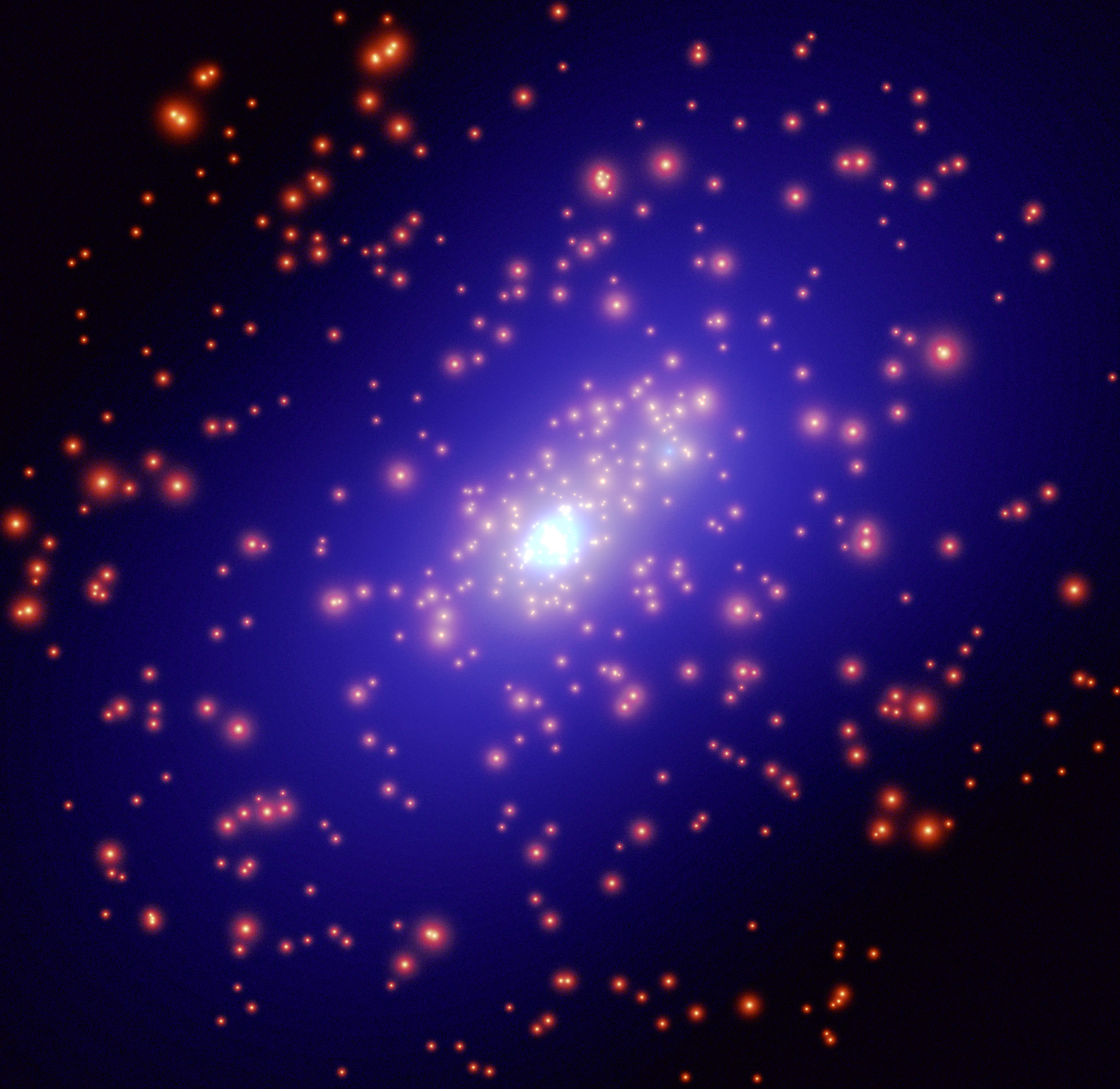
Dark matter with Sommerfeld enhanced annihilation has been proposed to explain observed cosmic ray positron excesses in the 10 GeV to TeV energy range. We show that the required enhancement implies thermal relic densities that are too small to be all of dark matter. We also show that the dark matter is sufficiently self-interacting that observations of elliptical galactic dark matter halos exclude large Sommerfeld enhancement for light force carriers. Resonant Sommerfeld enhancement does not modify these conclusions, and the astrophysical boosts required to resolve these discrepancies are disfavored, especially when significant self-interactions suppress halo substructure.The authors find that the relic density cannot be achieved in any Sommerfeld enhanced interaction scenario even with additional resonant boosting terms. What is more, they find that the Sommerfeld enhancement would create significant changes in dark matter halos because the additional interactions would isotropize the velocity dispersion and create spherical halos that contradict observations of NGC 720. The effects of dark matter self interactions can be seen in almost any x-ray image of a galaxy or cluster galaxies. For example, the image above of the galaxy cluster CL0025+1654 shows the dark matter (shown in blue) has an approximately thermal distribution and an elliptical shape. Subhalos with high density are also predicted to be present (in the image above the subhalos are not resolved, but many N-body simulations have predicted them to be there) with lower velocity dispersions than the thermal bulk of the halo, such that the Sommerfeld enhanced cross sections make these components especially important. Further observations of halos and subhalos will place even more constraints on dark matter self interactions.
I must comment on the authors findings on spherical halos. I would agree that enhanced interactions can create significant changes in the shapes of dark matter halos, but I caution that analysis of a single galaxy is not sufficient to constrain dark matter. Observations of our own Milky Way indicate that our dark matter halo probably looks like a beach ball flattened perpendicular to the visible plane of the galaxy. This would corroborate the authors findings, however, I have had discussions with colleagues on dark matter forming spherical halos. Finally, it should be obvious that any dark matter model that calls for heavily interacting dark matter would produce wildly inconsistent results. One theory that is been proposed is that there is a hidden world of mirror-matter that acts just like regular matter, but it doesn't interact with regular matter through any force but gravity. Mirror galaxies, mirror stars, and mirror planets are completely inconsistent with observations! The experiments discussed above placed constraints on the type and mass of dark matter particles that would rule out such mirror-matter. I did not include or discuss the DAMA experiment's observations earlier because they had not been reproduced independently by any other group until very recently. The CoGeNT experiment now has a confirmation of the DAMA signal and this may change things by allowing the considered masses of dark matter candidates to be reduced considerably (this still doesn't allow for mirror-matter although some are implying it does). I refuse to equivocate my opinion that there is no hidden sector which is an exact copy of the standard model.
A survey of the lessons and knowns about dark matter indicates that we need more data. Dark matter models motivated from cosmic positron observations require an enhanced cross section to reproduce the data, but this enhanced cross section is inconsistent with the relic dark matter density and observations of dark mater halos. We need observers to determine if the cosmic positron excess is caused by a local astrophysical source such as a pulsar. We need theorists to develop a simple model for dark matter that is motivated from fundamental particle physics that make testable predictions for future observations.
References:
Abdo, A., et al. (2010). Spectrum of the Isotropic Diffuse Gamma-Ray Emission Derived from First-Year Fermi Large Area Telescope Data Physical Review Letters, 104 (10) DOI: 10.1103/PhysRevLett.104.101101
Nima Arkani-Hamed, Douglas P. Finkbeiner, Tracy R. Slatyer, & Neal Weiner (2008). A Theory of Dark Matter Phys.Rev.D79:015014,2009 arXiv: 0810.0713v3
Feng, J., Kaplinghat, M., & Yu, H. (2010). Halo-Shape and Relic-Density Exclusions of Sommerfeld-Enhanced Dark Matter Explanations of Cosmic Ray Excesses Physical Review Letters, 104 (15) DOI: 10.1103/PhysRevLett.104.151301
Visions of space flight
We won't be getting out of the hood anytime soon.more by Adam Frank here. Also President Obama will announce plans for the future of Nasa at the Kennedy Space Center in Florida today.
It's the planetary neighborhood I am talking about here. The stars may beckon but it's an interplanetary, rather than interstellar culture that we will likely inhabit for hundreds if not thousands of years in the future. Baring the miracle of a "warp drive," the stars are simply too far away in space and time (via the theory of relativity) for a true interstellar culture to develop. The solar system with its 8 planets, 166 moons and countless asteroids and comets is likely to be our home -- our only home -- for a long, long time.
We should consider the implications of these limitations on coherent human cultures in space because today the president unveils his new plans for NASA.
The Obama administration made headlines recently when it reversed direction on NASA's Bush-era push to return to the Moon. The new plan turns to hungry young private space ventures to give us access to Near Earth Orbit. Stepping back on any present space mission the plan calls for development of the next generation of space technologies for the next generation of space exploration. But critics fault the Obama plan for its lack of any clear goals for these new technologies. Without a bold choice of destination -- Mars is the obvious choice) -- critics say the human space program will simply drift.


On the Phenomena of Lightning
 Thunderstorms are epic demonstrations of nature that can be quite fascinating when they aren't terrifying. The study of thunderstorms, in particular lightning, is of obvious practical interest, but also there is also a purely aesthetic and amusing aspect to them. I looked into the literature on lightning recently because lightning radio interference came up during my radio astronomy group meeting. The most visible form of thunderstorm lightning causes beautiful visible sprites and jets when a path of negatively charged ionized air reaches down from the clouds towards the ground where it meets the positively charged ground and following this low resistance channel of ionized air a luminous return stroke occurs, but beyond this visible display a full spectrum of electromagnetic waves may be induced in the ionosphere and magnetosphere. One of the most interesting phenomena are the reverberations around Earth in the radio spectrum called whistlers. With an appropriately tuned receiver and audio amplifier you can detect lightning's Earthly chorus. You can hear and see some of these sounds, including whistlers from lightning on Jupiter, over at professor Don Gurnett's selected sounds of space page. Read on to learn a little more about lightning, whistlers, and watch a video by the Kronos Quartet which incorporates some of these whistler sounds.
All about lightning
Observations of lightning from space show that there are about 2,000 thunderstorms active at any moment covering about 10% of the Earth's surface. Storms are not evenly distributed temporarily or spatially over the Earth; two out of three of lightning flashes occur over tropical regions and the peak of thunderstorm activity occurs through June to August. The simplest model of a thunderstorm is a vertically extended tripolar structure (though thunderstorms sometimes may involve up to six charge layers in the vertical direction) wherein there is a negative charge in the middle and positive charge at the upper and lower levels of the clouds. Thunderstorms produce various kinds of lightning strikes such as, cloud-to-cloud, cloud-to-ground and cloud-to-ionosphere electrical discharges. The common cloud-to-ground strike produces visible lightning that is the most familiar and transfers negative charges back to Earth. The intra-cloud process is a similar discharge between dipoles in a thunderstorm structure. Lightning can also create exotic processes like a Terrestrial Gama-ray Flashes which are most likely the result of bremsstrahlung radiation from relativistic electron beams generated in runaway lightning discharge processes. A bolt of lightning radiates an electromagnetic pulse with up 20 GW of peak power for 1 ms to 1 s in duration. This electromagnetic power jolt heats the partially ionized upper atmosphere with fields of up to 1 kV/m which may accelerate electrons to these relativistic energies.Lightning plays an important role in the dynamics of Earth's atmosphere. Lightning can be viewed as the equalizer of electrons in the atmosphere just as rainfall is the equalizer of water in the atmosphere. The classic analogy of the flow of electrons to flow of water is appropriate in this situation because as thunderstorms return water to the Earth's surface they also return charge from the atmosphere to Earth's surface. The water which falls as precipitation during storms is equal to the water evaporated on other parts of the Earth such that the total flow of water onto the Earth's surface and into the Earth's atmosphere is roughly equal. Similarly, there is a fair weather current of 1,000 A (1 pA/m2) which flows from the ionosphere to the Earth's surface over the 90% of the Earth which at any given moment has clear weather; over the other 10% of the Earth covered by thunderstorms there is a roughly equal but opposite current. This current flow sustains a dynamic equilibrium because the global circuit is sensitive to the instantaneous number of storms, for example at 1800 UT there is a maximum global current and a minimum at 0300 UT. More technically the flow of charge is formulated in terms of the Maxwell current density JM = JE + JC + JL + dD/dt which has contributions from the direct charge transfer terms: JE is the field dependent current, JC is the convection current generated by mechanical transport of charge (rain, air motion, etc.), JL is the impulsive and discontinuous lightning current. The final term is dD/dt is displacement current necessary to take into account time varying electric fields such as the building of charged thunderstorm clouds. The result of the various current flows is an active atmosphere that allows for copious amounts of lightning.

Whistlers
 Whistlers are electromagnetic waves generated by lightning in the frequency range 3 to 30 kHz which propagate globally along geomagnetic field lines without appreciable attenuation. They begin as a sharp pulse of radiation lasting a few milliseconds which is stretched out by the magnetosphere as the higher frequencies travel faster than the lower frequencies. There global nature allows one to use a radio antenna and an audio amplifier (since they occur in what would be the audible range were they sound waves) to study the dynamics of world wide lightning activity. Whistlers (and many other frequencies emitted by lightning in the range from a few Hz to several MHz) may reverberate around Earth several times because they are guided thorough the Earth-ionosphere waveguide like waves down a narrow water trough. If the wave has the right frequency it can propagate several times around the globe before being dissipated like water settling after bouncing back and forth from the end of a trough a few times. The image at right shows how a magnetic field line about the Earth is configured and how the electromagnetic wave propagates along that field line. The larger image above shows a whistler spectrogram which is the dynamic spectrum in the frequency-time domain of a whistler event (both images from professor Gurnett). From the spectrogram various patterns of spectra may be characterized as different signals from hiss to chorus; the characteristic modulation and stretching of the frequencies is a telltale sign of a periodic phenomena which is undergoing dispersion. Whistlers are not only a great demonstration of universal physics (there are Jovian whistlers too!), but an opportunity to get creative with nature. Samples of some of professor Gurnett's sounds have been used by the Kronos Quartet to create a unique performance:
References:
Siingh, D., Singh, A., Patel, R., Singh, R., Singh, R., Veenadhari, B., & Mukherjee, M. (2009). Thunderstorms, Lightning, Sprites and Magnetospheric Whistler-Mode Radio Waves Surveys in Geophysics, 29 (6), 499-551 DOI: 10.1007/s10712-008-9053-z
The LHC in Real Time
The Large Hadron Collider continues to set records for the highest particle energies ever reached (in controlled form on earth that is). Yesterday the LHC ramped up to a new high energy of 3.5 TeV. The best part about the LHC is that you can monitor the machine by looking at data directly streamed real time over at LHC Page 1. The page looks something like that seen below and a key to make sense of it can be found here, here, or down below.

1. This is the energy of beams. 1 TeV=1000 GeV. The LHC set the energy world’s record of 3.48 TeV per beam, today, 19 March 2010.It has been a rough road to get here; I documented the construction and catastrophic problems the machine had in this previous post on the LHC here.
2. Intensity of, respectively, B1 (blue) and B2 (red).
3. The information in these boxes can vary. Operators display the graphs that are relevant to the specific operation.
4. Most of the flags are set automatically. They provide a quick summary of the machine status. In order to have collisions the ‘Stable Beams’ flag must be set to green.
5. Here operators write down their messages to the experiments. Often, they write the ongoing activity, followed by the plan for the coming hours.
6. Machine Mode, indicating what the machine is currently doing. Operators can choose among several modes of operation, such as: circulate and dump, inject and dump, cycling, injection of physics beam, injection probe beam, prepare ramp, ramp, stable beams, etc.
7. Progressive number used for archiving purposes.
Inside a Nuclear Reactor
A poem from Poor Mojo's Almanac(k):
Inside a Nuclear Reactor

Inside a Nuclear Reactor
by Alice Mullen
Whole lives begin and end
in a thousandth
of a thousandth
of a thousandth of a second.
creation
grief
love
fury
sorrow
and death,
all occur in infinitesimal portions.
Protons give sentimental tokens
to one another,
through dancing electrons,
spinning in joyful abandon
to the music of quark logic.
Schrödinger's symphony builds to a cacophony.
Rhythm breaks down to decay the choreography.
Neutrons, split apart—with the grief of separation grow cynical.
Unstable and paranoid they guard their neutrinos from others.
Resentment and regret grow exponentially;
to radiate outward,
seeping into the ground water.
you are at the center of the universe


Subscribe to:
Posts (Atom)