Field of Science

Earthquakes and Telescopes

On Friday, February 26 at 10:34 PM PST there was an 8.8 magnitude earthquake in Chile. This earthquake released some 500 times more energy than the Haitian earthquake, but the death toll is only about 1/500 than that of Haiti. Thankfully, because Chile was prepared and because the epicenter was more distant from urban areas the destruction and human suffering was limited. My heart goes out to all those affected by the Chilean and Haitian earthquakes.

The astronomer in me immediately brought my mind to the telescopes in Chile. Chile is host to many present and planned astronomical observatories. If the telescopes there were to be destroyed or even minimally damaged it could set back astronomical research for years. How did the telescopes in Chile manage? So far I am only certain that the two 8.1 meter Gemini telescopes are okay and will carry on observations as normal tonight. High in the Chilean Andes there are many more astronomical observatories including the European Southern Observatory's Very Large Telescope, which is actually four separate 8.2 meter optical telescopes. The more I considered the region I realized that they are prepared for exactly this kind of event. Anil Ananthaswamy on the Edge of Physics blog explains with an excerpt from his new book why the VLT is most likely perfectly fine:
The primary mirror is 18 centimeters thick. Because of its weight, the mirror’s precise shape can warp when it is tilted, so 150 actuators, upon which the mirror rests, continually push and pull at least once a minute to ensure that the optimal curvature is maintained. More impressive than the actuators are the clamps around the edges of the mirror, which can, at a moment’s notice, lift the entire mirror, all 23 tons of it, off the actuators and secure it to the telescope’s support structure in case of an earthquake (moderate quakes, of less than 7.75 Richter, are not uncommon here, thanks to the ongoing collision of the Nazca and South American plates). The entire telescope is designed to swing during an earthquake, and securing the primary mirror prevents it from rattling against the metal tubes that surround it.
very large telescope mirror, VLT mirror
A Very Large Telescope primary mirror. The support structure and clamps are visible. Image by Dirk Essel. 

Update: Also NASA reports that the Chilean quake may have shortened earth days. The explanation for this  is of course the conservation of angular momentum: the earth is an ice skater pulling in its arms to spin faster.

The Astronomist @ Field of Science

The Astronomist has moved to a new home at Field of Science. It is great to be here with a community of other diverse science blogs which you can browse at the top of the page. A few things have changed with the blog like the look and the URL, but all the changes are for the better. I would also like to take this chance to talk a little about The Astronomist.

Why?

The Astronomist is a blog about science, mostly astronomy, but also anything else that is interesting. I write this blog because I am deeply committed to staying curious. I estimate that 99.999% of the world makes their way in this world by thinking only of what happens on earth, but some of us are concerned with what happens above. What is matters though is that all (even those of you who say you don't) of us feel awe when looking up. Occasionally, when I explain what I do I am asked why would we study the sky above when we haven't even figured out everything on earth, but I think if you have to ask, then you aren't asking enough. Through this virtual venue I can share my thoughts about various curiosities and just as importantly I hope that I can receive feedback from other wise and curious folks. I would not be surprised, in fact I hope, that blog comments could be better than my original posts because collectively the community knows far more than I will ever know. I don't always write about what I know so the best part my blog post could begin where the blog post ends. Just stay curious.

Astronomist is not a word

There are economists, agronomists, physicists, biologists, and scientists, but where are the Astronomists? When I was a child I took a long time to start reading and was diagnosed with dyslexia. I think one of the difficulties I encountered was the inconsistencies of language. In languages you can't be certain without a priori knowledge whether the patterns you know will be valid for a specific case. For example when pluralizing certain animals you can not just add an 's' and be done with the matter; you can have one goose, but there is no such thing as Gooses there are Geese (that nomenclature isn't so unexpected actually). However, when your Geese are just generally around a large group is a flock, when they are in flight they become a skein, and when they waddle on the ground they become a gaggle. How is anyone supposed to know that without having been told that? I know a little of many languages, mostly just enough to get myself in trouble, because I can't predict the special cases of conjugation, spelling, or pronunciation. I think all of us who are learning a new language just use the general rule or pattern we observe and extrapolate to new cases. Thus those who are learning English may take science and make the new word scientists, but when they take astronomy and make astronomists they are punished for their clever deduction! Thus I propose that Astronomist is a good as word as any.
Astronomist, astronomer, astronomy, image by raul-ruiz

Sun Dog

The Solar Dynamics Observatory just launched on February 11 on at Atlas V rocket. It is going to do great science. The launch was fantastic because the rocket's supersonic shock wave was visible in a sun dog!

28.07.2061

The next perihelion of Halley's Comet will be 28 July, 2061. The comet has a storied history, particularily its visit in 1066:

28.07.2061, Halley's commetIn 1066, the comet was seen in England and thought to be an omen: later that year Harold II of England died at the Battle of Hastings; it was a bad omen for Harold, but a good omen for the man who defeated him, William the Conqueror. The comet is represented on the Bayeux Tapestry as a fiery star, and the accounts that have been preserved represent it as having appeared to be four times the size of Venus, and to have shone with a light equal to a quarter of that of the Moon. Halley came within 0.10 AU of the Earth. This appearance of the comet is also noted in the Anglo-Saxon Chronicle. Eilmer of Malmesbury may have seen it in 989, as he wrote of the comet in 1066: "You've come, have you?…You've come, you source of tears to many mothers, you evil. I hate you! It is long since I saw you; but as I see you now you are much more terrible, for I see you brandishing the downfall of my country. I hate you!" The Irish Annals of the Four Masters recorded the comet as "A star [that] appeared on the seventh of the Calends of May, on Tuesday after Little Easter, than whose light the brilliance or light of the moon was not greater; and it was visible to all in this manner till the end of four nights afterwards." Chaco Native Americans in New Mexico may have recorded the 1066 apparition in their petroglyphs.
The comet also heralded the birth and death of Mark Twain. Twain said in his autobiography,

I came in with Halley's Comet in 1835. It is coming again next year, and I expect to go out with it. It will be the greatest disappointment of my life if I don't go out with Halley's Comet. The Almighty has said, no doubt: ‘Now here are these two unaccountable freaks; they came in together, they must go out together.'"
Indeed, he died two days after perihelion.

An Upper Limit On Not Knowing What the F*** They're Doing

First, I should say that the Supernova Cosmology Group and others using Type Ia supernova as standard candles are very precise in their work and I don't seriously doubt their results as they have been very consistent with other observations. There is though the one dark shadow looming over all their results and that is systematic error. Cosmologists use Type Ia supernova as a lighthouse in the dark because we can assume that all lighthouses have the same intrinsic luminosity and therefore any difference in observed luminosity is due solely to the distance from us. Thus by observing distant supernovae and recording their various properties such as luminosity and recession velocity from us we can plot their velocity versus distance and we can learn about the expansion of our universe and the cosmological constant. However, we assumed that we knew their intrinsic luminosity, but of course there are always unknown unknowns:
As we know,
There are known knowns.
There are things we know we know.
We also know
There are known unknowns.
That is to say
We know there are some things
We do not know.
But there are also unknown unknowns,
The ones we don’t know
We don’t know.

—Donald Rumsfeld, Feb. 12, 2002, Department of Defense news briefing
Today I read two things online that I really enjoyed and I realized that they are actually very connected. On The Blog of Steve Shwartz I read that No One Knows What the F*** They're Doing (or "The 3 Types of Knowledge") and couldn't agree more (for example, I certainly don't know what I am doing). And in Nature I read about An upper limit on the contribution of accreting white dwarfs to the type Ia supernova rate (and the arXiv preprint here) which raised questions about possible systematics in the use of supernovae in cosmology. The abstract from the nature article:
There is wide agreement that type Ia supernovae (used as standard candles for cosmology) are associated with the thermonuclear explosions of white dwarf stars. The nuclear runaway that leads to the explosion could start in a white dwarf gradually accumulating matter from a companion star until it reaches the Chandrasekhar limit, or could be triggered by the merger of two white dwarfs in a compact binary system. The X-ray signatures of these two possible paths are very different. Whereas no strong electromagnetic emission is expected in the merger scenario until shortly before the supernova, the white dwarf accreting material from the normal star becomes a source of copious X-rays for about 107 years before the explosion. This offers a means of determining which path dominates. Here we report that the observed X-ray flux from six nearby elliptical galaxies and galaxy bulges is a factor of ~30–50 less than predicted in the accretion scenario, based upon an estimate of the supernova rate from their K-band luminosities. We conclude that no more than about five per cent of type Ia supernovae in early-type galaxies can be produced by white dwarfs in accreting binary systems, unless their progenitors are much younger than the bulk of the stellar population in these galaxies, or explosions of sub-Chandrasekhar white dwarfs make a significant contribution to the supernova rate.
So, what the researchers found using Chandra data is observational evidence that type Ia supernovae are not simply explosions of Chandrasekhar mass white dwarfs, which would have been the simple case. The 'classic' picture is that when the amount of material accreted onto a white dwarf exceeds the Chandrasekhar mass the dwarf explodes:
The new Chandra results indicate that some Type Ia supernovae probably originate from the collision of white dwarf binaries. The collision occurs because the stars radiate away gravitational waves and move inevitably closer. The result is an explosion of two stars that are near the Chandrasekhar mass so the observed luminosity may not be so standard:
There is at least one caveat to the results and the explanation given above. The Chandra observations were focused on elliptical galaxies and on the the center of one spiral galaxy because these areas had minimal amounts of gas and dust which block X-rays from reaching detectors. To summarize the results, the dominant mechanism for Type Ia supernovae in the elliptical early type galaxies Chandra observed is white dwarf mergers and not mass accretion. The take away point is that cosmologists need to take into account the galaxy type when using supernovae as standard candles because elliptical and spiral galaxies have different supernova progenitors; the supernova cosmology surveys have only used a small fraction of supernova from elliptical galaxies though, so it wont really change current results! So all that worry to discover nothing so troubling, but perhaps we gain assurance that soon even more distant standard candles can be trusted (like the GRB as a standard candle) despite that we can never really place anything more than an upper limit on unknown unknowns.

ResearchBlogging.org
References:


Marat Gilfanov, & Akos Bogdan (2010). An upper limit on the contribution of accreting white dwarfs to the type
Ia supernova rate Nature, 18 February 2010, Vol.463, p.924 arXiv: 1002.3359v1

Imagine the next 60 years

the next 60 years, four visions of the future, human development index versus planetary health
Futurism is an endeavor fraught with speculation. This is an inescapable fact. Many people, myself included, like to think about the future and wild things like space travel or exotic space ships, but this thinking is too often aimed at tangible objects and fiction. What we need is a frame work for thinking about the future that involves the most important factor and that is people. Consider the future in terms of the human development index versus planetary health. Consider how the future might be and what we want the future to be like. This is a refreshing approach to futurism because rather than an obsession with a singular aspect of the future, like the singularity, we are encouraged to make a plan for what to do with the wild technologies we may or may not obtain. Here is Dr. Chris Luebkeman with four predictions for Earth's future.

imagine

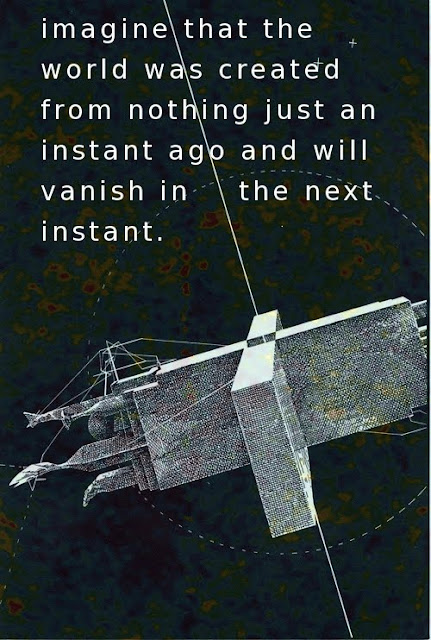
Imagine the world was just created a momemnt ago and will be gone the next
This is a philosophy experiment. The idea is not as absurd as it sounds (similarly, physicists are perplexed by the Boltzmann brain paradox and you should be too).You will not need any materials to preform it other than your brain. Simply consider what it would mean if the universe was created just an instant ago, and will vanish again the next instant.

The Cosmos isn't strange, people are strange

The cosmos isn't strange, people are strange. The universe on the largest of scales is actually simple compared to the complexities of the human mind or even the weather. In a statistical sense all current observations indicate that universe is homogeneous and isotropic everywhere. The best evidence for this statement is the cosmic microwave background (CMB) radiation which is light from the big bang that has traveled unimpeded through the universe since recombination. A simple and consistent model for the universe is that just after the big bang an inflationary field with quantum fluctuations rapidly expanded. These fluctuations seeded the CMB with a Gaussian random field of temperature perturbations. The seventh year Wilkinson Microwave Anisotropy Probe (WMAP) data is consistent with an inflationary ΛCDM model that specifies just six parameters (see Larson et al. 2010): the baryon density Ωb, the cold dark matter density Ωc, a cosmological constant ΩΛ, a spectral index of scalar fluctuations ns, the optical depth to reionization Ï„ , and the scalar fluctuation amplitude Δ2R. These results are not new. They are further refinements on previous WMAP data which have all been consistent with the ΛCDM model showing that the universe is flat, with a nearly (but not exactly) scale invariant fluctuation spectrum seeded by quantum flucuations during inflation, with Gaussian random phases, and with statistical isotropy over the entire sky. When WMAP data are combined with additional cosmological data, the ΛCDM model remains robust, and stronger constraints are placed on allowed parameters.

However, if you keep looking closer you can find surprises in the data. The human mind is a readily adept tool at recognizing patterns so a visual inspection of the WMAP image is always a good idea. You can find many statistically unlikely events in the WMAP sky map, but because the human mind is naturally a poor estimator of probabilities strange observations more often only mark the strange patterns of human thought and not fundamental inconsistencies of the cosmos. Exactly what is hidden in the cosmic microwave background is like asking what you see in the clouds, but some claim to see the secret masters of the universe at work. In fact you can see Stephen Hawking's initials in the WMAP image!

Stephen Hawking's initials in the WMAP sky, secret masters of the universe, CMB anomalies
This seems like an outrageous claim so the first thing I did when I heard this was to look at my desktop, which of course is an image of the WMAP sky, and indeed this is no ruse. All I have done in the above image is to outline what was already present; to corroborate this I encourage you to observe the original images of the microwave sky from the WMAP collaboration.

There are many other strange occurrences in the WMAP sky which are not so easily observed by the casual observer or with the human eye. However when you go bowling with the CMB even statistics can lead you astray. You have to ask yourself is physics cognitively biased? Some striking visual anomalies that cosmologists have pointed out include the extremely large cold spot at the center, the four blue ridges in the lower hemisphere, the 'SH' initials, etc. Despite these observations the standard cosmological interpretation (see Komatsu et al. 2010) is, not surprisingly, standard. There are no anomalies to account for, but many researchers are searching for them. The situation is similar to particle physics where if the LHC finds the Higg's boson at the expected energy range then the standard model is validated, but if something unexpected is found new physics, answers to open questions, or a new direction for discovery other than the standard model may be opened (indeed, some find the prospect of merely finding the Higg's boson a disappointment). For example if there is statistically significant support for a hemispherical or dipole power asymmetry across the sky this could point to evidence for a unique inflaton field and, out on a limb here, evidence for physics beyond our universe. The real question is whether or not there are anomolies in the data which are significant. In Bennet et al 2010 the prospect for CMB anomalies is seriously addressed. An excerpt from the abstract
In this paper we examine potential anomalies and present analyses and assessments of their significance. In most cases we find that claimed anomalies depend on posterior selection of some aspect or subset of the data. Compared with sky simulations based on the best fit model, one can select for low probability features of the WMAP data. Low probability features are expected, but it is not usually straightforward to determine whether any particular low probability feature is the result of the a posteriori selection or non-standard cosmology. Hypothesis testing could, of course, always reveal an alternate model that is statistically favored, but there is currently no model that is more compelling. We find that two cold spots on the map are normal CMB fluctuations. We also find that that the amplitude of the quadrupole is well within the expected 95% confidence range and therefore is not anomalously low. We find no significant anomaly with a lack of large angular scale CMB power for the best-fit CDM model. We examine in detail the properties of the power spectrum data with respect to the CDM model and find no significant anomalies. The quadrupole and octupole components of the CMB sky are remarkably aligned, but we find that this is not due to any single map feature; it results from the statistical combination of the full sky anisotropy pattern. It may be due, in part, to chance alignments between the primary and secondary anisotropy, but this only shifts the coincidence from within the last scattering surface to between it and the local matter density distribution. This alignment has been known for years and yet no theory has replaced CDM as more compelling. We examine claims of a hemispherical or dipole power asymmetry across the sky and find that the evidence for these claim is not statistically significant. We confirm the claim of a strong quadrupolar power asymmetry effect, but there is considerable evidence that the effect is not cosmological. The likely explanation is an insufficient handling of beam asymmetries. We conclude that there is no compelling evidence for deviations from the CDM model, which is generally an acceptable statistical fit to WMAP and other cosmological data.
In case no one ever told you, the answer to any question asked in a paper's title is no. So if you make an arbitrary decision on how to run statistical analysis on your data (like something as a trivial as a tuned bin size in a histogram) this imposes a posterior selection on the data which will likely effect your conclusion. In order to draw conclusions about such a complicated observation (I began by saying this was all simple and I maintain that, but the instrument and detectors taking the observations are not simple) you must run Monte Carlo simulations to determine expected deviations from your model. So in conclusion cosmic variance limited data will necessarily show probabilistically unlikely events, and the cosmos isn't strange people are strange. Though this certainly isn't the end of probing the CMB with the PLANCK mission currently flying and CMB polarization just being explored. We still want to know how closely natures matches our theory, exactly or not exactly? And I will give you a hint here, you can always measure again so if you have to ask...

ResearchBlogging.org
References:

C. L. Bennett, R. S. Hill, G. Hinshaw, D. Larson, K. M. Smith, J. Dunkley, B. Gold, M. Halpern, N. Jarosik, A. Kogut, E. Komatsu, M. Limon, S. S. Meyer, M. R. Nolta, N. Odegard, L. Page, D. N. Spergel, G. S. Tucker, J. L. Weiland, E. Wollack, & E. L. Wright (2010). Seven-Year Wilkinson Microwave Anisotropy Probe (WMAP) Observations: Are
There Cosmic Microwave Background Anomalies? ApJ arXiv: 1001.4758v1