Field of Science

A Trip to the Moon

A Trip to the Moon (French: Le Voyage dans la lune) is a 1902 French black-and-white silent film by Georges Méliès. It was extremely popular at the time of its release, and is the best-known of the hundreds of fantasy films made by Méliès. A Trip to the Moon is considered the first science fiction film with its use of innovative animation and special effects. It is based loosely on two popular novels of the time: Jules Verne's From the Earth to the Moon and H. G. Wells' The First Men in the Moon. The film depicts six brave astronomers who build a space capsule and a huge cannon which shoots them into space. On the moon the astronomers find the unexpected.

Outer Space

Perhaps at first the images seem like the brush strokes of artist infatuated with geometry and abstract forms. Then precise patterns becomes unmistakable and you envision the path the spacecraft traced in space and its journey over space and time. The origin of the images only serves to heighten your realization of how amazing the universe is.

Disassociate Galaxy Clusters

A dissociative galaxy cluster is a cluster of galaxies that just can't keep it together any longer. This may sound like an unnecessary anthropomorphication of galaxies, but it is actually a description of galaxy clusters which have collided and experienced stratification of their constituent parts. In the standard and successful model of cosmology the largest scale structures in the universe, like super clusters of thousands of galaxies, form via the merger of filamentary structures composed of smaller clusters of galaxies. Gravity keeps pulling clusters together along highways of galaxy clusters. Occasionally it is expected and observed that galaxy clusters meet each other head on in cosmic train wrecks moving at thousands of kilometers per second. These traumatic merging events scar the galaxy clusters for life. Their post traumatic stress afflictions include hot shocked X-ray gas and galaxies displaced from their gas halos. Lets consider the three main constituents of a galaxy cluster: stars, gas, and dark matter.
  • Clusters are made of aggregates of hundreds or thousands of galaxies and each galaxy is made of hundreds of billions of stars. The stars of the galaxy cluster are conspicuous in that they shine and are observable in pictures, but they account for only about 5% or less of the cluster's mass. The luminous stars of galaxies don't interact much during a collision with another cluster of galaxies and so they act like people in two crowds which are moving in opposite directions. Stars are part of the cosmic ghost train.
  • The gas in galaxy clusters accounts for about 10% of the regular (or baryonic) mass in clusters. Gas does interact during a collision. The gas clouds in colliding galaxy clusters slams together like two waves of water meeting and stalls out, but not without undergoing a process known as shock heating first which raises the gas temperature to millions of degrees.Gas is part of the cosmic train wreck.
  • The dark matter in galaxy clusters is the most dominant part of the cluster by mass making up about 90% the mass. Dark matter does not interact much. The dark matter halos travel right through each other like ghosts when two clusters collide. However, it is possible that the dark matter does interact slightly and dissociative collisions are a powerful tool in constraining this dark matter interaction. The dark matter halos of the colliding clusters should sail right past each other like two ghost trains, but if the trains slow down even in the slightest it may indicate something strange.
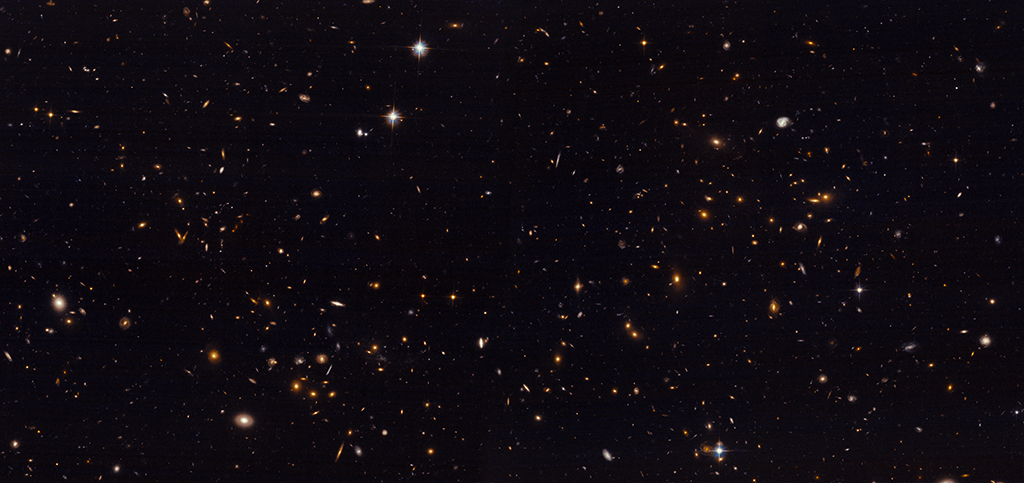
These so called dissociation mergers are difficult to observe and analyze. They require telescopes in space, follow up observations on the ground, observations in multiple wavelength regimes, and algorithms to predict the distribution of dark matter. So far there are six such dissociation mergers systems detected. You would think it would be obvious to spot some of the most massive structures in the universe smashing into each other, but spotting galaxy clusters is actually very difficult because of their great distance. Perhaps in an optical survey, like that in the image below taken by the Hubble Space telescope, over densities of galaxies are detected.

In practice many times it is easier to first identify galaxy clusters through their gas content because the gas content is more massive than the stellar component. Many new clusters are identified by observing the cluster gas's effect in the microwave regime or in the X-ray regime. In the image below taken by the the NASA Chandra X-ray observatory the hot intracluster gas is seen in pink. This image corresponds to exactly the same field of view on the sky as the optical image above.
It may dawn on you that by the very definition of dark matter there is no telescope which can observe it directly. The only in way in which dark matter interacts strongly is through gravity and thus that is how astronomers look for it. Through theoretical predictions and confirmed observations we know that gravity bends light and thus massive galaxy clusters will bend the light of even more distant galaxies. Thus through weak gravitational lensing the dark matter betrays its presence. A careful statistical analysis of galaxy shapes in the optical image above reveals that the galaxies which are confirmed not to be in the foreground cluster are slightly distorted in shape via the gravitational force of the dark matter which is in the foreground. A reconstruction of the total mass in the clusters is shown in the image below where the parts of the cluster which have the most mass are shown in blue. This image corresponds to exactly the same field of view on the sky as optical and X-ray images above.
Finally, a superposition of all the data allows us to glimpse at what a crisis this merging cluster is in. Note that the optical image remains in its original color, the gas is in pink, and the mass is in blue. The image below is known as the Musket Ball Cluster. The actual collision of galaxies occurred about 700 million years ago. We can rewind the collisions in our heads and envision that blue/optical cluster on the right of the image was once on the left and so the blue/optical cluster on the left of the image was once on the right; the clusters collided head on and the gas stopped dead at the center, but the galaxies and dark matter hardly stopped. There are several other images below of other dissociative cluster mergers with the same color scheme. Notice the different morphologies and distributions of mass, stars, and gas. The collisions are not always so straight forward.

Musket Ball Cluster. X-ray: NASA/CXC/UCDavis/W.Dawson et al; Optical: NASA/STScI/UCDavis/W.Dawson et al.
Train Wreck Cluster. X-ray: NASA/CXC/UVic./A.Mahdavi et al. Optical/Lensing: CFHT/UVic./A.Mahdavi et al.
Bullet Cluster. Credit: X-ray: NASA/CXC/CfA/M.Markevitch et al.;  Optical: NASA/STScI; Magellan/U.Arizona/D.Clowe et al.; Lensing Map:  NASA/STScI; ESO WFI; Magellan/U.Arizona/D.Clowe et al.
Bullet Cluster. Credit: X-ray: NASA/CXC/CfA/M.Markevitch et al.; Optical: NASA/STScI; Magellan/U.Arizona/D.Clowe et al.; Lensing Map: NASA/STScI; ESO WFI; Magellan/U.Arizona/D.Clowe et al.
The awesome thing about these cosmic mergers is how they can constrain the dark matter self-interaction cross-section. That is, exactly who much does dark matter interact with itself? The interpretation of these collisions is not always simple such as in the Train Wreck Cluster (seen above) where there seems to be an extra dark matter core not associated with any bright galaxy at the center of the image, but nonetheless these mergers can be thought of as astrophysical laboratories of dark matter. It would be very interesting to discover that dark matter self-interacts at all, however dissociate clusters will only be one piece of the extraordinary evidence necessary to make that claim.

ResearchBlogging.org

Dawson, W., Wittman, D., Jee, M., Gee, P., Hughes, J., Tyson, J., Schmidt, S., Thorman, P., Bradač, M., Miyazaki, S., Lemaux, B., Utsumi, Y., & Margoniner, V. (2012). DISCOVERY OF A DISSOCIATIVE GALAXY CLUSTER MERGER WITH LARGE PHYSICAL SEPARATION The Astrophysical Journal, 747 (2) DOI: 10.1088/2041-8205/747/2/L42

Jee, M., Mahdavi, A., Hoekstra, H., Babul, A., Dalcanton, J., Carroll, P., & Capak, P. (2012). A STUDY OF THE DARK CORE IN A520: THE MYSTERY DEEPENS The Astrophysical Journal, 747 (2) DOI: 10.1088/0004-637X/747/2/96

Markevitch, M., Gonzalez, A., Clowe, D., Vikhlinin, A., Forman, W., Jones, C., Murray, S., & Tucker, W. (2004). Direct Constraints on the Dark Matter Self‐Interaction Cross Section from the Merging Galaxy Cluster 1E 0657−56 The Astrophysical Journal, 606 (2), 819-824 DOI: 10.1086/383178

Conservation in the Real World

Peter Kareiva has surprisingly radical ideas on conservation. He is the chief scientist at the Nature Conservancy and is serious about protecting the Earth and all the creatures that depend on it. His views are unconventional in some ways. He argues that enviromentalism is on the decline and that we need to choose our environmental battles.

The Most Astounding Fact

We are part of this Universe, but perhaps more important is that the Universe is in us. You may have even heard it stated as a fact that we are made of stardust. What does this mean? Well in the early early Universe, a few minutes after the big bang, the Universe consisted of only hydrogen, helium, and a smidgen of lithium. There was no oxygen, carbon, or any other heavy elements. Complex life had to wait. It took hundreds of thousands of years for stars to form. Eventually in the cores of massive stars the atoms of which we exist were forged under massive pressure and heat through the process of fusion—the merging of lighter atoms to create heavier atoms. The key to unlocking those delicious elements was fantastic stellar explosions. We could say the stars died for us.

Humans are at least 60% water by mass (this is the most uncertain number here because after you drink a few beers this number quickly starts to change). Water is by mass is 11% hydrogen. Thus the mass of hydrogen in our body from water is at least 7% though of course there is lots of other hydrogen in our body from other molecules (lipids, amino acids, and so on). A better estimate is that we are 10% hydrogen by mass (if we do our accounting by number of atoms in the body we are 63% hydrogen atoms). Ultimately every atom in us is that is not hydrogen was forged in stars, and so 90% of the mass in our bodies is stardust.

The Story of Fixing Hubble

I can't tell if Charles Pellerin, the director of NASA astrophysics at the time the Hubble Space Telescope was launched in 1990, is a really honest person or a really lucky person. He was able to get a mission together that fixed Hubble after a disastrous design flaw was found in the telescope after it was already in space. In an article over at Computerworld he gives an account of the technical and social workings that led to the launch of Hubble with a spherically aberrerated mirror — the telescope's mirror was flawed such that it would take a space serving mission to make it usable for science. In 1993 a space mission did successfully fix Hubble, just three years after Huuble went to space as a deferred dream. In hindsight Pellerin believes what led to the mistake in Hubble's design, and the 1986 Challenger disaster, was as much technical as social. The pressure put on the rational scientists by management led to the problems.

Large projects have social forces at play such as 'normalisation of deviance' wherein problems become okay logically when you step back from them. An entire mission can drift noticeably into situations where more than a simple technical argument can stop it. Pellerin took notice of research which shows that social context can be a larger determinate of performance rather than individual abilities. Pellerin asserts that Hubble nor Challenger was a product of invisible or unmanageable forces. While certain accidents may be unavoidable, others are avoidable and they may be the fault of leadership. Today Pellerin teaches management techniques founded concepts of mutual respect, authenticity, and efficient action incorporated into the leadership.

There's nothing unusual about having a bad day at the office. But some people have worse days than others, and in his time Charles (Charlie) Pellerin has had a few notable ones. Not many people find themselves having to explain why an organisation has invested a decade and half and in the vicinity of $3 billion on a project that has failed.

That's the position Pellerin found himself in as NASA's director of astrophysics in the wake of the 1990 launch of the Hubble Space Telescope, which had what appeared to be an unfixable flaw in its optical system.

It's difficult to overstate what a disaster this was and the humiliation faced by NASA; not just as an organisation but also the individuals who worked for the agency. A good friend of Pellerin who worked on the telescope fell ill in the wake of the launch and died. Two of Pellerin's senior staffers had to be removed from their offices by guards and taken to alcohol rehab facilities. "These are PhDs sitting at their desk getting drunk; this is how bad the stress was," says Pellerin.

Read on about how NASA's short-sightedness led to a flaw in Hubble's optics.

Science writing versus writing like a scientist

It is a fact that I have written more fiction in my life than science writing and more science writing that I have scientific papers. When my advisor has asked me to write I am able to naturally come up with an abstract and an introduction like a magician pulling a rabbit out of a hat. I summarize the current state of the field neatly and present our results as the natural evolution of what comes next. Then when it comes to writing out the details of the research and the work I slow down. My advisor has a bit of criticism about the introduction (it is not specific enough they say), and plenty of criticism for the rest of the writing as if my entire style is not adequate. What is with the style of science writing in grants and research papers?

It as if scientists are bound to a certain kind of writing that is dry, concise (and it has to be when we have to pay per page published in most research journals), and standardized. I think many scientist would agree that our language doesn't have to be dry as long as it is standardized. Expository writing is different from other kinds of writing sure, but we have to ask ourselves how and why? Science writing for journalism is different than that of science writing for papers of grants even though they are both technically expository writing. I wonder if this is because they must be or because mediocre writing has become the style in science papers. Adam Ruben has written a wonderful opinion piece over at Science magazine mocking some of the quirks of scientific paper writing. The piece is worth a read and he includes a list of science paper tropes which are hilarious. Here is an excerpt:

Image of a book, by Flickr user romling1. Scientific papers must begin with an obligatory nod to their own relevance, usually by citing exaggerated figures about disease prevalence or other impending disasters. If your research does not actually address one of these issues, pretend it does, because hey, that didn’t stop you on the grant application. For example, you might write, “Twenty million children die of scabies every day. OMG we built a robot kangaroo!”

2. Using the first person in your writing humanizes your work. If possible, therefore, you should avoid using the first person in your writing. Science succeeds in spite of human beings, not because of us, so you want to make it look like your results magically discovered themselves.

3. Some journals, such as Science, officially eschew the passive voice. Others print only the passive voice. So find a healthy compromise by writing in semi-passive voice.

ACTIVE VOICE: We did this experiment.

PASSIVE VOICE: This experiment was done by us.

SEMI-PASSIVE VOICE: Done by us, this experiment was.

Yes, for the semi-passive voice, you’ll want to emulate Yoda. Yoda, you’ll want to emulate.


Read on you will want to, like a scientist you must write.

What entropy is or is not

A primer of what entropy is or is not at 3 Quarks Daily by Rishidev Chaudhuri and Jason Merrill:
C.P. Snow famously said that not knowing the second law of thermodynamics is like never having read Shakespeare. Whatever the particular merits of this comparison, it does speak to the centrality of the idea of entropy (and its increase) to the physical sciences. Entropy is one of the most important and fundamental physical concepts and, because of its generality, is frequently encountered outside physics. The pop conception of entropy is as a measure of the disorder in a system. This characterization is not so much false as misleading (especially if we think of order and information as being similar). What follows is a brief explanation of entropy, highlighting its origin in the particular ways we describe the world, and an explanation of why it tends to increase. We've made some simplifying assumptions, but they leave the spirit of things unchanged.
Read on.