Field of Science

Listening to the Universe

The enigmatic people at VBS TV just posted a piece on LOFAR, a next generation radio telescope (my own research is on a very similar radio telescope, the MWA, which I will discuss another day). Mother Board, the technology focused side of VBS even has a radio astronomy portal. Radio astronomy has never seemed so cool:
For the longest time, astronomy centered around what could be observed with our most wonderful and yet meager visual tool, the eye. But in the last fifty years, the ability to gaze up into space using radio waves, infrared and ultraviolet radiation and X- and gamma rays have provided new and completely unexpected information about the nature and history of the Universe, yielding a cosmic zoo of strange and exotic objects. But we have yet to properly explore the low radio frequencies, the lowest energy extreme of the spectrum accessible from the Earth. (Astronomers don’t actually listen to the signals, but convert them into data and images.)

With more “resolution” than any other telescope, the 1500 km-wide LOFAR array will open this frontier to a broad range of astrophysical studies, including transient sources, ultra high energy cosmic rays, cosmic magnetism, and the Epoch of Reionization. [more from Mother Board, Listening to the Universe]

I want to give one more shout out to the strange and amazing VBS TV. It is a news source which I have heard described as '60 Minutes meets Jackass' which is a powerful combination whether your watching Shane Smith in the Vice Guide to North Korea or anything from the expansive Vice Guide to Everything so please check it out.

Man vs. Machine: Computable Knowledge and Language Processing

Computers have come a long way since Charles Babbage's time. Babbage was the inventor of the concept of the programmable computer. He designed and attempted to build several machines including the Analytical Engine which was a programmable mechanical computer. It would have been the first Turing-complete (roughly implying it can simulate any other computer or proper program) machine ever. People at the time were confused by the entire concept of a computer.
"Mr. Babbage, if you put into the machine wrong figures, will the right answers come out?" I am not able rightly to apprehend the kind of confusion of ideas that could provoke such a question.
People thought that if a computer could do calculations it must be smart in the same way a person is smart, that is make deductions, inferences, and synthesize information to make conclusions. In the 1960's computers showed great promise and some researchers thought the age of truly intelligent machines was just a few years away. It turned out that the human mind is formidable opponent. Machines which think exactly like humans may not ever exist, but machines that 'think' are already here.
The final question, "William Wilkenson’s 'An Account of the Principalities of Wallachia and Moldavia' inspired this author's most famous novel." All contestants got the question right, but Jenning's knew he was not catching up.
Humans and machines were doing a lot of thinking this week when humans faced off against computers in a three day exhibition Jeopardy! match. The computer in the match was called Watson which was able to defeat Ken Jennings, the winngest ever Jeopardy player, and Brian Rutter, the all-time Jeopardy money winner. Watson is a purpose built technology demonstrating computer built by IBM which uses language processing and machine learning to play Jeopardy. A very good documentary produced by NOVA is available online which discuss the research and development that went into Watson, The Smartest Machine on Earth, which is a good watch even if you have been following the news on Watson. In the three day match things began slowly as Watson held is own, but occasionally stumbled. However, in the end Watson was light years ahead. Here is the recap:
This isn't the first time a human vs. machine battle has been played. In 1997 a highly publicized battle occurred between world chess champion Gary Kasparov and IBM's Deep Blue. Kasparov fell hard in the battle and even accused IBM of cheating. In retrospect his protests were in compete futility, as is proven by the fact that in 2006 world chess champion Vladimir Kramnik was beaten by a computer, Deep Fritz, running on a standard personal computer (running two Intel Core 2 Duo). Chess playing computers are not too 'smart'; they basically use their computing power to play out likely board configurations and so the techniques employed by chess playing programs have been excluded from some definitions of artificial intelligence. And of course maybe Watson isn't that smart either you could say. Watson uses knowledge humans have gathered, finds patterns, finds the relative strength of each answer, and returns the answer. It is hard to exactly define what intelligence is so I won't even try. Instead I will make two observations about the implications of machines besting humans. First, what takes a super computer at one point, will take a microchip in the future as indicated by the evolution of chess playing computers. Second, while the argument about what intelligence is goes on the pace and ability of computers also goes on.

How does Watson think? Watson uses machine learning. Basically Watson is fed a bunch of text documents like Wikipedia and IMDB (note that Watson was not online during the Jeopardy competition, but had access to these documents pre archived). Then programmers feed Watson questions and correct answer pairs which Watson can use to look through its database to find patterns. A complex architecture of rules and statistics allow Watson to choose the right answer, but amazingly programmers on the project don't explicitly tell Watson how or what the right answer is. Modern computer programs are big and complicated so it is best to let the computer take care of writing their own programs.

Watson's success means there is a bright future for language processing computers (at least IBM wants us to think so and buy their products). I have been contemplating the merger of Wolfram|Alpha and IBM's Watson as the ultimate language processing computational engine. Alpha if you have never used it is a live web program that anyone can use. The creator, Stephen Wolfram, calls Alpha a computational knowledge engine. This means that Alpha doesn't parse language in the most human receptive manner, but it has powerful database and computational algorithm resources such that if you want to know the error function of the GDP of Italy divided by the GDP of the US all divided by the 144th prime, well you can do that. Also, Alpha can do math, and how. IBM's Watson on the other hand could tell you the name of the country with its boot dipped in the Mediterranean. These smart computers are different for obvious reasons, they have access to different information databases and they are programed differently. An explanation of the difference recently came up on Stephen Wolfram's blog in pictorial form.
It would be a powerful combination to have Alpha's database and analytical skills paired with Watson's language processing. Perhaps we will have a Watson|Alpha soon. I remarked to a colleague in jest the other day that if they made such a machine I would be out of a job, but he replied that I would still have job as long as computers only have answers and not questions. True enough. I am reminded of the Hitchhikers Guide to the Galaxy where an immense computer calculates the answer to the universe, however, with the answer in hand it is realized a bigger more powerful computer must be constructed to determine the question.

The Universe and Life is asymmetric: Chirality

The shadow of symmetry haunts physics. Symmetry is invoked to understand nature concisely, but broken symmetry is invoked to understand nature completely. Physics is filled with examples of shattered symmetries: there is more matter than antimatter, neutrinos only come in the left handed spin flavor, and quantum processes break symmetries constantly, but nature also violates symmetry in chemistry and biology in a very clever manner. Chemistry and biology are subjects I do no normally touch upon, but I am intrigued by the curious circumstance of life on Earth: many molecules are not superimposable upon their mirror images, a property called chirality, and life on Earth has a preference for these chiral mirror configurations. Physics and life is inherently asymmetric.

That something is not identical to its mirror image is a property known as chirality. Hands (etymologically the word chirality is derived from the Greek word for hand), spiral galaxies, and the DNA helix are all examples of chiral objects. In particle physics chirality is a more abstract notion defined by transformations of a particle with respect to a left right of left handed representation in the Poincaré group. In chemistry chirality is well described by analogy to your hands wherein left and right hands cannot be superposed on each other even though the fingers are the same and match up.

This article is an exploration of chirality in biochemistry. I want to ask what makes life chiral, why is life chiral, and how did life become chiral. In order to supplement my limited knowledge of the subject I interviewed a world expert and author of over twenty papers on the subject, Robert Compton, who I must give a deep thanks to for being willing to answer my silly questions.
It is important to accept that the concept of symmetry is tinted by the human notion of harmonious or aesthetically pleasing forms, but the strict mathematical interpretation of symmetry relies upon metrics of geometry. To this end many seemingly symmetric forms in the living natural world are actually examples of broken symmetries: spiral tree trunks, the human form, and sea shells (which generally only coil in one particular direction according to species). The remarkable thing is that this macro asymmetry can be traced back to a micro asymmetry in the chemistry of life. The arrangement of atoms in a molecule defines the function of that molecule, but even molecules with the same chemical configuration can behave differently as in the case of chiral molecules which are like mirror images of the same molecule that come in 'left' and 'right' handed forms. The great asymmetry of life is that all living organisms on Earth almost exclusively utilize the left handed (or levorotatory) configuration for amino acids and the right handed (or dextrorotatory) configuration for sugars belonging to DNA or RNA.

Perhaps it is trivial or obvious that life is chiral when looking at the nautilus, but this obvious chirality is a macroscopic feature which belies the fine arrangement of atoms which defines the chirality of biomolecules.

Different structural forms of compounds with the same molecular formula are known as isomers to chemists. A stereoisomer is an isomeric molecule which has the identical constitution and sequence of bonded atoms, but has a different three-dimensional geometry in space. An enantiomer is one specific steroisomer of the two possible mirror images that are non-superposable. The dominance of the left handed chiral enantiomer in biology is a massive blow to the idea that nature is perfectly symmetric and is an unsolved mystery as to why nature is this way.

Many molecules are chiral, however because molecules are constantly vibrating the instantaneous structure of a molecule may lack the exact structure or symmetry seen in an ideal model.  Regardless, enantiomers have identical chemical properties except when they react with other molecules which are also enantiomeric in which case chiral forces yield a difference in behavior. Further, and perhaps more important for biology, particularly astrobiology, is that enantiomers have identical physical properties except with respect to the way they interact with plane-polarized or circularly polarized light or other chiral compounds. A pure enantiomer compound will rotate the plane of a monochromatic plane-polarized light by a certain angle in one direction, say clockwise, while the other enantiomer form of the compound will rotate the light by an equal amount in the opposite direction. Things that rotate light are said to be optically active.  Measurements with a polarimeter allow chemists to determine if a compound is chiral or not. Polarization of light by organic compounds was discovered in 1815 by the French physicist and chemist Jean-Baptiste Biot. He found that organically produced chemical solutions consistently rotated plane polarized light, but laboratory synthesized chemicals did not reproduce the rotation. Beyond conjectures he had no explanation for the phenomena.Years later Louis Pasteur preformed a similar experiment with tartaric acid produced from grapes and tartaric acid synthesized in the lab. Pasteur went further and somehow used tweezers and a microscope (I do not conceive to understand how) to separate the tartaric acid crystals which he produced in the laboratory into piles of left and right handed molecules. He found that polarized light was rotated by the left handed molecules that he had selected in the same way the polarized light was rotated by the organic tartaric acid. He concluded that chiral molecules are responsible for the rotation of polarized light.

So chiral molecules rotate light, but actually so does an individual achiral molecule! In an ensemble of achiral molecules each individual molecule may rotate the plane of the polarization, but the net rotation averaged over the ensemble will result in zero rotation. A mixture of two enantiomers in a 1:1 ratio (which is what you get when you create chemicals in the lab) is optically inactive because the rotation results in a zero net polarization rotation. When a reagent or catalyst is optically active the chiral product will also be optically active, or in the presence of chiral forces such as circularly polarized light this may also induce optical activity via enantimoeric excess in the products as well. Generally you can get optically active compounds in two ways 1) The reagent in already optically active. 2) The reaction of achiral but optically inactive precursors in a chiral optically active environment occurs. It takes an optically active molecule or chiral force to produce a product that is optically active.

Most chemical reactions are not enantiomerically selective so that the initial reason for a completely homochiral biology on Earth remains a mystery just as when Biot and Pasteur discovered chirality through optical activity. Of course chirality is simply geometric in nature and thus this geometric asymmetry is what makes life chiral. Any molecule that contains a tetrahedral carbon or other central atom bonded to four different atoms or constituents will exist in enantiomeric forms; given that all biological molecules are at least this complicated, then (almost?) all biological molecules exist in enantiomeric forms. It may be that the chirality of biomolcules is simply a consequence of the emergent complexity of basic physics. The conditions necessary for a solution initially containing near equal number of chiral forms to evolve towards pure chirality has been explored (see Frederick Frank 1953) and is plausible. A tiny initial imbalance has spiraled out of control and now each successive generation of biomolecules on Earth is produced by the previous generation of chiral reagents, thus this is the why life is chiral. None of this explains how life is chiral, but a common answer is that because life can be chiral it is chiral.

From this persepctive this topic is not so interesting, honestly. I have come to the conclusion that chriality is as it must be given that each generation of life is spawned from the previous generation under conditions which do have enantiomeric selection forces present. The question is why was left handed chirality chosen for life on our Earth?

Now actually, the chirality of biomolecules is not just a philosophical diversion; it a serious issue of biochemistry in balance. There are over 530 synthetic chiral drugs worldwide today. It is technically and economically prohibitive to make enantiomerically pure drugs in all cases. This results in drugs that may have strange, null, or fatal interactions with human subjects. In some cases the difference between two enantiomeric forms is simple, as in the case of the olfactory exciting chemical carvone; in one configuration it smells like spearmint and the other configuration like caraway seeds. So, "Perhaps," as Alice said to her cat in Lewis Carroll's Though the Looking Glass, "looking-glass milk isn't good to drink".

I digress. Before we hear what Dr. Compton has to say on this matter lets look at what fundamental physics would bias the chirality of life on Earth and how homochirality was selected on Earth.  There are three distinct mechanisms that seem plausible.
  • The weak force. Of the fundamental forces, nuclear, electroweak and gravitational, only the weak force can distinguish between left and right parity particles. The weak force it turns out does not conserve parity (although it does conserve CPT symmetry) during some interactions such as the radioactive beta decay corresponding to the emission of an electron with intrinsic spin 1/2 hbar. Also, the weak force induces a parity-violating energy difference, PVED, between molecules or the interactions of left-handed electrons emitted during beta decay with molecules. So the weak force could preselect a handedness in nature through either beta decay or PVED. The idea is that if one chiral configuration is a lower energy state then nature will prefer that configuration (in fact the exact scaling from thermodynamics is that the reaction rate for the oppositely chiral molecules is proportional to the canonical partition function in physics going as e-PVED/kT where e is the Euler's number, k is Boltzmann's constant, T is the temperature in Kelvin). The difference in energy from the PVED can be theoretically calculated from a Hamiltonian operator that is scaled by the Fermi electroweak coupling constant. The energy difference between chiral configurations is predicted to be small, around 10-14 Joules per mol which means that not only is this energy difference believed to be minimally important to early life's synthesis, but it is also out of reach of current experimental techniques. However, it turns out that the PVED predicts that the left handed chiral states would be of lower energy, just as they are found dominantly in life on Earth. The weakforce influences chemical reactions because during beta decay, spin polarized electrons produce a an abundance of left-circularly polarized gamma-rays which, if present during the synthesis of biomolecules would tend to create an enantiomeric excess of left handed molecules. However, laboratory experiments have not shown conclusively that this effect is strong enough to matter either. There is some debate as to the exact nature of the PVED which will depend on further experimental measurements. The weakforce seems to preselect a hand in nature, but it is a feeble force.
  • Polarization. Optically active organic molecules being synthesized in the presence of polarized light will be chiral. Sunlight is slightly polarized just before sunrise and after sunset. This averages out to zero, but chemical activity that dominates in the morning/evening or occurs in the presence of shadows could feel a net polarization effect. Also plausible are astronomical sources of polarized light outside the solar system. Supernovae have been known to emit circularly polarized light as have star forming or nebulae regions. These sources while weak would create conditions necessary for the synthesis of homochiral biomolecules.
  • Vorticity. A chemical solution being stirred or agitated results in the synthesis of homochiral biomolecules, however, the handedness of the chirality is random. Certaintly there were chaotic turbulent conditions on the early Earth.
There is no conclusion to be drawn as to how life became homochiral. I found more questions than answers. So I asked Robert Compton for some answers.

1) Enantiomers are allotropes then?
Interesting question but allotropes are "two or more existing forms of an element" such as graphite, diamond and fullerenes. There are a number of fullerenes which are chiral, e.g. C84. The C84 molecule has an R and and S enantiomer as well as the meso- form (the meso is a combination of the R- and S- form). This is illustrated below. One goes from the left to the right by rotating two of the carbons twice and reconnecting the dots going through the achiral meso-form.

2) Life on earth is overwhelmingly 'left-handed' homochiral. Is this merely a coincidence of history? Do you think a fundamental effect like PVED or an environmental effect like polarized light from a local supernova or nebula was responsible for primordial chirality on Earth?
This is the 64 million dollar question. Did life end up as “left-handed” (or better L-amino acids) due to some fundamental bias or was it pure chance and there may be a planet out there that is made up of D-amino acids. I have discussed the possibilites in my review article on “Chirality of Biomolecules” but to summarize it may be due to 1) the influence of circularly-polarized light on biomolecules giving rise to life over long periods of time, or 2)the chiral weak force making one enantiomer be lower in energy than the other ( this is certainty true but the effect is really, really small) or 3) chiral beta – rays interacting with matter to produce handed biomolecules. At the present time I favor the interaction of circularly polarized light on molecules in interstellar space (maybe chiral microwaves). Meteors then bring these molecules to Earth to begin life forms.
I really feel that PVED is too small. My bet is on circularly polarized light from a local supernova or nebula.
3) Subsequent proteins formed in the presence of a particular enantiomer protein will be preferentially homochial to that primordial protein. Assuming 'the spark of life' only occurred once with a particular enantiomer protein present, would you agree that it isn't surprising that life is homochiral? Is this assumption realistic?
Homochirality is understandable. Everyone agrees that life molecules are preordained to be homochiral. But there is no reason that they will be of only one handedness, of a specific chirality. That’s the rub. It has always been a big surprise to me that ALL life is made of L-amino acids ( and chiral sugars in the backbone of the DNA).
4) Imagine we went to planet X and found the same flora and fauna as Earth, but planet X's organisms were dominated by the opposite chiral form as that found on Earth. Could we mate with or consume nutrients from creatures on this planet?
No. I don’t think I would like to try this.
5) It is obvious in biology that chirality is a function of emergent complexity in the system. In physics chirality is often considered to be a function of the deepest laws of nature. Could chirality in physics also be a function of emergent complexity from unseen laws of nature?
I believe the current view is that the Universe began as both matter and anti-matter but bifurcated into matter due to some fundamental reason. Thus the Weak force gives rise to left spinning beta particles. There are a lot of scientists trying to understand how the Universe ended up as matter. This may be the “emergent complexity from unseen laws of nature” that you asked about.
6) In biology and chemistry symmetry breaking on macro scales is understood through chiral selection processes which act on micro scales. That symmetry breaking on micro scales may be traced back to an asymmetry in fundamental physics. Is the universe fundamentally asymmetric?
 I think this is ture. You may have seen the book “The Left Hand of Creation” by Barrow and Silk or “The New Ambidextrous Univesre” by Martin Gardner. They touch on this subject. Gardner is fun reading and can be (should be) read by high school students.

ResearchBlogging.org


Robert N. Compton, Richard M. Pagni, & Volume 48, 2002, Pages 219-261 (2002). The chirality of biomolecules Advances In Atomic, Molecular, and Optical Physics, 48, 219-261

Our Terraqueous globe

Carl Sagan's Pale Blue Dot is a resonating vision of human's future in space. Sagan combined elements of  science, philosophy, and sincere humanity in his public works that has made him a cosmic ambassador. His words seem timeless and in combination with music and visuals his message is even more powerful. Most humans who have ever looked up will enjoy these two videos created by NASA fan Reid Gower, and Sagan fan Michael Marantz.


I was struck by the strange wording that Sagan chooses at the beginning here.
We were hunters and foragers.

The frontier was everywhere.

We were bounded only by the Earth, and the ocean, and the sky. The open road still softly calls.

Our little terraquious globe as the madhouse of those hundred thousand millions of worlds.
Little terraquious globe sounds a little bit like an archaic way of saying pale blue dot. Indeed, I think it is. And the phrase  'the madhouse of those hundred thousand millions of worlds' seems rather forced compared to Sagan's usual poetic ease. I did some searching and found a usage of this term in François-Marie Arouet's (better known by his pen name Voltaire) short story Memnon, the Philosopher of Human Wisdom. The story tells of Memnon who decides to become a philosopher one day and upon that same day he loses his eye, his health, his fortune, and his reason. He passes into sleep in despair at the end of the day and is visited by a celestial spirit in a dream. The spirit says that things could be worse, in fact the spirit states that there are a hundred thousand million worlds and in each world there are degrees of philosophy and enjoyment, but each world has less than the next; there is a world of perfect philosophy and enjoyment somewhere the spirit implies. Memnon is afraid that the Earth must be on the low end of the list and replies, “that our little terraqueous globe here is the madhouse of those hundred thousand millions of worlds”. It is clear to me that Sagan had read this; Sagan's entire attitude to humanity's existence is identical to the thesis of Memnon, the Philosopher of Human Wisdom. Sagan (as does Voltaire in this story) holds that
For All Our Failings, Despite Our Limitations And Fallibilities, We Humans Are Capable Of Greatness.
Thus the great 18th century philosopher Voltaire has profoundly influenced one of the most popular 20th century scientists. Finally, Sagan's work may influence the direction that humanity takes in exploring outer space in the 21st century. I will end this strange tale with the tale itself, Voltaire's short story Memnon, the Philosopher of Human Wisdom.
Memnon one day took it into his head to become a great philosopher. There are few men who have not, at some time or other, conceived the same wild project. Says Memnon to himself, To be a perfect philosopher, and of course to be perfectly happy, I have nothing to do but to divest myself entirely of passions; and nothing is more easy, as everybody knows. In the first place, I will never be in love; for, when I see a beautiful woman, I will say to myself, These cheeks will one day grow wrinkled, these eyes be encircled with vermilion, that bosom become flabby and pendant, that head bald and palsied. Now I have only to consider her at present in imagination, as she will afterwards appear; and certainly a fair face will never turn my head. 
In the second place, I will be always temperate. It will be in vain to tempt me with good cheer, with delicious wines, or the charms of society. I will have only to figure to myself the consequences of excess, an aching head, a loathing stomach, the loss of reason, of health, and of time. I will then only eat to supply the waste of nature; my health will be always equal, my ideas pure and luminous. All this is so easy that there is no merit in accomplishing it. 
But, says Memnon, I must think a little of how I am to regulate my fortune; why, my desires are moderate, my wealth is securely placed with the Receiver General of the finances of Nineveh: I have where-withal to live independent; and that is the greatest of blessings. I shall never be under the cruel necessity of dancing attendance at court: I will never envy anyone, and nobody will envy me; still, all this is easy. I have friends, continued he, and I will preserve them, for we shall never have any difference; I will never take amiss anything they may say or do; and they will behave in the same way to me. There is no difficulty in all this. 
Having thus laid his little plan of philosophy in his closet, Memnon put his head out of the window. He saw two women walking under the plane trees near his house. The one was old, and appeared quite at her ease. The other was young, handsome, and seemingly much agitated: she sighed, she wept, and seemed on that account still more beautiful. Our philosopher was touched, not, to be sure, with the beauty of the lady (he was too much determined not to feel any uneasiness of that kind) but with the distress which he saw her in. He came downstairs and accosted the young Ninevite in the design of consoling her with philosophy. That lovely person related to him, with an air of great simplicity, and in the most affecting manner, the injuries she sustained from an imaginary uncle; with what art he had deprived her of some imaginary property, and of the violence which she pretended to dread from him. “You appear to me,” said she, “a man of such wisdom that if you will condescend to come to my house and examine into my affairs, I am persuaded you will be able to draw me from the cruel embarrassment I am at present involved in.” Memnon did not hesitate to follow her, to examine her affairs philosophically and to give her sound counsel. 
The afflicted lady led him into a perfumed chamber, and politely made him sit down with her on a large sofa, where they both placed themselves opposite to each other in the attitude of conversation, their legs crossed; the one eager in telling her story, the other listening with devout attention. The lady spoke with downcast eyes, whence there sometimes fell a tear, and which, as she now and then ventured to raise them, always met those of the sage Memnon. Their discourse was full of tenderness, which redoubled as often as their eyes met. Memnon took her affairs exceedingly to heart, and felt himself every instant more and more inclined to oblige a person so virtuous and so unhappy. By degrees, in the warmth of conversation, they ceased to sit opposite; they drew nearer; their legs were no longer crossed. Memnon counseled her so closely and gave her such tender advices that neither of them could talk any longer of business nor well knew what they were about. 
At this interesting moment, as may easily be imagined, who should come in but the uncle; he was armed from head to foot, and the first thing he said was, that he would immediately sacrifice, as was just, the sage Memnon and his niece; the latter, who made her escape, knew that he was well enough disposed to pardon, provided a good round sum were offered to him. Memnon was obliged to purchase his safety with all he had about him. In those days people were happy in getting so easily quit. America was not then discovered, and distressed ladies were not nearly as dangerous as they are now. 
Memnon, covered with shame and confusion, got home to his own house; there he found a card inviting him to dinner with some of his intimate friends. If I remain at home alone, said he, I shall have my mind so occupied with this vexatious adventure that I shall not be able to eat a bit, and I shall bring upon myself some disease. It will therefore be prudent in me to go to my intimate friends, and partake with them of a frugal repast. I shall forget in the sweets of their society that folly I have this morning been guilty of. Accordingly, he attends the meeting; he is discovered to be uneasy at something, and he is urged to drink and banish care. A little wine, drunk in moderation, comforts the heart of god and man: so reasons Memnon the philosopher, and he becomes intoxicated. After the repast, play is proposed. A little play with one’s intimate friends is a harmless pastime. He plays and loses all that is in his purse, and four times as much on his word. A dispute arises on some circumstances in the game, and the disputants grow warm: one of his intimate friends throws a dice box at his head, and strikes out one of his eyes. The philosopher Memnon is carried home to his house, drunk and penniless, with the loss of an eye. 
He sleeps out his debauch, and when his head has got a little clear, he sends his servant to the Receiver General of the finances of Nineveh to draw a little money to pay his debts of honor to his intimate friends. The servant returns and informs him that the Receiver General had that morning been declared a fraudulent bankrupt and that by this means an hundred families are reduced to poverty and despair. Memnon, almost beside himself, puts a plaster on his eye and a petition in his pocket, and goes to court to solicit justice from the king against the bankrupt. In the saloon he meets a number of ladies all in the highest spirits, and sailing along with hoops four-and-twenty feet in circumference. One of them, who knew him a little, eyed him askance, and cried aloud, “Ah! What a horrid monster!” Another, who was better acquainted with him, thus accosts him, “Good-morrow, Mr. Memnon. I hope you are very well, Mr. Memnon. La, Mr. Memnon, how did you lose your eye?” And, turning upon her heel, she tripped away without waiting an answer. Memnon hid himself in a corner and waited for the moment when he could throw himself at the feet of the monarch. That moment at last arrived. Three times he kissed the earth, and presented his petition. His gracious majesty received him very favorably, and referred the paper to one of his satraps, that he might give him an account of it. The satrap takes Memnon aside and says to him with a haughty air and satirical grin, “Hark ye, you fellow with the one eye, you must be a comical dog indeed, to address yourself to the king rather than to me; and still more so, to dare to demand justice against an honest bankrupt, whom I honor with my protection, and who is nephew to the waiting-maid of my mistress. Proceed no further in this business, my good friend, if you wish to preserve the eye you have left.” 
Memnon, having thus in his closet resolved to renounce women, the excesses of the table, play and quarreling, but especially having determined never to go to court, had been in the short space of four- and-twenty hours, duped and robbed by a gentle dame, had got drunk, had gamed, had been engaged in a quarrel, had got his eye knocked out, and had been at court where he was sneered at and insulted. 
Petrified with astonishment, and his heart broken with grief, Memnon returns homeward in despair. As he was about to enter his house, he is repulsed by a number of officers who are carrying off his furniture for the benefit of his creditors: he falls down almost lifeless under a plane tree. There he finds the fair dame, of the morning, who was walking with her dear uncle; and both set up a loud laugh on seeing Memnon with his plaster. The night approached, and Memnon made his bed on some straw near the walls of his house. Here the ague seized him, and he fell asleep in one of the fits, when a celestial spirit appeared to him in a dream. 
It was all resplendent with light: it had six beautiful wings, but neither feet nor head nor tail, and could be likened to nothing.
“What art thou?” said Memnon.
“Thy good genius,” replied the spirit.
“Restore to me then my eye, my health, my fortune, my reason,” said Memnon; and he related how he had lost them all in one day. “These are adventures which never happen to us in the world we inhabit,” said the spirit.
“And what world do you inhabit?” said the man of affliction.
“My native country,” replied the other, “is five hundred millions of leagues distant from the sun, in a little star near Sirius, which you see from hence.”
“Charming country!” said Memnon. “And are there indeed no jades to dupe a poor devil, no intimate friends that win his money, and knock out an eye for him, no fraudulent bankrupts, no satraps that make a jest of you while they refuse you justice?”
“No,” said the inhabitant of the star, “we have nothing of what you talk of; we are never duped by women, because we have none among us; we never commit excesses at table, because we neither eat nor drink; we have no bankrupts, because with us there is neither silver nor gold; our eyes cannot be knocked out because we have not bodies in the form of yours; and satraps never do us injustice because in our world we are all equal.”
“Pray, my lord,” then said Memnon, “without women and without eating how do you spend your time?”
“In watching,” said the genius, “over the other worlds that are entrusted to us; and I am now come to give you consolation.”
“Alas!” replied Memnon, “why did you not come yesterday to hinder me from committing so many indiscreations?”
“I was with your elder brother Hassan,” said the celestial being. “He is still more to be pitied than you are. His Most Gracious Majesty the Sultan of the Indies, in whose court he has the honor to serve, has caused both his eyes to be put out for some small indiscretion; and he is now in a dungeon, his hands and feet loaded with chains.”
“’Tis a happy thing truly,” said Memnon, “to have a good genius in one’s family, when out of two brothers one is blind of an eye, the other blind of both: one stretched upon straw, the other in a dungeon.”
“Your fate will soon change,” said the animal of the star. “It is true, you will never recover your eye, but, except that, you may be sufficiently happy if you never again take it into your head to be a perfect philosopher.”
“It is then impossible?” said Memnon.
“As impossible as to be perfectly wise, perfectly strong, perfectly powerful, perfectly happy. We ourselves are very far from it. There is a world indeed where all this is possible; but, in the hundred thousand millions of worlds dispersed over the regions of space, everything goes on by degrees. There is less philosophy, and less enjoyment on the second than in the first, less in the third than in the second, and so forth till the last in the scale, where all are completely fools.”
“I am afraid,” said Memnon, “that our little terraqueous globe here is the madhouse of those hundred thousand millions of worlds of which Your Lordship does me the honor to speak.”
“Not quite,” said the spirit, “but very nearly; everything must be in its proper place.”
“But are those poets and philosophers wrong, then, who tell us that everything is for the best?”
“No, they are right, when we consider things in relation to the gradation to the whole universe.”
“Oh! I shall never believe it till I recover my eye again,” said poor Memnon.

American Astronomical Society Meeting

The 217th American Astronomical Society Meeting was held here in Seattle this week. I attended every session I could, learned many new things, and met or reunited with many astronomy friends. I was too busy to blog during the event, but you can see what I and many others were saying during the conference by searching on twitter for #aas217 and below I have compiled a random selection of abstracts from interesting talks and posters I saw.
  • The History And Environment Of A Faded Quasar: HST Observations Of Hanny's Voorwerp And IC 2497. Keel, William C. Perhaps the signature discovery of the Galaxy Zoo citizen-science project has been Hanny's Voorwerp, high-ionization cloud extending 45 kpc from the spiral galaxy IC 2497. It must be ionized by a luminous AGN, either deeply obscured or having dimmed dramatically within 200,000 years. We explore this system using HST imaging and spectroscopy. The disk of IC 2497 is warped, with complex dust absorption near the nucleus; the near-IR peak coincides closely with the VLBI core marking the AGN. STIS spectra show the AGN as a low-luminosity LINER, with ionization parameter log U= -3.5, matching its weak X-ray emission. The nucleus is accompanied by an expanding loop of ionized gas 500 pc in diameter, opposite Hanny's Voorwerp. The loop's Doppler span 300 km/s implies kinematic age < 700,000 years. We find no high-ionization gas near the core, further evidence that the AGN is seen at a low radiative output (perhaps now dominated by kinetic energy). [O III] and Ha +[N II] ACS images show fine structure in Hanny's Voorwerp, including limb-brightened sections suggesting modest interaction with a galactic outflow. We identify small regions ionized by recent star formation, unlike the AGN ionization of the overall cloud. These H II regions contain blue continuum objects, consistent with young stellar populations; these occur where projected closest to IC 2497, perhaps meaning that the star formation was triggered by compression from an outflow. The ionization-sensitive [O III]/Ha ratio shows broad bands across the object, and no discernible pattern with emission-line structures or near the prominent "hole" in the ionized gas. These results fit with our picture of an ionization echo from an AGN whose ionizing luminosity has dropped by a factor >100 within the last 200,000 years. Such rapid fluctuations in luminosity could alter our understanding of AGN demographics. Supported by NASA/STScI. 

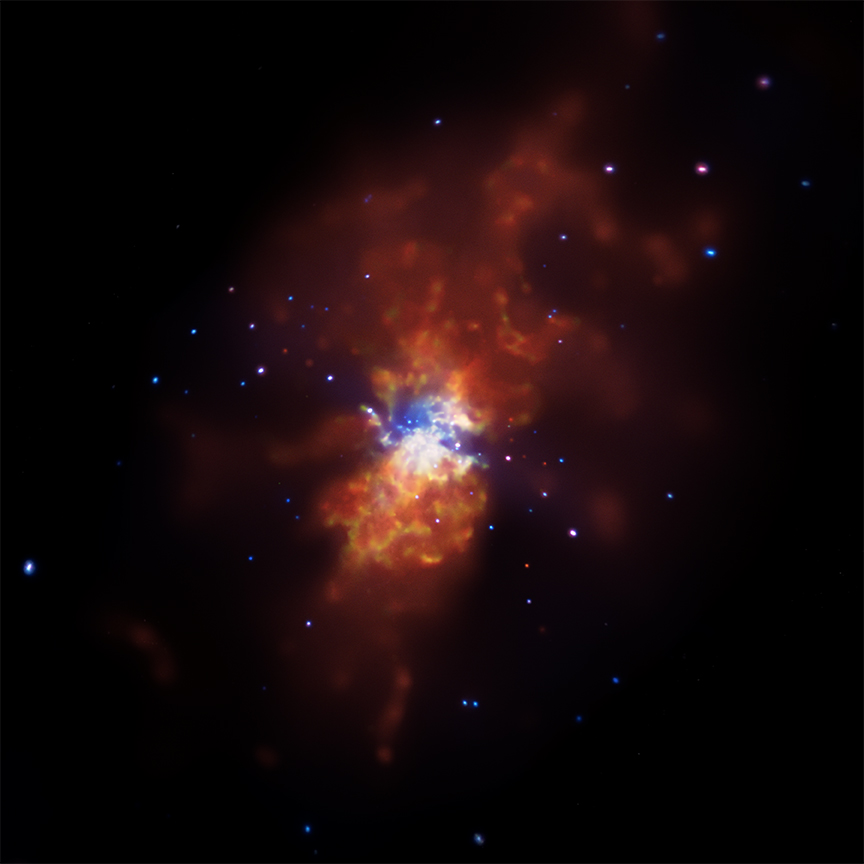
  • The Discrete X-ray Source Population of M82. Roy E. Kilgard.  M82 is the prototypical starburst galaxy in the nearby universe. As such, it is an excellent laboratory for studying high-mass X-ray binaries. We present an initial analysis of the discrete source population of M82, with an emphasis on the ultraluminous X-ray sources, using new and archival observations from the Chandra X-ray Observatory. M82 has been observed for more than 700 ks with ACIS and an additional 190 ks with the HRC, with observations spanning the entire Chandra lifetime to date. These data paint a portrait of the complex spectral and temporal variability of the high-mass X-ray binary population of a starburst galaxy. We will discuss the properties of these sources and the impact they have on the shape of the X-ray luminosity function. 

  • 3D Reconstruction of the Density Field: Using Redshift Information in Weak Lensing Analysis. Jake Vander Plas. We present a new method for constructing three-dimensional mass maps from gravitational lensing shear data. We solve the lensing inversion problem using truncation of singular values (within the context of generalized least squares estimation) without a priori assumptions about the statistical nature of the signal. This singular value framework allows a quantitative comparison between different filtering methods: we evaluate our method beside the previously explored Wiener filter approaches. Our method yields near-optimal angular resolution of the lensing reconstruction and allows cluster sized halos to be de-blended robustly. It allows for mass reconstructions which are 2-3 orders-of-magnitude faster than the Wiener filter approach, which will become increasingly important for future large surveys, e.g. LSST. Using this SVD framework, we discuss optimal redshift binning for 3D shear mapping, and explore how this informs the choice of binning in measurements of power spectrum evolution. 

  • Subtraction Of Point Sources From Interferometric Radio Images Through An Algebraic Forward Modeling Scheme. Gianni Bernardi.  Cutting edge cosmological investigations of the Epoch of Reionization (EoR) are driving a renovated effort in building low frequency radio interferometers. In order to detect the tiny EoR signal, high dynamic range (DR) imaging at frequencies below 200~MHz is required. High DR images are traditionally obtained by subtraction of bright sources from the ungridded visibilities, however, future generations of large-N radiotelescopes will generate such high volume data stream that the cost of storing the raw ungridded visibilities will be prohibitive. The DR will therefore be limited by well known pixelization effects. Further challenges for an image based deconvolution at low frequencies are a point spread function which varies significantly across the field of view, a time and frequency variable receptor response and ionospheric variability. In this presentation, we introduce a deconvolution algorithm which makes use of forward modeling to mitigate against the limitations of image-based deconvolution. Through forward modeling it is possible to generate a spatially variable point spread function and relate the sky brightness distribution to astrophysical parameters which are then retrieved through a non linear least squares minimization. We applied the method to the deconvolution of point sources on simulated observations of the Murchison Wide-field Array (MWA). MWA is the array with the largest number of correlated elements currently under construction (512 final elements) and will not have the option of storing the raw visibility data over long time integrations. We find that the accuracy to which point sources can be deconvolved/subtracted is only limited by their signal to noise ratio, not by their number or positions, therefore the DR increases with integration time. These results indicate this method to be promising for applications that require high DR imaging, like the detection of the EoR signal. This work was supported by the U.S. National Science Foundation. 

  • Early Astrophysics Results from Planck. Charles R. Lawrence. Since August 2009 Planck has been observing the sky at frequencies from 30 to 857 GHz, measuring not only the cosmic microwave background, but also everything else in the universe that radiates at these frequencies. I will describe the first scientific results from Planck covering a wide range of galactic and extragalactic astrophysics. 

  • Extracting The Astrophysics Of The First Sources From The 21 Cm Global Signal. Jonathan R. Pritchard. Low frequency radio observations of the redshifted 21 cm line of neutral hydrogen have the potential to open a new window into the period from redshift z=6-30 when the first galaxies formed and reionization occurred. Single dipole experiments targeted at the frequency evolution of the 21 cm global signal are likely to provide the first constraints on this epoch. In this talk, I discuss the science of this signal and quantify the prospects for these instruments using a Fisher matrix based approach. I will show that there is considerable room for these simple experiments to constrain the star formation rate and production of X-ray and UV photons by the first luminous sources, provided that issues of calibration, RFI, and the ionosphere can be controlled.

  • Radio Pulsars as Gravitational Wave Detectors: Recent Observational Results. Paul Demorest. The idea of using an array of millisecond radio pulsars as a nanohertz-frequency gravitational wave detector has continued to attract increasing attention over the past several years. Current experimental sensitivities are beginning to probe the upper limits of the predicted signal strength and a detection seems entirely within reach. The North American Nanohertz Observatory for Gravitational Waves (NANOGrav) project has been regularly timing a set of 20 millisecond pulsars over the past 5 years. These observations use the two largest radio telescopes on Earth, Arecibo Observatory and the NRAO Green Bank Telescope. In this talk, I will present newly developed analysis procedures and timing results from the NANOGrav 5-year data set. These are then used to place a new experimental limit on the strength of the stochastic nHz-frequency gravitational wave background.

  • Imaging the Spatial Fluctuations in Cosmic IR Background from Reionization with CIBER. Chris Frazer. The Cosmic Infrared Background Experiment (CIBER) is a rocket-born absolute photometry imaging and spectroscopy experiment optimized to detect unresolved infrared signatures of first-light galaxies that were present during reionization. The signatures from reionization are theorized to be dominant at the wavelengths upon which CIBER surveys. CIBER consists of two wide field imagers to measure the extragalactic background fluctuations in the H and I-Bands (1.6 and 0.9 microns respectively) of the cosmic infrared background (CIB) as well as two spectrometers designed to take measurements of the foreground zodiacal light and the absolute Extragalactic Background Light (EBL) spectrum They imagers are capable of examining high-redshift (z ~ 10-20) CIB fluctuations which will facilitate in the study of surface densities of sources associated with reionization. Studies of galaxies with similar redshift parameters (z > 6) are largely unaccounted for. The spectrometer configuration consists of one low resolution spectrometer and one narrow band spectrometer. They are respectively designed to take measurements of the absolute Extragalactic Background Light (EBL) spectrum, and foreground zodiacal light. In this poster we present the specifications for both CIBER imagers and detail how the fluctuations from galaxies during reionization will be measured.

  • The 21cm Forest. Katherine J. Mack. Future observations of the 21cm forest -- neutral hydrogen absorption against high-redshift radio sources -- will allow us to trace out the structure of the pre-reionization intergalactic medium (IGM), provided bright radio sources can be found at sufficiently high redshift. I will present a calculation of the expected 21cm forest as might be observed in coming years and show how statistical detection techniques could be used to overcome the low signal-to-noise. I will also discuss the trade-off between the availability of large populations of high-redshift background radio sources and the requirement that the IGM be sufficiently neutral for strong absorption. 

  • Gradual Mode Evolution in PSR B0943+10. Isaac Backus. 40 years after the discovery of pulsars, their emission mechanisms are still poorly understood. A problem which still lacks explanation is that of moding: it is observed that the average pulse profile of many pulsars switches between two or more discrete modes. We present an 8 hr observation of the well known drifting and moding pulsar B0943+10. While the pulsar has two discrete modes of emission, and switches between modes in less than a pulse, there is a gradual evolution of its properties within one of the modes: the linear polarization increases; the drift rate and the average pulse profile change with the same characteristic time. Under the subbeam carousel model, we infer from these dynamics that the ExB drift velocity may gradually vary during one mode which may imply a change in temperature at the polar cap.

  • Addressing Unconscious Bias: Steps toward an Inclusive Scientific Culture
    Author Block. Abigail Stewart. In this talk I will outline the nature of unconscious bias, as it operates to exclude or marginalize some participants in the scientific community. I will show how bias results from non-conscious expectations about certain groups of people, including scientists and astronomers. I will outline scientific research in psychology, sociology and economics that has identified the impact these expectations have on interpersonal judgments that are at the heart of assessment of individuals' qualifications. This research helps us understand not only how bias operates within a single instance of evaluation, but how evaluation bias can accumulate over a career if not checked, creating an appearance of confirmation of biased expectations. Some research has focused on how best to interrupt and mitigate unconscious bias, and many institutions--including the University of Michigan--have identified strategic interventions at key points of institutional decision-making (particularly hiring, annual review, and promotion) that can make a difference. The NSF ADVANCE Institutional Transformation program encouraged institutions to draw on the social science literature to create experimental approaches to addressing unconscious bias. I will outline four approaches to intervention that have arisen through the ADVANCE program: (1) systematic education that increases awareness among decisionmakers of how evaluation bias operates; (2) development of practices that mitigate the operation of bias even when it is out of conscious awareness; (3) creation of institutional policies that routinize and sanction these practices; and (4) holding leaders accountable for these implementation of these new practices and policies. Although I will focus on ways to address unconscious bias within scientific institutions (colleges and universities, laboratories and research centers, etc.), I will close by considering how scientific organizations can address unconscious bias and contribute to creating an inclusive scientific culture.

Winter Solstice Lunar Eclipse Tonight

As a young child I remember going outside in my pajamas on a cool evening to see a lunar eclipse. Interesting I thought that the moon disappears regularly, yet this event was clearly special. I have since always wished I could have lived thousands of years ago and been able to predict lunar eclipses.

The moon appears to phase in and out of darkness to an Earth bound observer on a monthly cycle, but in reality the Sun's rays are always falling upon the moon. The arced and crescent moon shapes are due to our perspective on Earth of the spherical moon being illuminated from a single direction. The rotation of the moon and the revolution of the moon are synchronously locked in a period of 27 days, 7 hours, and 43 minutes such that only one lunar hemisphere is ever visible from Earth and the other side is apparently locked in darkness. In reality the dark side of the moon sees just as much Sun as the near side on a lunar day cycle almost matching the revolution period. Despite the moon's serene appearance it is a place of extremes because without an atmosphere the Sun heats the moon to 250 Fahrenheit (123 Celsius) during its day and the moon cools to -390 Fahrenheit (-233 Celsius) during its night.

There is of course one time in which the Sun's rays are not falling upon the moon. During a total lunar eclipse the Earth blocks the light from the Sun and the Earth's shadow casts the moon into a dark red copper shadow. A total lunar eclipse will be viewable tonight in the Northern Hemisphere at U.T. 7:41 (or E.S.T. 2:41 am or P.S.T. 11:41 pm). NASA has some further information about the lunar eclipse here. Unfortunately, clouds may block your view so check the weather, indeed here in Seattle the weather may completely block this rare winter solstice lunar eclipse. That is right, this lunar eclipse occurs on the winter solstice. This really is a rare event!

As solace I have looked up several times recently in Seattle to see a moon dog or a moon ring.  A moon dog and moon ring is a halo (the ring) and bright spots (the dog) to the left and right of the moon created by the moon's light refracting through ice crystals or high clouds in the atmosphere. Even if you can't see the Eclipse tonight look up this winter to perhaps see the Moon's winter halo.

Supermassive Black Holes

A black hole is a massive object with such powerful gravity that not even light may escape from it. Black holes only have three unique properties which are mass, charge, and spin. At one time black holes were a speculative phenomena, but astronomers now understand that black holes are a relatively common and important occurrence in our Universe, unfortunately the public and science fiction still seems to be in dark. There are a lot of misconceptions about black holes:
  • If the Sun was replaced by an equal mass black hole then the Earth would fall into it. In reality we would continue to orbit about the center of mass of the new black hole object and about eight minutes later after the Sun was removed it would be dark on Earth (that is how long it takes light from the sun to get to us). 
  • Supermassive black holes distort the space time around them in a very extreme way. Actually, the larger the black hole the smaller the distortion and tidal forces around it such that a very massive black hole hardly distorts the space time outside its event horizon, of course, every black holes does very strange things with space time inside the event horizon.
  • Tiny black holes created by particle accelerators like the LHC may destroy Earth. The truth is that these tiny black holes would evaporate extremely rapidly via Hawking Radiation and they have such a small gravitational interaction they would not pull in any other matter.
  • Black holes lead to extra dimensions. Why don't you jump into one and tell astrophysicists what you find?
Black holes are strange objects. Massive black holes shape the evolution of galaxies, charged black holes are thought not to exist, and spinning black holes pull space itself around at close to the speed of light.  According to Einstein mass tells space time how to curve and space time tells mass how to curve. So all mass distorts space in a small manner, but black holes create what are known as singularities where the mathematics which describes the curvature of space time breaks down.

You can solve the equations of general relativity and see how black holes arise, but they also arise in the context of standard Newtonian physics. Consider a rocket launching from earth into space. In order for the rocket to free itself from the gravitational pull of Earth it must be moving at the escape velocity (the actual situation is much more complicated than this, but suffice to say it's... complicated). We can find the escape velocity for any object of mass, m, away from a more massive object of mass M by setting the object's kinetic energy, 1/2 m v 2, equal to the potential energy of the object in the massive object's gravitational field, GMm/r, where G is Newton's gravitational constant. A terrible thing happens when you consider what happens if the object had a velocity equivalent to the speed of light, c. Suddenly you find there in a mass and radius combination which creates and object so dense from which not even light can escape. The radius to which an object must be compressed to form a black hole is known as the Shwarzchild radius or the event horizon.
Karl Schwarzchild was a German mathematician who was working as an artillery lieutenant during World War I when he was the first person to solve the Einstein field equations. He found a solution corresponding to a physical object with strange properties: apparently matter and energy could enter, but not exit ( again it is actually more complicated as Hawking has taught us, but I digress ). His solution known as the Schwarzschild metric is a rather succinct description of the spacetime around a non-spinning black hole:
The details of this equation aren't important here. I have shown it for two reasons. First, it really is a thing of beauty that some of you will hopefully appreciate. Second, is the realization that as the radius of the object r approaches the Schwarzchild radius rs the denominator becomes zero and dividing by zero is next to impossible. This is the singularity. The singularity is unavoidable as no mathematical trick or coordinate transformation can rid the Schwarzchild metric of all singularities.

The astronomy of supermassive black holes

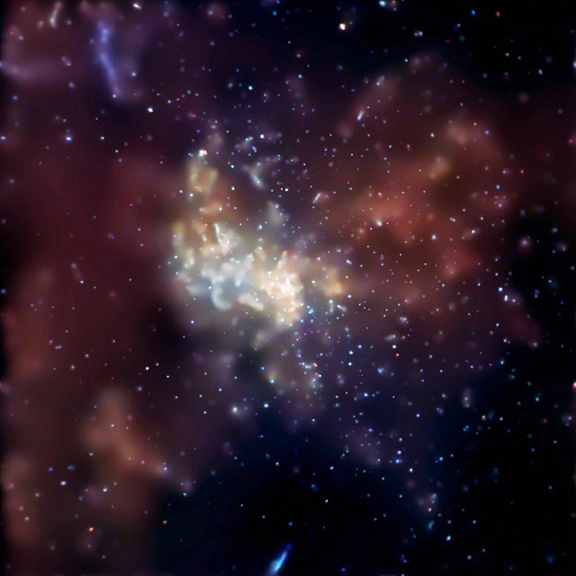
Observations of other galaxies, particularly nearby galaxies, reveal compelling evidence that nearly all galaxies have a super massive black hole at their center. The Milky Way has a supermassive black hole at its center known as Sgr A*. How these black holes form is not well understood, but it must have been long ago when the universe was very young such that the black holes had time to grow. They may form from the collapse of some of the first stars created in the Universe known as Pop III stars or they may form from the monolithic collapse of a cold could of gas in the early Universe. Many galaxies emit very high energy radiation from their centers (ultraviolet, X-ray or gamma ray) that is easily explained by a super massive black hole at their center. These galaxies are said to have Active Galactic Nuclei (AGN), but our Milky Way does not emit such high energy radiation. This an interesting and lucky fact that astronomers have explained by noting that if gas is actively falling onto a black hole it forms and accretion disk which heats up to very high temperatures. Thus matter falling into a black hole emits massive amounts of powerful radiation just before it falls into the black hole. Active galactic nuclei are especially correlated with galaxies which have just undergone mergers with other galaxies which are gas rich; the theory, which is backed up by simulations and observations, says that when gas rich galaxies merge gas funnels into the central super massive black holes and induces a period of high luminosity. The black hole at the center of our Milky Way also undergoes periods of gas accretion or luminosity spikes in the X-ray to radio bands. One such event in May of 2003 was a powerful flare seen located just a few milli-arcseconds from the position of Sgr A* which corresponds to less than ten Schwarzschild radii from the black hole position.

Observing supermassive black holes

How do we know that we have really observed black holes not something else? This is a hard question and astronomers may often talk about compact massive objects instead of black holes if they are not certain about a particular object in the sky. In the case of the supermassive black hole at the center or our Milky Way more direct observations are possible. Astronomers have been watching Sgr A* for decades, but only with modern instruments has powerful evidence come to light. Observations of flare events close to the Schwarzschild radius of a suspected black hole like the event described above are one way. Also watching the gravitational influence of the dark object is another:
The movie above was made with high resolution near-infrared observations over many years (in the bottom left corner is the year of the observations) on the 10 meter Keck telescope in Mauna Kea by a group at UCLA led by Andrea Gehez. These stars are right at the center of the Milky Way in the immediate vicinity of Sgr A* and they are moving in a Keplerian orbit around a central mass which is unseen in optical light. The stars are moving at speeds up to 1400 km/s (or 3 million mph) and so using Kepler's laws of motion the central object is estimated to be four million solar masses. The object is also very minute. Given this great mass and small size astrophysicists only have one explanation for the object. In the near future radio astronomers plan to use interferometry to directly image the event horizon of Sgr A*.

An unexpected relationship between black holes and galaxies

We have good reason to believe that nearly all galaxies contain a central supermassive black hole. Furthermore, the mass of the central black hole strongly correlates with the mass, velocity dispersion, and momentum parameter of the corresponding host galaxy. The most interesting relation is that of the central black hole mass with the velocity dispersion of stars in the host galaxy bulge. This is known as the m-σ relation which has a very simple basic scaling:
Thus the mass of the central black hole and the velocity of nearby stars is highly correlated. This is an empirical relation and so the value of 5 here is approximate (for example in the plot below the value is 5.8 and in some previous work was as low as 4). This relation was discovered and reported in the literature in 2000 by two independent groups (Gebhardt et al. and Ferrarese et al.), but astronomers are still seeking a theoretical model able to elucidate the origin for the correlation.
What is so amazing is how strong the correlation is over a range of galaxy and black hole sizes as seen in the log-log plot above from a very recent paper on the archive by Feoli and Mancini which complied data from Hu 2009. Even a hundred million solar mass black hole will not have a significant gravitational effect on the stars in the bulge of a galaxy (the black hole is big, but there are billions of stars and they are far away from the black hole's gravitational force which of course drops as distance-2) so the  m-σ relation is somewhat of a mystery. Likely the current relation is dependent upon the galaxy and black hole co-evolution (as evidenced by the fact that the empirical scaling is only measured for cosmologically very close galaxies). Theorists and rock bands continue to search for a coherent explanation.

Look up and find your local black hole

Lets try and bring black holes back down to Earth by stargazing. The nearest (super massive) black hole is at the center of our Milky Way Galaxy in the constellation Sagittarius. Sagittarius according to Greek mythology is a centaur archer who was shot with a poisoned arrow and in honor he was given a place in the sky in the constellation Sagittarius. The arrow of Sagittarius points towards the bright star Antares in Scorpius, but it also points to the galactic center and the super massive black hole that lies there. A modern interpretation of the constellation is as a teapot which is as I have outlined it here, but I think the image of a centaur shooting an arrow in the heart of our galaxy is much more dramatic.
Sagittarius is best viewed during summer nights (this paragraph has been kind of western history and northern hemisphere centric, sorry) and can be found between the constellations Ophiuchus and Capricornus near the galactic plane. The actual object that is identified as the super massive black hole at the center of our galaxy is the luminous compact radio object Sagittarius A* (or Sgr A*) which is not visible in the optical spectrum. Another way to identify Sgr A* is that Scorpius almost wraps his tail around it. Look for Saggitarius's arrow and Scorpius's tail and you will have found a super massive black hole; happy sky hunting.

ResearchBlogging.org

Gebhardt, K., Bender, R., Bower, G., Dressler, A., Faber, S., Filippenko, A., Green, R., Grillmair, C., Ho, L., Kormendy, J., Lauer, T., Magorrian, J., Pinkney, J., Richstone, D., & Tremaine, S. (2000). A Relationship between Nuclear Black Hole Mass and Galaxy Velocity Dispersion The Astrophysical Journal, 539 (1) DOI: 10.1086/312840

Genzel, R., Schödel, R., Ott, T., Eckart, A., Alexander, T., Lacombe, F., Rouan, D., & Aschenbach, B. (2003). Near-infrared flares from accreting gas around the supermassive black hole at the Galactic Centre Nature, 425 (6961), 934-937 DOI: 10.1038/nature02065

Ghez, A., Salim, S., Weinberg, N., Lu, J., Do, T., Dunn, J., Matthews, K., Morris, M., Yelda, S., Becklin, E., Kremenek, T., Milosavljevic, M., & Naiman, J. (2008). Measuring Distance and Properties of the Milky Way’s Central Supermassive Black Hole with Stellar Orbits The Astrophysical Journal, 689 (2), 1044-1062 DOI: 10.1086/592738

QR Codes

Science doesn't stop, but blogging occasionally does. Some good posts are on the way, but for today I have something fun: QR codes. You may recognize them as those little matrix barcodes that carry text, numbers, binary, or URLs that are starting to crop up in the real world in augmented reality or hardlink applications where objects in the physical world get linked to the digital world. If you didn't know already you can use your phone or camera to read these things no matter where you see them. They can carry quite a bit of information and because of fault tolerance and error handling in some cases portions of the QR code can be lost and the data still read. I made a few artistic renditions of a QR code that link to The Astronomist. I removed some of the bits from the center and replaced it with an A and I found I was still able to read them handily with the code scanner on my iPhone so I assume they aren't corrupt. Now I just need to make some stickers out of them or something so the digital and physical world will meet at The Astronomist.