Field of Science

Showing posts with label cosmology. Show all posts

The Hubble Extreme Deep Field

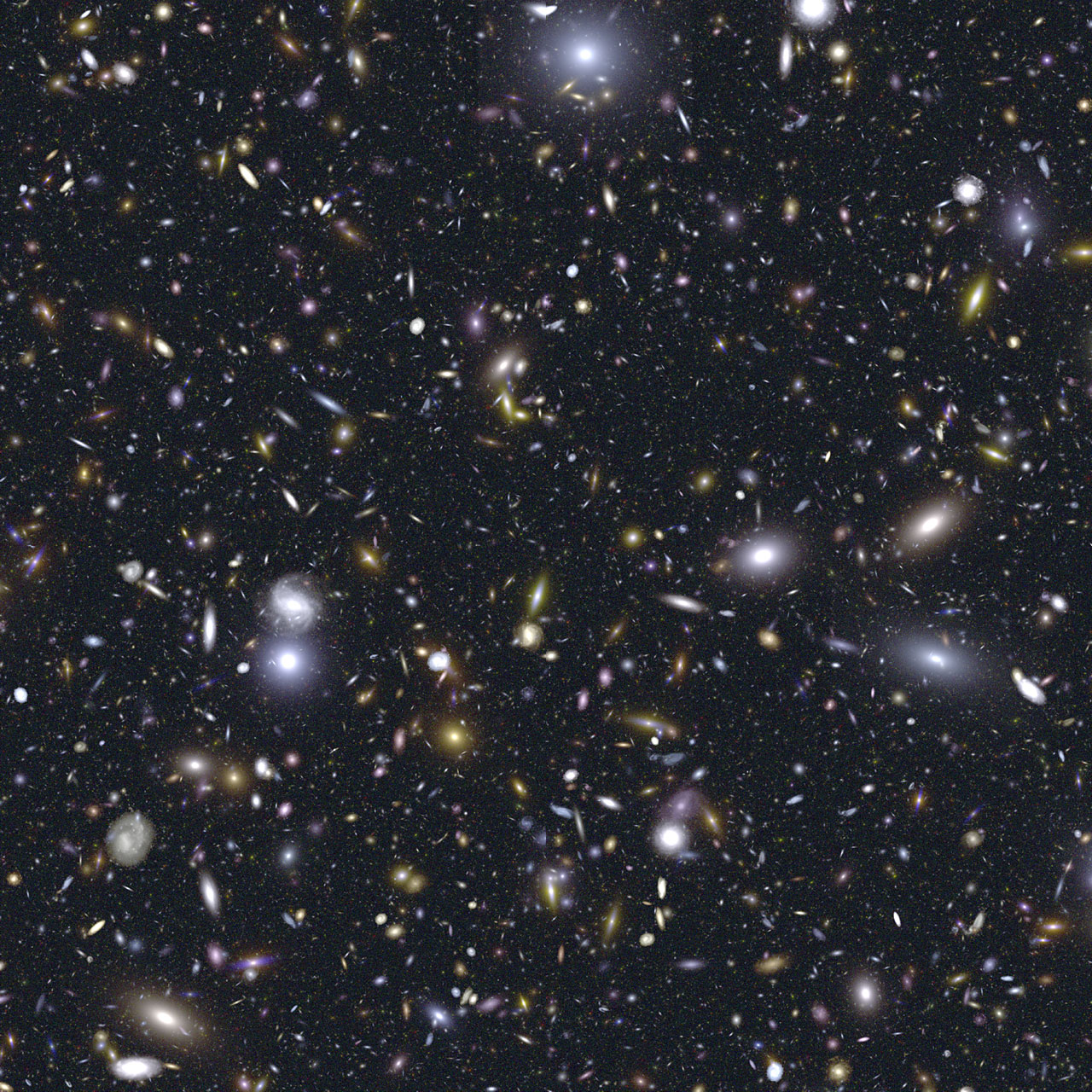
Almost a decade ago when astronomers pointed the Hubble Space Telescope at an apparently featureless patch of the sky they were rewarded with a spectacular image. The was the Hubble Ultra Deep Field. The image allowed us to see that galaxies were forming as early as just a billion years after the Big Bang. The farther from Earth we look the farther back in time we see; starlight from those distant galaxies is just arriving at earth now. Now we have glimpsed even further with the Hubble Extreme Deep Field. This new image was created by aggregating 10 years of Hubble images taken centered at the same location of the original Ultra Deep Field. In addition to staking old images additional new images were included which had been taken with infrared cameras installed during the 2008 Hubble Space servicing missions. Infrared images offer important additional data for distant galaxies because the light from such distant objects has been stretched to longer wavelengths as it has journeyed across the universe. Here is the Hubble Extreme Deep Field:
The new Hubble Extreme Deep Field


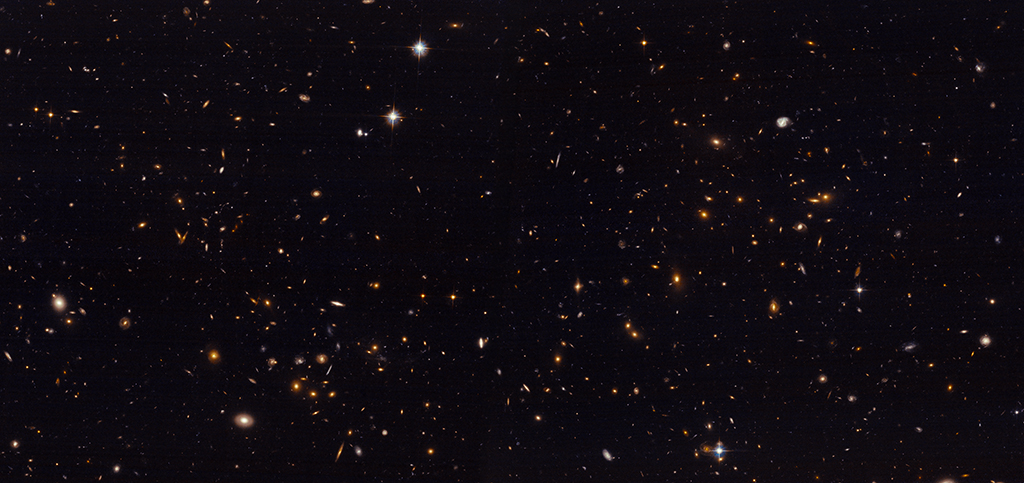
This is the deepest image of the sky ever seen. It allows us to explore the faintest galaxies ever as far back as a time just half a billion years after the Big Bang. Soon though we will have even deeper images. The James Web Space Telescope will be a 6.5 meter diameter(or 21 foot, so big that it will be a segmented mirror that will unfold in space) space telescope that will launch in 2018. It will see further. Here is a simulated image of what the James Web Space Telescope will see:
The James Web Space Telescope Simulated Deep Field Image
If you are intrigued by Hubble's deep images of the sky there is a Google Event webinar to discuss the latest findings. The public is invited. show up online and ask questions of the astronomers involved. It is at 1 p.m. Sept. 27 and can be joined either at HubbleSite’s Google Plus page or the HubbleSite YouTube Channel.

Disassociate Galaxy Clusters

A dissociative galaxy cluster is a cluster of galaxies that just can't keep it together any longer. This may sound like an unnecessary anthropomorphication of galaxies, but it is actually a description of galaxy clusters which have collided and experienced stratification of their constituent parts. In the standard and successful model of cosmology the largest scale structures in the universe, like super clusters of thousands of galaxies, form via the merger of filamentary structures composed of smaller clusters of galaxies. Gravity keeps pulling clusters together along highways of galaxy clusters. Occasionally it is expected and observed that galaxy clusters meet each other head on in cosmic train wrecks moving at thousands of kilometers per second. These traumatic merging events scar the galaxy clusters for life. Their post traumatic stress afflictions include hot shocked X-ray gas and galaxies displaced from their gas halos. Lets consider the three main constituents of a galaxy cluster: stars, gas, and dark matter.
  • Clusters are made of aggregates of hundreds or thousands of galaxies and each galaxy is made of hundreds of billions of stars. The stars of the galaxy cluster are conspicuous in that they shine and are observable in pictures, but they account for only about 5% or less of the cluster's mass. The luminous stars of galaxies don't interact much during a collision with another cluster of galaxies and so they act like people in two crowds which are moving in opposite directions. Stars are part of the cosmic ghost train.
  • The gas in galaxy clusters accounts for about 10% of the regular (or baryonic) mass in clusters. Gas does interact during a collision. The gas clouds in colliding galaxy clusters slams together like two waves of water meeting and stalls out, but not without undergoing a process known as shock heating first which raises the gas temperature to millions of degrees.Gas is part of the cosmic train wreck.
  • The dark matter in galaxy clusters is the most dominant part of the cluster by mass making up about 90% the mass. Dark matter does not interact much. The dark matter halos travel right through each other like ghosts when two clusters collide. However, it is possible that the dark matter does interact slightly and dissociative collisions are a powerful tool in constraining this dark matter interaction. The dark matter halos of the colliding clusters should sail right past each other like two ghost trains, but if the trains slow down even in the slightest it may indicate something strange.
These so called dissociation mergers are difficult to observe and analyze. They require telescopes in space, follow up observations on the ground, observations in multiple wavelength regimes, and algorithms to predict the distribution of dark matter. So far there are six such dissociation mergers systems detected. You would think it would be obvious to spot some of the most massive structures in the universe smashing into each other, but spotting galaxy clusters is actually very difficult because of their great distance. Perhaps in an optical survey, like that in the image below taken by the Hubble Space telescope, over densities of galaxies are detected.

In practice many times it is easier to first identify galaxy clusters through their gas content because the gas content is more massive than the stellar component. Many new clusters are identified by observing the cluster gas's effect in the microwave regime or in the X-ray regime. In the image below taken by the the NASA Chandra X-ray observatory the hot intracluster gas is seen in pink. This image corresponds to exactly the same field of view on the sky as the optical image above.
It may dawn on you that by the very definition of dark matter there is no telescope which can observe it directly. The only in way in which dark matter interacts strongly is through gravity and thus that is how astronomers look for it. Through theoretical predictions and confirmed observations we know that gravity bends light and thus massive galaxy clusters will bend the light of even more distant galaxies. Thus through weak gravitational lensing the dark matter betrays its presence. A careful statistical analysis of galaxy shapes in the optical image above reveals that the galaxies which are confirmed not to be in the foreground cluster are slightly distorted in shape via the gravitational force of the dark matter which is in the foreground. A reconstruction of the total mass in the clusters is shown in the image below where the parts of the cluster which have the most mass are shown in blue. This image corresponds to exactly the same field of view on the sky as optical and X-ray images above.
Finally, a superposition of all the data allows us to glimpse at what a crisis this merging cluster is in. Note that the optical image remains in its original color, the gas is in pink, and the mass is in blue. The image below is known as the Musket Ball Cluster. The actual collision of galaxies occurred about 700 million years ago. We can rewind the collisions in our heads and envision that blue/optical cluster on the right of the image was once on the left and so the blue/optical cluster on the left of the image was once on the right; the clusters collided head on and the gas stopped dead at the center, but the galaxies and dark matter hardly stopped. There are several other images below of other dissociative cluster mergers with the same color scheme. Notice the different morphologies and distributions of mass, stars, and gas. The collisions are not always so straight forward.

Musket Ball Cluster. X-ray: NASA/CXC/UCDavis/W.Dawson et al; Optical: NASA/STScI/UCDavis/W.Dawson et al.
Train Wreck Cluster. X-ray: NASA/CXC/UVic./A.Mahdavi et al. Optical/Lensing: CFHT/UVic./A.Mahdavi et al.
Bullet Cluster. Credit: X-ray: NASA/CXC/CfA/M.Markevitch et al.;  Optical: NASA/STScI; Magellan/U.Arizona/D.Clowe et al.; Lensing Map:  NASA/STScI; ESO WFI; Magellan/U.Arizona/D.Clowe et al.
Bullet Cluster. Credit: X-ray: NASA/CXC/CfA/M.Markevitch et al.; Optical: NASA/STScI; Magellan/U.Arizona/D.Clowe et al.; Lensing Map: NASA/STScI; ESO WFI; Magellan/U.Arizona/D.Clowe et al.
The awesome thing about these cosmic mergers is how they can constrain the dark matter self-interaction cross-section. That is, exactly who much does dark matter interact with itself? The interpretation of these collisions is not always simple such as in the Train Wreck Cluster (seen above) where there seems to be an extra dark matter core not associated with any bright galaxy at the center of the image, but nonetheless these mergers can be thought of as astrophysical laboratories of dark matter. It would be very interesting to discover that dark matter self-interacts at all, however dissociate clusters will only be one piece of the extraordinary evidence necessary to make that claim.

ResearchBlogging.org

Dawson, W., Wittman, D., Jee, M., Gee, P., Hughes, J., Tyson, J., Schmidt, S., Thorman, P., Bradač, M., Miyazaki, S., Lemaux, B., Utsumi, Y., & Margoniner, V. (2012). DISCOVERY OF A DISSOCIATIVE GALAXY CLUSTER MERGER WITH LARGE PHYSICAL SEPARATION The Astrophysical Journal, 747 (2) DOI: 10.1088/2041-8205/747/2/L42

Jee, M., Mahdavi, A., Hoekstra, H., Babul, A., Dalcanton, J., Carroll, P., & Capak, P. (2012). A STUDY OF THE DARK CORE IN A520: THE MYSTERY DEEPENS The Astrophysical Journal, 747 (2) DOI: 10.1088/0004-637X/747/2/96

Markevitch, M., Gonzalez, A., Clowe, D., Vikhlinin, A., Forman, W., Jones, C., Murray, S., & Tucker, W. (2004). Direct Constraints on the Dark Matter Self‐Interaction Cross Section from the Merging Galaxy Cluster 1E 0657−56 The Astrophysical Journal, 606 (2), 819-824 DOI: 10.1086/383178

Turtles all the way down

The beginning was heralded by an elephant's trumpet.

The universe is carried on the back of an ancient turtle.

There were once ten suns embodied by crows. All but one crow was shot by an archer.

The moon is a decapitated head. Her face is painted with bells.

The stars are your ancestors eyes worth remembering.

In time you too will have nine tails and be older and wiser.

All the things which you do not know are vague. Drift clouds.

Having come so far is a matter of vagueness.
I wrote this poem because even modern cosmology faces infinite regression paradoxes with respect to the initial impetus of the Universe. The various creation stories independently formed in different cultures create some stunning mental images for me. The funniest idea for me is that the Universe is resting on the back of a giant turtle. What is the turtle resting on? Why it is turtles all the way down. Oh, and I almost forgot the best blog posts always have a picture; here is a picture of a turtle.

A Universe From Nothing

Lawrence Krauss speaks humorously and frankly on cosmology. This talk is filled with insights on how we came to our remarkable knowledge of modern cosmology. I especially enjoy the opening quote:
The initial mystery that attends any journey is: how did the traveler reach his starting point in the first place. ~Louise Bogan

Magnetic Fields in Cosmology

The existence of magnetic fields on cosmologically large scales is an unsolved problem in astrophysics. Theory favors a universe that did not begin with any magnetic fields present and classical magnetohydrodynamics restricts the spontaneous emergence of a magnetic state under the influence of ideal forces. In a paper entitled Twisting Space-Time: Relativistic Origin of Seed Magnetic Field and Vorticity appearing Physical Review letters Swadesh Mahajan and Zensho Yoshida propose a universal magnetic field generating effect using ideal special relativistic fluid dynamics. Mahajan and Yoshida's insight was that in describing magnetic fields, which are mathematically equivalent to a vorticity, a careful application of ideal dynamics in the framework of distortions caused by special relativity may result in the spontaneous emergence of a magnetic state in contrast to the previous theoretical result.

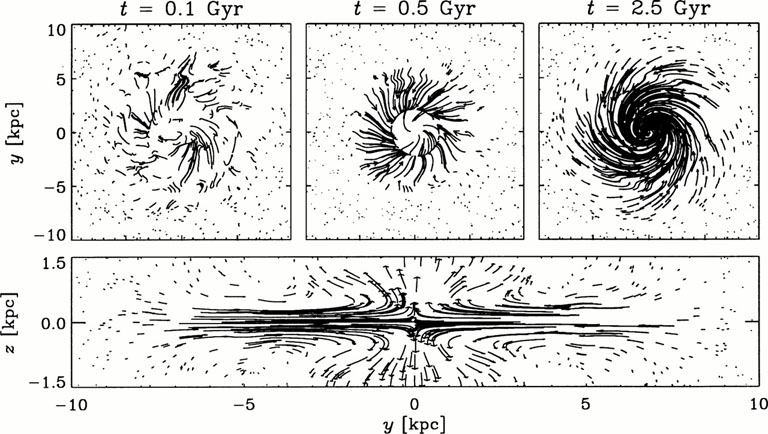
Magnetic fields are found to be important in every scale hierarchy of the universe. Most notably detailed images of galaxies paradoxically display regions of chaotic turbulence and beautiful grand coherent designs at once. Thus it is clear that turbulent motion on scales below hundreds of parsecs does not necessarily destroy coherent optical or magnetic features over scales of kiloparsecs. Indeed, magnetic fields are indirectly observed at optical and radio wavelengths by detecting the polarization of the electromagnetic field through the Faraday effect and also by the Zeeman splitting effect. The Faraday effect is the rotation of the linear polarization vector of light which occurs when polarized radiation passes through a magnetized and ionized medium. Radio observations are the most powerful technique and by measuring both the dispersion and polarization rotation the mean of the magnetic field along the line of sight can be measured. Such observations indicate a wide range of magnetic field are present in astrophysics. The image at right below shows the magnetic fields present in M51 which are likely similar in structure and strength to that of the Milky Way.

Faraday rotation, magnetic fields, m51
The total radio continuum emission from the "whirlpool" galaxy M51 (distance estimates range between 13 and 30 million light years) is strongest at the inner edges of the optical spiral arms, probably due to the compression of magnetic fields by density waves. The vectors give the orientations of the regular magnetic fields as derived from the polarized emission. The field lines follow nicely the optical spiral arms. Unexpectedly, strong polarized emission is observed also between the optical arms which indicates the action of a dynamo. This image was observed with the VLA in its most compact configuration at 6cm radio wavelength (broadband continuum). As the VLA cannot detect the diffuse, large-scale radio emission, data from the Effelsberg 100-m telescope in Germany at the same wavelength was added. Investigator(s):  Rainer Beck (MPIfR Bonn, Germany), Cathy Horellou (Onsala Space Observatory). Image courtesy of NRAO/AUI

Microguass fields are present in galaxies at scales of a few kiloparsecs and on the much larger scales of megaparsecs ordered fields of perhaps a few orders of magnitude less are present in galaxy clusters. Magnetic fields in astronomy are controlled by induction of partially ionized gas. A common model for creating these magnetic fields is the dynamo effect wherein an electrically conductive fluid accelerated by some kinetic force generates convective motions in the fluid; it is plausible that a turbulent hydromagnetic dynamo of some kind coupled to an inverse cascade of magnetic energy wold give rise to regular galactic magnetic fields. Following the basic dynamo theory magnetic field lines can be simulated for galaxies which are consistent with observations. The dynamo theory is actually a mechanism for maintaining or growing fields rather than creating them, but it is expected that minuscule primordial magnetic field seeds in the early universe of cosmological origin drive the magnetic fields observed today.

The magnetic dynamo and the primordial magnetic seed theories are both unsatisfactory. The model wherein the the large scale magnetic field in galaxies is the result of the twisting of a cosmological magnetic fields by galactic differential rotation is not satisfactory because a primordial field wound up by differential rotation ultimately decays in an effect known as flux expulsion. The primordial seed theory must explain the presence of large magnetic fields in higher redshift objects when the universe was much younger when the fields should not have had sufficient time to grow. Researchers disagree over what initial primordial field strength is necessary to create the magnetic fields seen today; estimates vary from as large as 10-9 gauss [1] to 10-30 gauss [2], but either way an alternative model would be welcome.

Mahajan and Yoshida's work was motivated by the search for a universal mechanism for magnetic field generation. They key to creating a magnetic field is the vorticity of an ionized material which is analyzed in this paper with topological constraints. In mathematical terms fundamental cosmology requires a topological constraint on the vorticity of the universe (consider that you wouldn't expect the universe to have a preferred rotation), however this constraint can be broken by the application of special relativity. The problem of magnetic fields lies in the fact that vorticity must vanish for every ideal force such as the entropy conserving thermodynamic forces (this can be proven though the governing Hamiltonian dynamics of an ideal fluid where ultimately Kelvin's circulation theorem shows that if the initial state has no circulation the later sate will also be vorticity-free). Introduction of the Lorentz factor γ=(1-(v/c)2)-1/2 from special relativity destroys the exactness of the ideal thermodynamic force and allows spontaneous vorticity.

The authors find a new term that provides a magnetic field growing mechanism as long as the kinetic energy is inhomogeneous. The authors mechanism can provide a finite seed for even mildly relativistic flows. They provide an example for very standard parameters (electron density n=1010 cm3, temperature T= 20 eV and velocity, v, compared to c of v/c=10-2) and find their relativistic drive mechanism remains dominate over other effects until magnetic fields of 1 gauss or so which is much larger than most magnetic fields ever observed, thus the relativistic drive is the only dominant effect. The relativistic drive mechanism will likely help us understand, among other things, the origin of magnetic fields in astrophysical and cosmic settings.
ResearchBlogging.org
References:

[1] Beck, R., Brandenburg, A., Moss, D., Shukurov, A., & Sokoloff, D. (1996). GALACTIC MAGNETISM: Recent Developments and Perspectives Annual Review of Astronomy and Astrophysics, 34 (1), 155-206 DOI: 10.1146/annurev.astro.34.1.155

[2] Davis, A., Lilley, M., & Törnkvist, O. (1999). Relaxing the bounds on primordial magnetic seed fields Physical Review D, 60 (2) DOI: 10.1103/PhysRevD.60.021301

[3] Mahajan, S., & Yoshida, Z. (2010). Twisting Space-Time: Relativistic Origin of Seed Magnetic Field and Vorticity Physical Review Letters, 105 (9) DOI: 10.1103/PhysRevLett.105.095005

The Future History of the Universe

Current observations of our universe indicate that the universe is expanding at an accelerating rate. The expansion of the universe will eventually place all galaxies which are not gravitationally bound to the Milky Way beyond our observable horizon (yet I caution that the notion of a horizon is a subtle point and a source of expanding confusion). Galaxies will cease to be brilliant. The passing of time will see stars exhaust all of their fuel. Stars will cease to shine. Black holes will evaporate due to Hawking radiation dispersing a bath of dull photons into the universe. Black holes will cease to exist. The universe will cool as it expands to a uniformly frigid temperature. Entropy will be maximized. The universe will be cold, dark, and lonely.
Roman forum, Andromeda galaxy, sepia photo
The future history of the universe described above is an implicit result of the standard cosmology accepted today. It is an extrapolation of accepted theory into the distant future. There is good reason to be skeptical of extraordinary predictions which is why the big bang and the past expansion history of the universe is the major focus of cosmology and not predicting the future of the universe. We need to know exactly what happened in the past to understand the reasons for the accelerating expansion (what is dark energy?). The current observations and the 'standard cosmology' I speak of are part of what is known in physics as the concordance model of cosmology. Every peer reviewed research paper that discusses the universe has this one sentence in it that goes something like this (taken from generic research paper on cosmology and extragalactic astrophysics):
Throughout this paper we assume a Friedmann-Lemaître-Robertson-Walker metric with a standard cosmology with ΩM=.3, Ω Λ=.7, H0=70 km s-1 Mpc-1.
Lets break down this generic statement and see what it implies. The Friedmann-Lemaître-Robertson-Walker metric implies we are assuming a universe which is consistent with a homogeneous isotropic expanding universe, the Ω values are dimensionless energy density parameters which quantify the energy contribution from matter (mostly dark matter, denoted M) and dark energy (denoted Λ), and finally the H0 value is the Hubble parameter in units of kilometers per second per megaparsec which describes how fast, v, an object at a given distance, d, is moving away from us such that H0=d/v. The statement effectively means that the universe is flat (it is conceivably possible that you could travel a very long way in one direction and end up where you started, like what happens if you travel around the earth, but observations indicate that this is not the case so we conclude the universe has no curvature) and the universe is expanding in such a way that the universe will not collapse back down on itself. Thus our best guess is that the universe will keep expanding forever. The consequence of this, and this is the crux here, is that as time moves forward entropy inexorably increases (this is the second law of thermodynamics) to the point that all ordered processes, complex systems, life and semblance of thought is impossible.

If you lived forever it would be hard to avoid the situation where eventually you and your fellow space travelers were huddled around a few dieing stars in a bland galaxy in an exhausted void. There are small stars which are burning today and will be burning in 100 billion years and more stars will form for a while. But eventually, stars really will shut down and cool. You could try to travel to another galaxy, but that would take a long time (if the distance to our neighbor galaxy Andromeda was held constant it would take about 2.5 million years to travel there at the speed of light), and even then there would be few stars and most problematically most other galaxies would have receded beyond our horizon. Where would you want to head in this barren universe? Recent studies of the entropy of the universe indicate that the majority of the entropy in the universe is actually contributed by super massive black holes. Interestingly gravity is rather unlike most systems in thermodynamics. Generally entropy is increased by say smashing something into many pieces, but for gravity when energy is uniformly distributed gravity is quite low compared to the state where matter has collapsed into stars or to the extreme state of a black hole. There is one more step in producing more entropy which occurs as black holes slowly emit radiation in the form of Hawking radiation. A black hole the mass of the sun would emit Hawking radiation for 2 × 1067 years which is much longer than the current age of the universe at 13.7 × 10⁹ years. A super massive black hole of 100 billion solar masses, about the mass of our entire Milky Way galaxy, would emit Hawking radiation for 2 × 10100   years. You could hang out near one of these black holes for a while as a source of energy because the black hole would still be producing entropy. Finally, all the black holes would also evaporate and the universe would consist of a diffuse gas of photons and leptons. Any activity in the universe would be very limited at this point and what did occur would take truly epic time scales.

Vermeer, astronomer, cosmologyThe concordance cosmology, the theoretical models, and the measured parameters implicitly assume that the end of the universe is cold, dark, and lonely. The universe ending as cold void in which life can no longer be sustained is sometimes known as the Big Chill. At this point there is only speculation, perhaps it is philosophical. The universe may expand again in a secondary inflationary epoch or the vacuum may decay into an even lower energy state. Actually, there are other possible scenarios such as the Big Rip in which dark energy pulls apart the fabric of space through some exponentially increasing expansion. Revisionist history is the best kind of history, so when talking about the future history revisions are always welcome. There may already be information about universe which has been erased that would change our expectations. One example of the universe erasing information is if the radius of curvature of the universe is much greater than the horizon distance then observing this curvature would be like trying perceive the curvature of the earth just by looking at the horizon so as the universe, or earth, expanded observing curvature could more difficult. Paradoxically, conceding that there is information about the universe which has been erased which would indicate an ultimate fate other than the one outlined here also supports the argument that the ultimate fate of the universe is an extremely high entropy state.

Conceding that the universe may not be infinite or that the end is simply cold and lonely is very difficult for some. This theme was explored in Issac Asimov's story The Last Question in my previous post. In this story man ponders how the heat death of the universe can be avoided. Man asks the greatest computer created how the second law of thermodynamics can be reversed. [spoiler alert] After hundreds of billions of years the computer still cannot answer the humans. Ultimately all of humanities mental facilities from the trillions of humans spread throughout the universe merge their minds with this ultimate computer to from a singular unified mental process. The question is asked again and there is still no answer. Time goes on until space and time cease to exist, however the ultimate mind continues to ponder the question in hyperspace and eventually finds an answer. There is no one or no thing left to report the answer to so the mind decides to show the answer by demonstrating the reversal of entropy. The mind spends another eternity determining how to do this and writing a careful program to execute. Upon execution of the program the mind reverses entropy and thus creates the universe anew.

Hubble Bubble

The Copernican principle holds that humans are not privileged observers of the Universe. Copernicus stated that the Earth is not at the center of the solar system or at any particularly special position in the heavens. Modern cosmology has extended this idea to reason that the earth does not occupy any unique position in the Universe. Modern philosophy of science pushes the principle even further to conclude that every observer (even if they be they little green men) should reason as if they were the most standard observer. However, despite all these humble and rational thoughts it is still tempting to explain certain aspects of modern cosmology that seem finely tuned as consequences of observer selection effects. Namely I am speaking of dark energy or the accelerated cosmological expansion which supposedly could be explained if we occupy a privileged position near the center of a large, nonlinear, and nearly spherical void in mass density. The idea that the region of the cosmos around us could be a void is colloquially known in astronomy as the Hubble bubble. Technically a Hubble bubble is defined as a region of space wherein there is an observed departure of the local value of the Hubble constant from its cosmologically averaged value.
Lets speculate a little further on what it would be like to live in a Hubble bubble. In the standard cosmological model of the Universe the structures we see today like galaxies and clusters of galaxies (and similarly the structures we don't see like the massive dark matter halos the visible matter is embedded in) formed from tiny primordial quantum fluctuations in the early universe. The fluctuations were random variations in density such that locations which were over-dense formed galaxies and those which were under-dense formed voids. It is possible, in fact statistically quite acceptable that there are voids of various sizes in the Universe. These voids would become increasingly under-dense as the Universe evolved and equivalently over-dense regions of the Universe became increasingly over-dense. Inside the void matter would expand outward due to the gravitational pull of matter in surrounding dense regions and thus an observer at the center of the void would see an accelerated expansion of matter outward. Now it is also possible that our entire observable Universe is a Hubble bubble, but that really flies in the face in all of cosmology. It is unfounded, absurd, and really the whole idea of a Hubble bubble may explain dark energy, but is hardly a very good explanation.

The Hubble Bubble is wildly speculative and precision cosmology has almost completely defeated it as a credible explanation. First, as the framework of cosmology has been successful resting on the Copernican principle it seems odd to throw it out now. It is odd and largely misguided. First, the probability of producing a void of necessary magnitude; to mimic aspects of dark energy is extremely small in the standard structure formation models. Second, the probability of an observer being at the center (the only location where the expansion effect would be noticed) is extremely low. Finally, the void would need to be close to spherical to match the observed spatial smoothness (or isotropy) of the universe. These qualitative arguments and many more quantitative arguments from precision cosmology data are laid forth in a recent paper by A. Moss, J. Zibin, and D. Scoot titled Precision Cosmology Defeats Void Models for Acceleration. The abstract follows:

The suggestion that we occupy a privileged position near the center of a large, nonlinear, and nearly spherical void has recently attracted much attention as an alternative to dark energy. Putting aside the philosophical problems with this scenario, we perform the most complete and up-to-date comparison with cosmological data. We use supernovae and the full cosmic microwave background spectrum as the basis of our analysis. We also include constraints from radial baryonic acoustic oscillations, the local Hubble rate, age, big bang nucleosynthesis, the Compton y-distortion, and for the first time include the local amplitude of matter fluctuations, σ8. These all paint a consistent picture in which voids are in severe tension with the data. In particular, void models predict a very low local Hubble rate, suffer from an "old age problem", and predict much less local structure than is observed.
The paper makes several quantitative arguments against the plausibility any kind of void model for cosmic acceleration by drawing together an impressive amount of cosmological data and technical expertise, however, they don't ever mention the term Hubble Bubble. A 2007 paper by Conley et al. takes the Hubble Bubble paradigm head on: Is There Evidence for a Hubble Bubble? The Nature of Type Ia Supernova Colors and Dust in External Galaxies. In Conley et al. they explore how dust effects the colors of type Ia supernovae because they reason if the dust can be modeled as a purely local Milky Way effect then the supernovae data would actually favor the Hubble Bubble. Of course, despite difficulties the analysis, they find that in their parametrization there is evidence for more than the simply effect of local Milky Way dust implying doom for the Hubble Bubble. So the Hubble Bubble has been burst.

ResearchBlogging.org
References:

Adam Moss, James P. Zibin, & Douglas Scott (2010). Precision Cosmology Defeats Void Models for Acceleration arXiv preprint arXiv: 1007.3725v1

Conley, A., Carlberg, R., Guy, J., Howell, D., Jha, S., Riess, A., & Sullivan, M. (2007). Is There Evidence for a Hubble Bubble? The Nature of Type Ia Supernova Colors and Dust in External Galaxies The Astrophysical Journal, 664 (1) DOI: 10.1086/520625

Upper Bound on Neutrino Masses from Galaxy Surveys

Cosmology not only probes the absolute mass scale of the neutrino but is a completely independent method to test against. In any case, it is imperative to include an accurate prescription for the neutrino in cosmology, as any failure to do so can bias the other cosmological parameters. A cosmological constraint on the sum of the neutrino masses is primarily a constraint on the relic big bang neutrino density Ων. One can relate this density to the sum of the mass eigenstates ∑mν as given by Ων= ∑mν/(93.14 h2 eV). The direct effects of the neutrinos depend on whether they are relativistic or nonrelativistic and the scale under consideration. Neutrinos have a large thermal velocity as a result of their low mass and subsequently erase their own perturbations on scales smaller than the free streaming length. This subsequently contributes to a suppression of the statistical clustering of galaxies over small scales and can be observed in a galaxy survey. The abundance of neutrinos in the Universe can also have a direct effect on the primary CMB anisotropies if nonrelativistic before the time of decoupling (i.e., when sufficiently massive). However, one of the most clear effects at this epoch is a displacement in the time of matter-radiation equality. All these cosmological effects can be used to impose bounds on the neutrino mass. Previous studies have capitalized on these signatures and have started to place sub eV constraints on the absolute mass scale . We utilize the new Sloan Digital Sky Survey MegaZ luminous red galaxy (LRG) DR7 galaxy clustering data  to provide the first photometric galaxy clustering constraint on the neutrino and, combining with the CMB, examine the complementarity of these early- and late-time probes. With an almost comprehensive combination of probes this renders one of the tightest constraints on the neutrinos in cosmology and therefore physics.
Cosmological observations provide independent constraints on the neutrino mass scale provided that a few assumptions (a flat universe with Gaussian and adiabatic primordial fluctuations and a constant spectral index for example) can be made. Compared to the prospects of current-to-next generation particle neutrino experiments (like KATRIN) it may be that astronomical surveys of the cosmic microwave background anisotropies or optical surveys of the large scale structure of the Universe will place the tightest constraints on neutrino masses for some time. Continue reading from the excerpt above written by Shaun Thomas, Filipe Abdalla, and Ofer Lahav on their invited viewpoint article in Physical Review Letters (freely available):Upper Bound of 0.28 eV on Neutrino Masses from the Largest Photometric Redshift Survey.

Microwave Sky Seen by Planck

The first image of the microwave sky was released today by the Planck collaboration. The image is the result of a year of observations from the Planck satellite. How far we have come since the first image of the cosmic microwave background by COBE! The most prominent aspect of the image is the bright band across sky caused by diffuse gas and dust emission from our own Milky Way. Also visible are local clouds of gas, nearby galaxies such as Andromeda, and more distant galaxies which host supermassive black holes in their center. The more subtle variations which will be visible when the foregrounds are removed are tiny temperature fluctuations which carry information about the cosmic microwave background and primordial density fluctuations seeded by the Big Bang. However, scientists are waiting to dive into detailed analysis of the multi-frequency data ranging from 30 GHz to 857 GHz until all of the foregrounds and telescope systematics can be understood. Ultimately the Planck data will give us the most precise constraints humans have ever had on the parameters of our cosmos.
Planck is a major step forward in cosmic microwave background (CMB) observations because it measures polarization of microwave photons. The polarization of photons may carry information about the universe from inflation or when the CMB was generated 400,000 years after the Big Bang. Generally when an electromagnetic wave or photon is incident upon a free electron the scattered photon is polarized perpendicularly to the incident direction. Different regions of the CMB may have a net linear polarization generated when radiation from perpendicular directions in the sky has different intensities. Different directions in the sky have different intensities dependent upon perturbations; there are three kinds of perturbations 1) scalar perturbations due to density fluctuations, 2) vector perturbations due to vorticity (like cosmic strings or defects, although these are not likely to be detected), 3) and tensor perturbations due to gravity waves. The Planck mission will be the first CMB space satellite to measure the as of yet unseen gravity wave or "B-mode" poarlization which will reveal the physics of primordial gravity waves when the Universe was in existence for just 10-36 seconds.

The History of the Universe

LINDAU, Germany — John Mather is humble when describing his measurements of the cosmic microwave background radiation despite the fact that Steven Hawking described this measurement as possibly the most important discovery humans have ever made. The cosmic microwave background radiation is the remnant glow of the Big Bang; it is the primary evidence.  Mather is careful to place his work in context next to the original work of Penzias and Wilson who made the first measurement of the cosmic microwave background radiation.

The cosmic microwave background (CMB) was first measured by Penzias and Wilson in 1965, but it was predicted decades earlier independently by several astrophysicists. You can read about the journey Penzias and Wilson took to making their discovery in this previous post on pigeon waste, cosmic melodies and noise in scientific communication. Cosmologists were not content with the first tenuous measurement of the 2.7 kelvin background, but they would have to wait until the Cosmic Microwave Background Explorer (COBE) was launched in 1989 to measure the CMB to one part in 100,000 or 30 millionths of a degree difference in temperature. In 2006 John Mather and George Smoot received the Nobel Prize in physics for their discovery of the blackbody form and anisotropy of the CMB. Mather and Smoot's precision measurements indicated that the Big Bang produced radiation that was perfectly consistent with the theoretical predictions for a blackbody and that the anisotropy, or spatial variations, of the relic radiation were extremely miniscule. The observations fit the theory so well that when plotting the data the error bars must be enlarged to make them visible.

Mather told the attendees the entire history of the Universe during a morning lecture. First, there was the Big Bang. Then a brief period of stupendous growth occurred known as inflation. The early Universe was extremely hot and contained simple particles of matter as well as antimatter; the matter and antimatter annihilated upon contact until only one part per billion of of the early universe was antimatter (this is good for us, because we are made of normal matter, but a mystery to cosmologists). Within the first 3 minutes the formation of Helium nuclei had occurred. The Universe remained in a dense fog of mostly free protons, electrons, and  Helium nuclei until about 400000 years after the Big Bang. At this point the Universe had cooled enough that electrons could become captured by the free protons and Helium nuclei to form neutral atoms. The photons which up until this point had been scattering off of the free particles suddenly found that they could effectively travel the entire distance of the universe before having another scattering. These photons cooled as they traversed the expanding Universe until they encountered the detectors on COBE.
If Mather is the stoic scientist, then Smoot is the adventuring explorer. In a break away afternoon session Smoot had the opportunity to tell young scientists a few more details about the CMB and the ramifications. The minor variations in the CMB are quantum fluctuations that were super sized during the period of inflation. Smoot says that our own galaxy was a quantum fluctuation at one time. Through analysis of the CMB with the technique of spherical harmonics Smoot is keen to to stress that the early Universe is extremely linear and that deviations from the known amount of dark matter, dark energy, or age of the universe creatures significant inconsistencies with the data and the theory. 

Every galaxy we observe today is related to the small perturbations present in the early Universe. The cold spots in the CMB are slightly denser than the surrounding areas and so as the universe evolved gravity's long range attractive forces meant that over densities were inherently unstable. The over densities grew larger and larger until galaxies, clusters, and super clusters formed. Today, astronomers are measuring the result of this growth of structure through galaxy surveys such as as the Sloan Digital Sky Survey. The observed distribution of galaxies is perfectly consistent with the theories.

Telling the entire history of the Universe must be a humbling job. Astronomers, Mather says, actually have a simple job of describing the universe, galaxies, stars, and places where life may form. Astronomers don't actually have to say how life formed, but there are researchers and Nobel Laureates here at Lindau who are trying to answer that exact question. Mather finished his talk with more questions than answers. How did we get here? Are we alone? What happens next?

Dark Matter Confronts Observations

Dark matter is like the Rome of astronomy, all observations lead to dark matter. The problem is that physicists and astronomers, don't know what it actually is. The observations which support dark matter come from many different independent observations, so it is not just some observational error. The observations which corroborate the dark matter paradigm make for a fantastic discussion, but for right now I would like to focus on explanations for what dark matter may be. Specifically, what kind of particles are dark matter?
Dark matter is like the Rome of astronomy, all observations lead to dark matter.

Dark Matter is not like any particle before

The most attractive candidate theory for dark matter would be simple, it would be motivated from fundamental particle physics, and it would make testable predictions for future observations. Whatever dark matter particles are we know that dark matter does not interact with photons, is electrically neutral, is highly non-relativistic, and it is dissipationless; so basically that means dark matter is boring. To drive at what dark matter really is I would first ask, can even begin to understand the observations without tying ourselves to any specific models for dark matter's nature? I do not know. I am merely going to outline the fundamentals of a plausible dark matter model and address how it confronts observations. There are dark matter particles theories invoked from supersymmtery, universal extra dimensions, and branes; the most common dark matter candidate which I will focus on here is the so called weakly interacting massive particle (WIMP). If dark matter is a WIMP, then we still have only narrowed down what kind of particle it is to a zoo of particles. If we want a pure motivation for an unknown dark matter particle we could go back to the early 1930's when Enrico Fermi developed a theory of beta decay that involved the neutrino and necessitated a new mass scale in nature; this mass scale introduces new fundamental particles that would interact weakly with regular matter and presto, WIMPs. It turns out that WIMPs, particularly supersymmetric neutralinos, are a compelling fit given the current data, but as more precises observations accumulate the theory faces scrutiny. There was a plague of rumors of an affirmative dark matter detection a year ago which were of course unfounded (it took much restraint not to throw in my lot with the speculations). Today dark matter looms as a unsolved problem because its existence is not in question, only its origin.

A plausible theory for dark matter

Dark matter particles zoom right through matter without interacting, similarly to neutrinos, but unlike neutrinos dark matter particles are very massive. The gravitational potential of the largest structures in the universe, like galaxies and galaxy clusters, is dominated by dark matter. Dark matter is everywhere (yes, even here on Earth dark matter is present and it does have some gravitational effect, but it is infinitely more feeble compared to the Earth or the Sun), but dark matter doesn't clump, it doesn't form dark molecules, and it doesn't form dark galaxies. Regular matter that you or I are made of (known as baryonic matter) is gravitationally attracted to dark matter (non-baryonic matter), but dark matter dominates because there is so much of it. It is hard to notice dark matter because it only interacts with regular matter through gravity for the most part and gravity is the weakest of forces. Dark matter remains like giant clouds in which a galaxy or a cluster of galaxies resides within. Dark matter is different from regular matter because regular matter can be detected through electromagnetic waves which dark matter shouldn't produce, unless dark matter self annihilates.
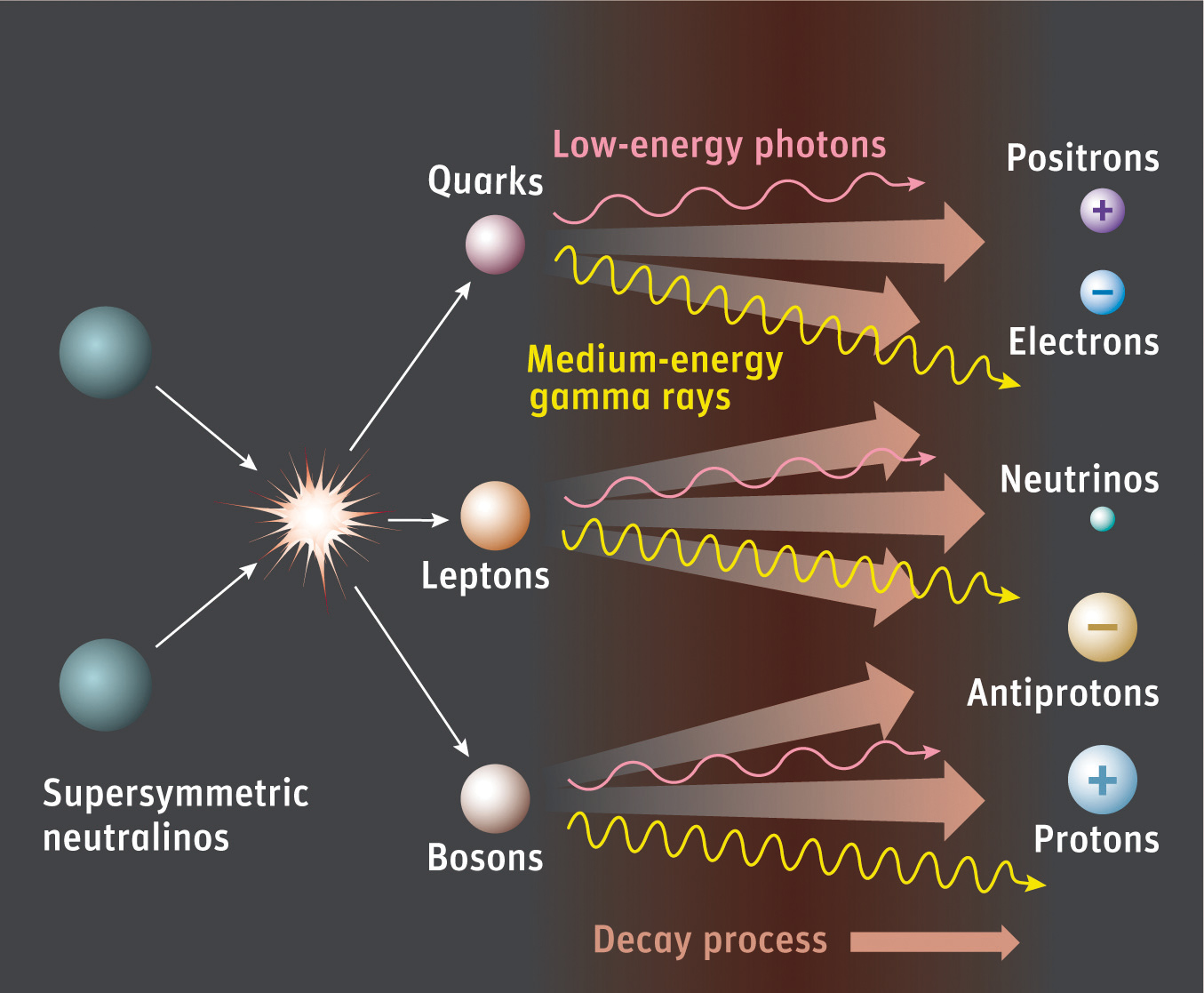
annihilation mechanisms for dark matter neutralino WIMPs

If dark matter is thermal weakly interacting massive particles (WIMPs) then it may produce observable signals when it self annihilates. A popular model for the WIMP which would self annihilate is the neutralino (see figure at right). Self annihilation is exactly what it sounds like, like two identical but opposite forces meeting, the result is an explosion of energy and particles (the interaction conserves energy, momentum, and other quantum numbers). WIMP self annihilations into positrons and electrons could be detected by cosmic ray detectors. These self annihilations and the observable signal would be rare though. If they were common we would see a lot more signal. In the early universe these annihilations would have been much more common such that if there was a primordial abundance of dark matter it would have self annihilated to be consistent with the much lower density of dark matter we observe today (to wrap your head around this take my contrived analogy of a king who has many identical twin sons all born at once, in time they might murder each other until there was enough land for the remaining sons to all have just enough). Mathematically this is stated that the density of dark matter today, Ω, is proportional to the inverse of the particle cross section times relative velocity at freeze-out, σν, (think of this as probability the particles would interact). Today dark matter is said to have frozen out at its current density because on average a dark matter particle will travel the entire distance across the universe (this distance changes also invoking the Hubble scaling h) before interacting with another dark matter particle:
relic dark matter density, the wimp miracle
This is known as the WIMP miracle. Particle physics independently predicts a particle with the right density to be the dark matter that astronomers observe.

Evidence for WIMPs

Recent observations from experiments and collaborations including  ATICFermi/GLASTPAMELA, and others have observed an excess over the expected background of cosmic ray positrons (I am lumping these experiments together, but they actually detect subtly different kinds of particles and found different kinds of anomalies; for example PAMELA detected an upturn in the positron fraction e+/(e++e-) from 10-100 Gev while ATIC detected and excess in the total e++ecount at energies of 300-800 Gev). The reality is that anomalies are not unexpected given the uncertainty in astrophysical foregrounds which vary with energy.

Cosmic rays are charged particles (like positrons, e+,and electrons, e-) fired like bullets moving close to the speed of light at random throughout the universe and may be created by any of your favorite high energy astrophysical sources like magnetars, super massive black holes, supernovae, and so forth. Cosmic ray particles (any very fast moving charged particles) can interact with the galactic magnetic field, the interstellar medium, or the interstellar radiation field. These interactions generally cause the particles to lose energy and that energy is emitted in the form of observable photons. Thus dark matter will leave an astronomical signature not only in the form of cosmic rays from direct annihilation into positrons or electrons as discussed above, but also in the form of scattering of photons. The reason for all this talk about cosmic rays is that now we can see that the dark matter models explaining the PAMELA, ATIC, and Fermi results would also produce other observables, for example, an excess of gamma ray photons from the galactic center (they would be focused from the galactic center because that is where the dark matter would be densest and annihilating most rapidly) at energies 100 GeV and more. Another signal that may come from dark matter was seen in observations made by the WMAP satellite which detected residual microwave emission from the galactic center known as the 'WMAP haze'.

You can't just ask a particle where it came from. The electrons and positrons of WIMP annihilation are cosmic rays with an exotic origin, but because there may be an undetected 'local' pulsar producing the cosmic ray anomalies being detected we do not yet know where the positron excess originates. The interpretation of the photon background can be similarly difficult. It is well known that the cosmic x-ray background is the cumulative emission from active galactic nuclei (it can be modeled with a single power-law), but on top of this background local astrophysical phenomena and or dark matter annihilation may contribute to the signal. Astrophysicists are curious to know if dark matter annihilation is necessary or do cosmic rays account for all the gamma rays in diffuse galactic radiation? The most promising and ongoing source of data to constrain WIMPs comes from the Fermi collaboration. Despite initial excitement in the astrophysics community and the blogosphere about the possible origins of the anomalies (if you don't read the physics blogosphere see here or here) the Fermi collaboration now states their results on the measured cosmic-ray spectra are consistent with a standard model of diffuse galactic gamma-ray emission,
The new result, based on the initial ten months of science observations, significantly improves and extends our knowledge of the isotropic diffuse emission at the high-energy end. The observed emission is softer and lower in intensity than measurements with EGRET had indicated previously. Fermi’s observed spectrum is consistent with a single power-law description over nearly three orders of magnitude in energy
In conclusion the prospect for direct astrophysical observations of dark matter is overwhelmed by uncertainty in the backgrounds and only more careful observations will improve this situation. I should reiterate that the uncertainty is in the detection of dark matter signature, and not the presence of gravitating dark matter.

dark matter map

Making dark matter consistent with observations

Despite the uncertainty in observations we may still draw conclusions and place bounds on possible dark matter candidates. The observed relic density implies that the dark matter annihilation cross section times the relative velocity at freeze-out is very small (see equation above). Unfortunately, given this predicted annihilation cross section the positron signal would be 2 to 3 orders of magnitude smaller than the observed cosmic ray excesses! In order for the WIMP model to fit the various observations a cross section much larger than that predicted by the relic abundance is necessary. Various unknown forces (the dark sector) could increase the annihilation rate. Some researchers have suggested the neutralino WIMP with Sommerfeld enhanced annihilations may explain the observed cosmic ray excesses. Sommerfeld enhancement increases the cross section of particles at low velocities similarly to classical gravitational enchantment. To wrap your head around this imagine dark matter particles as strangers quickly passing in the street; dark matter particles and strangers don't bother to hang out with each other at this speed, but if they stop at a coffee shop then the possibility that strangers would have some kind of interaction is greatly enhanced. If dark matter particles are jetting around too fast they wont have any interactions, however, if the particles slow down a significant interaction may occur between them. The classical gravitational enhancement analogy can quantify Sommerfeld enhancement a little more. Consider a particle encountering a star of radius R and mass M so the cross section should just be πR2 in the case that the particle directly hits the star, but as the particle approaches the star at a velocity ν it is trivial to show using conservation of energy and angular momentum that the cross section is increased to
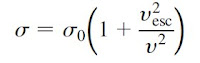
SOMMERFELD ENHANCEMENT
where νesc2=2GM/R. The Sommerfeld enhancement is the quantum extension of this classical phenomena. If you work through the entire derivation the result is that the enhacement leads to a cross section that scales at low energies as σν ∝ 1/ν. It turns out that the velocity of dark matter particles is a factor of ~10- 3 less now compared to what it was at freeze out. It is a miracle of dark matter that Sommerfeld enhancement provides an elegant mechanism for boosting annihilations now to exactly the amount needed.

However, a satisfactory solution to the dark matter problem must not only have dark matter annihilating at the correct rate, but it must also produce the right density and structure on all cosmological scales which is consistent with observations. In a paper appearing in Physical Review Letters, Jonathan L. Feng, Manoj Kaplinghat, and Hai-Bo Yu of the University of California, Irvine, point out some problems with these explanations, in thier own words from the abstract:
Dark matter with Sommerfeld enhanced annihilation has been proposed to explain observed cosmic ray positron excesses in the 10 GeV to TeV energy range. We show that the required enhancement implies thermal relic densities that are too small to be all of dark matter. We also show that the dark matter is sufficiently self-interacting that observations of elliptical galactic dark matter halos exclude large Sommerfeld enhancement for light force carriers. Resonant Sommerfeld enhancement does not modify these conclusions, and the astrophysical boosts required to resolve these discrepancies are disfavored, especially when significant self-interactions suppress halo substructure.
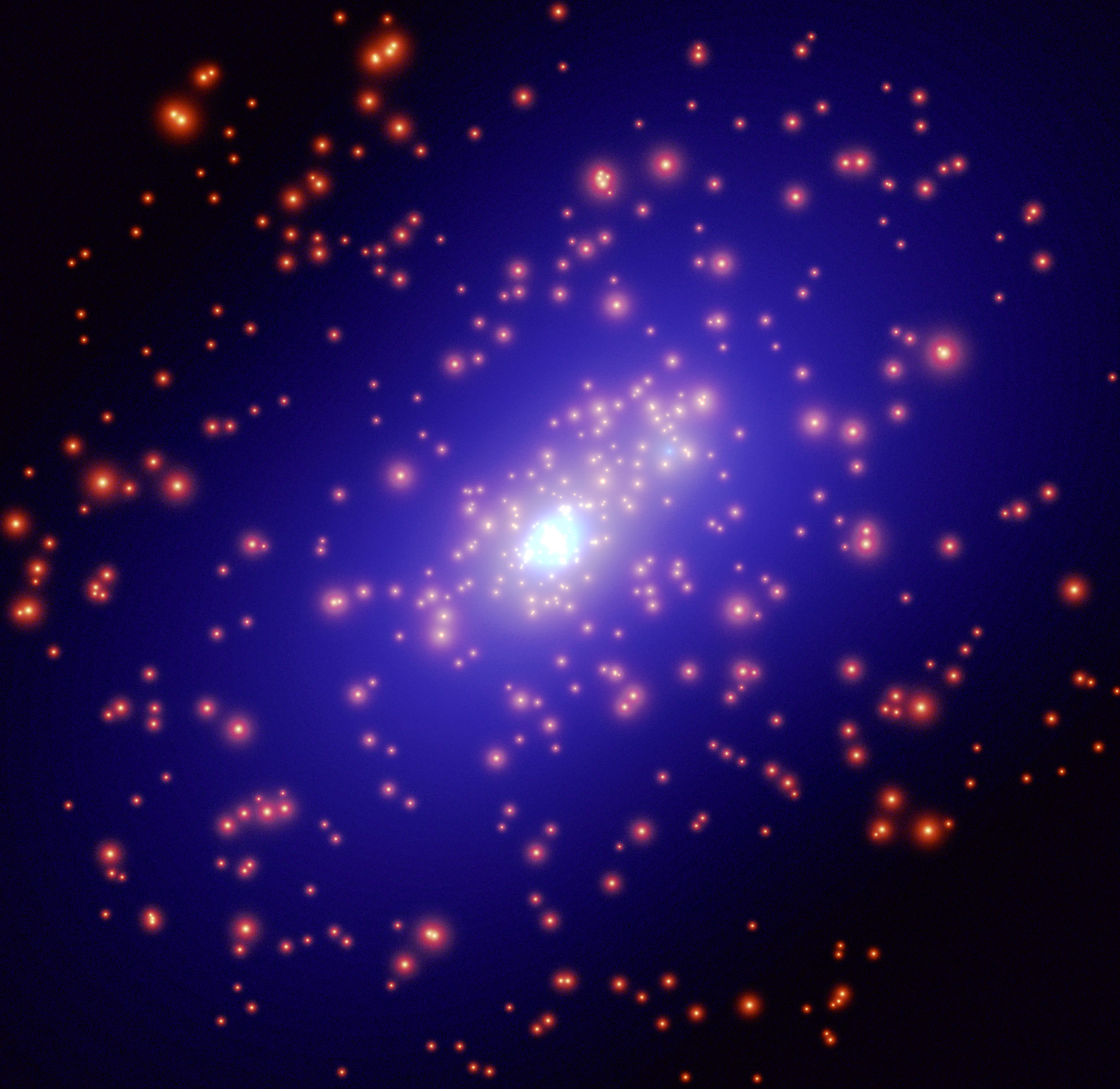
The authors find that the relic density cannot be achieved in any Sommerfeld enhanced interaction scenario even with additional resonant boosting terms. What is more, they find that the Sommerfeld enhancement would create significant changes in dark matter halos because the additional interactions would isotropize the velocity dispersion and create spherical halos that contradict observations of NGC 720. The effects of dark matter self interactions can be seen in almost any x-ray image of a galaxy or cluster galaxies. For example, the image above of the galaxy cluster CL0025+1654 shows the dark matter (shown in blue) has an approximately thermal distribution and an elliptical shape. Subhalos with high density are also predicted to be present (in the image above the subhalos are not resolved, but many N-body simulations have predicted them to be there) with lower velocity dispersions than the thermal bulk of the halo, such that the Sommerfeld enhanced cross sections make these components especially important. Further observations of halos and subhalos will place even more constraints on dark matter self interactions.

I must comment on the authors findings on spherical halos. I would agree that enhanced interactions can create significant changes in the shapes of dark matter halos, but I caution that analysis of a single galaxy is not sufficient to constrain dark matter. Observations of our own Milky Way indicate that our dark matter halo probably looks like a beach ball flattened perpendicular to the visible plane of the galaxy. This would corroborate the authors findings, however, I have had discussions with colleagues on dark matter forming spherical halos. Finally, it should be obvious that any dark matter model that calls for heavily interacting dark matter would produce wildly inconsistent results. One theory that is been proposed is that there is a hidden world of mirror-matter that acts just like regular matter, but it doesn't interact with regular matter through any force but gravity. Mirror galaxies, mirror stars, and mirror planets are completely inconsistent with observations! The experiments discussed above placed constraints on the type and mass of dark matter particles that would rule out such mirror-matter. I did not include or discuss the DAMA experiment's observations earlier because they had not been reproduced independently by any other group until very recently. The CoGeNT experiment now has a confirmation of the DAMA signal and this may change things by allowing the considered masses of dark matter candidates to be reduced considerably (this still doesn't allow for mirror-matter although some are implying it does). I refuse to equivocate my opinion that there is no hidden sector which is an exact copy of the standard model.

A survey of the lessons and knowns about dark matter indicates that we need more data. Dark matter models motivated from cosmic positron observations require an enhanced cross section to reproduce the data, but this enhanced cross section is inconsistent with the relic dark matter density and observations of dark mater halos. We need observers to determine if the cosmic positron excess is caused by a local astrophysical source such as a pulsar. We need theorists to develop a simple model for dark matter that is motivated from fundamental particle physics that make testable predictions for future observations.

ResearchBlogging.org
References:

Abdo, A., et al. (2010). Spectrum of the Isotropic Diffuse Gamma-Ray Emission Derived from First-Year Fermi Large Area Telescope Data Physical Review Letters, 104 (10) DOI: 10.1103/PhysRevLett.104.101101

Nima Arkani-Hamed, Douglas P. Finkbeiner, Tracy R. Slatyer, & Neal Weiner (2008). A Theory of Dark Matter Phys.Rev.D79:015014,2009 arXiv: 0810.0713v3

Feng, J., Kaplinghat, M., & Yu, H. (2010). Halo-Shape and Relic-Density Exclusions of Sommerfeld-Enhanced Dark Matter Explanations of Cosmic Ray Excesses Physical Review Letters, 104 (15) DOI: 10.1103/PhysRevLett.104.151301

you are at the center of the universe

You Are at the center of the universe
The cosmological principle states the universe is homogeneous and isotropic when viewed on large enough scales. It is the ultimate extension of the Copernican Principle which asserts that the Earth is not in any special place in the universe. Mathematically this statement reduces to the Friedmann-Lemaître-Robertson-Walker metric solution to the Einstein field equations. In our expanding universe with scale factor a, as a function of time t, with the constant k representing the curvature of space (we have measured it and it is about zero), the angles θ and φ being the normal azimuthal and polar angles in spherical coordinates, and r being the radius, the metric solution to your universe is:
Friedmann-Lemaître-Robertson-Walker metric solution to the Einstein field equations
It is a beautiful thing that each observer is in a unique position to be at the center of their own observed universe because the expansion of the universe results in a coherent Hubble flow away from your point of reference in every direction. Thus one may entertain the notion that you are at the center of the universe. However, an external observer would also perceive that they are at the center of the universe. Thus, while observationally everyone is at the center of their own personal expanding universe, we logically conclude that this is merely an observational illusion of isotropic and homogeneous expansion. By carefully examining anisotropies in the cosmic microwave background or measuring the redshift of galaxies in different directions over time we can determine if the Copernican Principle is valid.

Sean Carroll on the Arrow of Time

The Origin of the Universe and the Arrow of time with Sean Carroll
A Sunday diversion with Sean Carroll on the origin of the universe and the arrow of time. Part two is here.

An Upper Limit On Not Knowing What the F*** They're Doing

First, I should say that the Supernova Cosmology Group and others using Type Ia supernova as standard candles are very precise in their work and I don't seriously doubt their results as they have been very consistent with other observations. There is though the one dark shadow looming over all their results and that is systematic error. Cosmologists use Type Ia supernova as a lighthouse in the dark because we can assume that all lighthouses have the same intrinsic luminosity and therefore any difference in observed luminosity is due solely to the distance from us. Thus by observing distant supernovae and recording their various properties such as luminosity and recession velocity from us we can plot their velocity versus distance and we can learn about the expansion of our universe and the cosmological constant. However, we assumed that we knew their intrinsic luminosity, but of course there are always unknown unknowns:
As we know,
There are known knowns.
There are things we know we know.
We also know
There are known unknowns.
That is to say
We know there are some things
We do not know.
But there are also unknown unknowns,
The ones we don’t know
We don’t know.

—Donald Rumsfeld, Feb. 12, 2002, Department of Defense news briefing
Today I read two things online that I really enjoyed and I realized that they are actually very connected. On The Blog of Steve Shwartz I read that No One Knows What the F*** They're Doing (or "The 3 Types of Knowledge") and couldn't agree more (for example, I certainly don't know what I am doing). And in Nature I read about An upper limit on the contribution of accreting white dwarfs to the type Ia supernova rate (and the arXiv preprint here) which raised questions about possible systematics in the use of supernovae in cosmology. The abstract from the nature article:
There is wide agreement that type Ia supernovae (used as standard candles for cosmology) are associated with the thermonuclear explosions of white dwarf stars. The nuclear runaway that leads to the explosion could start in a white dwarf gradually accumulating matter from a companion star until it reaches the Chandrasekhar limit, or could be triggered by the merger of two white dwarfs in a compact binary system. The X-ray signatures of these two possible paths are very different. Whereas no strong electromagnetic emission is expected in the merger scenario until shortly before the supernova, the white dwarf accreting material from the normal star becomes a source of copious X-rays for about 107 years before the explosion. This offers a means of determining which path dominates. Here we report that the observed X-ray flux from six nearby elliptical galaxies and galaxy bulges is a factor of ~30–50 less than predicted in the accretion scenario, based upon an estimate of the supernova rate from their K-band luminosities. We conclude that no more than about five per cent of type Ia supernovae in early-type galaxies can be produced by white dwarfs in accreting binary systems, unless their progenitors are much younger than the bulk of the stellar population in these galaxies, or explosions of sub-Chandrasekhar white dwarfs make a significant contribution to the supernova rate.
So, what the researchers found using Chandra data is observational evidence that type Ia supernovae are not simply explosions of Chandrasekhar mass white dwarfs, which would have been the simple case. The 'classic' picture is that when the amount of material accreted onto a white dwarf exceeds the Chandrasekhar mass the dwarf explodes:
The new Chandra results indicate that some Type Ia supernovae probably originate from the collision of white dwarf binaries. The collision occurs because the stars radiate away gravitational waves and move inevitably closer. The result is an explosion of two stars that are near the Chandrasekhar mass so the observed luminosity may not be so standard:
There is at least one caveat to the results and the explanation given above. The Chandra observations were focused on elliptical galaxies and on the the center of one spiral galaxy because these areas had minimal amounts of gas and dust which block X-rays from reaching detectors. To summarize the results, the dominant mechanism for Type Ia supernovae in the elliptical early type galaxies Chandra observed is white dwarf mergers and not mass accretion. The take away point is that cosmologists need to take into account the galaxy type when using supernovae as standard candles because elliptical and spiral galaxies have different supernova progenitors; the supernova cosmology surveys have only used a small fraction of supernova from elliptical galaxies though, so it wont really change current results! So all that worry to discover nothing so troubling, but perhaps we gain assurance that soon even more distant standard candles can be trusted (like the GRB as a standard candle) despite that we can never really place anything more than an upper limit on unknown unknowns.

ResearchBlogging.org
References:


Marat Gilfanov, & Akos Bogdan (2010). An upper limit on the contribution of accreting white dwarfs to the type
Ia supernova rate Nature, 18 February 2010, Vol.463, p.924 arXiv: 1002.3359v1