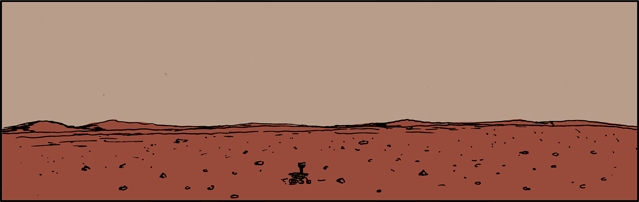
Imagine the closest star beyond the Sun has a planet orbiting it about the size of Earth. Visualize what your sunset would look like on this distant planet. Perhaps there would be two stars at the center of this solar system. Your sunset would be breathtaking. You could even visualize what the Sun would look like from this planet – just another unassuming star in the sky. You don't have to merely imagine that such a planet might exist. A planet like this really does exist – of course you'd still have to imagine the part where you are on the surface of this world. The Alpha Centauri star system, which is essentially a triple star system of Alpha Centauri A, Alpha Centauri B, and Proxima Centauri has just such a planet. There is a planet in the sky waiting for us at a distance that is just two hundred and seventy thousand times further than the Earth is from the Sun. This planet is near 1500 degrees on the surface, so we wouldn't want to be there, but nonetheless the fact is that astronomers are finding similar planets commonly. There may be a planet just the size of Earth at a nice temperature quite near us galactic speaking. We are searching.
Most planets don't seem to be much like Earth. In fact so far we haven't found a single planet that has a temperature and size similar to Earth, but part of the problem with finding planets is that finding big giant planets – like Jupiter is easy – while small rocky planets like Earth are elusive. But we are on the edge of discovery. All in all Earth-like planets likely abound. In fact with 95% confidence there is an Earth size planet in the habitable zone of a small star within 23 light years of us. The habitable zone is the place where a planet would not be too hot or too cold. A place where a planet wouldn't see its oceans boiled off or frozen into desolate ice tundra. Habitable planets are common in our galaxy and by galactic standards not very far apart. On average Earth-like planets are only 13 light-years apart.
Continue reading my essay on planets over at 3 Quarks Daily...
Field of Science
-
-
Change of address1 year ago in Variety of Life
-
Change of address1 year ago in Catalogue of Organisms
-
-
Earth Day: Pogo and our responsibility1 year ago in Doc Madhattan
-
What I Read 20241 year ago in Angry by Choice
-
I've moved to Substack. Come join me there.1 year ago in Genomics, Medicine, and Pseudoscience
-
-
-
-
Histological Evidence of Trauma in Dicynodont Tusks7 years ago in Chinleana
-
Posted: July 21, 2018 at 03:03PM8 years ago in Field Notes
-
Why doesn't all the GTA get taken up?8 years ago in RRResearch
-
-
Harnessing innate immunity to cure HIV10 years ago in Rule of 6ix
-
What kind of woman would pray for health or use spiritual healing?10 years ago in Epiphenom
-
-
-
-
-
-
post doc job opportunity on ribosome biochemistry!11 years ago in Protein Evolution and Other Musings
-
-
Blogging Microbes- Communicating Microbiology to Netizens11 years ago in Memoirs of a Defective Brain
-
Re-Blog: June Was 6th Warmest Globally12 years ago in The View from a Microbiologist
-
-
-
The Lure of the Obscure? Guest Post by Frank Stahl14 years ago in Sex, Genes & Evolution
-
-
Lab Rat Moving House15 years ago in Life of a Lab Rat
-
Goodbye FoS, thanks for all the laughs15 years ago in Disease Prone
-
-
Slideshow of NASA's Stardust-NExT Mission Comet Tempel 1 Flyby15 years ago in The Large Picture Blog
-
in The Biology Files
Showing posts with label planets. Show all posts
Sunset
Proffesor Frédéric Pont at the University of Exeter has simulated what sunsets on planets orbiting distant stars would look like.
What does the sunset look like on HD 189733 b? Amazingly, we know quite accurately. This is because the colour of the sunset is exactly what is measured when collecting the transmission spectrum of the atmosphere of a transiting planet. We have measured the transmission spectrum of ’189 with the STIS spectrograph on the Hubble Space Telescope. STIS covers visible wavelengths, and HD 189733 is bright enough that the precision of the spectrum is sufficient for a precise translation into colours perceived by the human eye.
What does the sunset look like on HD 209458 b?
Mars Rover Curiosity
This animation depicts what will happen in August 2012 if all goes as planned for Curiosity, NASA's next Mars rover. This rover is much larger and and more competent than the previous rovers. It is about the size of a small car and has an entire suite of experiments on board. During entry it uses a series of thrusters to maneuver to the designated landing area. Once the ship has slowed down to Mach two (keep in mind that the atmospheric pressure on the surface of Mar's is of the order .05% that of Earth's) a parachute is deployed. As the vehicle slows the heat shield comes off and a radar detects how close the surface is approaching in order to slow for a smooth landing. The last daring step is a so called 'sky crane' which lowers the rover with a long cable from the rocket thrusted ship above. Eventually Curiosity will begin roving, but it won't be limited to roving only during the day by solar panels as the previous rovers were. The large tilted box on the back of the rover contains 4.8 kg of plutonium dioxide which emits heat serving as the power source of the rover. The power should keep flowing for much longer than the minimum specked science mission of two Earth years. The rover will seek out rough rocks such as ancient Martian riverbeds or canyons where evidence of early environments on Mars can be found. The ability to navigate to these areas is an important science requirement for the rover and is one of the reasons for the rover's large size and nuclear battery which should allow it to travel at least 20 kilometers during its lifetime. Geologists and astrobiologists also want to know if certain conditions such as those necessary for organic molecules are present. In the video a laser and a drill are shown performing experiments. The laser is ChemCam which will project onto hard to reach rocks and detect the reflected light in order to discern the chemical composition of rocks. The drill is about a centimeter in diameter and will extract the dust from the holes it creates to run experiments in mineralogy (the laser device inside the rover shown in the video) or detecting organic molecules. All of these experiments aim to answer the question, could Mars have had an environment capable of supporting life at one time?
If the sky crane works we may soon know the answer to this question. Curiosity has a launch window from November 25 to December 18, 2011 from Kennedy Space Center in Florida. And in other news NASA's James Webb Space Telescope is being threatened with the axe in budget bill in the U.S. House of Representatives today. NASA will never run out of adversaries pulling it down: Gravity and the budget.
The Goldilocks Planet
Once upon a time there was a planet named Earth. It orbited exactly one astronomical unity away from a G2V type star. Billions of years went by and Earth found that it lived right in the habitable zone where liquid water was maintained on it surface and life spontaneously arose. Pretty soon life on Earth became restless, questioned its own existence, and looked for life on Gliese 581. Earthlings found many planets and exclaimed, 'Gliese 581 b is too hot, Gilese 581 c is slightly too hot, Gliese 581 d is slightly too cold, Gliese 581 e is way too hot, Gliese 581 f is too cold, but Gliese 581 g is just right!' so the story goes.
Gliese 581 is an unassuming star: it is relativity close at 20 light years away (the 87th closest cataloged star to earth), it is only a third the mass of the sun, and it is relativity quiet in terms of stellar activity (which is beneficial for life because flares scorch planets). It is the sixth planet from Gliese 581 denoted merely as g that harbors so much potential. It is not to hot, not too cold, it is just right. It is the Goldilocks planet. Vogt et al. 2010 recently reported on the discovery of this planet which is a 3.1 Earth mass (or larger) planet orbiting in the habitable zone of the M3V type star Gliese 581. The problem is that this planet may not exist.
The onus of proof in science is upon those who make extraordinary claims. Vogt et al. were only able to find this planet by combing the available data sets; they actually state in their paper that they did not detect the planet in either of the data sets independently, only in combination. The damning part of the Swiss groups statement is that they say they have much more data available at this point that Vogt et al. did no have access to during their analysis. When the Swiss team forces planet g to fit their complete data they actually get a negative fit indicating that planet g really isn't there. The thing about this paper that I am least happy with is the quoted false alarm probability. The false alarm probability appears to be 1% based on the figures in the paper (see figure 3 specifically), but in the text it is quoted as ~10-5. I don't know what is going on.
Then there is their error analysis (warning this is about to get technical feel free to skip this paragraph). Vogt et al. used the peaks in the power spectrum to identify the planets in the system then subtracted off the highest power modes corresponding to the planets they had found. The power spectrum for each planet carried with it a false alarm probability, but once the planet had been subtracted out of the power spectrum its false alarm probability was washed away (you can see this happening in figure 3). They compound their errors after the 1st, 2nd, 3rd, 4th, and 5th planets which have varying false alarm rates. The proper way to do this is a joint fit model to all planets in the system using Bayesian analysis.
The strangest thing about all this is that when this paper was first submitted to The Astrophysical Journal the Swiss group was reviewing the paper and it was rejected. This Vogt paper meta chronicles its own history and discusses why it was retracted previously over concern of systematics. Unfortunatly the quality of the paper may not have improved. The Swiss group has actually leveled one specific concern, Vogt used perfectly circular orbits to find planet g, but the evidence shows the orbits are probably slightly elliptical. In fact in 2009 Vogt used elliptical orbits, but in this new paper circular orbits have been adopted. The image above illustrates this and makes a pictorial argument as to how circular vs elliptical orbits could introduce errors.
The discovery of an Earth-like planet seems imminent. I do not know if this is it. I will hold off further judgment until more information was available.

References:
Steven S. Vogt, R. Paul Butler, Eugenio J. Rivera, Nader Haghighipour, Gregory W. Henry, & Michael H. Williamson (2010). The Lick-Carnegie Exoplanet Survey: A 3.1 M_Earth Planet in the
Habitable Zone of the Nearby M3V Star Gliese 581 ApJ accepted : arXiv: 1009.5733v1
Also thanks to Amit and Rory for discussion and figures.
Gliese 581 is an unassuming star: it is relativity close at 20 light years away (the 87th closest cataloged star to earth), it is only a third the mass of the sun, and it is relativity quiet in terms of stellar activity (which is beneficial for life because flares scorch planets). It is the sixth planet from Gliese 581 denoted merely as g that harbors so much potential. It is not to hot, not too cold, it is just right. It is the Goldilocks planet. Vogt et al. 2010 recently reported on the discovery of this planet which is a 3.1 Earth mass (or larger) planet orbiting in the habitable zone of the M3V type star Gliese 581. The problem is that this planet may not exist.
The Media
I did not immediately discuss Gliese 581 here at The Astronomist because I wanted to read the paper before weighing in. However the authors were compelled to issue a press release about their findings before making their peer reviewed paper available. After I finally looked at the paper I was somewhat disappointed. The whole thing was a science journalism media circus. A selection of some of my favorite excerpts:- “Found: An Earth like Planet, at Last” Time magazine
- “The chances of life on this planet are 100 percent,” Steven Vogt
- “Could contain more gold than we could ever imagine” PR Fire
- "Are the Gliesans going to Hell?" Huffington Post
- "An Alderaan Moment: Earth-Like planet disappears" Death+Taxes
The Science
All the planets around Gliese 581 were discovered using the radial velocity technique. In any gravitationally bound system the bodies orbit their common center of mass. It is a subtle effect in a star-planet system where the central star dominates the mass. The central star will move at a characteristic speed depending on the orbits of the planets around it. The movement of the star is measured through the Doppler shift of the light emitted by the star. Modern instruments are super sensitive to even the smallest movements of stars down to as little as 1 m/s. Observations of the radial velocity of the star over a period of time (usually several years) is analyzed using Fourier analysis. The Fourier analysis identifies periodic signals in the data corresponding to the orbital period of the planet or planets.
The researchers used two data sets spanning almost two decades. Most of the data came from the researcher's own instrument HIRES, and additional data came from a Swiss group with the HARPS instrument. The HIRES data spans a larger time range, but the HARPS data is more precise. This combined data set is how the researchers identified two new planets f and g.
The Problems
A little after this new Goldilocks planet was announced the Swiss group announced that they could find no evidence of Gliese 581 g in their data. Does this mean it doesn't exist? Well this is tricky. A planetary researcher in my department, Rory Barnes, spoke to the New York times before the Swiss group had spoke up and said that the planet looked like the 'real deal'. After the announcement was made I spoke to Barnes again and he said that he would have to hold off further judgment until more information was available.The onus of proof in science is upon those who make extraordinary claims. Vogt et al. were only able to find this planet by combing the available data sets; they actually state in their paper that they did not detect the planet in either of the data sets independently, only in combination. The damning part of the Swiss groups statement is that they say they have much more data available at this point that Vogt et al. did no have access to during their analysis. When the Swiss team forces planet g to fit their complete data they actually get a negative fit indicating that planet g really isn't there. The thing about this paper that I am least happy with is the quoted false alarm probability. The false alarm probability appears to be 1% based on the figures in the paper (see figure 3 specifically), but in the text it is quoted as ~10-5. I don't know what is going on.
Then there is their error analysis (warning this is about to get technical feel free to skip this paragraph). Vogt et al. used the peaks in the power spectrum to identify the planets in the system then subtracted off the highest power modes corresponding to the planets they had found. The power spectrum for each planet carried with it a false alarm probability, but once the planet had been subtracted out of the power spectrum its false alarm probability was washed away (you can see this happening in figure 3). They compound their errors after the 1st, 2nd, 3rd, 4th, and 5th planets which have varying false alarm rates. The proper way to do this is a joint fit model to all planets in the system using Bayesian analysis.
The strangest thing about all this is that when this paper was first submitted to The Astrophysical Journal the Swiss group was reviewing the paper and it was rejected. This Vogt paper meta chronicles its own history and discusses why it was retracted previously over concern of systematics. Unfortunatly the quality of the paper may not have improved. The Swiss group has actually leveled one specific concern, Vogt used perfectly circular orbits to find planet g, but the evidence shows the orbits are probably slightly elliptical. In fact in 2009 Vogt used elliptical orbits, but in this new paper circular orbits have been adopted. The image above illustrates this and makes a pictorial argument as to how circular vs elliptical orbits could introduce errors.
The discovery of an Earth-like planet seems imminent. I do not know if this is it. I will hold off further judgment until more information was available.
References:
Steven S. Vogt, R. Paul Butler, Eugenio J. Rivera, Nader Haghighipour, Gregory W. Henry, & Michael H. Williamson (2010). The Lick-Carnegie Exoplanet Survey: A 3.1 M_Earth Planet in the
Habitable Zone of the Nearby M3V Star Gliese 581 ApJ accepted : arXiv: 1009.5733v1
Also thanks to Amit and Rory for discussion and figures.
Richest Yet Planetary System Discovered: HD 10180
The era of complex planetary systems is here. The solar-type star HD 10180 is just 39 parsecs away and hosts at least 5 extrasolar planets; this is the richest planetary system yet discovered. The ESO 3.6 meter telescope in La Silla, Chile made the observations of HD 10180 with the precise High Accuracy Radial velocity Planet Searcher (HARPS) spectrograph for six years to confirm their findings.
Spirit, Already Dead
On January 26th, 2274 Mars days into the mission, NASA declared Spirit a 'stationary research station', expected to stay operational for several more months until the dust buildup on its solar panels forces a final shutdown.If the Spirit rover is just a little robot crawling around on a little red planet somewhere, then why are we so sad that it is dying? The rover is certainly easy to anthropomorphize, but I think there is more to it. The spectrum of sentient to insentient, is just that a spectrum. When we speak of these concepts we make subtle judgments through the connotation of our words. For example is the robot going to die, or is it going to shutdown? On some level it must be alive, or, at least it was.
New Planet Discovered 400 Light Years Away From Public's Interest
The Kepler team has just announced their first results on the discovery and confirmation of five new exoplanets. The news barely made a splash so it reminded me of an old Onion article, New Planet Discovered 400 Light Years Away From Public's Interest. I can't help but think that this is all too true. Now to be fair none of the new exoplanets are particularly interesting as they aren't in the habitable zone and have very short periods. However, this news from Kepler is proof that the satellite is working as planned so in the future we can expect some much more exciting finds.
Landing on Titan
Sounds from a left speaker trace Huygens' motion, with tones changing with rotational speed and the tilt of the parachute. There are also clicks that clock the rotational counter, as well as sounds for the probe's heat shield hitting Titan's atmosphere, parachute deployments, heat shield release, jettison of the DISR cover and touch-down.
Sounds from a right speaker go with DISR activity. There's a continuous tone that represents the strength of Huygens' signal to Cassini. Then there are 13 different chimes - one for each of DISR's 13 different science parts - that keep time with flashing-white-dot exposure counters.
Planets in Binary Systems, Planets Everywhere
A few weeks ago Debra Fischer from San Francisco State University gave a colloquium here at UW on the 'Formation of Planets in Binary Star Systems'. It was entertaining, enlightening, and involved our closest of friends the, Alpha Centauri binary. I didn't know how to explain how cool this subject or the project was at the time, but now SEED magazine has done the job for me here. Her talk at UW was tagged as

The theory of planet formation has evolved significantly with the detection of more than 300 planets orbiting nearby stars. However, half of stars similar to the Sun are members of binary or multiple star systems. A function of the binary star separation, evolution from the planetesimal to planet embryo stage faces some significant dynamical challenges and is not expected to occur for binary stars with close separations. Contradicting standard theory, a few planets have now been discovered even in close binary systems and provides an impetus to reconsider mechanisms for planet formation in these challenging environments.The problem observers often face is finding a suitable target to invest intensive observing resources towards (and of course the other problem is having too many targets). There are clues from where past planets have been found, as mentioned above, and from theories of planet formation as the article explains
No one yet knows for certain precisely how planets form, but the process seems to be a complex chain reaction that is highly dependent upon initial conditions. It begins with the creation of a star, which forms from a gravitationally collapsing cloud of gas and dust. The leftovers flatten out, due to the conservation of angular momentum, forming a spinning disk of material. To create a rocky world like Earth, dust must condense in the disk to form grains, grains must settle to form pebbles and rocks, and rocks must collide to form planetesimals, kilometer-sized objects that can gravitationally attract each other. These planetesimals must collide to form embryos, Moon-sized objects that collide in turn to finally form a planet.Fischer and many others (a team including Greg Laughlin who runs a blog on exoplanets, Systemic) have realized that the Alpha Centauri system's proximity make it a serendipitously excellent target for observing. There remain doubts as to whether a suitable planet can form in this particular binary system, but regardless the observing has begun. The team will be looking for doppler shifts in the motion of the two stars to determine if other massive bodies (a planet) are perturbing the orbit of the stars. It will be a cosmic starring contest lasting several years.

CTIO 1.5-meter telescope where the search happens every night (Copyright NOAO).
If I was a betting man I would bet that we will find an earth size object in the Alpha Centauri system, but I don't bet I count the cards. I claim astronomers will find an earth size object around a distant star within the next ten years, yeah, it is a longshot.
Subscribe to:
Posts (Atom)