Field of Science
-
-
Change of address1 year ago in Variety of Life
-
Change of address1 year ago in Catalogue of Organisms
-
-
Earth Day: Pogo and our responsibility1 year ago in Doc Madhattan


Showing posts with label technology. Show all posts
Showing posts with label technology. Show all posts
Quantum computing so close or so far?
Quantum computing so close or so far? The following promotional video is quite optimistic, but it does a decent job of explaining the most basic workings and potential of quantum computing so I thought I would share. For a more in depth perspective on the physics and prospects for quantum computers see my post about my visit to D-wave and their attempts to build the first quantum computer.
Fusion for the Future: ITER
The way of the future is fusion. I dream of a world where humans have harnessed the power of the Sun. Clean, safe, energy. But there is no clear path to fusion. The most exciting possibility for a future with fusion may be the International Thermonuclear Experimental Reactor or ITER. ITER is not the only option of course. Previously, I have discussed the National Ignition Facility or NIF which has pioneered unique technologies is the field, but their success is not ensured. Many small research projects around the world are also struggling to realize the dream of fusion, but with budget shortfalls and increasing pressure to produce results we as a society may shortsightedly end the dreams of a fusion future.
Fusion is what powers the Sun and all stars in our Universe. Fusion is the joining of two or more separate atomic nuclei into a larger nuclei. Fusion can create energy because the mass of the input and output nuclei are not necessarily equal in mass. An overview of what fusion is and why it is so important can be seen on my previous post on Fusion for the Future. Many scientists in the field acknowledge that a rapid development of fusion is unlikely, much less a commercial development, but there is hope. A reasonable time frame may be half a century before we see a world powered by the same process which drives the Sun. It will be an almost entirely clean, limitless, reliable, and safe source of power.
Christopher Llewellyn Smith states some cold hard numbers that are worth mentioning again. The price of ITER is at least 13 billion Euros or $17 billion. This cost is justified and dwarfed by the magnitude of the energy usage on Earth which amounts to a $5 trillion dollar a year market (I checked some of these numbers and they seem approximately correct. Did you know that you can download the International Energy Agency's annual reports as an iPhone or iPad app?). Particularly shocking are the subsides to fossil fuels which are over $500 billion a year worldwide (I am not so sure about this number, but the United States alone subsides fossil fules to the tune of $10 billion a year) while the subsides to renewables are only $45 billion worldwide. Smith says that the renewable energy sources of wind, bio, geothermal, and marine will never be able to meet the world's energy needs a current consumption rates. We must use solar, fission, or fusion energy.
It is a curious thing to ask a scientist to speculate on the future, but these two scientists have indulged us with a time frame for achieving fusion. Maybe the middle of this century at best they say. What makes fusion so difficult?

 The key to releasing the energy of the Sun is forcing the nuclei of atoms close enough together for them to overcome their electrical repulsion and allow the strong force which binds nuclei to merge the nuclei together. Such favorable conditions for atoms to smash into each other can only occur under extreme temperatures and pressures, like say at the center of a star, but it is almost impossible to hold a star on earth. Anything which is hot enough to undergo fusion is also hot enough to burn through any container, thus we must contain something without quite touching it. Enter the magnetic doughnut known as the tokamak. A tokamak is a toroidal or doughnut shaped container that uses magnetic fields to confine plasma. Plasma is a state of matter where all the atoms are ionized (the electrons that normally orbit the protons in the nucleus have escaped)—and at these temperatures the atoms contained in the tokamak are definitely ionized. Magnetic fields apply a force on the charged particles of plasma such that the plasma can be corralled and kept away from the walls of the container. In an actual tokamak huge magnets encircle the enclosure as shown in the figure here where the magnetic coils and the ITER plasma surface is shown. The colors and contour lines indicate the magnetic field strength which is not quite perfect, the lines are wavy, due to deviations from perfect symmetry in the structure because the tordioal magnetic field is made of a finite number of magnetic coils. The ITER tokamak will be huge. Check out the tiny little person (bottom left) in the image below.
 The complexity of this machine is astounding. One key challenge that must be overcome is the confinement of the plasma in a controlled manner. The Confinement Topical Group will determine exactly how to accomplish the confinement and avoid the performance degrading effects of Edge Localized Modes or (ELM modes). The hotter the plasma is the more internal plasma pressure is that must be balanced by stronger magnetic pressure fields; we could view this system in analogy to a balloon where that the plasma is the air under pressure and balloon's walls are the magnetic fields. The exact ratio of the plasma's internal current, the physical size of the tokamak, and the torodial magnetic field is a carefully tuned parameter to balance the gas temperature and magnetic pressures which does not yet have a known optimal configuration (the goal is I/aB < 2.5 where I is the plasma current, a is the minor radius, and B is the toroidal field on axis). It has been observed that the ELM modes periodically become unstable and have breakouts. This creates a large energy flux in a short time, like that of a solar flare on the Sun, where hot plasma breaks free of the magnetic fields. When this occurs the plasma may touch the side walls of the tokamak and overheat the internal surfaces to many thousands of degrees. The side wall surfaces will be evaporated and eroded inside the plasma chamber. In this way the ELM modes result in the introduction of plasma impurities which contribute to raising the effective atomic number (the number of free protons per particle) of the plasma which results in greatly reduced fusion efficiency or even the halting of the fusion reaction entirely; the target is to keep the effective atomic number below two. The aggregate erosion is large and the lining of the tokamak walls may need be replaced often. In order to operate the machine continuously and cost effectively the ELM modes must be controlled. The control of ELM is paramount for a successful fusion tokamak. In the video below Alberto Loarte tells us a little more about the control of ELM modes and clever ways that the ELMs are dealt with.
The plasma instabilities inside a fusion reactor are a serious engineering challenge, but they are not a safety concern at all. Unlike a fission reactor, when a fusion reactor is compromised it does not go critical in a dangerous explosion (like a fission reactor would), instead it just fizzles out harmlessly. This technology is not perfect though because while some may claim that a fusion reactor would create no dangerous radioactive material in fact it would produce some radioactive material that would need to be handled. It is the walls of the reactor which will become slightly radioactive (through neutron activation). Conveniently though the half life of such radioactive waste materials is less than 100 years and could be entirely handled on site.
We should all be hoping for fusion. I spoke with Michel Claessens, the head of communications for ITER, and one of the questions I asked him was, what should the public know about fusion and ITER?
Fusion is what powers the Sun and all stars in our Universe. Fusion is the joining of two or more separate atomic nuclei into a larger nuclei. Fusion can create energy because the mass of the input and output nuclei are not necessarily equal in mass. An overview of what fusion is and why it is so important can be seen on my previous post on Fusion for the Future. Many scientists in the field acknowledge that a rapid development of fusion is unlikely, much less a commercial development, but there is hope. A reasonable time frame may be half a century before we see a world powered by the same process which drives the Sun. It will be an almost entirely clean, limitless, reliable, and safe source of power.

 The key to releasing the energy of the Sun is forcing the nuclei of atoms close enough together for them to overcome their electrical repulsion and allow the strong force which binds nuclei to merge the nuclei together. Such favorable conditions for atoms to smash into each other can only occur under extreme temperatures and pressures, like say at the center of a star, but it is almost impossible to hold a star on earth. Anything which is hot enough to undergo fusion is also hot enough to burn through any container, thus we must contain something without quite touching it. Enter the magnetic doughnut known as the tokamak. A tokamak is a toroidal or doughnut shaped container that uses magnetic fields to confine plasma. Plasma is a state of matter where all the atoms are ionized (the electrons that normally orbit the protons in the nucleus have escaped)—and at these temperatures the atoms contained in the tokamak are definitely ionized. Magnetic fields apply a force on the charged particles of plasma such that the plasma can be corralled and kept away from the walls of the container. In an actual tokamak huge magnets encircle the enclosure as shown in the figure here where the magnetic coils and the ITER plasma surface is shown. The colors and contour lines indicate the magnetic field strength which is not quite perfect, the lines are wavy, due to deviations from perfect symmetry in the structure because the tordioal magnetic field is made of a finite number of magnetic coils. The ITER tokamak will be huge. Check out the tiny little person (bottom left) in the image below.
The plasma instabilities inside a fusion reactor are a serious engineering challenge, but they are not a safety concern at all. Unlike a fission reactor, when a fusion reactor is compromised it does not go critical in a dangerous explosion (like a fission reactor would), instead it just fizzles out harmlessly. This technology is not perfect though because while some may claim that a fusion reactor would create no dangerous radioactive material in fact it would produce some radioactive material that would need to be handled. It is the walls of the reactor which will become slightly radioactive (through neutron activation). Conveniently though the half life of such radioactive waste materials is less than 100 years and could be entirely handled on site.
We should all be hoping for fusion. I spoke with Michel Claessens, the head of communications for ITER, and one of the questions I asked him was, what should the public know about fusion and ITER?
As much as possible. More seriously, I would be happy if people understood the differences between fission and fusion.And he has a point I think. Most people simply don't understand what is at stake and what our options our. If you are reading this then you are already more informed than most. Tell people about the difference between fusion and fission and encourage your government (no matter what country you live in) to follow a wise energy policy. While I was writing this article the United States changed its funding proposition for ITER which was a welcome change because at one point the United States looked like it would falter on its commitment to fusion research and ITER completely. This is an investment in our future and the Earth. I asked Claessens a question about this topic too, how important is worldwide collaboration in achieving a successful ITER project?
Worldwide collaboration is useful and even necessary - to pool and ensure the best use of resources (human and financial). The ITER project is so complex that no single country has the scientific and technological skills to build the machine alone. In addition, the international collaboration was seen by ITER fathers (Gorbachev and Reagan) as a way out to cold war.The idea of harnessing the power of the Sun on the Earth is so much more than just a scientific endeavor. It is a very human dream to hold the Sun (what culture does not have some kind of original creation story or explanation for the sun?) and it is possible that realizing this dream may bring us together for all of the right reasons.
The First Quantum Computer
In a nondescript office park outside Vancouver with views of snow capped mountains in the distance is a mirrored business park where very special work is being done. The company is D-Wave, the quantum computing company. D-Wave's mission is to build a computer which will solve humanity's grandest challenges.
D-Wave aims to develop the first quantum computer in the world, perhaps they already have. The advent of quantum computers would be a sea change in the world that would allow for breaking of cryptography, better artificial intelligence, and exponential increases in computing speed for certain applications. The idea for quantum computers has been bubbling since Richard Feynman first proposed that the best way to simulate quantum phenomena would be with quantum systems themselves, but it has been exceedingly difficult to engineer a computer than can manipulate the possibilities of quantum information processing. Hardly a decade ago D-Wave began with a misstep which is the origin of their name. D-Wave got its name from their first idea which would have used yttrium barium copper oxide (YBCO) which is a charcoal looking material with a superconducting temperature above that of the boiling point of liquid nitrogen. This means that YBCO is the standard science lab demonstration of superconducting magnetic levitation. Ultimately the crystalline structure of YBCO was found to be an imperfect material, but the cloverleaf d-wave atomic orbital that lends YBCO its superconducting properties stuck as D-Wave's name. The vision of D-Wave did not change, but their approach did. They realized they would have to engineer and build the majority of the technology necessary to create a quantum computer themselves. They even built built their own superconducting electronics foundry to perform the electron beam lithography and metallic thin film evaporation processes necessary to create the qubit microchips at the heart of their machine.
I recently got to visit D-Wave, the factory of quantum dreams, for myself. The business park that D-Wave is in is so nondescript that we drove right by it at first. I was expecting lasers and other blinking lights, but instead our University of Washington rented van pulled into the wrong parking lot which we narrowly reversed out of. In the van were several other quantum aficionados, students, and professors, mostly from computer science who were curious at what a quantum computer actually looks like. I am going to cut the suspense and tell you now that a quantum computer looks like a really big black refrigerator or maybe a small room. The chip at the heart of the room is cooled to a few milikelvin, colder than interstellar space, and that is where superconducting circuits count electric quantum sheep. The tour began with us milling around a conference room and our guide, a young scientist and engineer, was holding in his hand a wafer which held hundreds of quantum processors. I took a picture and after I left that conference room they did not let me take any more pictures.
 Entering the laboratory it suddenly dawned on me that this wasn't just a place for quantum dreams it was real and observable. The entire notion of a quantum computer was more tangible. A quantum computer is a machine which uses quantum properties like entanglement to perform computations on data.The biggest similarity between a quantum computer and a regular computer is that they both perform algorithms to manipulate data. The data, or bits, of a quantum computer are known as qubits. A qubit is not limited to the values of 0 or 1 as in a classical computer but can be in a superposition of these states simultaneously. Sometimes a quantum computer doesn't even give you the same answer to the exact same question. Weird. The best way to conceive of a quantum computing may be to imagine a computation where each possible output of the problem has either positive or negative probability amplitudes (a strange quantum idea there) and when the amplitudes for wrong answers cancel to zero and right answers are reinforced.
The power of quantum computers is nicely understood within the theoretical framework of computational complexity theory. Say for example that I give you the number 4.60941636 × 10¹⁸ and ask for the prime factors of this number. Now if someone were to give you the prime factors you could verify them as correct very quickly, but what if I asked you to generate the prime factors for me (I dare you. I have the answer. I challenge you. In actually this challenge is easy. Nine digit number aren't that hard to factor, a friend says they found a webpage that will do it. But the problem doesn't scale well to larger numbers). The quintessential problem here is the P versus NP question which asks whether if a problem can be verified quickly can it also be solved quickly. Quickly is defined as polynomial time meaning that the algorithm scales as the number of some inputs to some power. Computational complexity theory basically attempts to categorize different kinds of problems depending on how fast a solution can be found as the size of the problem grows. A P class problem is one in which the solution can be found within polynomial time. A NP class problem is one in which the solution can be verified in polynomial time. So if I ask you for the prime factors of my number above that is an NP problem because given the numbers you could verify the answer quickly, but it would be very difficult to calculate the numbers just given the number. It is an open question, but it appears likely that all P problems are a subset of NP. This means that problems verifiable in polynomial time are not necessarily solved in polynomial time. The issue is that for some very interesting problems in the real world we could verify the answer if we stumbled upon it, but we won't even be able stumble upon the answer in a time shorter than the age of the universe with current computers and algorithms. What we know we know and what we think we know is a sea of confusion, but the popular opinion and where people would take their wagers is that P is not equal to NP.
Suddenly, with mystique and spooky actions at a distance, quantum computing comes swooping in and claims to be able to solve some NP problems and all P problems very quickly. A general quantum computer would belong to the complexity class of BQP. There is a grand question at hand, is BQP in NP? (More generally, is BQP contained anywhere in the polynomial hierarchy? The polynomial hierarchy is a complexity class which generalizes P and NP problems to a particular kind of perfect abstract computer with the ability to solve decision problems in a single step. See this paper here on BQP and the Polynomial Hierarchy by Scott Aaronson who is a outspoken critic of D-Wave) At this time we cannot even claim to have evidence that BQP is not part of NP, but most scientists close to the problem think that BQP is not a subset of NP. Quantum computing researchers are trying to get better evidence that quantum computers cannot solve NP-complete problems in polynomial time (if NP was a subset of BQP then the polynomial hierarchy collapses). A reasonable wager I would take is that P is a (proper) subset of BQP and BQP is itself is a (proper) subset of NP. This claim has not been rigorously proved but it is suspected to be true and further there are some NP problems which it has been shown to be true for such as prime factorization and some combinatoric problems.
There might be an elephant in the room here. The D-Wave architecture is almost certainly attacking a NP complete problem and reasonable logic says that quantum computers will solve P problems and some NP problems, but not NP complete problems (this is also not proven, but suspected). An NP complete problem is a problem in which the time it takes to compute the answer may reach into millions or billions of years even for moderately large versions of the problem. Thus we don't know if this particular quantum computer D-Wave has built even allows us to do anything efficiently we couldn't already do on a classical computer efficiently; it doesn't seem to be a BQP class computer thus it cannot for example solve prime factorization cryptography problems. So, yes it is a quantum machine, but we don't have any evidence it is an interesting machine. At the same time we don't have any evidence it is an uninteresting machine. It is not general purpose enough to be clear it is a big deal, nor is it so trivial it is totally uninteresting.
The D-Wave lab was bigger than I expected and it was at once more cluttered and more precise than I thought it would be. It turns out the entire process of quantum computing follows this trend. There are a lot of factors they contend with and on the tour I saw people dead focused with their eyes on a microscope executing precise wiring, coders working in pairs, theoreticians gesturing at a chaotic white board, and even automated processes being carried on by computers with appropriately looking futuristic displays. The engineering problems D-Wave faces include circuit design, fabrication, cryogenics, magnetic shielding and so on. There is too much to discuss here so I will focus on what I think are scientifically the two most interesting parts of the D-Wave quantum computer which are the qubit physics and the quantum algorithm which they implement; in fact these two parts of their computer are deeply intertwined.
In the image above is a wafer of Rainer core superconducting microchips. The chips are built to exacting specifications and placed at the center of the D-Wave quantum computer in isolation from external noise such as magnetic fields and heat. In the quantum world heat is noise so the chips are kept at a temperature of a few milikelvin to preserve the quantum properties of the system. On each chip are 128 superconducting flux qubits. The qubit is the quantum of information with which this computer works. There are various ways to create a qubit such as quantum dots, photons, electrons, and so on, but D-Wave has gone with the flux qubit design for engineering concerns.
A flux qubit is a micrometer size loop of conducting material (in this case Niobium) wherein a current either circulates the loop clockwise or counterclockwise in a quantized manner such that the loop is either in a spin up (that is +1 or ↑) or a spin down (that is -1 or ↓) state. There is an energy potential barrier between the loop spontaneous flipping spin (or current circulation direction) which can be modulated through various control schemes. They control these loops using compound Josephson junctions and SQUIDs using their own propriety techniques, but borrowing heavily on decades of advancement in solid state physics.
Perhaps even more important than the qubit itself is the architecture and the algorithm implemented by the computer. They use a quantum adiabatic algorithm based on the Ising model. When I realized that their algorithm was based on the Ising model I couldn't help but marvel at the powerful simplicity. The Ising model is a statistical mechanics model of ferromagnetism where the atoms (vertices or variables) in a metal (crystal lattice or graph) are discrete variables with spin values that take on spin up or spin down values and each spin interacts with its nearest neighbors. It is a simple model that leads to beautiful complexity (for example see this article on the Ising model here) especially when you allow the interaction of each spin with its neighbor to be finely controlled or when you allow the connectivity of the vertices to be varied. The Ising model is easily extended to more abstract problems. For example we can connect every single vertex to every other vertex, it wouldn't look like a crystalline structure any more, but it makes sense on paper or with wires on a chip.
The quantum adiabatic algorithm borrows ideas from physics such as the process of annealing and spin states in the Ising model to solve a generalized optimization problem. During my tour of D-Wave we continued to talk about the algorithm and what was possible and the whole concept slowly crystallized for me, but it is not immediately obvious why they designed the computer they way they did because their implementation would not create a universal quantum computer. Why the quantum adiabatic algorithm?
 Here E is the value to be minimized over the total system state s subject to the constraint of Jij (where Jij <1) acting between each element si and sj (where all s=+/-1). Each element s is weighted by the value hi (where hi >-1). The nearest neighbor spins of each ij pair is calculated according to the connections between vertices in a physics application or depending on the microchips graph architecture of actual physical connections on the D-Wave chip. ) The coupling between ij is determined by Jij so this means that J represents your knowledge of how each component of the system interacts with its neighbors. Immediately we extend the above minimization parameterization to the physical implementation of quantum flux qubits.
 In this new form the optimization problem is written as a Hamiltonian which determines the interaction and evolution of the system. The variables are modified, sj →σz i and si →σz i where σi z are are Pauli matrices at site i for a spin 1/2 qubit. Then hi is the transverse field that represents transitions up and down between the two spin states ↑ and ↓, of each spin. Here Kij is the weighting that defines the interaction between the qubits. The problem is to anneal the system as closely as possible to its classical ground state with the desired Kij.
 The D-Wave computer solves the the quantum adiabatic algorithm by initializing the spins of the flux qubits in their ground state with a simple Hamiltonian. Initially the potential well for the spin of qubits is U shaped; the ground state of the of the qubits when they are configured in this mode is a superposition of the |↑> and and |↓> flux basis. Then the qubits are adiabatically, or slowly, evolved to the specific Hamiltonian which encodes the optimization problem that is to be solved; the potential is evolved to the double-welled configuration at which point the ↑> and and |↓> states start to become the dominant basis. Actually, the final configuration is not exactly a double-welled symmetric state, but it has some relative energy difference between the to states which biases the machine towards the encoded problem. Evolving the Hamiltonian can be thought of as modifying the energy barrier between the spin up and down states for each flux qubit. In a real system each potential well has multiple energy levels possible in it besides the lowest energy state which is where the ideal calculation is performed. According to the adiabatic theorem the system remains in the ground state so that at the end the state of the system describes the solution to the problem. However, in a real machine noise, such as the ambient local heat, can still disturb the system out of the ground state. A key advantage to the D-Wave approach is robustness to noise in many situations. The slower the Hamiltonian is evolved, the more the process adheres to the ideal adiabatic theoretical calculation. Performing the calculation more slowly decreases the chance of jumping out of the ground state. Adding more qubits makes the energy gap at the tipping point smaller. Thus engineering is a machine with more qubits is hard. Interestingly, because quantum machines have statistical uncertainties each computation will have uncertainties which can be reduced by either running each calculation slower (and we are talking a few microseconds here) or by running the same calculation many times and seeing what different answers come up. As it turns out it is usually faster to run the calculation many times and compare answers than run one long calculation.
The theoretical minimization problem that is solved is best understood separately from what the actual quantum qubits are doing. Over at the D-Wave blog, Hacking the Mulitiverse, they liken the optimization problem to finding the best setting for a bunch of light switches that have various weightings. Each light switch can be either on or off and can have an either positive or negative weighting, the hi term above, and it can have a dependency on any other switch in the system determined by the Jij term. It turns out to a be a really hard problem as for just 100 switches there would be 2100 possible ways to arrange the switches.
 Traditionally the first program a coder writes in a new language is a simple print statement which says Hello world. On a quantum computer the first program you write says Hello multiverse! You could write this program on a D-Wave. Yes, you really can because you can go out any buy one. Lockheed Martin bought one earlier this year for ten million dollars. The detractors to D-Wave would say you are not getting a real quantum computer, but then why did Lockheed Martin buy one? It is legitimate to ask, is D-Wave if the first true quantum computer? This of course depends on your definition of a quantum computer. The answer is probably no if you want a universal quantum computer (which belonged to the BQP complexity class discussed earlier). Probably no here means that reasonable computer scientists studying quantum computers have excellent reason to believe the answer is no but they lack rigorous mathematical proof. On the other hand if you are looking for a computer which exploits quantum effects to implement a specific purpose quantum algorithm then I think you can safely say, yes, this is a quantum computer. I am just a naive astronomer though so don't take my word for it. So let me clarify and say that just because a computer exploits quantum mechanics does not make it a quantum computer. All microchips today are small enough that the designers know something about quantum mechanics, maybe they even have to account for it in the chip's design, but crucially the compilers and the code that is written for the machine has no knowledge of the quantum mechanics. The algorithms run on the machine assume nothing about quantum mechanics in our universe. However, a real quantum computer would obviously be programmed according to the rules of quantum mechanics. Indeed the the D-Wave computer is executing an algorithm which explicitly takes into account quantum mechanics. Further, whether or not the D-Wave computer is actually a quantum computer that will satisfy computer scientist's definition is a mute point compared to asking if it is useful. Currently D-Wave is running experiments that show that the speed scaling of their machine as a function of inputs is, hopefully, better than classical computers and algorithms. In the future they will have to show with double blind experiments that their machine scales better than classical machines. If they can execute calculations in a few microseconds which take classic computers decades I don't care if you call it the one true quantum computer or an oracle, I will just want one.
 References
Harris, R., Johansson, J., Berkley, A., Johnson, M., Lanting, T., Han, S., Bunyk, P., Ladizinsky, E., Oh, T., Perminov, I., Tolkacheva, E., Uchaikin, S., Chapple, E., Enderud, C., Rich, C., Thom, M., Wang, J., Wilson, B., & Rose, G. (2010). Experimental demonstration of a robust and scalable flux qubit Physical Review B, 81 (13) DOI: 10.1103/PhysRevB.81.134510
Harris, R., Johnson, M., Han, S., Berkley, A., Johansson, J., Bunyk, P., Ladizinsky, E., Govorkov, S., Thom, M., Uchaikin, S., Bumble, B., Fung, A., Kaul, A., Kleinsasser, A., Amin, M., & Averin, D. (2008). Probing Noise in Flux Qubits via Macroscopic Resonant Tunneling Physical Review Letters, 101 (11) DOI: 10.1103/PhysRevLett.101.117003
D-Wave aims to develop the first quantum computer in the world, perhaps they already have. The advent of quantum computers would be a sea change in the world that would allow for breaking of cryptography, better artificial intelligence, and exponential increases in computing speed for certain applications. The idea for quantum computers has been bubbling since Richard Feynman first proposed that the best way to simulate quantum phenomena would be with quantum systems themselves, but it has been exceedingly difficult to engineer a computer than can manipulate the possibilities of quantum information processing. Hardly a decade ago D-Wave began with a misstep which is the origin of their name. D-Wave got its name from their first idea which would have used yttrium barium copper oxide (YBCO) which is a charcoal looking material with a superconducting temperature above that of the boiling point of liquid nitrogen. This means that YBCO is the standard science lab demonstration of superconducting magnetic levitation. Ultimately the crystalline structure of YBCO was found to be an imperfect material, but the cloverleaf d-wave atomic orbital that lends YBCO its superconducting properties stuck as D-Wave's name. The vision of D-Wave did not change, but their approach did. They realized they would have to engineer and build the majority of the technology necessary to create a quantum computer themselves. They even built built their own superconducting electronics foundry to perform the electron beam lithography and metallic thin film evaporation processes necessary to create the qubit microchips at the heart of their machine.
I recently got to visit D-Wave, the factory of quantum dreams, for myself. The business park that D-Wave is in is so nondescript that we drove right by it at first. I was expecting lasers and other blinking lights, but instead our University of Washington rented van pulled into the wrong parking lot which we narrowly reversed out of. In the van were several other quantum aficionados, students, and professors, mostly from computer science who were curious at what a quantum computer actually looks like. I am going to cut the suspense and tell you now that a quantum computer looks like a really big black refrigerator or maybe a small room. The chip at the heart of the room is cooled to a few milikelvin, colder than interstellar space, and that is where superconducting circuits count electric quantum sheep. The tour began with us milling around a conference room and our guide, a young scientist and engineer, was holding in his hand a wafer which held hundreds of quantum processors. I took a picture and after I left that conference room they did not let me take any more pictures.

The power of quantum computers is nicely understood within the theoretical framework of computational complexity theory. Say for example that I give you the number 4.60941636 × 10¹⁸ and ask for the prime factors of this number. Now if someone were to give you the prime factors you could verify them as correct very quickly, but what if I asked you to generate the prime factors for me (I dare you. I have the answer. I challenge you. In actually this challenge is easy. Nine digit number aren't that hard to factor, a friend says they found a webpage that will do it. But the problem doesn't scale well to larger numbers). The quintessential problem here is the P versus NP question which asks whether if a problem can be verified quickly can it also be solved quickly. Quickly is defined as polynomial time meaning that the algorithm scales as the number of some inputs to some power. Computational complexity theory basically attempts to categorize different kinds of problems depending on how fast a solution can be found as the size of the problem grows. A P class problem is one in which the solution can be found within polynomial time. A NP class problem is one in which the solution can be verified in polynomial time. So if I ask you for the prime factors of my number above that is an NP problem because given the numbers you could verify the answer quickly, but it would be very difficult to calculate the numbers just given the number. It is an open question, but it appears likely that all P problems are a subset of NP. This means that problems verifiable in polynomial time are not necessarily solved in polynomial time. The issue is that for some very interesting problems in the real world we could verify the answer if we stumbled upon it, but we won't even be able stumble upon the answer in a time shorter than the age of the universe with current computers and algorithms. What we know we know and what we think we know is a sea of confusion, but the popular opinion and where people would take their wagers is that P is not equal to NP.
Suddenly, with mystique and spooky actions at a distance, quantum computing comes swooping in and claims to be able to solve some NP problems and all P problems very quickly. A general quantum computer would belong to the complexity class of BQP. There is a grand question at hand, is BQP in NP? (More generally, is BQP contained anywhere in the polynomial hierarchy? The polynomial hierarchy is a complexity class which generalizes P and NP problems to a particular kind of perfect abstract computer with the ability to solve decision problems in a single step. See this paper here on BQP and the Polynomial Hierarchy by Scott Aaronson who is a outspoken critic of D-Wave) At this time we cannot even claim to have evidence that BQP is not part of NP, but most scientists close to the problem think that BQP is not a subset of NP. Quantum computing researchers are trying to get better evidence that quantum computers cannot solve NP-complete problems in polynomial time (if NP was a subset of BQP then the polynomial hierarchy collapses). A reasonable wager I would take is that P is a (proper) subset of BQP and BQP is itself is a (proper) subset of NP. This claim has not been rigorously proved but it is suspected to be true and further there are some NP problems which it has been shown to be true for such as prime factorization and some combinatoric problems.
There might be an elephant in the room here. The D-Wave architecture is almost certainly attacking a NP complete problem and reasonable logic says that quantum computers will solve P problems and some NP problems, but not NP complete problems (this is also not proven, but suspected). An NP complete problem is a problem in which the time it takes to compute the answer may reach into millions or billions of years even for moderately large versions of the problem. Thus we don't know if this particular quantum computer D-Wave has built even allows us to do anything efficiently we couldn't already do on a classical computer efficiently; it doesn't seem to be a BQP class computer thus it cannot for example solve prime factorization cryptography problems. So, yes it is a quantum machine, but we don't have any evidence it is an interesting machine. At the same time we don't have any evidence it is an uninteresting machine. It is not general purpose enough to be clear it is a big deal, nor is it so trivial it is totally uninteresting.
The D-Wave lab was bigger than I expected and it was at once more cluttered and more precise than I thought it would be. It turns out the entire process of quantum computing follows this trend. There are a lot of factors they contend with and on the tour I saw people dead focused with their eyes on a microscope executing precise wiring, coders working in pairs, theoreticians gesturing at a chaotic white board, and even automated processes being carried on by computers with appropriately looking futuristic displays. The engineering problems D-Wave faces include circuit design, fabrication, cryogenics, magnetic shielding and so on. There is too much to discuss here so I will focus on what I think are scientifically the two most interesting parts of the D-Wave quantum computer which are the qubit physics and the quantum algorithm which they implement; in fact these two parts of their computer are deeply intertwined.
In the image above is a wafer of Rainer core superconducting microchips. The chips are built to exacting specifications and placed at the center of the D-Wave quantum computer in isolation from external noise such as magnetic fields and heat. In the quantum world heat is noise so the chips are kept at a temperature of a few milikelvin to preserve the quantum properties of the system. On each chip are 128 superconducting flux qubits. The qubit is the quantum of information with which this computer works. There are various ways to create a qubit such as quantum dots, photons, electrons, and so on, but D-Wave has gone with the flux qubit design for engineering concerns.
A flux qubit is a micrometer size loop of conducting material (in this case Niobium) wherein a current either circulates the loop clockwise or counterclockwise in a quantized manner such that the loop is either in a spin up (that is +1 or ↑) or a spin down (that is -1 or ↓) state. There is an energy potential barrier between the loop spontaneous flipping spin (or current circulation direction) which can be modulated through various control schemes. They control these loops using compound Josephson junctions and SQUIDs using their own propriety techniques, but borrowing heavily on decades of advancement in solid state physics.
Perhaps even more important than the qubit itself is the architecture and the algorithm implemented by the computer. They use a quantum adiabatic algorithm based on the Ising model. When I realized that their algorithm was based on the Ising model I couldn't help but marvel at the powerful simplicity. The Ising model is a statistical mechanics model of ferromagnetism where the atoms (vertices or variables) in a metal (crystal lattice or graph) are discrete variables with spin values that take on spin up or spin down values and each spin interacts with its nearest neighbors. It is a simple model that leads to beautiful complexity (for example see this article on the Ising model here) especially when you allow the interaction of each spin with its neighbor to be finely controlled or when you allow the connectivity of the vertices to be varied. The Ising model is easily extended to more abstract problems. For example we can connect every single vertex to every other vertex, it wouldn't look like a crystalline structure any more, but it makes sense on paper or with wires on a chip.
The quantum adiabatic algorithm borrows ideas from physics such as the process of annealing and spin states in the Ising model to solve a generalized optimization problem. During my tour of D-Wave we continued to talk about the algorithm and what was possible and the whole concept slowly crystallized for me, but it is not immediately obvious why they designed the computer they way they did because their implementation would not create a universal quantum computer. Why the quantum adiabatic algorithm?
- Quantum annealing is physically motivated method for a quantum computers which is not thwarted by thermodynamics or decoherence.
- Real world optimization problems can be modeled using the Ising spin glass. The hardware mirrors this.
- More complicated architectures will borrow from the quantum annealing approach such as a universal adiabatic quantum computer.
 The D-Wave computer solves the the quantum adiabatic algorithm by initializing the spins of the flux qubits in their ground state with a simple Hamiltonian. Initially the potential well for the spin of qubits is U shaped; the ground state of the of the qubits when they are configured in this mode is a superposition of the |↑> and and |↓> flux basis. Then the qubits are adiabatically, or slowly, evolved to the specific Hamiltonian which encodes the optimization problem that is to be solved; the potential is evolved to the double-welled configuration at which point the ↑> and and |↓> states start to become the dominant basis. Actually, the final configuration is not exactly a double-welled symmetric state, but it has some relative energy difference between the to states which biases the machine towards the encoded problem. Evolving the Hamiltonian can be thought of as modifying the energy barrier between the spin up and down states for each flux qubit. In a real system each potential well has multiple energy levels possible in it besides the lowest energy state which is where the ideal calculation is performed. According to the adiabatic theorem the system remains in the ground state so that at the end the state of the system describes the solution to the problem. However, in a real machine noise, such as the ambient local heat, can still disturb the system out of the ground state. A key advantage to the D-Wave approach is robustness to noise in many situations. The slower the Hamiltonian is evolved, the more the process adheres to the ideal adiabatic theoretical calculation. Performing the calculation more slowly decreases the chance of jumping out of the ground state. Adding more qubits makes the energy gap at the tipping point smaller. Thus engineering is a machine with more qubits is hard. Interestingly, because quantum machines have statistical uncertainties each computation will have uncertainties which can be reduced by either running each calculation slower (and we are talking a few microseconds here) or by running the same calculation many times and seeing what different answers come up. As it turns out it is usually faster to run the calculation many times and compare answers than run one long calculation.
The theoretical minimization problem that is solved is best understood separately from what the actual quantum qubits are doing. Over at the D-Wave blog, Hacking the Mulitiverse, they liken the optimization problem to finding the best setting for a bunch of light switches that have various weightings. Each light switch can be either on or off and can have an either positive or negative weighting, the hi term above, and it can have a dependency on any other switch in the system determined by the Jij term. It turns out to a be a really hard problem as for just 100 switches there would be 2100 possible ways to arrange the switches.
 Traditionally the first program a coder writes in a new language is a simple print statement which says Hello world. On a quantum computer the first program you write says Hello multiverse! You could write this program on a D-Wave. Yes, you really can because you can go out any buy one. Lockheed Martin bought one earlier this year for ten million dollars. The detractors to D-Wave would say you are not getting a real quantum computer, but then why did Lockheed Martin buy one? It is legitimate to ask, is D-Wave if the first true quantum computer? This of course depends on your definition of a quantum computer. The answer is probably no if you want a universal quantum computer (which belonged to the BQP complexity class discussed earlier). Probably no here means that reasonable computer scientists studying quantum computers have excellent reason to believe the answer is no but they lack rigorous mathematical proof. On the other hand if you are looking for a computer which exploits quantum effects to implement a specific purpose quantum algorithm then I think you can safely say, yes, this is a quantum computer. I am just a naive astronomer though so don't take my word for it. So let me clarify and say that just because a computer exploits quantum mechanics does not make it a quantum computer. All microchips today are small enough that the designers know something about quantum mechanics, maybe they even have to account for it in the chip's design, but crucially the compilers and the code that is written for the machine has no knowledge of the quantum mechanics. The algorithms run on the machine assume nothing about quantum mechanics in our universe. However, a real quantum computer would obviously be programmed according to the rules of quantum mechanics. Indeed the the D-Wave computer is executing an algorithm which explicitly takes into account quantum mechanics. Further, whether or not the D-Wave computer is actually a quantum computer that will satisfy computer scientist's definition is a mute point compared to asking if it is useful. Currently D-Wave is running experiments that show that the speed scaling of their machine as a function of inputs is, hopefully, better than classical computers and algorithms. In the future they will have to show with double blind experiments that their machine scales better than classical machines. If they can execute calculations in a few microseconds which take classic computers decades I don't care if you call it the one true quantum computer or an oracle, I will just want one.References
Harris, R., Johansson, J., Berkley, A., Johnson, M., Lanting, T., Han, S., Bunyk, P., Ladizinsky, E., Oh, T., Perminov, I., Tolkacheva, E., Uchaikin, S., Chapple, E., Enderud, C., Rich, C., Thom, M., Wang, J., Wilson, B., & Rose, G. (2010). Experimental demonstration of a robust and scalable flux qubit Physical Review B, 81 (13) DOI: 10.1103/PhysRevB.81.134510
Harris, R., Johnson, M., Han, S., Berkley, A., Johansson, J., Bunyk, P., Ladizinsky, E., Govorkov, S., Thom, M., Uchaikin, S., Bumble, B., Fung, A., Kaul, A., Kleinsasser, A., Amin, M., & Averin, D. (2008). Probing Noise in Flux Qubits via Macroscopic Resonant Tunneling Physical Review Letters, 101 (11) DOI: 10.1103/PhysRevLett.101.117003
Fusion for the Future: NIF
Fusion is only 50 years away and it will solve all of the worlds energy problems. That is the good news. The bad news is that it has been 50 years away for the last 50 years. If that situation is maddening to you then you are not alone. Leonardo Mascheroni, a retired Los Alamos National Laboratory physicist, wanted funding to build a colossal laser for producing energy from fusion and was willing to trade the United States' nuclear weapons secrets to realize his dream. Mascheroni was recently indicted on charges of treason concerning selling nuclear arms secrets and is awaiting trial sometime this year. In the meantime the United States is pressing forward with a completely separate laser fusion project called the National Ignition Facility or the NIF which uses 192 lasers fired in unison to recreate the energy source of the stars harnessed on Earth.
In this post I am going to talk about the basics of fusion and the NIF. I also have questions and answers with a physicist on the project, Siegfried Glenzer, at the end of the post. I asked him some hard questions not just about the science, but also about the politics going on around the project. Physicists would like their experiments and budgets to work in a vacuum, but alas they never are. I deeply thank doctor Glenzer for answering my questions.
 Fusion is very important; this is the kind of physics that future presidents should understand. In this post I am focusing on the basics of fusion and the prospects for the National Ignition Facility and a in a future post I will talk about another project known as ITER. I should clarify that there are effectively many different kinds of fusion machines and an important distinction is net energy positive and net energy negative machines. The ratio of fusion power to input power (often denoted Q in the field) must be positive to have a viable energy solution. There exist at this moment very many fusion machines which take more input power than they make in output power (they have a fractional Q value). Some of the current machines seem fantastic like 'table top' pyroelectric fusion devices, but the reality is that they take energy to run and have no foreseeable future in the energy game. These devices play a role as portable neutron generators in labs for various research purposes or in security as nuclear material detectors. Net energy positive machines have not yet been invented. The NIF will not produce energy, but will be a testbed for fusion technologies. The fusion technology goal is the sustainable production of energy from abundant raw elements such as hydrogen, helium, or related isotopes (Helium 3, deuterium, tritium). Fusion using these light elements is cheap, safe, and green. Fusion is cheap (however the technology development is expensive!) because the raw elements like hydrogen are abundant, further as a consequence of this virtually infinite supply (one in every 6,500 atoms on Earth is a deuterium atom) it can be considered a renewable energy. Fusion is safe because when a fusion nuclear reactor malfunctions unlike a fission nuclear reactor the reaction will snuff itself out rather than proceed uncontrollably to the point of a thermonuclear explosion. Finally, fusion is green or environmentally friendly because it produces no climate altering products.
There are so many reasons fusion is important. Fusion is the future. It is the next step in humanity's technological evolution. This video from the BBC Horizons series with physicist Brian Cox gives a cursory look at the NIF, and puts the entire endeavor into perspective (and to boot in finishes with The Kinks This Time Tomorrow which has the most appropriate lyrics ever).
Finally the lasers converge in the center of the laser chamber on the hohlraum. What is a holraum and what happens next? This was one of the questions I asked Dr. Glenzer and he responds,
 However, no one has ever measured the dynamic compression and shock breakout pressures present in the shell and the nonlinear nature of the process means is must be determined experimentally. There is no equation anyone has to say how this is going to work because the system is so complex. An example of one specific issue the physicists at the NIF face is the so called Rayleigh-Taylor instability that originates from the interface between the solid shell and the deuterium and tritiutm fuel within it. It is this instability which causes the fusion reaction to proceed asymmetrically such that the necessary temperatures and pressures are not reached because instead the capsule explodes before the implosion is complete. Overcoming physics challenges like this will lead to efficient fusion.
I leave you with some questions and answers with Dr. Glenzer.
1) What are the design challenges of the NIF?
2) What does focusing lasers at a hohlraum with a deuterium-tritium target at the center do? And what is a hohlraum?
3) This machine creates a star on Earth?
4) In an experiment in early November of 2010 a 1.3 megajoule laser shot run produced a world record neutron yield for laser-driven fusion in internal confinement target, thus fusion is being achieved at NIF, yet this is not considered ignition. What does ignition mean and what advancements are necessary to achieve it?
5) This machine is designed to do vastly more than just fusion. What other fundamental physics is explored?
6) The NIF has been accused of black ops, cost overruns, political pork-barreling, and misleading the public on the reality of fusion. Does this situation put additional pressure on the scientists on the project?
7) When will we have sustainable energy producing fusion on Earth?
References
Glenzer, S., MacGowan, B., Michel, P., Meezan, N., Suter, L., Dixit, S., Kline, J., Kyrala, G., Bradley, D., Callahan, D., Dewald, E., Divol, L., Dzenitis, E., Edwards, M., Hamza, A., Haynam, C., Hinkel, D., Kalantar, D., Kilkenny, J., Landen, O., Lindl, J., LePape, S., Moody, J., Nikroo, A., Parham, T., Schneider, M., Town, R., Wegner, P., Widmann, K., Whitman, P., Young, B., Van Wonterghem, B., Atherton, L., & Moses, E. (2010). Symmetric Inertial Confinement Fusion Implosions at Ultra-High Laser Energies Science, 327 (5970), 1228-1231 DOI: 10.1126/science.1185634
In this post I am going to talk about the basics of fusion and the NIF. I also have questions and answers with a physicist on the project, Siegfried Glenzer, at the end of the post. I asked him some hard questions not just about the science, but also about the politics going on around the project. Physicists would like their experiments and budgets to work in a vacuum, but alas they never are. I deeply thank doctor Glenzer for answering my questions.
What is fusion?
Fusion is the joining of two or more separate atomic nuclei into a larger nuclei. Fusion can create energy because the mass of the input and output nuclei are not necessarily equal in mass. Specifically, if the mass of the output nuclei is less than the total mass of the input nuclei then the mass difference is made up by the production of energy as Einstein taught us E=mc2 (conversely if the output nuclei are more in total mass than the input nuclei then the reaction would consume energy). In particular, stars like our Sun fuse lighter elements into heavier elements up until the point the star is attempting fusion of iron which does not produce energy because iron has the largest binding energy per nucleon. Actually fusion processes in stars normally involve several intermediate nuclei or elements. The most important process for our Sun is the proton-proton chain which fuses four hydrogen nuclei, 11H, to form a single helium nuclei 42He with a mass difference of ΔM. Einstein's mass energy relation shows us how much energy this process releases.4 ⋅ 11H -42He = ΔM
ΔM c2 ≈ 27 MeV
The key to joining two nuclei together is overcoming the repulsive electric Coulomb force between nuclei. The positive charge on nuclei repel each other until the two nuclei actually meet and then the attractive short range strong nuclear force takes over to bind the two nuclei into new larger nuclei. The fewer the number of protons in the nuclei the easier it is to fuse. The repulsive force between nuclei may be overcome in several ways. Inside stars heat and pressure, which comes from the stars gravitational contraction, occasionally forces two nuclei close enough together for them to fuse and all together the star burns consistently for a very long time. The more massive the star the hotter and denser it is at the center so larger nuclei can be fused. The production of heavier elements by stars fusing hydrogen is essentially the origin of all elements heavier than lithium; massive stars occasionally explode, and thus we are all made of stardust. The input elements for the first fusion reactors will be the hydrogen isotopes of deuterium (H with a neutron) and tritium (H with two neutrons) because this reaction has the highest nuclear cross section and high energy yield.Why is fusion important?
 Fusion is very important; this is the kind of physics that future presidents should understand. In this post I am focusing on the basics of fusion and the prospects for the National Ignition Facility and a in a future post I will talk about another project known as ITER. I should clarify that there are effectively many different kinds of fusion machines and an important distinction is net energy positive and net energy negative machines. The ratio of fusion power to input power (often denoted Q in the field) must be positive to have a viable energy solution. There exist at this moment very many fusion machines which take more input power than they make in output power (they have a fractional Q value). Some of the current machines seem fantastic like 'table top' pyroelectric fusion devices, but the reality is that they take energy to run and have no foreseeable future in the energy game. These devices play a role as portable neutron generators in labs for various research purposes or in security as nuclear material detectors. Net energy positive machines have not yet been invented. The NIF will not produce energy, but will be a testbed for fusion technologies. The fusion technology goal is the sustainable production of energy from abundant raw elements such as hydrogen, helium, or related isotopes (Helium 3, deuterium, tritium). Fusion using these light elements is cheap, safe, and green. Fusion is cheap (however the technology development is expensive!) because the raw elements like hydrogen are abundant, further as a consequence of this virtually infinite supply (one in every 6,500 atoms on Earth is a deuterium atom) it can be considered a renewable energy. Fusion is safe because when a fusion nuclear reactor malfunctions unlike a fission nuclear reactor the reaction will snuff itself out rather than proceed uncontrollably to the point of a thermonuclear explosion. Finally, fusion is green or environmentally friendly because it produces no climate altering products.
There are so many reasons fusion is important. Fusion is the future. It is the next step in humanity's technological evolution. This video from the BBC Horizons series with physicist Brian Cox gives a cursory look at the NIF, and puts the entire endeavor into perspective (and to boot in finishes with The Kinks This Time Tomorrow which has the most appropriate lyrics ever).
How do we use fusion to make energy?
Under the correct conditions of incredibly high density, pressure, and temperature a self sustaining fusion process can occur. These conditions are of course exactly what you find at the center of a star, but on Earth these conditions are engineered via the use of confinement and heating mechanisms. The NIF will use a symphony of lasers to simultaneously heat and compress a pellet of deuterium and tritium to simulate the conditions inside of a star. A deuterium and tritium target has been chosen for this first experiment because the fusion cross section between deuterons and tritons is three orders of magnitude larger than for any other atoms. Other fusion projects like ITER will use a toroidal (or doughnut shaped) chamber known as a tokamak to confine a deuterium and tritium plasma which is then heated through magnetic field confinement or radio frequency heating kind of like a big nuclear microwave. Once the fusion process is begun radiation and fast neutrons will be emitted which will be absorbed by the walls of the machine in order to gather heat to drive a steam-turbine generator to produce electricity pretty much just like every power plant.How does NIF work?
It all starts with a single primordial laser source with very low power which is slightly preamplified and split into 48 parts. These pulses are then amplified by a factor of 10 billion in another set of preamplifiers then they are split into 192 parts and sent to the main amplifier. Then electrical energy stored in capacitors is dumped into 7680 xenon flashtubes which operate pretty much like the flash on your camera, except they are over 6 feet tall and take 30 kilojoules of input power each. The bright incoherent full spectrum light from the flashtubes passes through Neodymium doped glass and in a stupendously inefficient process amplifies the laser beams. The lasers bounce back and fourth a few times and finally go through the amplifier and the main optics system again before heading to the target chamber. At this point the primordial laser has been amplified by a factor of 1015 (in the video below he says quadrillion which apparently doesn't even have an agreed upon meaning, I think 1015 is right). The beams travel equidistant paths into the final optics assemblies which convert the original infrared light in to UV light that enters the target chamber. Inside the chamber the light focuses onto a little cylinder called a hohlraum and then, maybe, fusion starts. This process is very complex, this video explains it way better than I can.Finally the lasers converge in the center of the laser chamber on the hohlraum. What is a holraum and what happens next? This was one of the questions I asked Dr. Glenzer and he responds,
A hohlraum is a radiation enclosure. The laser irradiates the inside of the hohlraum wall and is converted to soft x-rays. The soft x-rays homogeneously ablate the outer layer (the ablator) of a 2.2 mm spherical fusion capsule in the center of the hohlraum. Due to Newton's third law, the dense fuel on the inside the ablator layer is accelerated towards the center producing a hot plasma surrounded by dense deuterium and tritium (1000 times solid density). The center will get very hot launching a burn wave into the dense deuterium-tritium layer: A microscopic star is born.This is in theory, exactly what happens. The 192 lasers induce densities and temperatures sufficient for nuclear fusion by not allowing the spherical fusion capsule to explode asymmetrically (technically this is called internal confinement fusion). The rate of fusion is proportional to density squared times the temperature to the fourth power, so the more rapidly the capsule can be made to implode the better. In reality the lasers impending on the capsule will create an imploding shock which will cause instabilities to grow under high acceleration of the shell during the convergence and allow energy to escape ruining the efficiency of fusion. Compression is maximized by keeping the fuel cool hydrodynamically with several laser pulses stepped in time such that the spherical deuterium and tritium fuel capsule is qausi-isentropically compressed. When the deutrieum and tritum nuclei get close enough for the strong force to kick in fusion results in 14 MeV neutrons and 3.5 MeV alpha particles being emitted. The 3 MeV alpha paricles have a short mean free path in the dense enviroment which causes local heating and facilitates sustained fusion.

Politics at the NIF
The politics of the NIF are as complicated as the fusion itself. The project is wildly expensive so that alone makes it controversial and beyond fusion the NIF has a second major task that doesn't fit in their public relations campaign so well. The NIF will provide needed data on the nuclear weapons status, capability and performance in this era of nuclear weapon testing abstinence. The United States has a stockpile stewardship and management program run by the DOE which tests nuclear weapons, but it can't go around nuking like it used to as a result of the comprehensive test ban treaty established in 1996 (edit: the United States has signed but not ratified this treaty, regardless live nuke testing is frowned upon in the modern age) . The NIF should be able to experimentally simulate on small scales the conditions of pressure, temperature, and energy density close to those that occur during a nuclear explosion. I have never read anything that describes how the NIF is meeting these goals in technical terms information is tight. As for our would be spy, Mascheroni, the evidence regarding his case was placed under a limited protective order by a judge last Tuesday. Documents containing sensitive nuclear weapons information will be crucial in his case, but, like so much else at the NIF, confidential.Hope for the NIF
The NIF has everything: science, intrigue, spies, money, and hope. The hope is that it leads the path forward to sustainable fusion. The issue currently is that there is a physics and engineering problem at the NIF and based on what is known today it seems unlikely that NIF will produce any practical amount of fusion energy because it wasn't designed to. It is a scientific experiment which will give us answers about fusion. It will light a path forward, literally, with the power of the stars.Questions and Answers on the NIF
I leave you with some questions and answers with Dr. Glenzer.
1) What are the design challenges of the NIF?
The NIF laser is finished and operational. At this point, we can deliver more than 1.2 MJ energy and 400 TW (yes, 400 TW) on target and we have calculations that indicate a good chance at ignition at these energies if everything else works as expected.
One of our goals is to increase the laser energy and power further to 1.8 MJ and 500 TW to increase ignition margin. This requires careful placement of beam smoothing optics and proper planning of optics maintenance. We are in the process of implementing this capability while we are doing experiments in the facility every day. A very challenging task.
2) What does focusing lasers at a hohlraum with a deuterium-tritium target at the center do? And what is a hohlraum?
A hohlraum is a radiation enclosure. The laser irradiates the inside of the hohlraum wall and is converted to soft x-rays. The soft x-rays homogeneously ablate the outer layer (the ablator) of a 2.2 mm spherical fusion capsule in the center of the hohlraum. Due to Newton's third law, the dense fuel on the inside the ablator layer is accelerated towards the center producing a hot plasma surrounded by dense deuterium and tritium (1000 times solid density). The center will get very hot launching a burn wave into the dense deuterium- tritium layer: A microscopic star is born.
3) This machine creates a star on Earth?
Yes, a microscopic star will exists for a billionth of a second burning deuterium and tritium into helium nuclei.
4) In an experiment in early November of 2010 a 1.3 megajoule laser shot run produced a world record neutron yield for laser-driven fusion in internal confinement target, thus fusion is being achieved at NIF, yet this is not considered ignition. What does ignition mean and what advancements are necessary to achieve it?
Ignition means producing a burning plasma where fusion processes occur on a much higher rate than observed so far. This is about the case when the energy produced by fusion processes is of the order of 1 MJ, i.e. of the same order as the laser energy used to heat the target.
This is of fundamental interest for laboratory astrophysics and dense plasma physics. To make this process useful for energy production using fusion we are further developing targets that produce about a factor of 100 more energy than initially used by the laser.
5) This machine is designed to do vastly more than just fusion. What other fundamental physics is explored?
The rough split is 40% fusion, 40% defense, and 20% basic science. There are calls for proposals on the NIF website, and Universities around the world have responded to the first call submitting more than 40 proposals. Eight experiments were selected to be scheduled on NIF in the next few years. The proposals include the study of supernovae plasmas or states of matter of ultra-high pressures and densities never produced the laboratory before.
6) The NIF has been accused of black ops, cost overruns, political pork-barreling, and misleading the public on the reality of fusion. Does this situation put additional pressure on the scientists on the project?
I do not believe that there is additional pressure when people are asking critical questions. Fact is that there are fewer world-leading science machines left in the US than before- see LHC in CERN or the upcoming XFEL at DESY. I believe that NIF will make a big difference in science and it will be worth the investment.
7) When will we have sustainable energy producing fusion on Earth?
Good question - I believe that I will live to see it happen (I was born in 1966).
ReferencesGlenzer, S., MacGowan, B., Michel, P., Meezan, N., Suter, L., Dixit, S., Kline, J., Kyrala, G., Bradley, D., Callahan, D., Dewald, E., Divol, L., Dzenitis, E., Edwards, M., Hamza, A., Haynam, C., Hinkel, D., Kalantar, D., Kilkenny, J., Landen, O., Lindl, J., LePape, S., Moody, J., Nikroo, A., Parham, T., Schneider, M., Town, R., Wegner, P., Widmann, K., Whitman, P., Young, B., Van Wonterghem, B., Atherton, L., & Moses, E. (2010). Symmetric Inertial Confinement Fusion Implosions at Ultra-High Laser Energies Science, 327 (5970), 1228-1231 DOI: 10.1126/science.1185634
Man vs. Machine: Computable Knowledge and Language Processing
Computers have come a long way since Charles Babbage's time. Babbage was the inventor of the concept of the programmable computer. He designed and attempted to build several machines including the Analytical Engine which was a programmable mechanical computer. It would have been the first Turing-complete (roughly implying it can simulate any other computer or proper program) machine ever. People at the time were confused by the entire concept of a computer.

This isn't the first time a human vs. machine battle has been played. In 1997 a highly publicized battle occurred between world chess champion Gary Kasparov and IBM's Deep Blue. Kasparov fell hard in the battle and even accused IBM of cheating. In retrospect his protests were in compete futility, as is proven by the fact that in 2006 world chess champion Vladimir Kramnik was beaten by a computer, Deep Fritz, running on a standard personal computer (running two Intel Core 2 Duo). Chess playing computers are not too 'smart'; they basically use their computing power to play out likely board configurations and so the techniques employed by chess playing programs have been excluded from some definitions of artificial intelligence. And of course maybe Watson isn't that smart either you could say. Watson uses knowledge humans have gathered, finds patterns, finds the relative strength of each answer, and returns the answer. It is hard to exactly define what intelligence is so I won't even try. Instead I will make two observations about the implications of machines besting humans. First, what takes a super computer at one point, will take a microchip in the future as indicated by the evolution of chess playing computers. Second, while the argument about what intelligence is goes on the pace and ability of computers also goes on.
How does Watson think? Watson uses machine learning. Basically Watson is fed a bunch of text documents like Wikipedia and IMDB (note that Watson was not online during the Jeopardy competition, but had access to these documents pre archived). Then programmers feed Watson questions and correct answer pairs which Watson can use to look through its database to find patterns. A complex architecture of rules and statistics allow Watson to choose the right answer, but amazingly programmers on the project don't explicitly tell Watson how or what the right answer is. Modern computer programs are big and complicated so it is best to let the computer take care of writing their own programs.
Watson's success means there is a bright future for language processing computers (at least IBM wants us to think so and buy their products). I have been contemplating the merger of Wolfram|Alpha and IBM's Watson as the ultimate language processing computational engine. Alpha if you have never used it is a live web program that anyone can use. The creator, Stephen Wolfram, calls Alpha a computational knowledge engine. This means that Alpha doesn't parse language in the most human receptive manner, but it has powerful database and computational algorithm resources such that if you want to know the error function of the GDP of Italy divided by the GDP of the US all divided by the 144th prime, well you can do that. Also, Alpha can do math, and how. IBM's Watson on the other hand could tell you the name of the country with its boot dipped in the Mediterranean. These smart computers are different for obvious reasons, they have access to different information databases and they are programed differently. An explanation of the difference recently came up on Stephen Wolfram's blog in pictorial form.
 It would be a powerful combination to have Alpha's database and analytical skills paired with Watson's language processing. Perhaps we will have a Watson|Alpha soon. I remarked to a colleague in jest the other day that if they made such a machine I would be out of a job, but he replied that I would still have job as long as computers only have answers and not questions. True enough. I am reminded of the Hitchhikers Guide to the Galaxy where an immense computer calculates the answer to the universe, however, with the answer in hand it is realized a bigger more powerful computer must be constructed to determine the question.
"Mr. Babbage, if you put into the machine wrong figures, will the right answers come out?" I am not able rightly to apprehend the kind of confusion of ideas that could provoke such a question.People thought that if a computer could do calculations it must be smart in the same way a person is smart, that is make deductions, inferences, and synthesize information to make conclusions. In the 1960's computers showed great promise and some researchers thought the age of truly intelligent machines was just a few years away. It turned out that the human mind is formidable opponent. Machines which think exactly like humans may not ever exist, but machines that 'think' are already here.
The final question, "William Wilkenson’s 'An Account of the Principalities of Wallachia and Moldavia' inspired this author's most famous novel." All contestants got the question right, but Jenning's knew he was not catching up.
Humans and machines were doing a lot of thinking this week when humans faced off against computers in a three day exhibition Jeopardy! match. The computer in the match was called Watson which was able to defeat Ken Jennings, the winngest ever Jeopardy player, and Brian Rutter, the all-time Jeopardy money winner. Watson is a purpose built technology demonstrating computer built by IBM which uses language processing and machine learning to play Jeopardy. A very good documentary produced by NOVA is available online which discuss the research and development that went into Watson, The Smartest Machine on Earth, which is a good watch even if you have been following the news on Watson. In the three day match things began slowly as Watson held is own, but occasionally stumbled. However, in the end Watson was light years ahead. Here is the recap:This isn't the first time a human vs. machine battle has been played. In 1997 a highly publicized battle occurred between world chess champion Gary Kasparov and IBM's Deep Blue. Kasparov fell hard in the battle and even accused IBM of cheating. In retrospect his protests were in compete futility, as is proven by the fact that in 2006 world chess champion Vladimir Kramnik was beaten by a computer, Deep Fritz, running on a standard personal computer (running two Intel Core 2 Duo). Chess playing computers are not too 'smart'; they basically use their computing power to play out likely board configurations and so the techniques employed by chess playing programs have been excluded from some definitions of artificial intelligence. And of course maybe Watson isn't that smart either you could say. Watson uses knowledge humans have gathered, finds patterns, finds the relative strength of each answer, and returns the answer. It is hard to exactly define what intelligence is so I won't even try. Instead I will make two observations about the implications of machines besting humans. First, what takes a super computer at one point, will take a microchip in the future as indicated by the evolution of chess playing computers. Second, while the argument about what intelligence is goes on the pace and ability of computers also goes on.
How does Watson think? Watson uses machine learning. Basically Watson is fed a bunch of text documents like Wikipedia and IMDB (note that Watson was not online during the Jeopardy competition, but had access to these documents pre archived). Then programmers feed Watson questions and correct answer pairs which Watson can use to look through its database to find patterns. A complex architecture of rules and statistics allow Watson to choose the right answer, but amazingly programmers on the project don't explicitly tell Watson how or what the right answer is. Modern computer programs are big and complicated so it is best to let the computer take care of writing their own programs.
Watson's success means there is a bright future for language processing computers (at least IBM wants us to think so and buy their products). I have been contemplating the merger of Wolfram|Alpha and IBM's Watson as the ultimate language processing computational engine. Alpha if you have never used it is a live web program that anyone can use. The creator, Stephen Wolfram, calls Alpha a computational knowledge engine. This means that Alpha doesn't parse language in the most human receptive manner, but it has powerful database and computational algorithm resources such that if you want to know the error function of the GDP of Italy divided by the GDP of the US all divided by the 144th prime, well you can do that. Also, Alpha can do math, and how. IBM's Watson on the other hand could tell you the name of the country with its boot dipped in the Mediterranean. These smart computers are different for obvious reasons, they have access to different information databases and they are programed differently. An explanation of the difference recently came up on Stephen Wolfram's blog in pictorial form.
QR Codes
Science doesn't stop, but blogging occasionally does. Some good posts are on the way, but for today I have something fun: QR codes. You may recognize them as those little matrix barcodes that carry text, numbers, binary, or URLs that are starting to crop up in the real world in augmented reality or hardlink applications where objects in the physical world get linked to the digital world. If you didn't know already you can use your phone or camera to read these things no matter where you see them. They can carry quite a bit of information and because of fault tolerance and error handling in some cases portions of the QR code can be lost and the data still read. I made a few artistic renditions of a QR code that link to The Astronomist. I removed some of the bits from the center and replaced it with an A and I found I was still able to read them handily with the code scanner on my iPhone so I assume they aren't corrupt. Now I just need to make some stickers out of them or something so the digital and physical world will meet at The Astronomist.
 |  |
 |  |
The Technology War
You may be aware that Google recently threatened to cease operations in China. They publicly spun the decision as a response to censorship laws, but the cold hard truth is that Google's new approach to China resulted from “a highly sophisticated and targeted attack on our corporate infrastructure originating from China that resulted in the theft of intellectual property". I have seen a spat of computer security related articles recently and I have been thinking about technology and security. This topic is a little bit off my regular focus, but I found that as I looked deeper there were disturbing trends and tons of information available.
Corporate cyber espionage is rampant and current security systems are woefully unprepared to deal with involved studied attacks. Governments around the world are setting up cyber defenses and military attacks are rumored to exist, but if they are most are classified. Finally, most attacks whether military, corporate or personal begin with social engineering and are targeted such that common defenses (firewalls, anti-virus, anti-malware, etc.) do practically nothing resulting in a state of misplaced paranoia.
Analysts have found that the Aurora attacks were actually an entire campaign of observation and intrusion. The ISEC Partners report details the infiltration program of the Aurora malware suite and the pattern it followed:
We all know the threat is there, but are we watching the flank? Every computer network is guarded with a password, albeit probably a poor password, in order to keep out those who shouldn't access to specific systems. Is it velociraptor paranoia to password everything? No, in fact I would argue more secure steps should be taken even for average users like restriction of remote logins, biometric scans (I already use one for my laptop), and security key fobs (even video games, like World of Warcraft now have authenticators!) that must be present for login. There is a rumble of talk about dark nets, foreign cyber attacks, corporate espionage, and an entire business sector for malware which lead me to believe there is an incredibly serious danger at hand. Perhaps there is a cold cyber war going on right now. In a globalized world I don't see how much of a benefit it would be to destroy another nation that you trade with or that is in debt to you (if you could hack into the banking system, would you destroy the banks, steal all the money at once, or just take enough?). Like the cold war, a cyber war would have the threat of mutually assured destruction. Yet, this will not abate the fears that all our electronics have Trojan back-doors (the ultimate outflanking maneuver) yielding all resistance (and passwords) futile.
I am wondering for each press release how many undetected probing attacks are made? Or for each missile the air force launches how many digital attacks does it make? You can bet it is a lot, but I wouldn't lose sleep over it because history shows us that doomsday is less likely than government control schemes.

Corporate cyber espionage is rampant and current security systems are woefully unprepared to deal with involved studied attacks. Governments around the world are setting up cyber defenses and military attacks are rumored to exist, but if they are most are classified. Finally, most attacks whether military, corporate or personal begin with social engineering and are targeted such that common defenses (firewalls, anti-virus, anti-malware, etc.) do practically nothing resulting in a state of misplaced paranoia.
China Attacks Google & Others
There is a lot of speculation about the details of the attacks. The only thing that is known for certain is that in December anonymous attackers targeted the source-code repositories of at least 30 American companies (though some investigations report that over 100 companies may have been targeted) and critically compromised at least some of their targets. Another high profile company that was a victim of the attacks was Intel though they have not revealed how much or what was stolen. To get an idea of the gravity of the situation last week when the CEO of Intel Paul Otellini was interviewed by Charlie Rose when asked by Rose, "What is the next big idea you think in technology in terms of the internet and in terms of processing information?", Otellini replied, "I think recent events have given us all a wake up call on security. I think we need to do a much better job of protecting people's privacy corporate assets, government assets... this is everything from credit card fraud, to phishing, to state sponsored cyber attacks... all of that suggests we need to do a hardening of our systems... ". Now, keep in mind they were not talking about security when Rose asked this. Otellini recommends that breaking passwords should become so hard that it needs a massive amount of computing power to be done. The interview is an excellent review of the current situation of technology. I highly recommend the Charlie Rose Paul Otellini interview.
The National Security Agency and others have been working to determine the origin of the attacks which are now being called the Aurora attacks. You know if the NSA is on the case this is serious. I suspect that the recent media spotlight on international hacker warfare is only scratching at the surface of an ongoing cold cyber war, a cold war 2.0 of sorts. Various sources have found links to two Chinese schools with close ties to the Chinese military to the Aurora attacks. However, because the Chinese government encourages volunteer “patriotic hackers” to run espionage it is possible that the source of the attacks was not officially sanctioned, but rather zealous computer nerds. There is also the possibility that the attacks came from China, but not from Chinese citizens; no matter how well you trace digital fingerprints unless you have the web cam on the other end turned on it is impossible to tell who is actually at the terminal. At best you can trace the route back to a location. A United States military contractor that faced the same attacks as Google has pointed to a specific computer science class at the Lanxiang Vocational School. The other school fingered by investigations is the Shanghai Jiaotong University. The Chinese approach to online espionage is distributed which will make definite proof of the origin of an attack almost impossible.
The National Security Agency and others have been working to determine the origin of the attacks which are now being called the Aurora attacks. You know if the NSA is on the case this is serious. I suspect that the recent media spotlight on international hacker warfare is only scratching at the surface of an ongoing cold cyber war, a cold war 2.0 of sorts. Various sources have found links to two Chinese schools with close ties to the Chinese military to the Aurora attacks. However, because the Chinese government encourages volunteer “patriotic hackers” to run espionage it is possible that the source of the attacks was not officially sanctioned, but rather zealous computer nerds. There is also the possibility that the attacks came from China, but not from Chinese citizens; no matter how well you trace digital fingerprints unless you have the web cam on the other end turned on it is impossible to tell who is actually at the terminal. At best you can trace the route back to a location. A United States military contractor that faced the same attacks as Google has pointed to a specific computer science class at the Lanxiang Vocational School. The other school fingered by investigations is the Shanghai Jiaotong University. The Chinese approach to online espionage is distributed which will make definite proof of the origin of an attack almost impossible.
Short Circuit on Demand
Consumers often joke that manufactures build products only long enough to last until when next generation of the product is available. What if manufactures could simply turn off your electronics from a distance at their command? They already can. Windows will stop working eventually if you don't register your version of the software and your car's engine can be stopped by OnStar. These situations are benevolent. The real threat is malicious Trojan horses hidden in computer chips that control our nations financial systems, communications networks, power grids, and military defenses. The scenario postulated is that a foreign nation supplying the microchips to another nation may include an undetectable back-door in those microchips. This New York Times article, Old Trick Threatens the Newest Weapons, indicates that this kind of digital warfare has already occurred

A Trojan horse kill switch may already have been used. A 2007 Israeli Air Force attack on a suspected partly constructed Syrian nuclear reactor led to speculation about why the Syrian air defense system did not respond to the Israeli aircraft. Accounts of the event initially indicated that sophisticated jamming technology was used to blind the radars. Last December, however, a report in an American technical publication, IEEE Spectrum, cited a European industry source in raising the possibility that the Israelis might have used a built-in kill switch to shut down the radars.
Separately, an American semiconductor industry executive said in an interview that he had direct knowledge of the operation and that the technology for disabling the radars was supplied by Americans to the Israeli electronic intelligence agency, Unit 8200.
The disabling technology was given informally but with the knowledge of the American government, said the executive, who spoke on the condition of anonymity. His claim could not be independently verified, and American military, intelligence and contractors with classified clearance declined to discuss the attack.
The United States has used a variety of Trojan horses, according to various sources.
In 2004, Thomas C. Reed, an Air Force secretary in the Reagan administration, wrote that the United States had successfully inserted a software Trojan horse into computing equipment that the Soviet Union had bought from Canadian suppliers. Used to control a Trans-Siberian gas pipeline, the doctored software failed, leading to a spectacular explosion in 1982.
Image by toastforbrekkie
These past events show that any sophisticated computer system that is not built entirely on home soil can never be completely trusted. This problem is essentially one of globalization. In the case of military defenses a country must remain self-sufficient; that is it must be an autarky. However, autarky is not viable in most realms, but can be pursed with great economic cost to those countries which have sufficient resources to develop their own arms from scratch. In the case of the United States the Pentagon now securely manufactures about 2 percent of the integrated circuits which the military buys annually (Intel also does a lot of manufacturing work in the United States, see the Otellini interview). The push to have a completely organic source of microprocessor seems to be economically prohibitive. Some say that the computer security industry plays up the fears of catastrophe and deliberate sabotage, rather, the larger threat is design and programming errors in hardware or software. The severity of this problem is open for debate and I am not enough of an expert on it to weigh in too heavily. I wont don't delve into science fiction paranoia about it, but I do think it is a risk. You can read more on this topic at IEEE Spectrum in the report The Hunt for the Kill Switch.Testing the Electric Fences
In Jurassic park the seasoned park ranger demands that the velociraptors be killed as they're far too intelligent. They are testing the electric fence for weaknesses, but never the same spot twice, because as he says, "They remember". They escape as soon as the power is cut and claw their way out; they have been waiting. Finally, despite that the ranger knows the danger, as he's stalking one velociraptor, another ambushes him from the side. His famous last words:Analysts have found that the Aurora attacks were actually an entire campaign of observation and intrusion. The ISEC Partners report details the infiltration program of the Aurora malware suite and the pattern it followed:
Despite the diversity of victims in these attacks, we have seen a common pattern in the attacks, which generally proceed like this:In the report they outline recommendations for all organizations or companies even if they have not been contacted or found evidence of an Aurora infection. The ISEC team lists off steps that companies need to take to defend themselves, but troublesomely states:
1. The attacker socially engineers a victim, often in an overseas office, to visit a malicious website.
2. This website uses a browser vulnerability to load custom malware on the initial victim’s machine.
3. The malware calls out to a control server, likely identified by a dynamic DNS address.
4. The attacker escalates his privilege on the corporate Windows network, using cached or local administrator credentials.
5. The attacker attempts to access an Active Directory server to obtain the password database, which can be cracked onsite or offsite.
6. The attacker uses cracked credentials to obtain VPN access, or creates a fake user in the VPN access server.
7. At this point, the attack varies based upon the victim. The attacker may steal administrator credentials to access production systems, obtain source code from a source repository, access data hosted at the victim, or explore Intranet sites for valuable intellectual property.
The most interesting aspect of this incident is that a number of small to medium sized companies now join the ranks of major defense contractors, utilities and major software vendors as potential victims of extremely advanced attackers. This is concerning for many reasons, not the least of which is that even most Fortune-500 companies will not be able to assemble security teams with the diversity of skills necessary to respond to this type of incident.
Security Clearance Required
Last week it was reported that the US is unable to win a cyber war because it is unprepared:
Mike McConnell, the former Director of National Intelligence, said to the US Senate Commerce, Science, and Transportation Committee yesterday that if the US got involved in a cyber war at this moment, they would surely lose. "We're the most vulnerable. We're the most connected. We have the most to lose," he stated.
It is not at if we aren't trying to prepare, in fact the United States is much better prepared than most countries, but we are also a primary target. Given the rumble of talk about cyberwar and such programs as the United States Cyber Command the only thing that is clear is that the United States is keeping its cards close.
We all know the threat is there, but are we watching the flank? Every computer network is guarded with a password, albeit probably a poor password, in order to keep out those who shouldn't access to specific systems. Is it velociraptor paranoia to password everything? No, in fact I would argue more secure steps should be taken even for average users like restriction of remote logins, biometric scans (I already use one for my laptop), and security key fobs (even video games, like World of Warcraft now have authenticators!) that must be present for login. There is a rumble of talk about dark nets, foreign cyber attacks, corporate espionage, and an entire business sector for malware which lead me to believe there is an incredibly serious danger at hand. Perhaps there is a cold cyber war going on right now. In a globalized world I don't see how much of a benefit it would be to destroy another nation that you trade with or that is in debt to you (if you could hack into the banking system, would you destroy the banks, steal all the money at once, or just take enough?). Like the cold war, a cyber war would have the threat of mutually assured destruction. Yet, this will not abate the fears that all our electronics have Trojan back-doors (the ultimate outflanking maneuver) yielding all resistance (and passwords) futile.
The McCarthyism of McAfee
There is one catch to all this fear mongering which I would call the McCarthyism of McAfee. You see many anti-virus programs are detected as viruses by other anti-virus programs. These programs take up system resources and don't protect users from their own worst enemy (themselves). On my old desktop I did some monitoring and determined that my anti-virus software is actually about the 15th greatest system resource hog in terms of CPU and RAM utilization on average and I don't even have it turned on to actively scan. The is not much of a threat on your home computer if your a tech savvy user. The threat is from social engineering and on the business network you log into.I am wondering for each press release how many undetected probing attacks are made? Or for each missile the air force launches how many digital attacks does it make? You can bet it is a lot, but I wouldn't lose sleep over it because history shows us that doomsday is less likely than government control schemes.
Top Ten Observatories
This is a list of the 10 greatest modern astronomical observatories ever imagined. Some are being built presently, some are scouring for funding, and some are dreams. They are in no precise order, but I have tried to place them according to their extremeness with respect to scientific impact, cost, technology, and size.

LISA is in a class of its own. In some sense it does not belong on this list because it literally transcends every other observatory on this list by monitoring the universe through gravitational waves and not electromagnetic waves. If LISA is successful it will be the first direct observation (unless a project like advanced LIGO beats it to the punch) of gravitational waves which are predicted by Einstein's theory of General Relativity. LISA will detect the variation in distance of three spacecraft flying in an equilateral triangle formation. The LISA instruments are classic interferometers sensitive to gravitational waves which distort the space-time between the spacecraft by as little as just tens of pm. Soon the LISA Pathfinder mission will be launched to prove the concept and technology necessary for the complete observatory. LISA is a profound step forward for humankind, like an infant opening its eyes for the first time.

The TPF is visionary space mission which will likely consist of two observatories in space a coronagraph and an interferometer array. The TPF will search for extrasolar terrestrial planets around relatively close stars like the Alpha Centauri system and systems where the probability to find an extra solar planet is high. The coronagraph would be a very large optical telescope, at least three times that of Hubble, that would also have special optics to occult the light of bright stars in order to see the dim planets next to their brilliant host stars. The interferometer, illustrated above, would consist of several small infrared telescopes orbiting in formation; the interferometric technique would allow the telescopes to obtain a resolution of a much larger telescope.

The JWST is considered the successor to the Hubble Space Telescope. It will study galaxy, star and planet formation in the Universe with supreme depth and precision. Just imagine the James Webb Ultra Deep Field. The telescope engineering is impressive. The telescope's primary mirror will consist of a 6.5 m (about 6 times the area of Hubble) gold coated beryllium refelector composed of 18 hexagonal segments which will unfold in space. The mirror is made of such special materials because of the need for specific thermal and reflective properties. For example beryllium is the metal with the greatest heat dissipation characteristics per unit weight and further its relatively low coefficient of thermal expansion imparts stability to the mirror. JWST is designed to observe very distant objects such that much of their light will be in the infrared when it reaches the telescope and therefore JWST will be an infrared telescope, hence the gold coated reflecting surface. JWST is packed with advanced technology like hemispherical resonator gyros which should last longer than the traditional mechanical gyroscopes which were on Hubble and needed servicing during missions. This is necessary because JWST will be far from earth at Lagrange point two, some 1.5 million km from Earth and not close enough for simple repair missions. If all this sounds ambitious and outlandish that is because it is, but the science that the JWST will produce will certainly justify the effort.

The OWL is the most unlikely telescope on this list; the project has been eclipsed by the European Extremely Large Telescope, the EELT, on all practical accounts. The OWL would be a unrealistically large 100 m telescope allowing it to observe objects as faint as an apparent magnitude of 38. In order to control costs the OWL would be based on mass production of major cost items like the structural components and segmented mirrors, but a review panel determined the cost would be at least 1.2 billion Euros. This cost is considered unacceptably high.


The EELT is the realistic result of the OWL telescope proposal. The primary mirror will be 42 meters consisting of 984 1.4 meter segments of only 50 mm thickness. The mirrors are thin in order to have excellent thermal properties. The EELT will have an adaptive optics system which will perform active adjustment of a 2.5 meter mirror to compensate for atmospheric affects which distort images. There will be 5000 actuators supporting this mirror which precisely adjust the mirror's shape thousands of times per second in order to correct images. The reality is that the limiting effect on all large ground based telescopes is atmospheric seeing, therefore all the ground based optical telescopes on this list use some kind of adaptive optics.
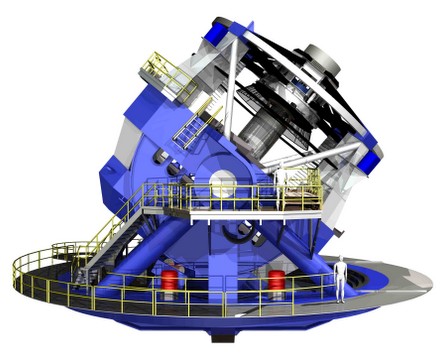
The LSST is an 8-meter telescope with a 3 degree field of view (consider that the moon is only half a degree in the sky). This design configuration allows the LSST to implement an observing program that detects near-Earth objects which are small and faint in exposures of 10 or 20 seconds, and it allows images to be stacked for deep and wide imaging for star and galaxy surveys. The science mission drivers of LSST include the nature of dark energy, the solar system, optical transients, and galactic structure. It is the LSST technology and the rate at which it will produce data that makes it so remarkable. The LSST camera is 3200 Megapixels (it is a giant array of 189 CCD chips) and will create 400,000 sixteen Megapixel images per night (resulting in about 30 TB) for a total of 60 PB of raw data over 10 years. The total data volume after processing will be over 100 PB requiring 250 TFlops of computing power for processing. LSST will be wide, fast, and deep. It should be ready for first light by 2014.

The TMT is another extremely large ground based telescope. Its design calls for a collecting area that is thirty meters or about 100 feet in diameter. In order to better explore the early universe it will be sensitive to light in the optical near infrared. Relative to the Hubble the TMT will have 144 times more collecting area and a factor of 10 better spatial resolution in the near-infrared. The TMT will have a primary mirror composed of 492 segments with a rotating tertiary mirror (as seen in the above image, a Ritchey-Chretien telescope) in order to direct light onto multiple instruments and it will of course use adaptive optics to correct for turbulence in earth's atmosphere. The TMT will implement a scaled of version of the segmented mirror technology of the Keck telescopes at a size which will produce significant science at a reasonable cost.

The GMT differentiates itself from the other giant ground based telescopes on this list in that its primary mirror will not be segmented in the standard manner, but will instead consist of seven monolithic 8.4 m mirrors. Because six of the mirrors are off-axis (they don't focus light to a point directly above them, but rather to a point off to their side; see image above) they present a unique engineering challenge that will synthesize a telescope with a resolving power of a single 24.5 m mirror. Currently the first mirror has been cast at the Steward Observatory Mirror Lab as a proof of concept that an acceptably accurate shape can be achieved.

It is of note that there is an over arching principle of segmentation present in all of these observatories; these telescopes use multiple almost identical components working in unison in order to gather signal. LISA, the SKA, TPF, and ALMA use interferometry or correlation to observe. The EELT, TMT, JWST, use segmented primary mirrors. GMT uses several identical mirrors to simulate one primary mirror. LSST uses a massive array of CCD detectors. Modern technology and the economic/complexity benefits of reproducible industrial construction make this possible, but it takes modern computing to gather the data from the individual receiving elements and produce coherent observations and science.
1. Laser Interferometer Space Antenna
2. Terrestrial Planet Finder
3. James Webb Space Telescope

4. Overwhelmingly Large Telescope
5. The Square Kilometer Array
The SKA will be a radio telescope with a million kilometers of collecting area. It will be the largest telescope ever created and perhaps the most expensive at 1.5 billion Euro. The SKA will probe the gaseous component of the early Universe with sensitivity 50 times greater than the Very Large Array. This sensitivity and a wide field of view will also allowing the SKA to probe general relativity by monitoring the timing of a network of pulsars. Like the VLA the SKA will be an interferometric array consisting individual antenna stations working together to synthesize an aperture with a diameter up to several thousand kilometers. Many things about the final design for the SKA are uncertain, in fact factions within astronomy have threatened to doom the entire project. The disagreements stem from different opinions on what the primary scientific objectives should be for the project. Currently it is planned that approximately 50% of the collecting area would be contained in a dense central array of 5 km in diameter to provide high brightness sensitivity at arc-second scale resolution for studies of faint spectral lines from structures in the early universe. Another 25% of the collecting area would be located within a diameter of 150 km; the image above shows a possible layout for the array with arms in a spiral pattern with a diamter of 150 km. The remainng 25% of the collecting area would be at baselines of 3000 km or greater. The distribution of antennas directly impacts what kind of science can be accomplished. The video below shows a possible layout for the SKA in dramatic fashion.
6. European Extremely Large Telescope
7. Large Synoptic Survey Telescope
8. Thirty Meter Telescope
9. Giant Magellan Telescope
10. Atacma Large Submillimeter Array
ALMA is probably the most practical observatory on this list and it is almost already completed (located in the Atacama desert), whereas many of the other observatories on this list are only the twinkle in astronomer's eyes. It is currently under construction in the thin (altitude of 5,000 m or 16,000 feet), dry air, of northern Chile. ALMA is not actually a single telescope, but an array of 50 (this number may change and has already been reduced once) antennae working in unison. It merits a place on this list because it will revolutionize astronomy by providing a senstive eye on mm wavelength light where early universe star/planet formation can be viewed best. Each of its 12 m antennas will observe in bands ranging fom 30 Ghz to 1 Thz and the array will have specialized telescope transporters which will enable baselines ranging from 150 m to 16 km. ALMA is only practical in respect to the grandiose telescopes on this list; it the the most ambitious ground-based telescope ever built and costs in excess of one billion US dollars.
The future of great astronomical observatories
This list is merely my musings on astronomical observatories. There are more productive observatories that have already built, or will be built, but these are the most exciting in my humble opinion. This list does not include even more speculative projects such as plans for a lunar radio telescope or an extremely sensitive and larger LISA. There are other planned observatories not mentioned, like IXO, that just didn't make the list.It is of note that there is an over arching principle of segmentation present in all of these observatories; these telescopes use multiple almost identical components working in unison in order to gather signal. LISA, the SKA, TPF, and ALMA use interferometry or correlation to observe. The EELT, TMT, JWST, use segmented primary mirrors. GMT uses several identical mirrors to simulate one primary mirror. LSST uses a massive array of CCD detectors. Modern technology and the economic/complexity benefits of reproducible industrial construction make this possible, but it takes modern computing to gather the data from the individual receiving elements and produce coherent observations and science.
Subscribe to:
Posts (Atom)