Imagine the closest star beyond the Sun has a planet orbiting it about the size of Earth. Visualize what your sunset would look like on this distant planet. Perhaps there would be two stars at the center of this solar system. Your sunset would be breathtaking. You could even visualize what the Sun would look like from this planet – just another unassuming star in the sky. You don't have to merely imagine that such a planet might exist. A planet like this really does exist – of course you'd still have to imagine the part where you are on the surface of this world. The Alpha Centauri star system, which is essentially a triple star system of Alpha Centauri A, Alpha Centauri B, and Proxima Centauri has just such a planet. There is a planet in the sky waiting for us at a distance that is just two hundred and seventy thousand times further than the Earth is from the Sun. This planet is near 1500 degrees on the surface, so we wouldn't want to be there, but nonetheless the fact is that astronomers are finding similar planets commonly. There may be a planet just the size of Earth at a nice temperature quite near us galactic speaking. We are searching.
Most planets don't seem to be much like Earth. In fact so far we haven't found a single planet that has a temperature and size similar to Earth, but part of the problem with finding planets is that finding big giant planets – like Jupiter is easy – while small rocky planets like Earth are elusive. But we are on the edge of discovery. All in all Earth-like planets likely abound. In fact with 95% confidence there is an Earth size planet in the habitable zone of a small star within 23 light years of us. The habitable zone is the place where a planet would not be too hot or too cold. A place where a planet wouldn't see its oceans boiled off or frozen into desolate ice tundra. Habitable planets are common in our galaxy and by galactic standards not very far apart. On average Earth-like planets are only 13 light-years apart.
Continue reading my essay on planets over at 3 Quarks Daily...
Field of Science
-
-
Change of address1 year ago in Variety of Life
-
Change of address1 year ago in Catalogue of Organisms
-
-
Earth Day: Pogo and our responsibility1 year ago in Doc Madhattan
-
What I Read 20241 year ago in Angry by Choice
-
I've moved to Substack. Come join me there.1 year ago in Genomics, Medicine, and Pseudoscience
-
-
-
-
Histological Evidence of Trauma in Dicynodont Tusks7 years ago in Chinleana
-
Posted: July 21, 2018 at 03:03PM8 years ago in Field Notes
-
Why doesn't all the GTA get taken up?8 years ago in RRResearch
-
-
Harnessing innate immunity to cure HIV10 years ago in Rule of 6ix
-
What kind of woman would pray for health or use spiritual healing?10 years ago in Epiphenom
-
-
-
-
-
-
post doc job opportunity on ribosome biochemistry!11 years ago in Protein Evolution and Other Musings
-
-
Blogging Microbes- Communicating Microbiology to Netizens11 years ago in Memoirs of a Defective Brain
-
Re-Blog: June Was 6th Warmest Globally12 years ago in The View from a Microbiologist
-
-
-
The Lure of the Obscure? Guest Post by Frank Stahl14 years ago in Sex, Genes & Evolution
-
-
Lab Rat Moving House15 years ago in Life of a Lab Rat
-
Goodbye FoS, thanks for all the laughs15 years ago in Disease Prone
-
-
Slideshow of NASA's Stardust-NExT Mission Comet Tempel 1 Flyby15 years ago in The Large Picture Blog
-
in The Biology Files
Showing posts with label astronomy. Show all posts
Galaxy Formation in the Cosmic Web
The research group I work with has made a fantastic poster about how galaxies form in the cosmic web and how we use computer simulations to understand such a complex process. We made the poster as a form of outreach and in particular for students who may be interested in astronomy research. Please feel free share or print the poster and if there is interest we may consider printing and sending out full size version of the poster for public display. Here is a large pdf version of the poster "Galaxy formation in the Cosmic Web".
See a bit more over at Common Observer...
A Comet Unnoticed
Comets have long been portents of change. They challenge the rote repetition of our skies. An astute observer of the sky will perhaps have recently noticed a new object in the sky, a comet, present for the last few weeks (you would have had to look east just before sunrise near the star Spica). This was the comet ISON. But comet ISON, having strayed too close to the Sun, has been mostly annihilated. If there is a comet in the sky and no one sees it, was it ever really there?
William Carlos William's poem, Landscape with the Fall of Icarus, captures the essence of comet ISON's elusive journey around the Sun. Brueghel, the Felmish Renaissance painter, carefully recorded the event like a faithful astronomer, but the worker is not keen on the sky and Icarus goes wholly unnoticed. It is just the same to the worker, for had they noticed Icarus or not it would likely make no difference to their toils in the field. And similarly ISON went largely unnoticed.
ISON made a brief appearance to the unaided eye for a few days before it grazed the sun and then uncoiled itself. But to the learned astronomer ISON is still interesting. Comets are rare objects in the inner solar system so even a dead comet is a chance to learn something, in fact, further spectroscopic observations of this dead comet's remains will continue to tell us exactly what it was made of. There is a legacy here.According to Brueghel when Icarus fell it was spring a farmer was ploughing his field the whole pageantry of the year was awake tingling with itself sweating in the sun that melted the wings' wax unsignificantly off the coast there was a splash quite unnoticed this was Icarus drowning
I am a contributor over at 3 Quarks Daily now so you can read the rest of the story of this lost comet over there...
Comet ISON in the Sky
There is a new object in the sky. Comet ISON is an icy wanderer making its first and probably last last trip into the solar system from its previous home in the Oort cloud. It will graze by the Sun brilliantly and then depart. As it approaches the inner solar system, it is now inside the orbit of Earth, astronomers have been watching its outbursts of ice and volatile materials which then reflect sunlight and make the comet very bright. It is just visible to the naked eye according to some reports now. Comet ISON has increased in brightness many times over in the last few days.We don't know how bright it will get. Astronomers generally just don't know as much about comets as we would like. The comet has undergone outbursts of brightening and dimming, while generally tending to get brighter as it enters in to the inner solar system ISON may become entirely disrupted or get brighter and brighter - the comet of the century. The reason for all this uncertainty is that comets and this object in particular are not well studied. But also it is that comets are not dense rocks, but rather they are loose aggregations of dust, rubble, and ices. Tidal forces and heating of the ices can literally unbind entire comets. I haven't been able to see it for myself yet, it hasn't been quite visible because it rises so late I think. Currently, if you want to see comet ISON from North America look east right before dawn as it passes Mercury. Read the rest of my post on comet ISON over at Common Observer...
ALMA in Search of Our Cosmic Origins
ALMA (the Atacama Large Millimeter/submillimeter Array) is the most complex and ambitious astronomical observatory ever completed. And it is officially completed. Last week the telescope array was inaugurated at an official ceremony; all the major systems of the telescope are now operational. ALMA is an important instrument for astronomers because it allows us to see in the submillimeter wavelength band where stars formation in distant galaxies are evident. In addition to seeing distant galaxies dusty obscured regions of space can be explored with this instrument. In order to get such a fantastic view of the universe astronomers have had to build the telescope array at an elevation of 5000 meters (16,400 feet) in the dry Atacama desert because the atmosphere would otherwise (particularly water vapor) block the light at the these wavelengths. There have been many engineering and management hurdles in the completion of ALMA so the success of the project deserves recognition. ALMA is an expensive partnership between Chile, Europe, North America, and East Asia that represents what is hopefully the beginning of many more massive multinational collaborative astronomical observatories. The European Southern Observatory who does a lot of the primary management of the observatory also does a lot of great work generating public outreach. They have produced this video which presents the history of ALMA from the origins of the project decades ago to the recent first science results.
Alma means soul in Spanish. A beautiful name for the observatory that looks so serene as it gazes up at the Milky Way discovering our cosmic origins.
The Hubble Extreme Deep Field
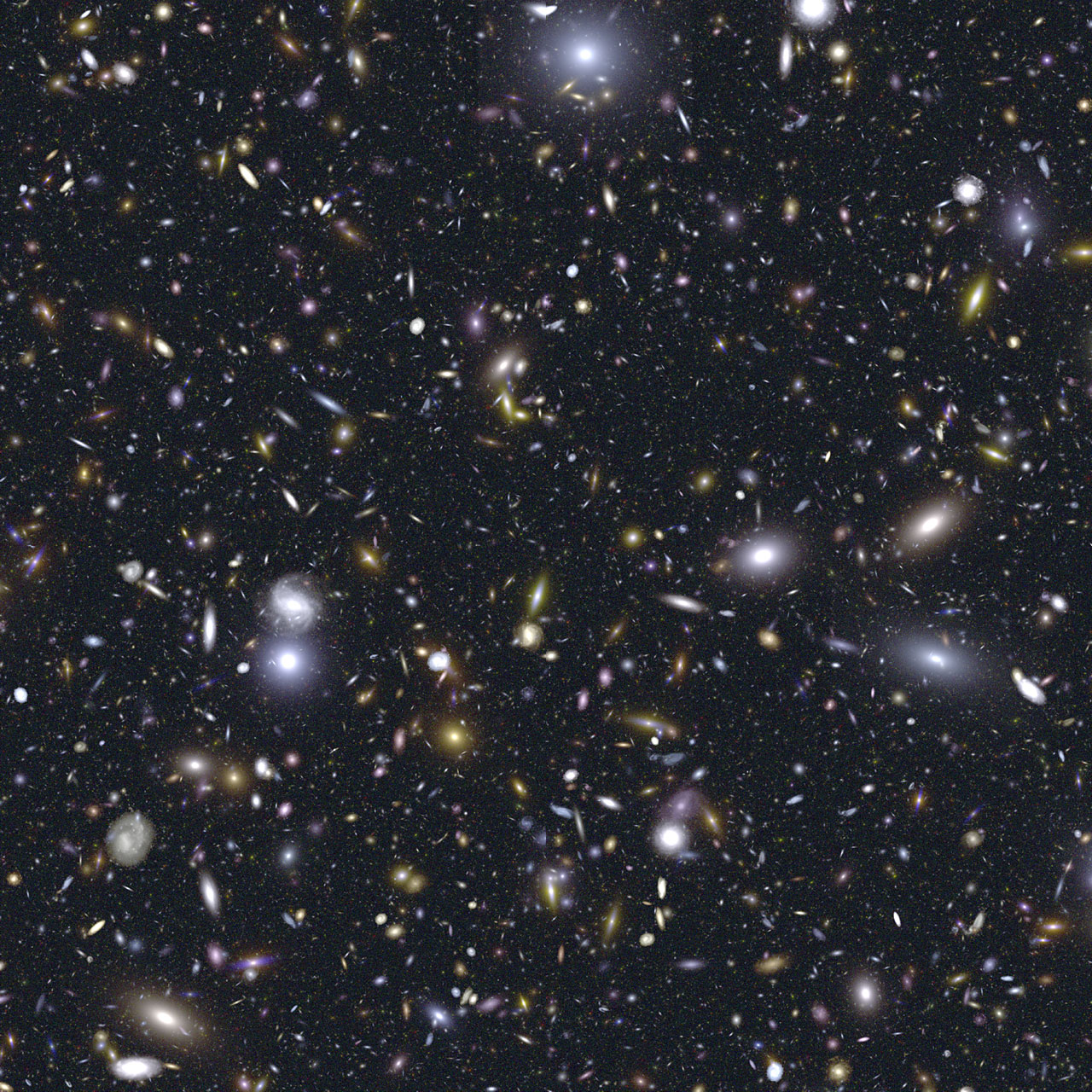
Almost a decade ago when astronomers pointed the Hubble Space Telescope at an apparently featureless patch of the sky they were rewarded with a spectacular image. The was the Hubble Ultra Deep Field. The image allowed us to see that galaxies were forming as early as just a billion years after the Big Bang. The farther from Earth we look the farther back in time we see; starlight from those distant galaxies is just arriving at earth now. Now we have glimpsed even further with the Hubble Extreme Deep Field. This new image was created by aggregating 10 years of Hubble images taken centered at the same location of the original Ultra Deep Field. In addition to staking old images additional new images were included which had been taken with infrared cameras installed during the 2008 Hubble Space servicing missions. Infrared images offer important additional data for distant galaxies because the light from such distant objects has been stretched to longer wavelengths as it has journeyed across the universe. Here is the Hubble Extreme Deep Field:

If you are intrigued by Hubble's deep images of the sky there is a Google Event webinar to discuss the latest findings. The public is invited. show up online and ask questions of the astronomers involved. It is at 1 p.m. Sept. 27 and can be joined either at HubbleSite’s Google Plus page or the HubbleSite YouTube Channel.
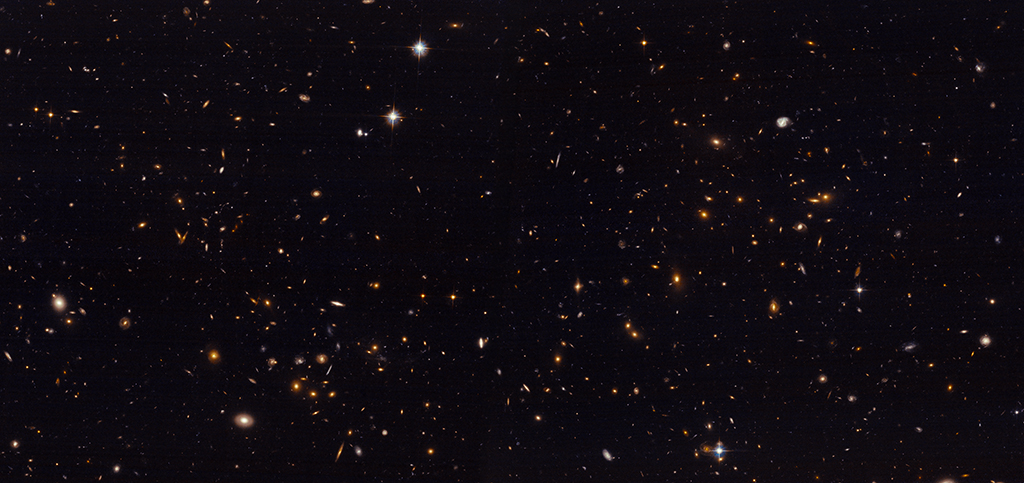
This is the deepest image of the sky ever seen. It allows us to explore the faintest galaxies ever as far back as a time just half a billion years after the Big Bang. Soon though we will have even deeper images. The James Web Space Telescope will be a 6.5 meter diameter(or 21 foot, so big that it will be a segmented mirror that will unfold in space) space telescope that will launch in 2018. It will see further. Here is a simulated image of what the James Web Space Telescope will see:

If you are intrigued by Hubble's deep images of the sky there is a Google Event webinar to discuss the latest findings. The public is invited. show up online and ask questions of the astronomers involved. It is at 1 p.m. Sept. 27 and can be joined either at HubbleSite’s Google Plus page or the HubbleSite YouTube Channel.
Perseid meteor shower 2012
Find a dark place on a late night this weekend to enjoy the Perseid meteor shower. You can even participate in citizen science by counting the number of meteors you see with NASA's Meteor Counter app.
Astrophysicist Neil deGrasse Tyson shares some thoughts on his life and his experience in astrophysics.
Outer Space
Perhaps at first the images seem like the brush strokes of artist infatuated with geometry and abstract forms. Then precise patterns becomes unmistakable and you envision the path the spacecraft traced in space and its journey over space and time. The origin of the images only serves to heighten your realization of how amazing the universe is.
Disassociate Galaxy Clusters
A dissociative galaxy cluster is a cluster of galaxies that just can't keep it together any longer. This may sound like an unnecessary anthropomorphication of galaxies, but it is actually a description of galaxy clusters which have collided and experienced stratification of their constituent parts. In the standard and successful model of cosmology the largest scale structures in the universe, like super clusters of thousands of galaxies, form via the merger of filamentary structures composed of smaller clusters of galaxies. Gravity keeps pulling clusters together along highways of galaxy clusters. Occasionally it is expected and observed that galaxy clusters meet each other head on in cosmic train wrecks moving at thousands of kilometers per second. These traumatic merging events scar the galaxy clusters for life. Their post traumatic stress afflictions include hot shocked X-ray gas and galaxies displaced from their gas halos. Lets consider the three main constituents of a galaxy cluster: stars, gas, and dark matter.
In practice many times it is easier to first identify galaxy clusters through their gas content because the gas content is more massive than the stellar component. Many new clusters are identified by observing the cluster gas's effect in the microwave regime or in the X-ray regime. In the image below taken by the the NASA Chandra X-ray observatory the hot intracluster gas is seen in pink. This image corresponds to exactly the same field of view on the sky as the optical image above.
It may dawn on you that by the very definition of dark matter there is no telescope which can observe it directly. The only in way in which dark matter interacts strongly is through gravity and thus that is how astronomers look for it. Through theoretical predictions and confirmed observations we know that gravity bends light and thus massive galaxy clusters will bend the light of even more distant galaxies. Thus through weak gravitational lensing the dark matter betrays its presence. A careful statistical analysis of galaxy shapes in the optical image above reveals that the galaxies which are confirmed not to be in the foreground cluster are slightly distorted in shape via the gravitational force of the dark matter which is in the foreground. A reconstruction of the total mass in the clusters is shown in the image below where the parts of the cluster which have the most mass are shown in blue. This image corresponds to exactly the same field of view on the sky as optical and X-ray images above.
Finally, a superposition of all the data allows us to glimpse at what a crisis this merging cluster is in. Note that the optical image remains in its original color, the gas is in pink, and the mass is in blue. The image below is known as the Musket Ball Cluster. The actual collision of galaxies occurred about 700 million years ago. We can rewind the collisions in our heads and envision that blue/optical cluster on the right of the image was once on the left and so the blue/optical cluster on the left of the image was once on the right; the clusters collided head on and the gas stopped dead at the center, but the galaxies and dark matter hardly stopped. There are several other images below of other dissociative cluster mergers with the same color scheme. Notice the different morphologies and distributions of mass, stars, and gas. The collisions are not always so straight forward.

Dawson, W., Wittman, D., Jee, M., Gee, P., Hughes, J., Tyson, J., Schmidt, S., Thorman, P., Bradač, M., Miyazaki, S., Lemaux, B., Utsumi, Y., & Margoniner, V. (2012). DISCOVERY OF A DISSOCIATIVE GALAXY CLUSTER MERGER WITH LARGE PHYSICAL SEPARATION The Astrophysical Journal, 747 (2) DOI: 10.1088/2041-8205/747/2/L42
Jee, M., Mahdavi, A., Hoekstra, H., Babul, A., Dalcanton, J., Carroll, P., & Capak, P. (2012). A STUDY OF THE DARK CORE IN A520: THE MYSTERY DEEPENS The Astrophysical Journal, 747 (2) DOI: 10.1088/0004-637X/747/2/96
Markevitch, M., Gonzalez, A., Clowe, D., Vikhlinin, A., Forman, W., Jones, C., Murray, S., & Tucker, W. (2004). Direct Constraints on the Dark Matter Self‐Interaction Cross Section from the Merging Galaxy Cluster 1E 0657−56 The Astrophysical Journal, 606 (2), 819-824 DOI: 10.1086/383178
- Clusters are made of aggregates of hundreds or thousands of galaxies and each galaxy is made of hundreds of billions of stars. The stars of the galaxy cluster are conspicuous in that they shine and are observable in pictures, but they account for only about 5% or less of the cluster's mass. The luminous stars of galaxies don't interact much during a collision with another cluster of galaxies and so they act like people in two crowds which are moving in opposite directions. Stars are part of the cosmic ghost train.
- The gas in galaxy clusters accounts for about 10% of the regular (or baryonic) mass in clusters. Gas does interact during a collision. The gas clouds in colliding galaxy clusters slams together like two waves of water meeting and stalls out, but not without undergoing a process known as shock heating first which raises the gas temperature to millions of degrees.Gas is part of the cosmic train wreck.
- The dark matter in galaxy clusters is the most dominant part of the cluster by mass making up about 90% the mass. Dark matter does not interact much. The dark matter halos travel right through each other like ghosts when two clusters collide. However, it is possible that the dark matter does interact slightly and dissociative collisions are a powerful tool in constraining this dark matter interaction. The dark matter halos of the colliding clusters should sail right past each other like two ghost trains, but if the trains slow down even in the slightest it may indicate something strange.
In practice many times it is easier to first identify galaxy clusters through their gas content because the gas content is more massive than the stellar component. Many new clusters are identified by observing the cluster gas's effect in the microwave regime or in the X-ray regime. In the image below taken by the the NASA Chandra X-ray observatory the hot intracluster gas is seen in pink. This image corresponds to exactly the same field of view on the sky as the optical image above.
It may dawn on you that by the very definition of dark matter there is no telescope which can observe it directly. The only in way in which dark matter interacts strongly is through gravity and thus that is how astronomers look for it. Through theoretical predictions and confirmed observations we know that gravity bends light and thus massive galaxy clusters will bend the light of even more distant galaxies. Thus through weak gravitational lensing the dark matter betrays its presence. A careful statistical analysis of galaxy shapes in the optical image above reveals that the galaxies which are confirmed not to be in the foreground cluster are slightly distorted in shape via the gravitational force of the dark matter which is in the foreground. A reconstruction of the total mass in the clusters is shown in the image below where the parts of the cluster which have the most mass are shown in blue. This image corresponds to exactly the same field of view on the sky as optical and X-ray images above.
Finally, a superposition of all the data allows us to glimpse at what a crisis this merging cluster is in. Note that the optical image remains in its original color, the gas is in pink, and the mass is in blue. The image below is known as the Musket Ball Cluster. The actual collision of galaxies occurred about 700 million years ago. We can rewind the collisions in our heads and envision that blue/optical cluster on the right of the image was once on the left and so the blue/optical cluster on the left of the image was once on the right; the clusters collided head on and the gas stopped dead at the center, but the galaxies and dark matter hardly stopped. There are several other images below of other dissociative cluster mergers with the same color scheme. Notice the different morphologies and distributions of mass, stars, and gas. The collisions are not always so straight forward.
Musket Ball Cluster. X-ray: NASA/CXC/UCDavis/W.Dawson et al; Optical: NASA/STScI/UCDavis/W.Dawson et al.
Train Wreck Cluster. X-ray: NASA/CXC/UVic./A.Mahdavi et al. Optical/Lensing: CFHT/UVic./A.Mahdavi et al.
Bullet Cluster. Credit: X-ray: NASA/CXC/CfA/M.Markevitch et al.; Optical: NASA/STScI; Magellan/U.Arizona/D.Clowe et al.; Lensing Map: NASA/STScI; ESO WFI; Magellan/U.Arizona/D.Clowe et al.
The awesome thing about these cosmic mergers is how they can constrain the dark matter self-interaction cross-section. That is, exactly who much does dark matter interact with itself? The interpretation of these collisions is not always simple such as in the Train Wreck Cluster (seen above) where there seems to be an extra dark matter core not associated with any bright galaxy at the center of the image, but nonetheless these mergers can be thought of as astrophysical laboratories of dark matter. It would be very interesting to discover that dark matter self-interacts at all, however dissociate clusters will only be one piece of the extraordinary evidence necessary to make that claim.Train Wreck Cluster. X-ray: NASA/CXC/UVic./A.Mahdavi et al. Optical/Lensing: CFHT/UVic./A.Mahdavi et al.
Bullet Cluster. Credit: X-ray: NASA/CXC/CfA/M.Markevitch et al.; Optical: NASA/STScI; Magellan/U.Arizona/D.Clowe et al.; Lensing Map: NASA/STScI; ESO WFI; Magellan/U.Arizona/D.Clowe et al.
Dawson, W., Wittman, D., Jee, M., Gee, P., Hughes, J., Tyson, J., Schmidt, S., Thorman, P., Bradač, M., Miyazaki, S., Lemaux, B., Utsumi, Y., & Margoniner, V. (2012). DISCOVERY OF A DISSOCIATIVE GALAXY CLUSTER MERGER WITH LARGE PHYSICAL SEPARATION The Astrophysical Journal, 747 (2) DOI: 10.1088/2041-8205/747/2/L42
Jee, M., Mahdavi, A., Hoekstra, H., Babul, A., Dalcanton, J., Carroll, P., & Capak, P. (2012). A STUDY OF THE DARK CORE IN A520: THE MYSTERY DEEPENS The Astrophysical Journal, 747 (2) DOI: 10.1088/0004-637X/747/2/96
Markevitch, M., Gonzalez, A., Clowe, D., Vikhlinin, A., Forman, W., Jones, C., Murray, S., & Tucker, W. (2004). Direct Constraints on the Dark Matter Self‐Interaction Cross Section from the Merging Galaxy Cluster 1E 0657−56 The Astrophysical Journal, 606 (2), 819-824 DOI: 10.1086/383178
The Story of Fixing Hubble
I can't tell if Charles Pellerin, the director of NASA astrophysics at the time the Hubble Space Telescope was launched in 1990, is a really honest person or a really lucky person. He was able to get a mission together that fixed Hubble after a disastrous design flaw was found in the telescope after it was already in space. In an article over at Computerworld he gives an account of the technical and social workings that led to the launch of Hubble with a spherically aberrerated mirror — the telescope's mirror was flawed such that it would take a space serving mission to make it usable for science. In 1993 a space mission did successfully fix Hubble, just three years after Huuble went to space as a deferred dream. In hindsight Pellerin believes what led to the mistake in Hubble's design, and the 1986 Challenger disaster, was as much technical as social. The pressure put on the rational scientists by management led to the problems.
Large projects have social forces at play such as 'normalisation of deviance' wherein problems become okay logically when you step back from them. An entire mission can drift noticeably into situations where more than a simple technical argument can stop it. Pellerin took notice of research which shows that social context can be a larger determinate of performance rather than individual abilities. Pellerin asserts that Hubble nor Challenger was a product of invisible or unmanageable forces. While certain accidents may be unavoidable, others are avoidable and they may be the fault of leadership. Today Pellerin teaches management techniques founded concepts of mutual respect, authenticity, and efficient action incorporated into the leadership.
Read on about how NASA's short-sightedness led to a flaw in Hubble's optics.
Large projects have social forces at play such as 'normalisation of deviance' wherein problems become okay logically when you step back from them. An entire mission can drift noticeably into situations where more than a simple technical argument can stop it. Pellerin took notice of research which shows that social context can be a larger determinate of performance rather than individual abilities. Pellerin asserts that Hubble nor Challenger was a product of invisible or unmanageable forces. While certain accidents may be unavoidable, others are avoidable and they may be the fault of leadership. Today Pellerin teaches management techniques founded concepts of mutual respect, authenticity, and efficient action incorporated into the leadership.
There's nothing unusual about having a bad day at the office. But some people have worse days than others, and in his time Charles (Charlie) Pellerin has had a few notable ones. Not many people find themselves having to explain why an organisation has invested a decade and half and in the vicinity of $3 billion on a project that has failed.
That's the position Pellerin found himself in as NASA's director of astrophysics in the wake of the 1990 launch of the Hubble Space Telescope, which had what appeared to be an unfixable flaw in its optical system.
It's difficult to overstate what a disaster this was and the humiliation faced by NASA; not just as an organisation but also the individuals who worked for the agency. A good friend of Pellerin who worked on the telescope fell ill in the wake of the launch and died. Two of Pellerin's senior staffers had to be removed from their offices by guards and taken to alcohol rehab facilities. "These are PhDs sitting at their desk getting drunk; this is how bad the stress was," says Pellerin.
Read on about how NASA's short-sightedness led to a flaw in Hubble's optics.
Perspectives on the Vertical
Powers of Ten was originally inspired by a 1957 book by the Dutch educator Kees Boeke titled Cosmic View. By 1963, the Eameses were experimenting with tracking shots that gave the effect of a camera pulling away with accelerating motion from an object, and in 1968 used these in a film called A Rough Sketch for a Proposed Film Dealing with the Powers of Ten and the Relative Size of Things in the Universe. Shot in black and white, it was followed by an extended color version—the one known as Powers of Ten—made in 1977. The basic set-up of the latter film is well-known. It opens with a picnic scene in a park in Chicago. From a ground level view, the camera then switches to a vertical, aerial position from which it looks down, the frame centered—as we later find out—on an atom in the man’s hand. At this point the narrator tells us that we are one meter away and looking at a square one meter by one meter. Now the camera pulls away vertically and begins to accelerate so that every ten seconds our distance from the initial scene is ten times greater. The camera continues its upward trajectory until just after 1024 meters (100 million light years) when it gradually slows and begins its descent, collapsing beyond its original position and now decelerating through the ever-smaller dimensions of cells, molecules, atoms, and beyond.
Read on.
A likely Supernova in M95
A bright object has appeared conspicusouly in the outer spiral arm of the local galaxy M95 38 million light years away in the constellation Leo. This new illumination in M95 is probably a supernova. While supernova are not all that rare throughout the entire universe, a supernova occurring this close is rare and interesting as it is a chance to gather higher fidelity data. Conveniently Mars happens to currently be, by projection, right next to M95 so if you look at Mars in the next few days consider what lurks beyond. Unfortunately you need a telescope to see the object.
The Stars seen from the the International Space Station
Sunset
Proffesor Frédéric Pont at the University of Exeter has simulated what sunsets on planets orbiting distant stars would look like.
What does the sunset look like on HD 189733 b? Amazingly, we know quite accurately. This is because the colour of the sunset is exactly what is measured when collecting the transmission spectrum of the atmosphere of a transiting planet. We have measured the transmission spectrum of ’189 with the STIS spectrograph on the Hubble Space Telescope. STIS covers visible wavelengths, and HD 189733 is bright enough that the precision of the spectrum is sufficient for a precise translation into colours perceived by the human eye.
What does the sunset look like on HD 209458 b?
G34.3
Wow, there really is something new to learn everyday.
I Hate Astrology
Perhaps it is cruel to snuff out the shinning gleam in the eyes of a person who upon hearing that I am an astronomer exclaims, "Oh, I love astrology!" and I reply, "No, I study ASTRONOMY." But they don't understand it. The subtle differences in syllables of the words belies the vast gulf in empirical tendencies between the separate endeavors and it is too much to explain. I simply walk away.
I hate astrology and I hate when people get astronomy and astrology mixed up. I could be more understanding, but I have to choose my battles. I meet a lot of interesting people in coffee shops, bars, airplanes, parties and wherever else life takes me and when someone gets excited about the fact that I study astronomy it means they have a deep curiosity about the skies above. That curiosity is occasionally deeply misguided with astrology and their questions are so fundamentally misconceived I struggle to answer them with candor and accuracy (for example they ask, 'Do the planets affect our daily lives?' and I hesitate to answer honestly that we must consider their gravitational pull, so the answer must be yes). On the other hand I meet people who are genuinely interested in massive collections of gravitationally bound glowing gas and I am very happy to answer their questions.
There is a real danger when logic, or pseudologic, is applied to astrology. Recently there was an uproar about the shifting of the zodiac that made it into some news headlines. Briefly I shared the frustrated sentiments of astrologers because the shifted zodiac has been well known for some time, why is the public just now hearing about it? The book in the image above is from the seventies and claims right there on the cover that, 'Most astrology is unscientific and inaccurate', and goes on to explain the shifted zodiac and how to have a movie ending romance. The ideas in this book are the apotheosis of dangerous thought. A little bit of knowledge is a very dangerous thing when combined with pseudologic in the guise of rigorous proof. It has also not escaped my observation that many of the people I have known who believe in astrology also believe in God as if to demonstrate the utter confusion and inconsistency of their minds. I don't mean to badger defenseless people here. This is simply an honest expression of how I feel. I have summed up my sentiments into a paragraph which I think would be nice to place on a card with which to hand out to people who confuse astrology with astronomy:
I cannot rightly conceive of a logic which would allow one to study such disparate phenomena of love, planets, stars and come to see any connection. Perhaps, desperate for meaning people find it wherever they look; conclusions are forged before the data have been taken. Those who would apply science to astrology may as well attempt to apply science on whom to love and sociologists do study what makes a lasting relationship and neurobiologists study what chemicals are active in the brain during feelings of love, but no scientist will claim that Romeo shouldn't love Juliet. I believe science and an understanding of natural phenomena adds to the beauty life, but pseudologic and lies even when propagated with good intentions ultimately lead to pain and suffering. The human mind has the ability to find patterns anywhere, indeed often where they do not exist.
I hate astrology and I hate when people get astronomy and astrology mixed up. I could be more understanding, but I have to choose my battles. I meet a lot of interesting people in coffee shops, bars, airplanes, parties and wherever else life takes me and when someone gets excited about the fact that I study astronomy it means they have a deep curiosity about the skies above. That curiosity is occasionally deeply misguided with astrology and their questions are so fundamentally misconceived I struggle to answer them with candor and accuracy (for example they ask, 'Do the planets affect our daily lives?' and I hesitate to answer honestly that we must consider their gravitational pull, so the answer must be yes). On the other hand I meet people who are genuinely interested in massive collections of gravitationally bound glowing gas and I am very happy to answer their questions.
There is a real danger when logic, or pseudologic, is applied to astrology. Recently there was an uproar about the shifting of the zodiac that made it into some news headlines. Briefly I shared the frustrated sentiments of astrologers because the shifted zodiac has been well known for some time, why is the public just now hearing about it? The book in the image above is from the seventies and claims right there on the cover that, 'Most astrology is unscientific and inaccurate', and goes on to explain the shifted zodiac and how to have a movie ending romance. The ideas in this book are the apotheosis of dangerous thought. A little bit of knowledge is a very dangerous thing when combined with pseudologic in the guise of rigorous proof. It has also not escaped my observation that many of the people I have known who believe in astrology also believe in God as if to demonstrate the utter confusion and inconsistency of their minds. I don't mean to badger defenseless people here. This is simply an honest expression of how I feel. I have summed up my sentiments into a paragraph which I think would be nice to place on a card with which to hand out to people who confuse astrology with astronomy:
I cannot rightly conceive of a logic which would allow one to study such disparate phenomena of love, planets, stars and come to see any connection. Perhaps, desperate for meaning people find it wherever they look; conclusions are forged before the data have been taken. Those who would apply science to astrology may as well attempt to apply science on whom to love and sociologists do study what makes a lasting relationship and neurobiologists study what chemicals are active in the brain during feelings of love, but no scientist will claim that Romeo shouldn't love Juliet. I believe science and an understanding of natural phenomena adds to the beauty life, but pseudologic and lies even when propagated with good intentions ultimately lead to pain and suffering. The human mind has the ability to find patterns anywhere, indeed often where they do not exist.
Astronomy in Western Australia
Murchison, AUSTRALIA - Building a radio telescope is nothing like working on an optical telescope, except that both bring you to remote areas. Western Australia reminds me of the Texas hill country. I grew up in Texas and as simple as I can describe it Western Australia is like an upside down Texas. And the people they are nearly the same: they have thick accents, more land than they know what to do with, and national pride. It is hard to describe everything so here are a few pictures of what I have seen out here.
This is a massive 12 meter radio dish from the experiment next door. Western Australia is perfect for radio astronomy. There are very few people and no radio stations to interfere with the data. Several other projects, most importantly the Australian Square Kilometer Array Pathfinder (ASKAP), are very nearby to the Murchison Widefield Array (MWA). Australia is pushing to develop an infrastructure and technical knowledge base in a bid to host the Square Kilometer Array which will be the ultimate next generation radio telescope.
A Bungarra has come to visit MWA! A Bungarra or Sand Goana is a type of monitor lizard common in this part of Western Australia. They are big critters with a swaggering gate and curious yet skittish attitude. This one was wandering around our site for some time. I think he was as equally curious as to what we were doing as to I was about what he was doing. The big white box is a receiver that takes input from the antennas which we were testing.
The self reliant mind set is necessary out here. I am on what an American would call a ranch, but what they call a station. The stations muster, or as I would say drive, thousands of head of cattle and sheep to turn a profit. We were driving along the road one day on our 40 kilometer commute from the station to the antennas when we came upon this airplane. The station manager flies it around to help spot and muster the livestock because it is one of the only ways to find anything on 900,000 acres of land. There are lots of subtle differences to the stations round here to what I would expect in Texas actually. For example there are kangaroos instead of deer, and they don't use horses to muster they use dirt bikes.
This image is a track left by a Bungarra marching off into the distance. Long before the scientists, engineers, or even the ranchers converged onto this remote land an indigenous population known as the Wajarri lived here. Bungarra and their eggs were, or rather still are, a source of food for these people. The Wajarri, like other Aboriginal peoples in Australia, have a different cultural background which is hard for myself and many other westerners to comprehend. What is clear to me is that ancient wisdom still matters in this modern world because humans have a tendency to overreach; technology allows us to do many things, but what should we choose to do? The Wajarri people seem to agree that we should do astronomy as they have allowed us the use of their land for radio astronomy. Perhaps a desire to understand our place in the Universe is a shared cultural value.
This is a massive 12 meter radio dish from the experiment next door. Western Australia is perfect for radio astronomy. There are very few people and no radio stations to interfere with the data. Several other projects, most importantly the Australian Square Kilometer Array Pathfinder (ASKAP), are very nearby to the Murchison Widefield Array (MWA). Australia is pushing to develop an infrastructure and technical knowledge base in a bid to host the Square Kilometer Array which will be the ultimate next generation radio telescope.
A Bungarra has come to visit MWA! A Bungarra or Sand Goana is a type of monitor lizard common in this part of Western Australia. They are big critters with a swaggering gate and curious yet skittish attitude. This one was wandering around our site for some time. I think he was as equally curious as to what we were doing as to I was about what he was doing. The big white box is a receiver that takes input from the antennas which we were testing.
The self reliant mind set is necessary out here. I am on what an American would call a ranch, but what they call a station. The stations muster, or as I would say drive, thousands of head of cattle and sheep to turn a profit. We were driving along the road one day on our 40 kilometer commute from the station to the antennas when we came upon this airplane. The station manager flies it around to help spot and muster the livestock because it is one of the only ways to find anything on 900,000 acres of land. There are lots of subtle differences to the stations round here to what I would expect in Texas actually. For example there are kangaroos instead of deer, and they don't use horses to muster they use dirt bikes.
This image is a track left by a Bungarra marching off into the distance. Long before the scientists, engineers, or even the ranchers converged onto this remote land an indigenous population known as the Wajarri lived here. Bungarra and their eggs were, or rather still are, a source of food for these people. The Wajarri, like other Aboriginal peoples in Australia, have a different cultural background which is hard for myself and many other westerners to comprehend. What is clear to me is that ancient wisdom still matters in this modern world because humans have a tendency to overreach; technology allows us to do many things, but what should we choose to do? The Wajarri people seem to agree that we should do astronomy as they have allowed us the use of their land for radio astronomy. Perhaps a desire to understand our place in the Universe is a shared cultural value.
Nostalgia de la Luz
The present does not exist. All notions of the present are built upon the history of light. Patricio Guzmán's makes these surreal claims as he narrates in his documentary Nostalgia de la Luz (or Nostalgia for the Light) as he draws out the connections between astronomers and those searching for bones in Chile's Atacma Desert. Guzmán is obsessed with history and talented at drawing strange parallels in this compelling film. Chile under the rule of Pinochet in the '70s has a dark history of kidnapping, concentration camps, and mass murders of political dissidents. Chile also has clear dark skies which astronomers have fallen in love with.
I saw this film this evening and I was impressed. It takes one of the best parts of astronomy and projects it on to a real human conflict in a way that is scientifically tasteful and touching at once. There is a lot that could be said about the film and the director as well who was in exile from Chile in the '70s, but there is an easy way to summarize the film: the most profound questions about the Universe and human existence are the same. However, this summary doesn't do the film justice as it uses strong imagery to evoke what can't be said. I did not know that the half illuminated moon and a human skull looked so similar. In the end though you are left with the realization that those searching in Chile's deserts will not be able to change the past.
Naming the Unknown #1
* * *
Fermi Bubbles: Giant, Multibillion-Year-Old Reservoirs of Galactic Center Cosmic Rays. Roland M. Crocker , and Felix Aharonian. DOI: 10.1103/PhysRevLett.106.101102
There are two general lines of thought as to the source of the bubbles. In one scenario the black hole at the center of our milky way is somehow responsible for the gamma ray lobes. The black hole paradigm can further be broken down into two sub-categories: tidal disruption of a star and active galactic nuclei.
- The tidal disruption of a star occurs when the super massive black hole at the center of our Milky Way, Sagatarius A*, disrupts, or basically eats a wandering star. The tidal disruption of stars by black holes is viable and certainly does occur (see work by Guillochon et al. 2009) with the release of energy, hot plasma, wind, and shocks which could heat up the halo and produces thermal x-rays (see ongoing work by Cheng et al. 2011, unpublished). However, this explanation for the Fermi bubbles is slightly ad hoc and it would have to occur on a periodic basis to account for the bubbles.
- Saggatarius A* is dormant now, but if a star cluster or gas cloud fell/accreted into it in the past it may have undergone an active galactic nuclei like phase which could emit sufficient radiation and cosmic rays to explain the bubbles. This active galactic nuclei scenario would also have to occur periodically (10 million years or so) to explain the presence of the bubble.
Based on IRAS satellite data the galactic center star formation rate is ~0.08 solar masses per year in turn implying a rate of ~0.04 supernovae per century. These supernovae inject power at a rate of 1039 ergs per second into cosmic rays. These cosmic rays are removed the from the immediate vicinity of the galactic center and transported into the bubble regions by a super wind generated by the ongoing star formation and supernovae themselves. A wind such as this is observed commonly in many other star forming galaxies such as NGC 3079. The wind speed is ~1200 kilometers per second and has sufficient velocity to escape locally, but it has been shown that the wind should stall at a height less than ~15 kiloparsecs above the plane and this would explain the exact height of the bubbles.That continuous star formation (and subsequent supernovae) could be responsible for the Fermi bubbles is an Occam's razor kind of solution. It reproduces a number of observations seen in the bubbles and predicts some further properties. For example the electrons and positrons which are created along with the gamma ray emission will synchrotron radiate because of ambient magnetic fields with a luminosity of ~1026 ergs per second which is exactly what is seen in the 20-60 Ghz band by the WMAP satellite (the so called WMAP haze). This kind of after the fact observation is not so impressive, but the authors make various predictions which will be testable in future observations.
***
A large aside on the mess of publishing, press releases, and open access. When NASA made the press release on the Fermi bubbles and I first blogged about them I stated that I didn't have anything to go on besides the press release because no paper was available. How wrong was I! The first paper was published in The Astrophyical Journal, titled Giant Gamma-ray Bubbles from Fermi-LAT: AGN Activity or Bipolar Galactic Wind?, in November of 2010 (at the same time as the press release), but it was posted on the arxiv on the 29th of may 2010. This paper I mentioned here today was published the 16th of August 2010 on the arxiv and then published just a few days ago in March in physical review letters. It is astounding how long the peer review process took for each of these papers, but it is deplorable that NASA doesn't make readily available links to the actual paper. I could have told you about the Fermi bubbles and given a natural explanation for them about a year ago if I had been on top of this.Crocker, R., & Aharonian, F. (2011). Fermi Bubbles: Giant, Multibillion-Year-Old Reservoirs of Galactic Center Cosmic Rays Physical Review Letters, 106 (10) DOI: 10.1103/PhysRevLett.106.101102
Subscribe to:
Posts (Atom)