Field of Science
-
-
Change of address1 year ago in Variety of Life
-
Change of address1 year ago in Catalogue of Organisms
-
-
Earth Day: Pogo and our responsibility1 year ago in Doc Madhattan


Showing posts with label astrobiology. Show all posts
Showing posts with label astrobiology. Show all posts
Mars Rover Curiosity
This animation depicts what will happen in August 2012 if all goes as planned for Curiosity, NASA's next Mars rover. This rover is much larger and and more competent than the previous rovers. It is about the size of a small car and has an entire suite of experiments on board. During entry it uses a series of thrusters to maneuver to the designated landing area. Once the ship has slowed down to Mach two (keep in mind that the atmospheric pressure on the surface of Mar's is of the order .05% that of Earth's) a parachute is deployed. As the vehicle slows the heat shield comes off and a radar detects how close the surface is approaching in order to slow for a smooth landing. The last daring step is a so called 'sky crane' which lowers the rover with a long cable from the rocket thrusted ship above. Eventually Curiosity will begin roving, but it won't be limited to roving only during the day by solar panels as the previous rovers were. The large tilted box on the back of the rover contains 4.8 kg of plutonium dioxide which emits heat serving as the power source of the rover. The power should keep flowing for much longer than the minimum specked science mission of two Earth years. The rover will seek out rough rocks such as ancient Martian riverbeds or canyons where evidence of early environments on Mars can be found. The ability to navigate to these areas is an important science requirement for the rover and is one of the reasons for the rover's large size and nuclear battery which should allow it to travel at least 20 kilometers during its lifetime. Geologists and astrobiologists also want to know if certain conditions such as those necessary for organic molecules are present. In the video a laser and a drill are shown performing experiments. The laser is ChemCam which will project onto hard to reach rocks and detect the reflected light in order to discern the chemical composition of rocks. The drill is about a centimeter in diameter and will extract the dust from the holes it creates to run experiments in mineralogy (the laser device inside the rover shown in the video) or detecting organic molecules. All of these experiments aim to answer the question, could Mars have had an environment capable of supporting life at one time?
If the sky crane works we may soon know the answer to this question. Curiosity has a launch window from November 25 to December 18, 2011 from Kennedy Space Center in Florida. And in other news NASA's James Webb Space Telescope is being threatened with the axe in budget bill in the U.S. House of Representatives today. NASA will never run out of adversaries pulling it down: Gravity and the budget.
Double Rainbow
The Ring Nebula (M57) versus the Morning Glory geyser pool at Yellowstone National Park. How is that they look so similar? I can answer that.


- M57 was once a star like the Sun which exhausted its hydrogen fuel and puffed up into a red giant giving off winds; it is a planetary nebula. At the center an aging super hot star emits ultraviolet radiation exciting the nearby gas the most thus giving off the blue color. Towards the edge the gas is cooler and appears red. This is a real color image. View M57 with even a pair of large binoculars (3 inch) and it will look like a smoky ring, moving up to a larger telescope the colors and structure will become visible.
- The Morning Glory pool is a hot spring in Yellowstone National Park. It is an upwelling of water geothermally heated by the Earth's tectonic activity. The water at the center is blue because of the intrinsic color of water (it preferentially absorbs red light) and the depth at the center of the pool. At the edges of the pool bacteria in microbial mats grow (bacteria are absent in the center because of the lack of light and high temperatures). The color of the bacteria is determined by the amount of pigments in them particularly chlorophyll and carotenoids. This is a real color image (also see this even more vibrant picture of the Morning Glory Pool). Perhaps, life started in a hot bubbly pool like this on the primordial Earth.
Our Terraqueous globe
Carl Sagan's Pale Blue Dot is a resonating vision of human's future in space. Sagan combined elements of science, philosophy, and sincere humanity in his public works that has made him a cosmic ambassador. His words seem timeless and in combination with music and visuals his message is even more powerful. Most humans who have ever looked up will enjoy these two videos created by NASA fan Reid Gower, and Sagan fan Michael Marantz.
I was struck by the strange wording that Sagan chooses at the beginning here.
I was struck by the strange wording that Sagan chooses at the beginning here.
We were hunters and foragers.Little terraquious globe sounds a little bit like an archaic way of saying pale blue dot. Indeed, I think it is. And the phrase 'the madhouse of those hundred thousand millions of worlds' seems rather forced compared to Sagan's usual poetic ease. I did some searching and found a usage of this term in François-Marie Arouet's (better known by his pen name Voltaire) short story Memnon, the Philosopher of Human Wisdom. The story tells of Memnon who decides to become a philosopher one day and upon that same day he loses his eye, his health, his fortune, and his reason. He passes into sleep in despair at the end of the day and is visited by a celestial spirit in a dream. The spirit says that things could be worse, in fact the spirit states that there are a hundred thousand million worlds and in each world there are degrees of philosophy and enjoyment, but each world has less than the next; there is a world of perfect philosophy and enjoyment somewhere the spirit implies. Memnon is afraid that the Earth must be on the low end of the list and replies, “that our little terraqueous globe here is the madhouse of those hundred thousand millions of worlds”. It is clear to me that Sagan had read this; Sagan's entire attitude to humanity's existence is identical to the thesis of Memnon, the Philosopher of Human Wisdom. Sagan (as does Voltaire in this story) holds that
The frontier was everywhere.
We were bounded only by the Earth, and the ocean, and the sky. The open road still softly calls.
Our little terraquious globe as the madhouse of those hundred thousand millions of worlds.
For All Our Failings, Despite Our Limitations And Fallibilities, We Humans Are Capable Of Greatness.Thus the great 18th century philosopher Voltaire has profoundly influenced one of the most popular 20th century scientists. Finally, Sagan's work may influence the direction that humanity takes in exploring outer space in the 21st century. I will end this strange tale with the tale itself, Voltaire's short story Memnon, the Philosopher of Human Wisdom.
Memnon one day took it into his head to become a great philosopher. There are few men who have not, at some time or other, conceived the same wild project. Says Memnon to himself, To be a perfect philosopher, and of course to be perfectly happy, I have nothing to do but to divest myself entirely of passions; and nothing is more easy, as everybody knows. In the first place, I will never be in love; for, when I see a beautiful woman, I will say to myself, These cheeks will one day grow wrinkled, these eyes be encircled with vermilion, that bosom become flabby and pendant, that head bald and palsied. Now I have only to consider her at present in imagination, as she will afterwards appear; and certainly a fair face will never turn my head.
In the second place, I will be always temperate. It will be in vain to tempt me with good cheer, with delicious wines, or the charms of society. I will have only to figure to myself the consequences of excess, an aching head, a loathing stomach, the loss of reason, of health, and of time. I will then only eat to supply the waste of nature; my health will be always equal, my ideas pure and luminous. All this is so easy that there is no merit in accomplishing it.
But, says Memnon, I must think a little of how I am to regulate my fortune; why, my desires are moderate, my wealth is securely placed with the Receiver General of the finances of Nineveh: I have where-withal to live independent; and that is the greatest of blessings. I shall never be under the cruel necessity of dancing attendance at court: I will never envy anyone, and nobody will envy me; still, all this is easy. I have friends, continued he, and I will preserve them, for we shall never have any difference; I will never take amiss anything they may say or do; and they will behave in the same way to me. There is no difficulty in all this.
Having thus laid his little plan of philosophy in his closet, Memnon put his head out of the window. He saw two women walking under the plane trees near his house. The one was old, and appeared quite at her ease. The other was young, handsome, and seemingly much agitated: she sighed, she wept, and seemed on that account still more beautiful. Our philosopher was touched, not, to be sure, with the beauty of the lady (he was too much determined not to feel any uneasiness of that kind) but with the distress which he saw her in. He came downstairs and accosted the young Ninevite in the design of consoling her with philosophy. That lovely person related to him, with an air of great simplicity, and in the most affecting manner, the injuries she sustained from an imaginary uncle; with what art he had deprived her of some imaginary property, and of the violence which she pretended to dread from him. “You appear to me,” said she, “a man of such wisdom that if you will condescend to come to my house and examine into my affairs, I am persuaded you will be able to draw me from the cruel embarrassment I am at present involved in.” Memnon did not hesitate to follow her, to examine her affairs philosophically and to give her sound counsel.
The afflicted lady led him into a perfumed chamber, and politely made him sit down with her on a large sofa, where they both placed themselves opposite to each other in the attitude of conversation, their legs crossed; the one eager in telling her story, the other listening with devout attention. The lady spoke with downcast eyes, whence there sometimes fell a tear, and which, as she now and then ventured to raise them, always met those of the sage Memnon. Their discourse was full of tenderness, which redoubled as often as their eyes met. Memnon took her affairs exceedingly to heart, and felt himself every instant more and more inclined to oblige a person so virtuous and so unhappy. By degrees, in the warmth of conversation, they ceased to sit opposite; they drew nearer; their legs were no longer crossed. Memnon counseled her so closely and gave her such tender advices that neither of them could talk any longer of business nor well knew what they were about.
At this interesting moment, as may easily be imagined, who should come in but the uncle; he was armed from head to foot, and the first thing he said was, that he would immediately sacrifice, as was just, the sage Memnon and his niece; the latter, who made her escape, knew that he was well enough disposed to pardon, provided a good round sum were offered to him. Memnon was obliged to purchase his safety with all he had about him. In those days people were happy in getting so easily quit. America was not then discovered, and distressed ladies were not nearly as dangerous as they are now.
Memnon, covered with shame and confusion, got home to his own house; there he found a card inviting him to dinner with some of his intimate friends. If I remain at home alone, said he, I shall have my mind so occupied with this vexatious adventure that I shall not be able to eat a bit, and I shall bring upon myself some disease. It will therefore be prudent in me to go to my intimate friends, and partake with them of a frugal repast. I shall forget in the sweets of their society that folly I have this morning been guilty of. Accordingly, he attends the meeting; he is discovered to be uneasy at something, and he is urged to drink and banish care. A little wine, drunk in moderation, comforts the heart of god and man: so reasons Memnon the philosopher, and he becomes intoxicated. After the repast, play is proposed. A little play with one’s intimate friends is a harmless pastime. He plays and loses all that is in his purse, and four times as much on his word. A dispute arises on some circumstances in the game, and the disputants grow warm: one of his intimate friends throws a dice box at his head, and strikes out one of his eyes. The philosopher Memnon is carried home to his house, drunk and penniless, with the loss of an eye.
He sleeps out his debauch, and when his head has got a little clear, he sends his servant to the Receiver General of the finances of Nineveh to draw a little money to pay his debts of honor to his intimate friends. The servant returns and informs him that the Receiver General had that morning been declared a fraudulent bankrupt and that by this means an hundred families are reduced to poverty and despair. Memnon, almost beside himself, puts a plaster on his eye and a petition in his pocket, and goes to court to solicit justice from the king against the bankrupt. In the saloon he meets a number of ladies all in the highest spirits, and sailing along with hoops four-and-twenty feet in circumference. One of them, who knew him a little, eyed him askance, and cried aloud, “Ah! What a horrid monster!” Another, who was better acquainted with him, thus accosts him, “Good-morrow, Mr. Memnon. I hope you are very well, Mr. Memnon. La, Mr. Memnon, how did you lose your eye?” And, turning upon her heel, she tripped away without waiting an answer. Memnon hid himself in a corner and waited for the moment when he could throw himself at the feet of the monarch. That moment at last arrived. Three times he kissed the earth, and presented his petition. His gracious majesty received him very favorably, and referred the paper to one of his satraps, that he might give him an account of it. The satrap takes Memnon aside and says to him with a haughty air and satirical grin, “Hark ye, you fellow with the one eye, you must be a comical dog indeed, to address yourself to the king rather than to me; and still more so, to dare to demand justice against an honest bankrupt, whom I honor with my protection, and who is nephew to the waiting-maid of my mistress. Proceed no further in this business, my good friend, if you wish to preserve the eye you have left.”
Memnon, having thus in his closet resolved to renounce women, the excesses of the table, play and quarreling, but especially having determined never to go to court, had been in the short space of four- and-twenty hours, duped and robbed by a gentle dame, had got drunk, had gamed, had been engaged in a quarrel, had got his eye knocked out, and had been at court where he was sneered at and insulted.
Petrified with astonishment, and his heart broken with grief, Memnon returns homeward in despair. As he was about to enter his house, he is repulsed by a number of officers who are carrying off his furniture for the benefit of his creditors: he falls down almost lifeless under a plane tree. There he finds the fair dame, of the morning, who was walking with her dear uncle; and both set up a loud laugh on seeing Memnon with his plaster. The night approached, and Memnon made his bed on some straw near the walls of his house. Here the ague seized him, and he fell asleep in one of the fits, when a celestial spirit appeared to him in a dream.
It was all resplendent with light: it had six beautiful wings, but neither feet nor head nor tail, and could be likened to nothing.
“What art thou?” said Memnon.
“Thy good genius,” replied the spirit.
“Restore to me then my eye, my health, my fortune, my reason,” said Memnon; and he related how he had lost them all in one day. “These are adventures which never happen to us in the world we inhabit,” said the spirit.
“And what world do you inhabit?” said the man of affliction.
“My native country,” replied the other, “is five hundred millions of leagues distant from the sun, in a little star near Sirius, which you see from hence.”
“Charming country!” said Memnon. “And are there indeed no jades to dupe a poor devil, no intimate friends that win his money, and knock out an eye for him, no fraudulent bankrupts, no satraps that make a jest of you while they refuse you justice?”
“No,” said the inhabitant of the star, “we have nothing of what you talk of; we are never duped by women, because we have none among us; we never commit excesses at table, because we neither eat nor drink; we have no bankrupts, because with us there is neither silver nor gold; our eyes cannot be knocked out because we have not bodies in the form of yours; and satraps never do us injustice because in our world we are all equal.”
“Pray, my lord,” then said Memnon, “without women and without eating how do you spend your time?”
“In watching,” said the genius, “over the other worlds that are entrusted to us; and I am now come to give you consolation.”
“Alas!” replied Memnon, “why did you not come yesterday to hinder me from committing so many indiscreations?”
“I was with your elder brother Hassan,” said the celestial being. “He is still more to be pitied than you are. His Most Gracious Majesty the Sultan of the Indies, in whose court he has the honor to serve, has caused both his eyes to be put out for some small indiscretion; and he is now in a dungeon, his hands and feet loaded with chains.”
“’Tis a happy thing truly,” said Memnon, “to have a good genius in one’s family, when out of two brothers one is blind of an eye, the other blind of both: one stretched upon straw, the other in a dungeon.”
“Your fate will soon change,” said the animal of the star. “It is true, you will never recover your eye, but, except that, you may be sufficiently happy if you never again take it into your head to be a perfect philosopher.”
“It is then impossible?” said Memnon.
“As impossible as to be perfectly wise, perfectly strong, perfectly powerful, perfectly happy. We ourselves are very far from it. There is a world indeed where all this is possible; but, in the hundred thousand millions of worlds dispersed over the regions of space, everything goes on by degrees. There is less philosophy, and less enjoyment on the second than in the first, less in the third than in the second, and so forth till the last in the scale, where all are completely fools.”
“I am afraid,” said Memnon, “that our little terraqueous globe here is the madhouse of those hundred thousand millions of worlds of which Your Lordship does me the honor to speak.”
“Not quite,” said the spirit, “but very nearly; everything must be in its proper place.”
“But are those poets and philosophers wrong, then, who tell us that everything is for the best?”
“No, they are right, when we consider things in relation to the gradation to the whole universe.”
“Oh! I shall never believe it till I recover my eye again,” said poor Memnon.
The Goldilocks Planet
Once upon a time there was a planet named Earth. It orbited exactly one astronomical unity away from a G2V type star. Billions of years went by and Earth found that it lived right in the habitable zone where liquid water was maintained on it surface and life spontaneously arose. Pretty soon life on Earth became restless, questioned its own existence, and looked for life on Gliese 581. Earthlings found many planets and exclaimed, 'Gliese 581 b is too hot, Gilese 581 c is slightly too hot, Gliese 581 d is slightly too cold, Gliese 581 e is way too hot, Gliese 581 f is too cold, but Gliese 581 g is just right!' so the story goes.
 Gliese 581 is an unassuming star: it is relativity close at 20 light years away (the 87th closest cataloged star to earth), it is only a third the mass of the sun, and it is relativity quiet in terms of stellar activity (which is beneficial for life because flares scorch planets). It is the sixth planet from Gliese 581 denoted merely as g that harbors so much potential. It is not to hot, not too cold, it is just right. It is the Goldilocks planet. Vogt et al. 2010 recently reported on the discovery of this planet which is a 3.1 Earth mass (or larger) planet orbiting in the habitable zone of the M3V type star Gliese 581. The problem is that this planet may not exist.
The onus of proof in science is upon those who make extraordinary claims. Vogt et al. were only able to find this planet by combing the available data sets; they actually state in their paper that they did not detect the planet in either of the data sets independently, only in combination. The damning part of the Swiss groups statement is that they say they have much more data available at this point that Vogt et al. did no have access to during their analysis. When the Swiss team forces planet g to fit their complete data they actually get a negative fit indicating that planet g really isn't there. The thing about this paper that I am least happy with is the quoted false alarm probability. The false alarm probability appears to be 1% based on the figures in the paper (see figure 3 specifically), but in the text it is quoted as ~10-5. I don't know what is going on.
Then there is their error analysis (warning this is about to get technical feel free to skip this paragraph). Vogt et al. used the peaks in the power spectrum to identify the planets in the system then subtracted off the highest power modes corresponding to the planets they had found. The power spectrum for each planet carried with it a false alarm probability, but once the planet had been subtracted out of the power spectrum its false alarm probability was washed away (you can see this happening in figure 3). They compound their errors after the 1st, 2nd, 3rd, 4th, and 5th planets which have varying false alarm rates. The proper way to do this is a joint fit model to all planets in the system using Bayesian analysis.

The strangest thing about all this is that when this paper was first submitted to The Astrophysical Journal the Swiss group was reviewing the paper and it was rejected. This Vogt paper meta chronicles its own history and discusses why it was retracted previously over concern of systematics. Unfortunatly the quality of the paper may not have improved. The Swiss group has actually leveled one specific concern, Vogt used perfectly circular orbits to find planet g, but the evidence shows the orbits are probably slightly elliptical. In fact in 2009 Vogt used elliptical orbits, but in this new paper circular orbits have been adopted. The image above illustrates this and makes a pictorial argument as to how circular vs elliptical orbits could introduce errors.
The discovery of an Earth-like planet seems imminent. I do not know if this is it. I will hold off further judgment until more information was available.

References:
Steven S. Vogt, R. Paul Butler, Eugenio J. Rivera, Nader Haghighipour, Gregory W. Henry, & Michael H. Williamson (2010). The Lick-Carnegie Exoplanet Survey: A 3.1 M_Earth Planet in the
Habitable Zone of the Nearby M3V Star Gliese 581 ApJ accepted : arXiv: 1009.5733v1
Also thanks to Amit and Rory for discussion and figures.
The Media
I did not immediately discuss Gliese 581 here at The Astronomist because I wanted to read the paper before weighing in. However the authors were compelled to issue a press release about their findings before making their peer reviewed paper available. After I finally looked at the paper I was somewhat disappointed. The whole thing was a science journalism media circus. A selection of some of my favorite excerpts:- “Found: An Earth like Planet, at Last” Time magazine
- “The chances of life on this planet are 100 percent,” Steven Vogt
- “Could contain more gold than we could ever imagine” PR Fire
- "Are the Gliesans going to Hell?" Huffington Post
- "An Alderaan Moment: Earth-Like planet disappears" Death+Taxes
The Science
All the planets around Gliese 581 were discovered using the radial velocity technique. In any gravitationally bound system the bodies orbit their common center of mass. It is a subtle effect in a star-planet system where the central star dominates the mass. The central star will move at a characteristic speed depending on the orbits of the planets around it. The movement of the star is measured through the Doppler shift of the light emitted by the star. Modern instruments are super sensitive to even the smallest movements of stars down to as little as 1 m/s. Observations of the radial velocity of the star over a period of time (usually several years) is analyzed using Fourier analysis. The Fourier analysis identifies periodic signals in the data corresponding to the orbital period of the planet or planets.
The researchers used two data sets spanning almost two decades. Most of the data came from the researcher's own instrument HIRES, and additional data came from a Swiss group with the HARPS instrument. The HIRES data spans a larger time range, but the HARPS data is more precise. This combined data set is how the researchers identified two new planets f and g.
The Problems
A little after this new Goldilocks planet was announced the Swiss group announced that they could find no evidence of Gliese 581 g in their data. Does this mean it doesn't exist? Well this is tricky. A planetary researcher in my department, Rory Barnes, spoke to the New York times before the Swiss group had spoke up and said that the planet looked like the 'real deal'. After the announcement was made I spoke to Barnes again and he said that he would have to hold off further judgment until more information was available.The onus of proof in science is upon those who make extraordinary claims. Vogt et al. were only able to find this planet by combing the available data sets; they actually state in their paper that they did not detect the planet in either of the data sets independently, only in combination. The damning part of the Swiss groups statement is that they say they have much more data available at this point that Vogt et al. did no have access to during their analysis. When the Swiss team forces planet g to fit their complete data they actually get a negative fit indicating that planet g really isn't there. The thing about this paper that I am least happy with is the quoted false alarm probability. The false alarm probability appears to be 1% based on the figures in the paper (see figure 3 specifically), but in the text it is quoted as ~10-5. I don't know what is going on.
Then there is their error analysis (warning this is about to get technical feel free to skip this paragraph). Vogt et al. used the peaks in the power spectrum to identify the planets in the system then subtracted off the highest power modes corresponding to the planets they had found. The power spectrum for each planet carried with it a false alarm probability, but once the planet had been subtracted out of the power spectrum its false alarm probability was washed away (you can see this happening in figure 3). They compound their errors after the 1st, 2nd, 3rd, 4th, and 5th planets which have varying false alarm rates. The proper way to do this is a joint fit model to all planets in the system using Bayesian analysis.

The strangest thing about all this is that when this paper was first submitted to The Astrophysical Journal the Swiss group was reviewing the paper and it was rejected. This Vogt paper meta chronicles its own history and discusses why it was retracted previously over concern of systematics. Unfortunatly the quality of the paper may not have improved. The Swiss group has actually leveled one specific concern, Vogt used perfectly circular orbits to find planet g, but the evidence shows the orbits are probably slightly elliptical. In fact in 2009 Vogt used elliptical orbits, but in this new paper circular orbits have been adopted. The image above illustrates this and makes a pictorial argument as to how circular vs elliptical orbits could introduce errors.
The discovery of an Earth-like planet seems imminent. I do not know if this is it. I will hold off further judgment until more information was available.
References:
Steven S. Vogt, R. Paul Butler, Eugenio J. Rivera, Nader Haghighipour, Gregory W. Henry, & Michael H. Williamson (2010). The Lick-Carnegie Exoplanet Survey: A 3.1 M_Earth Planet in the
Habitable Zone of the Nearby M3V Star Gliese 581 ApJ accepted : arXiv: 1009.5733v1
Also thanks to Amit and Rory for discussion and figures.
Cylons and Smelloscopes: False Positives and False Negatives in the Search for Extraterrestrial Life
Are there planets outside of our solar system? Is there life on other planets? Is life on other planets like life on Earth? These are questions that astronomers, astrobiologists, chemists, and geologists are trying to answer with current experiments. In order to answer these questions we must observe distant planets and we must determine what life on those planets may be like. Detecting extrasolar planets is tricky enough, but imaging what alien life is like may well be stranger than science fiction. Yesterday evening I attended a lecture sponsored by the Seattle Astronomical Society given by Shawn Domagal-Goldman titled Cylons and Smelloscopes: False Positives and False Negatives in the Search for Extraterrestrial Life. It was an excellent lecture and filled with interesting topics. Shawn touched on the philosophical problem of defining life in the broadest of senses (is Number Six alive?) and he pointed out that the verification of life on distant planets faces technical challenges and basic scientific limitations (a smelloscope sure would help!).
Dimitar Sasselov set off minor shock waves of gossip and rumors in the media and astronomy communities when claimed that the NASA Kepler mission had found 140 Earth-like planets a few weeks ago during a talk he gave at the TED Global 2010 meeting in Oxford. The media thought we had found earth's twin, but astronomers knew that Sasselov had exaggerated the situation. Sasselov had to post a redaction of sorts on the Kepler blog in order to clarify what he said. What he should have said is that the Kepler mission will find and verify the presence of potentially habitable planets and that Kepler currently had 140 candidate extrasolar planets. The candidates are not confirmed and so a pessimistic outcome could be that half of the candidates will be false. The difficulty in finding extrasolar planets or life is fraught with false positive and false negatives. A false positive is a detection that seems like exactly what you were looking for, and maybe it is, but the detection was either bad data or you were looking for the wrong thing. A false negative is a detection which you conclude is not what you were looking for, but either your data was fouled or your detection threshold was too constrictive.
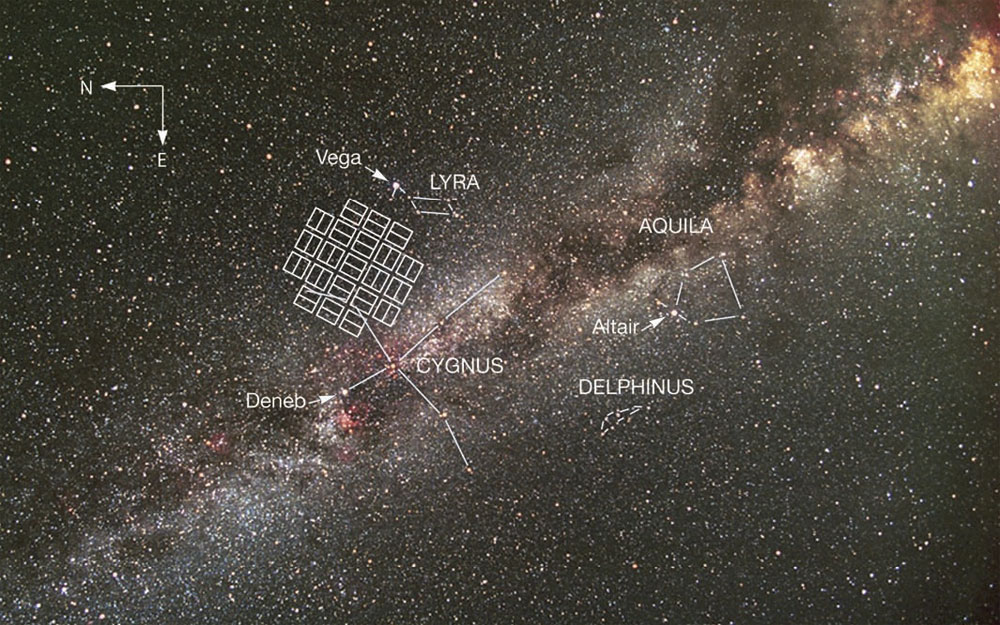
How do we find planets outside of our solar system? There are at least five methods to find planets: Doppler shift, astrometric measurement, transit method, gravitational microlensing, and direct detection. Shawn discussed in depth the Kepler mission that is currently monitoring more than 150,000 stars in the direction of the Cygnus constellation for any signs of extrasolar planets that may be orbiting those stars. So, what method does Kepler use to find planets? It watches for eclipses! When a planet orbiting a distant star crosses in front of the star some of the light from the host star is blocked. The planet will transit (astronomers often use the world transit not eclipse for exoplanets) in front of the the star once an orbit and thus the period of orbit can be determined. A secondary eclipse also occurs when the day side of the planet is blocked by the star. The video below illustrates the whole process.
Yes, there are planets outside of our solar system. The current exoplanet detection count is 473 and counting; you can watch that count go up over at Planet Quest. Kepler may double that number, but more importantly it has the ability to find earth size planets. Most of the planets found to date have been large, hot, and inhospitable to most kinds of life anyone can fathom.
 How do we detect signs of life on other planets? Astronomers look for bio-markers in the planet's atmosphere. Bio-markers are molecular signatures of certain compounds that could not be produced by non-biological process; bio-markers indicate that dynamic non-equilibrium chemistry is present on the surface of that planet. Astronomers can measure the light emitted as a function of wavelength, the spectra, that a planet emits to determine the molecular species present in the atmosphere. For example the Earth's atmosphere has the spectral signature of water which means it has conditions in which life as we know it can thrive. If we found an earth size planet that had water in its atmosphere which wasn't too hot we would say we had found a habitable planet. If we found oxygen or ozone (03) in an atmosphere it would almost certainly mean life was present on the planet because 03 is quickly removed from atmospheres through standard geological processes such as oxidation of iron, but it may remain present in an atmosphere if it is continually replenished by the photosynthesis mechanism of algae and plants. One of the topics Shawn talked about in his talk and a focus of his research was the problem of being certain that non-biological processes are not creating the oxygen rich atmospheres. The runaway greenhouse effect combined with the photo-disassociation of carbon dioxide can produce oxygen in a similar way to biological life. This is where the smelloscope would be useful: ozone along with other non-equilibrium species such as nitrous oxide and methane in specific ratios would be the scent we are looking for. Bio-signatures were not present on the early Earth. In fact the Earth probably looked a lot more like Venus. The diagram above shows that Venus, Earth, and Mars all have distinct spectral features that tell us about their atmospheres. The hardest part of looking for bio-signatures is that we do not have a telescope that is sensitive enough. Trying to take the spectra of a planet orbiting a bright star is like trying to tell the color of the wings on a gnat hovering around a spotlight on the moon. Like a baseball player holding up one hand to block the sun from his eyes as he focuses on the ball an occulter or star shade working with an existing telescope in space would do the trick. The current funding situation in astronomy is dire, but there is hope that a mission called New Worlds will one day work with the James Webb Space Telescope to allow us to take a closer look at planets which Kepler is finding.
 Is there life on other planets? We don't know and it may be a more complicated question than is suspected. There is a bias towards looking for life that is similar to what life on Earth is like. There is a bias towards looking for life that alters its host planet's atmosphere significantly enough to detect it with telescopes on earth. There is a bias towards looking for life that is alive as we define it. These biases may lead to false negatives in the search for life, but as Shawn pointed out the possibilities for life to exist are much grander than our imaginations so we do the best we can. Also, despite the difficulties for finding life on other planets and the gulf between the public's perception of aliens and reality scientists are taking this as a serious venture. Scientists from diverse fields are coming together to forge a path forward. One such project is the Virtual Planet Laboratory which employs scientists in fields such as geology, chemistry, biology, and astronomy. The Virtual Planet Laboratory is a team of scientists who are building computer simulated planets to discover the likely range of planetary environments for planets around other stars so we can better look for habitable planets and distinguish between planets with and without life. However, we can't even discern with certainty the presence of life on Mars or Europa at this point, what hope do we have for finding life on distant planets?
I think there is a lot of hope and I am not alone in that sentiment. I don't search for planets or life in my research, but I think that the search for life, particularly intelligent life, is a fundamental question. It is natural to wonder about the Universe on the grandest of scales, but it is wise to be concerned with what happens on the smallest of scales because that is where we will find life. We expect to find the unexpected in the search for life.
References:
Beichman, C. A., Woolf, N. J., & Lindensmith, C. A. (1999). The Terrestrial Planet Finder (TPF) : a NASA Origins Program to search for habitable planets JPL publication
Dimitar Sasselov set off minor shock waves of gossip and rumors in the media and astronomy communities when claimed that the NASA Kepler mission had found 140 Earth-like planets a few weeks ago during a talk he gave at the TED Global 2010 meeting in Oxford. The media thought we had found earth's twin, but astronomers knew that Sasselov had exaggerated the situation. Sasselov had to post a redaction of sorts on the Kepler blog in order to clarify what he said. What he should have said is that the Kepler mission will find and verify the presence of potentially habitable planets and that Kepler currently had 140 candidate extrasolar planets. The candidates are not confirmed and so a pessimistic outcome could be that half of the candidates will be false. The difficulty in finding extrasolar planets or life is fraught with false positive and false negatives. A false positive is a detection that seems like exactly what you were looking for, and maybe it is, but the detection was either bad data or you were looking for the wrong thing. A false negative is a detection which you conclude is not what you were looking for, but either your data was fouled or your detection threshold was too constrictive.
How do we find planets outside of our solar system? There are at least five methods to find planets: Doppler shift, astrometric measurement, transit method, gravitational microlensing, and direct detection. Shawn discussed in depth the Kepler mission that is currently monitoring more than 150,000 stars in the direction of the Cygnus constellation for any signs of extrasolar planets that may be orbiting those stars. So, what method does Kepler use to find planets? It watches for eclipses! When a planet orbiting a distant star crosses in front of the star some of the light from the host star is blocked. The planet will transit (astronomers often use the world transit not eclipse for exoplanets) in front of the the star once an orbit and thus the period of orbit can be determined. A secondary eclipse also occurs when the day side of the planet is blocked by the star. The video below illustrates the whole process.
Yes, there are planets outside of our solar system. The current exoplanet detection count is 473 and counting; you can watch that count go up over at Planet Quest. Kepler may double that number, but more importantly it has the ability to find earth size planets. Most of the planets found to date have been large, hot, and inhospitable to most kinds of life anyone can fathom.
 How do we detect signs of life on other planets? Astronomers look for bio-markers in the planet's atmosphere. Bio-markers are molecular signatures of certain compounds that could not be produced by non-biological process; bio-markers indicate that dynamic non-equilibrium chemistry is present on the surface of that planet. Astronomers can measure the light emitted as a function of wavelength, the spectra, that a planet emits to determine the molecular species present in the atmosphere. For example the Earth's atmosphere has the spectral signature of water which means it has conditions in which life as we know it can thrive. If we found an earth size planet that had water in its atmosphere which wasn't too hot we would say we had found a habitable planet. If we found oxygen or ozone (03) in an atmosphere it would almost certainly mean life was present on the planet because 03 is quickly removed from atmospheres through standard geological processes such as oxidation of iron, but it may remain present in an atmosphere if it is continually replenished by the photosynthesis mechanism of algae and plants. One of the topics Shawn talked about in his talk and a focus of his research was the problem of being certain that non-biological processes are not creating the oxygen rich atmospheres. The runaway greenhouse effect combined with the photo-disassociation of carbon dioxide can produce oxygen in a similar way to biological life. This is where the smelloscope would be useful: ozone along with other non-equilibrium species such as nitrous oxide and methane in specific ratios would be the scent we are looking for. Bio-signatures were not present on the early Earth. In fact the Earth probably looked a lot more like Venus. The diagram above shows that Venus, Earth, and Mars all have distinct spectral features that tell us about their atmospheres. The hardest part of looking for bio-signatures is that we do not have a telescope that is sensitive enough. Trying to take the spectra of a planet orbiting a bright star is like trying to tell the color of the wings on a gnat hovering around a spotlight on the moon. Like a baseball player holding up one hand to block the sun from his eyes as he focuses on the ball an occulter or star shade working with an existing telescope in space would do the trick. The current funding situation in astronomy is dire, but there is hope that a mission called New Worlds will one day work with the James Webb Space Telescope to allow us to take a closer look at planets which Kepler is finding.
I think there is a lot of hope and I am not alone in that sentiment. I don't search for planets or life in my research, but I think that the search for life, particularly intelligent life, is a fundamental question. It is natural to wonder about the Universe on the grandest of scales, but it is wise to be concerned with what happens on the smallest of scales because that is where we will find life. We expect to find the unexpected in the search for life.
References:
Beichman, C. A., Woolf, N. J., & Lindensmith, C. A. (1999). The Terrestrial Planet Finder (TPF) : a NASA Origins Program to search for habitable planets JPL publication
Drake
 Image by Lou Brooks
I just attended a colloquium by Frank Drake. Frank Drake is best known for his Drake equation which determines the number of intelligent civilizations in our galaxy that we might expect to encounter or rather have the possibility of communicating with. Drake told us that at the time the equation was something he thought up just before a conference in front of an eclectic collection of scientists and it was overshadowed by talking dolphins and Melvin Calvin (that is of the Calvin Cycle) winning the Nobel prize. The Drake equation went on to have quite a legacy, and despite the non-detection of intelligent extraterrestrial life people believe in the Drake equation's predictions today even more than they did then. I am not going to show or even discuss the Drake equation in depth here because if you know it you know it and it is not actually particularly enlightening, further to me the Drake equation is just a version of a Fermi problem that suffers from the Fermi paradox.
The Search for Extraterrestrial Intelligence, SETI, is an ongoing and very serious endeavor, for example the Allen Telescope Array is currently being constructed and looks very promising. As I always encourage people to get involved with programs like SETI@home; you could help discover aliens and what not simply by running a nifty screen saver (which I should mention is extremely scientifinic in fact, I quote "The colors you see in the graph signify absolutely nothing.", so you know it is real science). I leave you with words from an articulate speaker, Jill Tarter (a TED 2009 prize winner), to summarize.
Subscribe to:
Posts (Atom)