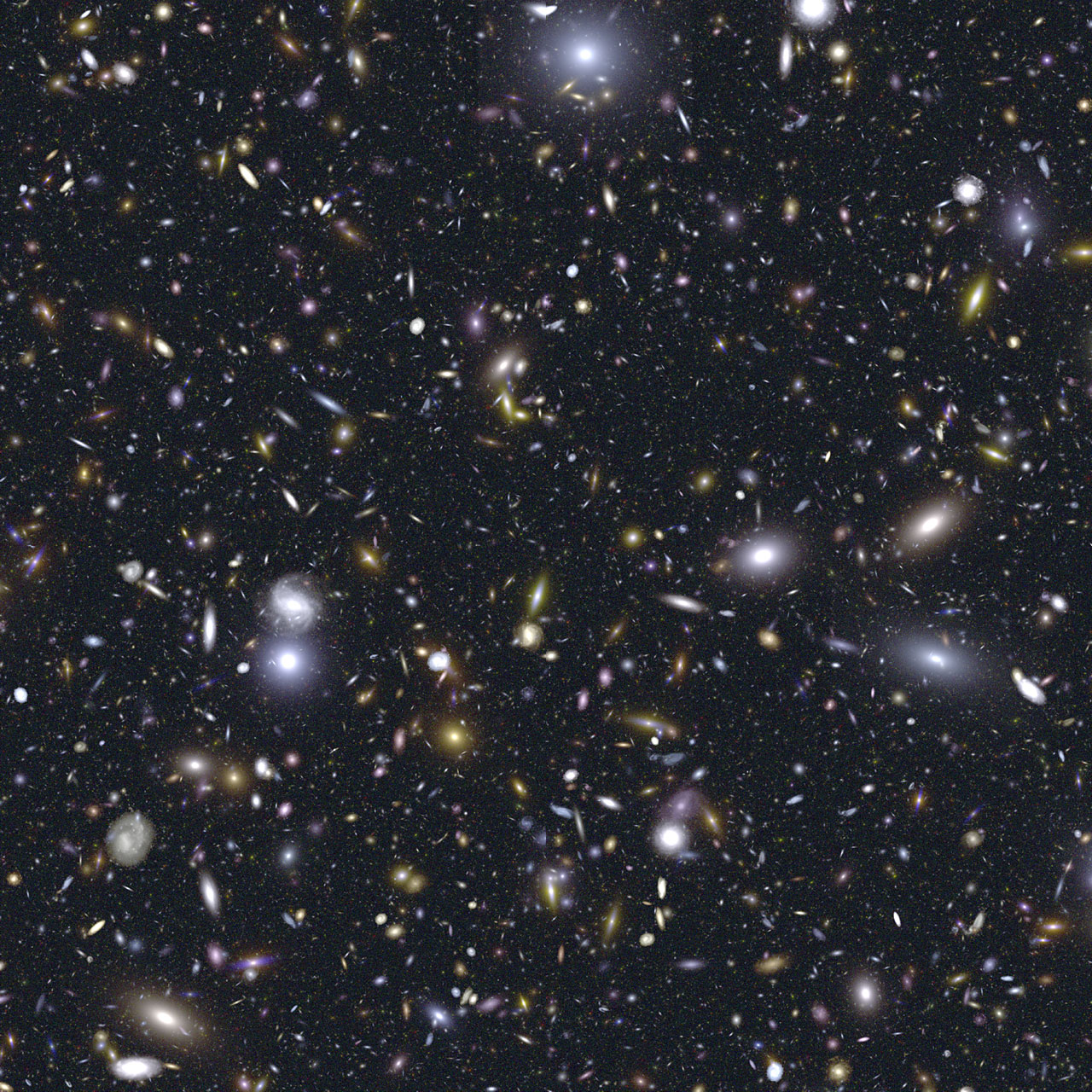
Almost a decade ago when astronomers pointed the Hubble Space Telescope at an apparently featureless patch of the sky they were rewarded with a spectacular image. The was the Hubble Ultra Deep Field. The image allowed us to see that galaxies were forming as early as just a billion years after the Big Bang. The farther from Earth we look the farther back in time we see; starlight from those distant galaxies is just arriving at earth now. Now we have glimpsed even further with the Hubble Extreme Deep Field. This new image was created by aggregating 10 years of Hubble images taken centered at the same location of the original Ultra Deep Field. In addition to staking old images additional new images were included which had been taken with infrared cameras installed during the 2008 Hubble Space servicing missions. Infrared images offer important additional data for distant galaxies because the light from such distant objects has been stretched to longer wavelengths as it has journeyed across the universe. Here is the Hubble Extreme Deep Field:
This is the deepest image of the sky ever seen. It allows us to explore the faintest galaxies ever as far back as a time just half a billion years after the Big Bang. Soon though we will have even deeper images. The James Web Space Telescope will be a 6.5 meter diameter(or 21 foot, so big that it will be a segmented mirror that will unfold in space) space telescope that will launch in 2018. It will see further. Here is a simulated image of what the James Web Space Telescope will see:
If you are intrigued by Hubble's deep images of the sky there is a Google Event webinar to discuss the latest findings. The public is invited. show up online and ask questions of the astronomers involved. It is at 1 p.m. Sept. 27 and can be joined either at HubbleSite’s Google Plus page or the HubbleSite YouTube Channel.
I got asked about 2012 the other day. Something about Mayans predicting the end of the world and or hidden planetary alignments. Sometimes I don't know where to begin addressing something so wrong. Whether you ask a scientist or a Mayan elder though they agree there is no end of days in 2012. Here is a scientist, Neil deGrasse Tyson, on the subject:
And here is David Morrison, expert on Earth impact hazards, speaking about misconceptions related to the year 2012:
I met Don Winget years ago on a cloudy night in the control room of the Otto von Struve Telescope. His enthusiasm and excitement was overflowing. I could hardly see his face, lit eerily by red lights, but his words painted a picture of far away white dwarf stars. These stars are pulsating, cooling, and perhaps intertwined with mysterious undiscovered axion particles. He continues extraordinary pursuits. He is looking for white dwarfs on earth with the Z Machine. The Z Machine releases a powerful electrical discharge over a brief amount of time to create plasma, X-rays, shock waves, and an electromagnetic pulse. The Z Machine releases several times the combined energy output of all power plants on earth for a few brief nanoseconds with each shot. Usually it does nuclear weapons research, but this wonderful research aims to simulate aspects of white dwarf stars on earth and it is inspiring art.
Find a dark place on a late night this weekend to enjoy the Perseid meteor shower. You can even participate in citizen science by counting the number of meteors you see with NASA's Meteor Counter app.
LINDAU, Germany — Tommrrow CERN will make an announcement, likely about the Higgs boson. The Higgs boson is a key part of the standard model of physics and this is a rather exciting discovery. You can read my article about the prospects for the discovery of the Higgs boson over at the Nature Lindau blog where I am writing.
It may appear that I haven't been busy lately because of the death of posts here at The Astronomist. You would be right to suspect that in reality I have actually been extremely busy. I passed my general exam here at the University of Washington and I am now a proto-doctor or a PhD candidate as it were. Regardless, now that this hurtle is out of the way I just have to do a thesis. In the spare time I have been up to so many other things. I did an interview with WHAT which is an organization that aims to raise a discussion about philosophy, science, and culture. They are based out of Spain, but the idea is international and focuses on people. I was interviewed as part of their series sobre el futuro or about the future where I talked about the future of the universe and the future for humans on Earth. I really, like the quote they caught from me, "No creo que ningún astrónomo piense que estamos solos en el Universo." You can watch the interview here.
Next up I am traveling to Lindau Germany once again to cover the Lindau Nobel Laureate Conference. I will be writing with the Nature blog team. I am very excited to be returning to Lindau this year. I first covered the Lindau Nobel Laureate conference in 2010 and at the time I really didn't know what to expect. I found that Lindau is an amazing place where ideas are exchanged at a rapid pace and discussions of science and the future are pervasive. I love it. I will be attending the conference from the journalist perspective of course so I will be interviewing people, including Nobel Laureates, while at the same time learning and communicating what I discover to a larger audience. If you haven't heard of the Lindau conference before (or even if you have) I recommend checking out the Lindau Mediatheque where they have videos of the lectures given by the Laureates. I am already blogging over on the Lindau blog; the conference starts on July 1st and lasts an entire week. Please go check it out and I will talk to you again from Germany.
“From this distant vantage point, the Earth might not seem of particular interest. But for us, it’s different. Consider again that dot. That’s here, that’s home, that’s us. On it everyone you love, everyone you know, everyone you ever heard of, every human being who ever was, lived out their lives. The aggregate of our joy and suffering, thousands of confident religions, ideologies, and economic doctrines, every hunter and forager, every hero and coward, every creator and destroyer of civilization, every king and peasant, every young couple in love, every mother and father, hopeful child, inventor and explorer, every teacher of morals, every corrupt politician, every “superstar,” every “supreme leader,” every saint and sinner in the history of our species lived there – on a mote of dust suspended in a sunbeam.”
The way of the future is fusion. I dream of a world where humans have harnessed the power of the Sun. Clean, safe, energy. But there is no clear path to fusion. The most exciting possibility for a future with fusion may be the International Thermonuclear Experimental Reactor or ITER. ITER is not the only option of course. Previously, I have discussed the National Ignition Facility or NIF which has pioneered unique technologies is the field, but their success is not ensured. Many small research projects around the world are also struggling to realize the dream of fusion, but with budget shortfalls and increasing pressure to produce results we as a society may shortsightedly end the dreams of a fusion future.
Fusion is what powers the Sun and all stars in our Universe. Fusion is the joining of two or more separate atomic nuclei into a larger nuclei. Fusion can create energy because the mass of the input and output nuclei are not necessarily equal in mass. An overview of what fusion is and why it is so important can be seen on my previous post on Fusion for the Future. Many scientists in the field acknowledge that a rapid development of fusion is unlikely, much less a commercial development, but there is hope. A reasonable time frame may be half a century before we see a world powered by the same process which drives the Sun. It will be an almost entirely clean, limitless, reliable, and safe source of power.
Christopher Llewellyn Smith states some cold hard numbers that are worth mentioning again. The price of ITER is at least 13 billion Euros or $17 billion. This cost is justified and dwarfed by the magnitude of the energy usage on Earth which amounts to a $5 trillion dollar a year market (I checked some of these numbers and they seem approximately correct. Did you know that you can download the International Energy Agency's annual reports as an iPhone or iPad app?). Particularly shocking are the subsides to fossil fuels which are over $500 billion a year worldwide (I am not so sure about this number, but the United States alone subsides fossil fules to the tune of $10 billion a year) while the subsides to renewables are only $45 billion worldwide. Smith says that the renewable energy sources of wind, bio, geothermal, and marine will never be able to meet the world's energy needs a current consumption rates. We must use solar, fission, or fusion energy.
It is a curious thing to ask a scientist to speculate on the future, but these two scientists have indulged us with a time frame for achieving fusion. Maybe the middle of this century at best they say. What makes fusion so difficult?
The key to releasing the energy of the Sun is forcing the nuclei of atoms close enough together for them to overcome their electrical repulsion and allow the strong force which binds nuclei to merge the nuclei together. Such favorable conditions for atoms to smash into each other can only occur under extreme temperatures and pressures, like say at the center of a star, but it is almost impossible to hold a star on earth. Anything which is hot enough to undergo fusion is also hot enough to burn through any container, thus we must contain something without quite touching it. Enter the magnetic doughnut known as the tokamak. A tokamak is a toroidal or doughnut shaped container that uses magnetic fields to confine plasma. Plasma is a state of matter where all the atoms are ionized (the electrons that normally orbit the protons in the nucleus have escaped)—and at these temperatures the atoms contained in the tokamak are definitely ionized. Magnetic fields apply a force on the charged particles of plasma such that the plasma can be corralled and kept away from the walls of the container. In an actual tokamak huge magnets encircle the enclosure as shown in the figure here where the magnetic coils and the ITER plasma surface is shown. The colors and contour lines indicate the magnetic field strength which is not quite perfect, the lines are wavy, due to deviations from perfect symmetry in the structure because the tordioal magnetic field is made of a finite number of magnetic coils. The ITER tokamak will be huge. Check out the tiny little person (bottom left) in the image below.
The complexity of this machine is astounding. One key challenge that must be overcome is the confinement of the plasma in a controlled manner. The Confinement Topical Group will determine exactly how to accomplish the confinement and avoid the performance degrading effects of Edge Localized Modes or (ELM modes). The hotter the plasma is the more internal plasma pressure is that must be balanced by stronger magnetic pressure fields; we could view this system in analogy to a balloon where that the plasma is the air under pressure and balloon's walls are the magnetic fields. The exact ratio of the plasma's internal current, the physical size of the tokamak, and the torodial magnetic field is a carefully tuned parameter to balance the gas temperature and magnetic pressures which does not yet have a known optimal configuration (the goal is I/aB < 2.5 where I is the plasma current, a is the minor radius, and B is the toroidal field on axis). It has been observed that the ELM modes periodically become unstable and have breakouts. This creates a large energy flux in a short time, like that of a solar flare on the Sun, where hot plasma breaks free of the magnetic fields. When this occurs the plasma may touch the side walls of the tokamak and overheat the internal surfaces to many thousands of degrees. The side wall surfaces will be evaporated and eroded inside the plasma chamber. In this way the ELM modes result in the introduction of plasma impurities which contribute to raising the effective atomic number (the number of free protons per particle) of the plasma which results in greatly reduced fusion efficiency or even the halting of the fusion reaction entirely; the target is to keep the effective atomic number below two. The aggregate erosion is large and the lining of the tokamak walls may need be replaced often. In order to operate the machine continuously and cost effectively the ELM modes must be controlled. The control of ELM is paramount for a successful fusion tokamak. In the video below Alberto Loarte tells us a little more about the control of ELM modes and clever ways that the ELMs are dealt with.
The plasma instabilities inside a fusion reactor are a serious engineering challenge, but they are not a safety concern at all. Unlike a fission reactor, when a fusion reactor is compromised it does not go critical in a dangerous explosion (like a fission reactor would), instead it just fizzles out harmlessly. This technology is not perfect though because while some may claim that a fusion reactor would create no dangerous radioactive material in fact it would produce some radioactive material that would need to be handled. It is the walls of the reactor which will become slightly radioactive (through neutron activation). Conveniently though the half life of such radioactive waste materials is less than 100 years and could be entirely handled on site.
We should all be hoping for fusion. I spoke with Michel Claessens, the head of communications for ITER, and one of the questions I asked him was, what should the public know about fusion and ITER?
As much as possible. More seriously, I would be happy if people understood the differences between fission and fusion.
And he has a point I think. Most people simply don't understand what is at stake and what our options our. If you are reading this then you are already more informed than most. Tell people about the difference between fusion and fission and encourage your government (no matter what country you live in) to follow a wise energy policy. While I was writing this article the United States changed its funding proposition for ITER which was a welcome change because at one point the United States looked like it would falter on its commitment to fusion research and ITER completely. This is an investment in our future and the Earth. I asked Claessens a question about this topic too, how important is worldwide collaboration in achieving a successful ITER project?
Worldwide collaboration is useful and even necessary - to pool and ensure the best use of resources (human and financial). The ITER project is so complex that no single country has the scientific and technological skills to build the machine alone. In addition, the international collaboration was seen by ITER fathers (Gorbachev and Reagan) as a way out to cold war.
The idea of harnessing the power of the Sun on the Earth is so much more than just a scientific endeavor. It is a very human dream to hold the Sun (what culture does not have some kind of original creation story or explanation for the sun?) and it is possible that realizing this dream may bring us together for all of the right reasons.